

Pharmacovigilance has always been a race against time. Today, the FDA’s Adverse Event Reporting System (FAERS) holds more than 24 million safety reports and receives over 2 million new reports. Read More

Top 10 Data Governance Companies in 2026
Enterprise data strategy in 2026 demands active operational stewardship. This evaluation assesses the top data governance companies in 2026, analyzes key market shifts, and provides a clear selection framework. Read More

What Is Data Extraction? Benefits, Techniques & Enterprise Use Cases
Data extraction is the automatic recovery and structuring of raw data from siloed enterprise sources. Critical business information often remains locked in unstructured documents and fragmented databases, creating a severe. Read More

Top 10 AI Agent Development Companies in 2026
Enterprises are deploying autonomous systems that reason, plan, and execute operations. This guide analyzes top AI agent development companies in 2026, evaluating their technical foundations, system integration capabilities, and enterprise readiness Read More

What Is a Data Catalog? Benefits, Tools & Enterprise Use Cases
An enterprise metadata inventory organizes information assets across hybrid and multi-cloud environments. It uses metadata to help business users, data scientists, and engineers discover, understand, govern, and trust data. Read More

Engineering the Intelligent Future of Scientific Publishing
For more than three centuries, scientific publishers have served as the custodians of scholarly communication. Their value was built on curating, validating, and distributing knowledge. But in the age of generative AI.
Read More

What Is Data Fabric? Architecture, Benefits & Enterprise Use Cases
Data fabric is an architectural framework that connects distributed datasets across multi-cloud, hybrid, and on-premises environments without physically relocating data. It relies on active metadata, knowledge graphs, and automated orchestration. Read More

The Future of Captive Centers: From Cost Efficiency to AI-Led Capability
A center that manages AI responsibly but does not build new capabilities will remain a cost line. Cost lines are easier to relocate, automate, or consolidate. Read More
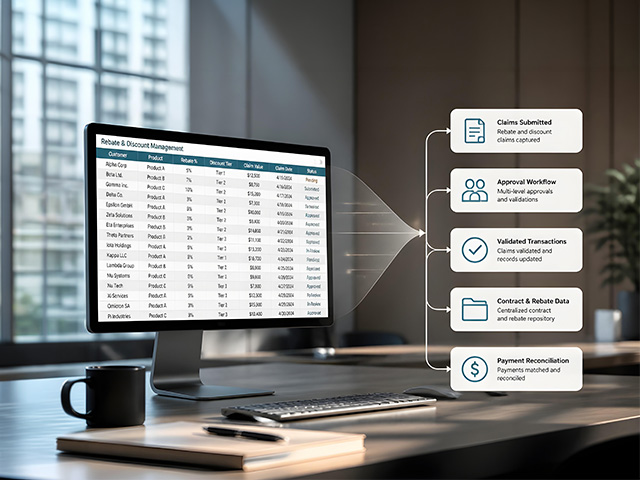
Beyond Spreadsheets: Why Rebate and Discount Programs Need Operations, Not Just Software
As rebate programs grow, control depends increasingly on what happens when a request leaves the standard route. Read More

What the Convergence Room Revealed about Operationalizing AI at Scale
Nearly 90% of enterprises experiment with AI, but only 6% see real returns. The Convergence Room explored how leaders move AI from isolated experimentation into scalable operational reality. Read More

Why Pharma & Biotech Associations Must Earn Member Trust Before Scaling AI
Artificial Intelligence (AI) is rapidly shifting from a speculative experiment to a core operational engine across the life sciences ecosystem. Read More

9 Questions to Ask Before You Sign Your Next AI Content Licensing Deal
Unambiguously, define post-termination asset rights, deletion duties, procedures for changing laws, termination triggers, and liability allocation. Read More

What Your Association Is Missing Without a Centralized Data Hub
A centralized data platform transforms scattered files into a living catalog. It allows researchers to move faster, staff to work smarter, and leaders to decide with confidence. Read More

How Content-Rich Companies Can Cash In on AI Licensing Revenue
Enterprises must organize their archives, confirm that they hold the necessary rights, secure author approvals, and prepare content in formats that AI systems can use.
Read More

AI-Powered Science & Research Publishing Journey: A Complete Framework for Authors and Publishing Operations
AI is beginning to help with this everyday work. Authors can search the literature more intelligently and get support with language. Editorial offices can check submissions and build reviewer shortlists. Read More