
Posted on: August 27th 2026
Only about a third of organizations worldwide have moved AI beyond isolated pilots into enterprise-wide scale, according to McKinsey‘s latest State of AI research. Fewer than 1 in 10 report AI fully embedded across their operations, and just 6% qualify as genuine high performers, attributing more than 5% of EBIT to AI. Nearly 9 in 10 companies use AI somewhere in the business. Almost none have made it pay at scale.
That gap is not a technology problem. It is an execution problem, and it is the single most important question facing enterprise leaders today: how does AI move from experimentation to outcomes that show up on the balance sheet?
It is also the question we built an entire evening around.
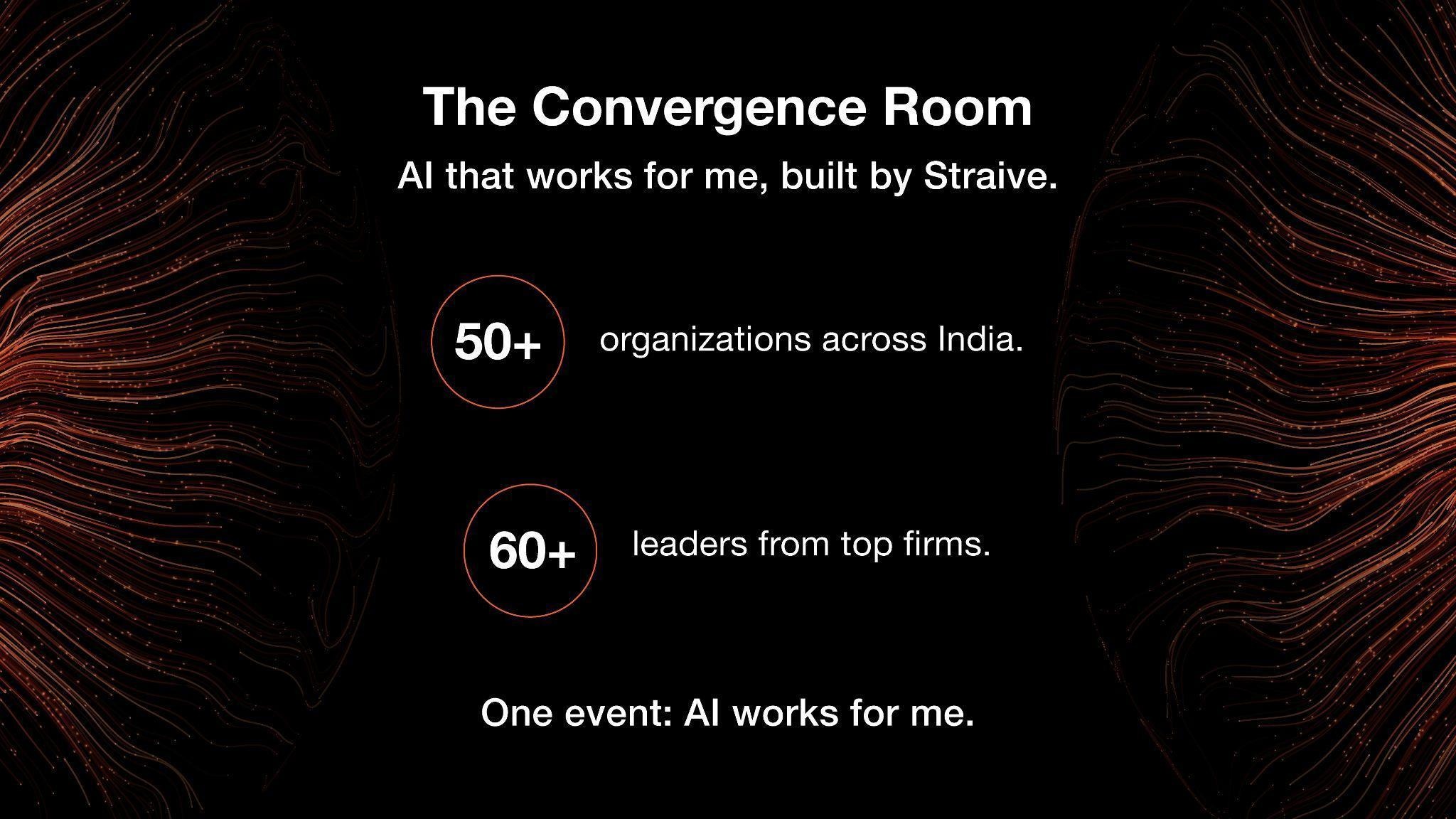
On July 27, 2026, more than 60 senior leaders, CEOs, CIOs, founders, and GCC heads from over fifty organizations across India and around the world gathered at ITC Kohenur in Hyderabad for The Convergence Room. We did not ask what AI might do someday. We asked a narrower, harder question: how is AI working for you today, what did it cost, what nearly stopped it, and what actually shipped?
“AI works for me” is not just a tagline. It is the filter we run every engagement through, and it shapes everything that follows.
Live AI War Room
AI War Room made this point live. Five teams built an AI readiness roadmap for a hypothetical GCC under time pressure, wrestling with governance, data maturity, talent, and executive alignment. Every team arrived at a different roadmap, but hit the same wall: technology was never the constraint. People and processes were.
Enterprises that break out of the pilot trap treat AI as a capability to be built with discipline, not a series of disconnected bets.
Where Straive Stands
Straive has spent years enhancing enterprise workflows by operationalizing AI across financial services, science and research, media, sports and entertainment, pharma and life sciences, energy, manufacturing and supply chain, education, and retail. We don’t sell AI as a standalone capability. We help enterprises operationalize AI into core workflows with a team of 1,000+ professionals, including 600+ domain experts and 38+ PhDs, sitting alongside 400+ AI and data engineers.
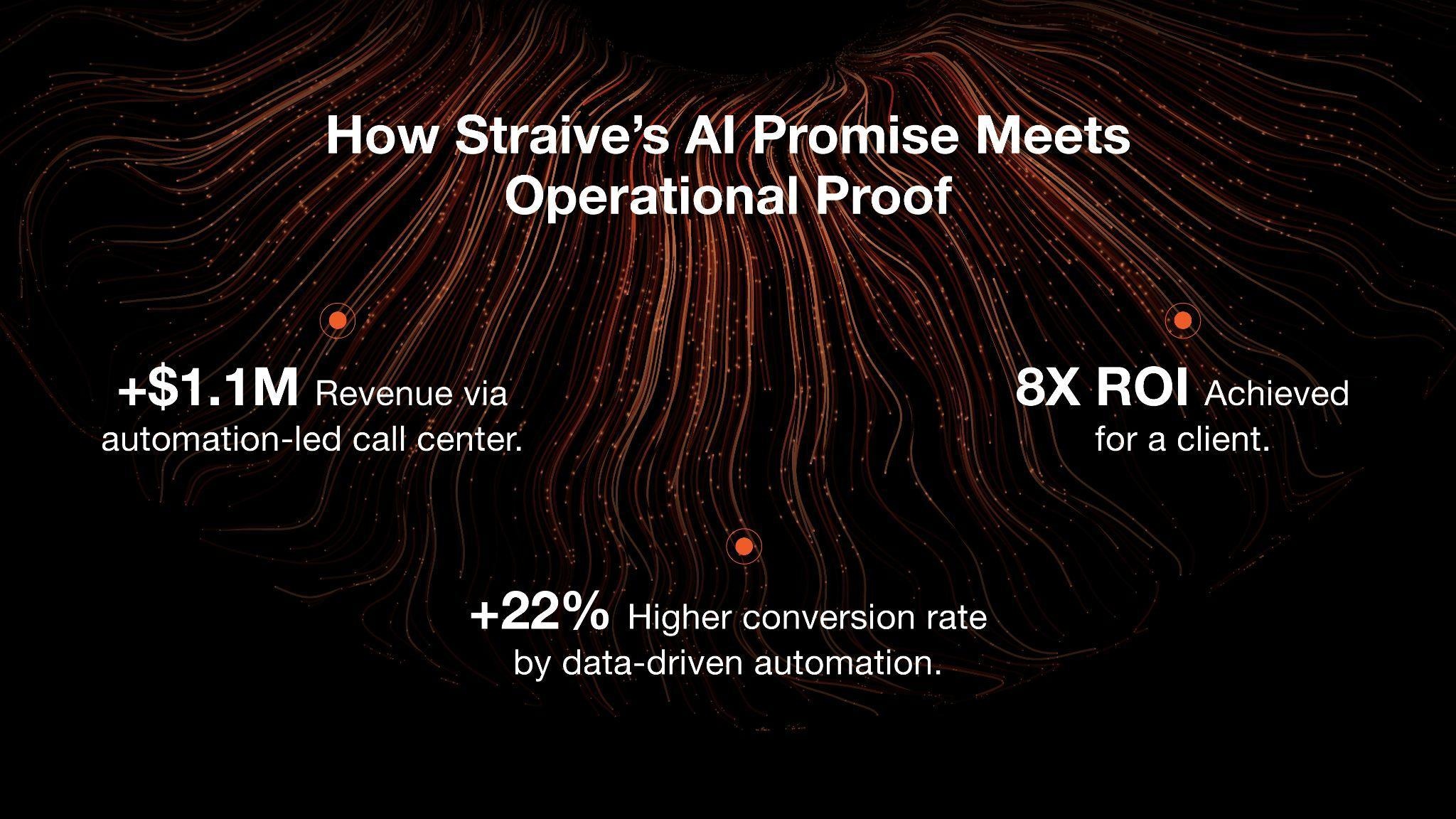
The results speak plainly. A $1.1M revenue lift from an automation-led call center transformation. A 22% jump in lead-to-opportunity conversion from a data-driven initiative. An 8x ROI for a client through a centralized K-12 data exchange, and this is what it looks like across every engagement.
That same bias for proof over polish showed up in Hyderabad’s Pedestal Sessions, where leaders from leading enterprises shared how AI had actually transformed their organizations.
From Ideation to Implementation
One reason pilots stall is that they take too long to prove anything. We have built our delivery model to compress that window. A working proof of concept typically takes 7 to 14 days, and a production deployment 8 to 10 weeks, made possible by a library of 200+ accelerators spanning document intelligence, schema generation, data quality, and more industry-specific agents. When a pilot runs for weeks instead of months, an enterprise can easily test more ideas. It is the same discipline the AI War Room compressed into four hours instead of four months: fail on the roadmap, in the room, before a dollar gets spent on the wrong bet.
The Convergence Room: A Platform, Not an Event
We didn’t build the Convergence Room to host another evening of predictions from a stage. We built it because the leaders we work with don’t need more forecasts about what AI might do. They need a room of peers solving the same problems, comparing what actually worked, what it cost, and what nearly didn’t make it through the rollout.
That’s the whole premise: strip away the vendor pitch, put the people making these calls in one room, and let the conversation go in the right direction.
The Convergence Room is a recurring home for such conversation. The same CEOs, CIOs, and GCC heads who filled the room in Hyderabad are the community to serve going forward, and a standing space where “AI works for me” will fuel the conversation again.
Shaping What Comes Next
The current generation of enterprise AI mostly assists. The next one executes. We are already seeing the shift in our own portfolio: from copilots that draft and summarize to multi-agent systems that plan step sequences, act on enterprise systems, correct themselves when they go wrong, and escalate to a human only when necessary.
A single model release or vendor claim will not decide the next phase of AI adoption. It will be decided by how well enterprises, industry experts, and technology partners learn from what is actually working. That is why we built The Convergence Room as a running platform rather than a launch, and why the clearest signal that any of this is working is not applause. It’s a renewal. Across our AI and data engagements, the large majority of clients come back, expand scope, and move onto a multi-year footing. The room in Hyderabad behaved the same way: people stayed past schedule because the conversation was still paying off.
The organizations pulling ahead are rarely the ones with the most advanced technology. They are the ones building the discipline and community to turn experimentation into a lasting operational advantage. Straive intends to keep showing up in rooms like this one. The next chapter of The Convergence Room won’t just be worth attending. It’ll be worth building your next roadmap around.
Straive partners with enterprises to build and operationalize data analytics and AI solutions that deliver measurable business impact.
To learn more about our approach:
About the Author

Vijay Nair leads Marketing at Straive. He blends over 20 years of experience, strategy, and storytelling to make AI less buzzword and more business impact.
Share with Friends:


