
Posted on: August 24th 2026
Introduction: Why AI is Reshaping the Research Publishing Journey
A manuscript can lose days for familiar reasons. The submission package is incomplete. Reviewer invitations go unanswered. A reference changed during revision is missed in the bibliography. A production query appears at proof when it could have been found earlier.
AI is beginning to help with this everyday work. Authors can search the literature more intelligently and get support with language. Editorial offices can check submissions and build reviewer shortlists. Production teams can identify inconsistencies before they become author queries.
Authors should notice the difference in fewer avoidable returns and clearer progress. Publishers should see cleaner handoffs and less rework.
The Traditional Research Publishing Journey And Its Pain Points
A paper passes through many hands. Authors search, write, submit, revise, and approve proofs. Editorial teams check files, manage peer review, and handle decisions. Production teams work through references, artwork, equations, metadata, and corrections.
The difficult moments often occur at the handoffs. Submission metadata does not match the manuscript. A supplementary file is cited but missing. A reviewer search stalls. A late correction fixes one problem and creates another.
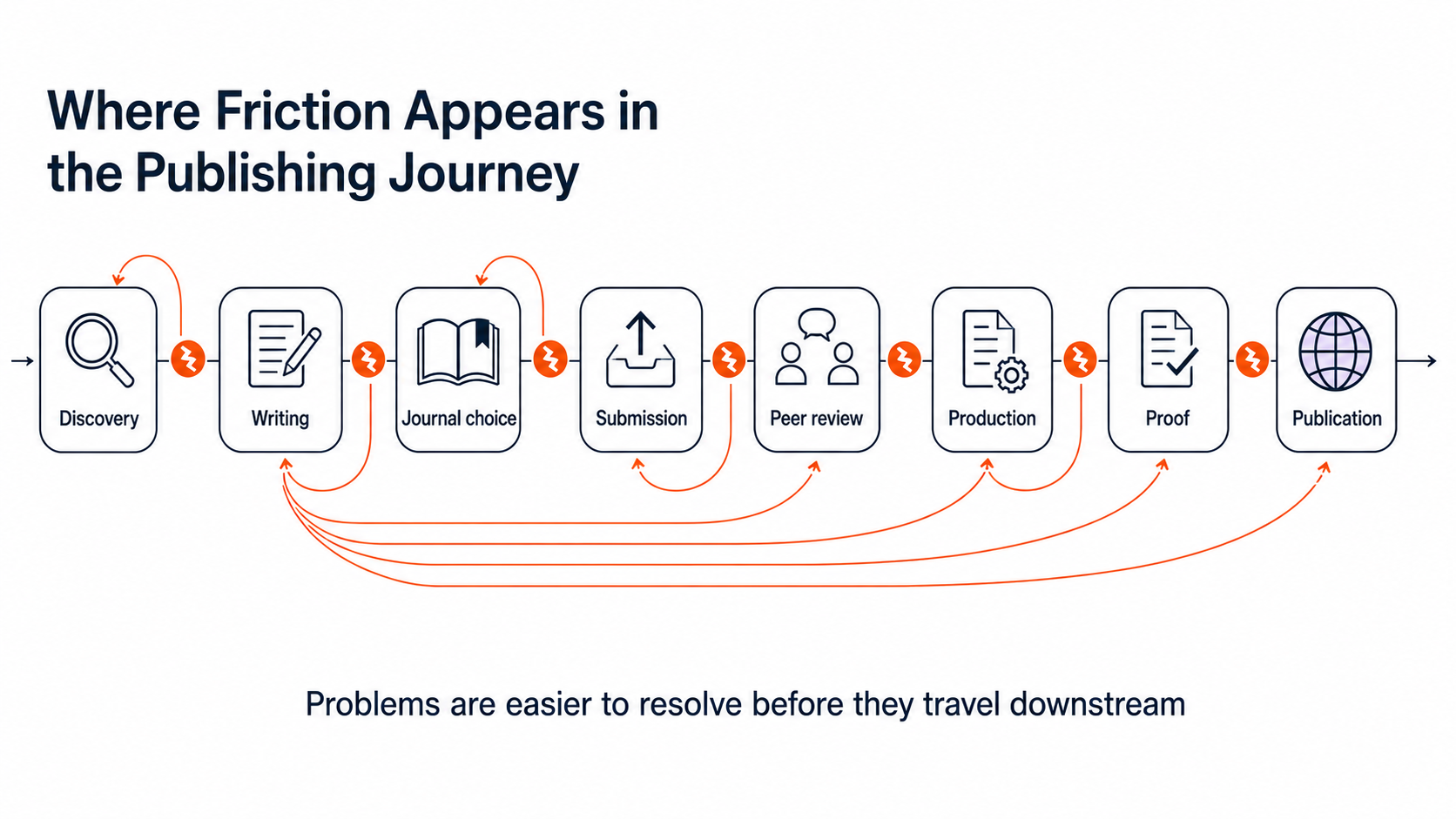
Earlier checking helps when it removes real downstream work without creating extra author correspondence.
Pre-Submission: Building Author Pipelines with AI
Journal choice can be awkward, especially for interdisciplinary papers or large publisher portfolios. Subject similarity alone does not tell an author whether the readership, article type, or current editorial emphasis is right.
AI-assisted matching can narrow the options from a title and abstract. Authors still need current journal guidance before deciding where to submit.
Recurring questions tell publishers something too. If authors repeatedly ask about preprints, data statements, or supplementary files, the instructions may need attention.
Discovery & Planning: AI-Assisted Literature Review
A literature search can return hundreds of plausible papers and still miss relevant work described in unfamiliar terminology. Semantic discovery is useful here, particularly across neighboring disciplines.
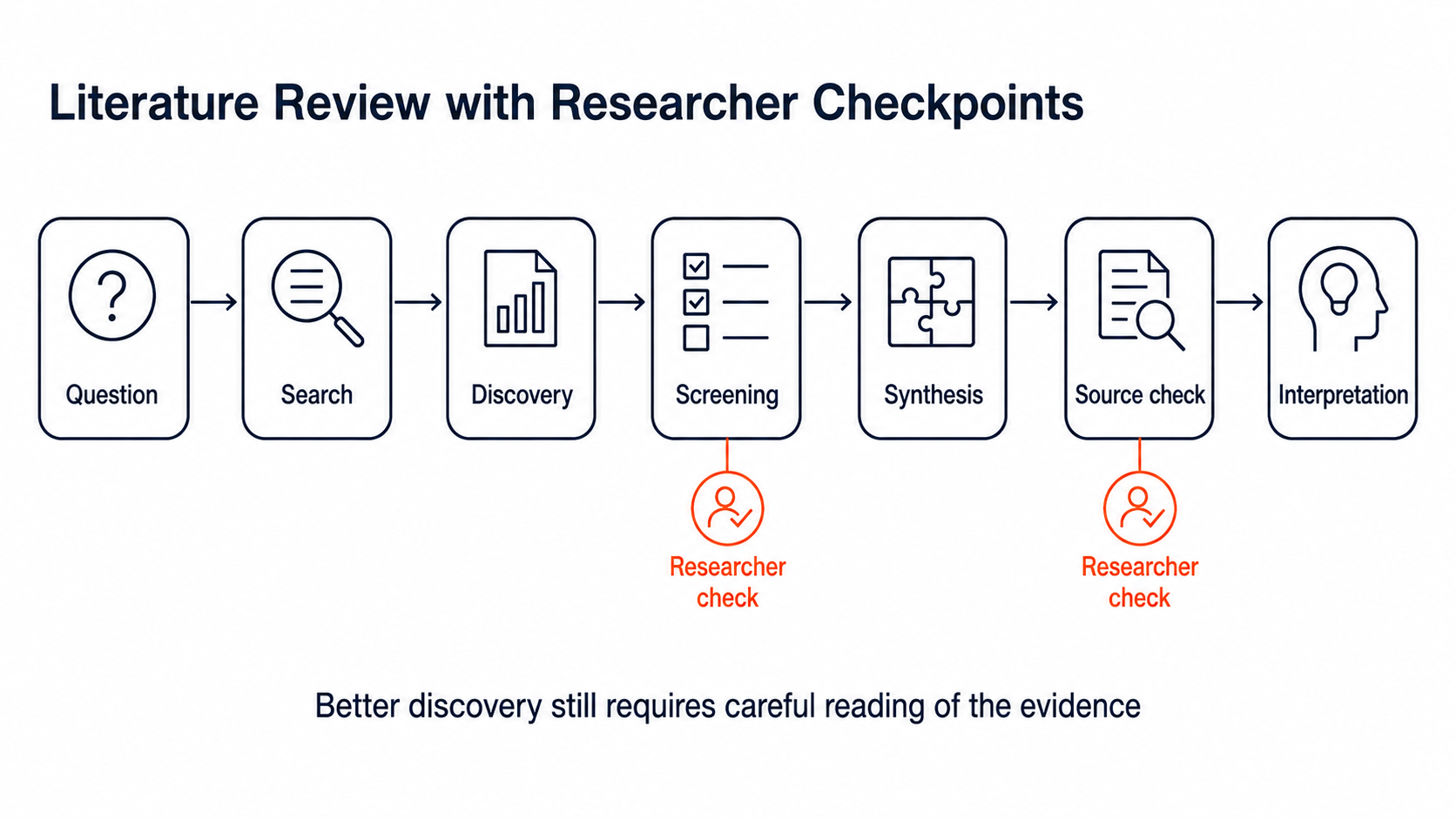
The paper found by a tool still has to earn its place in the review. Researchers need to examine methods, populations, outcomes, and limitations, and check whether the source actually supports the claim being made.
AI Research Tools: Which Ones Are Worth It?
Different tools suit different jobs. Elicit and Consensus support literature discovery; Paperpal supports academic writing; Zotero handles the collection, organization, and citation of research sources.
The practical test comes afterward. Can an important answer be traced to the paper? Are substantive edits visible? Is unpublished material handled appropriately? Verification effort belongs in the calculation of time saved.
Writing & Editing: AI for Research Paper Drafting
Language support is useful when an abstract is dense, a sentence is awkward, or a researcher writing in a second language wants cleaner prose.
Scientific wording deserves careful review. “Associated with” cannot casually become “caused by.” “May indicate” should not become “demonstrates” simply because the sentence sounds stronger.
Authors should review substantive changes, verify references, follow the policy governing the submission, and remain accountable for the final manuscript.
Submission to Acceptance: AI-Led Editorial Workflows
Editorial offices routinely handle missing declarations, absent supplementary files, mismatched metadata, and incorrect manuscript versions. Reliable automated checks can catch some of these before assessment begins.
Reviewer discovery requires more judgment. A publication record may show subject relevance, but editors still need to consider methodological fit, conflicts, recent collaborations, availability, and whether recommendations repeatedly favor the same highly visible researchers.
Research-integrity alerts need proportionate investigation. A flag gives an editor something to examine. It does not determine the outcome.
Acceptance to Publication: AI-Powered Production & Compliance
By acceptance, a manuscript may have accumulated several revisions and file replacements. Those versions do not always agree.
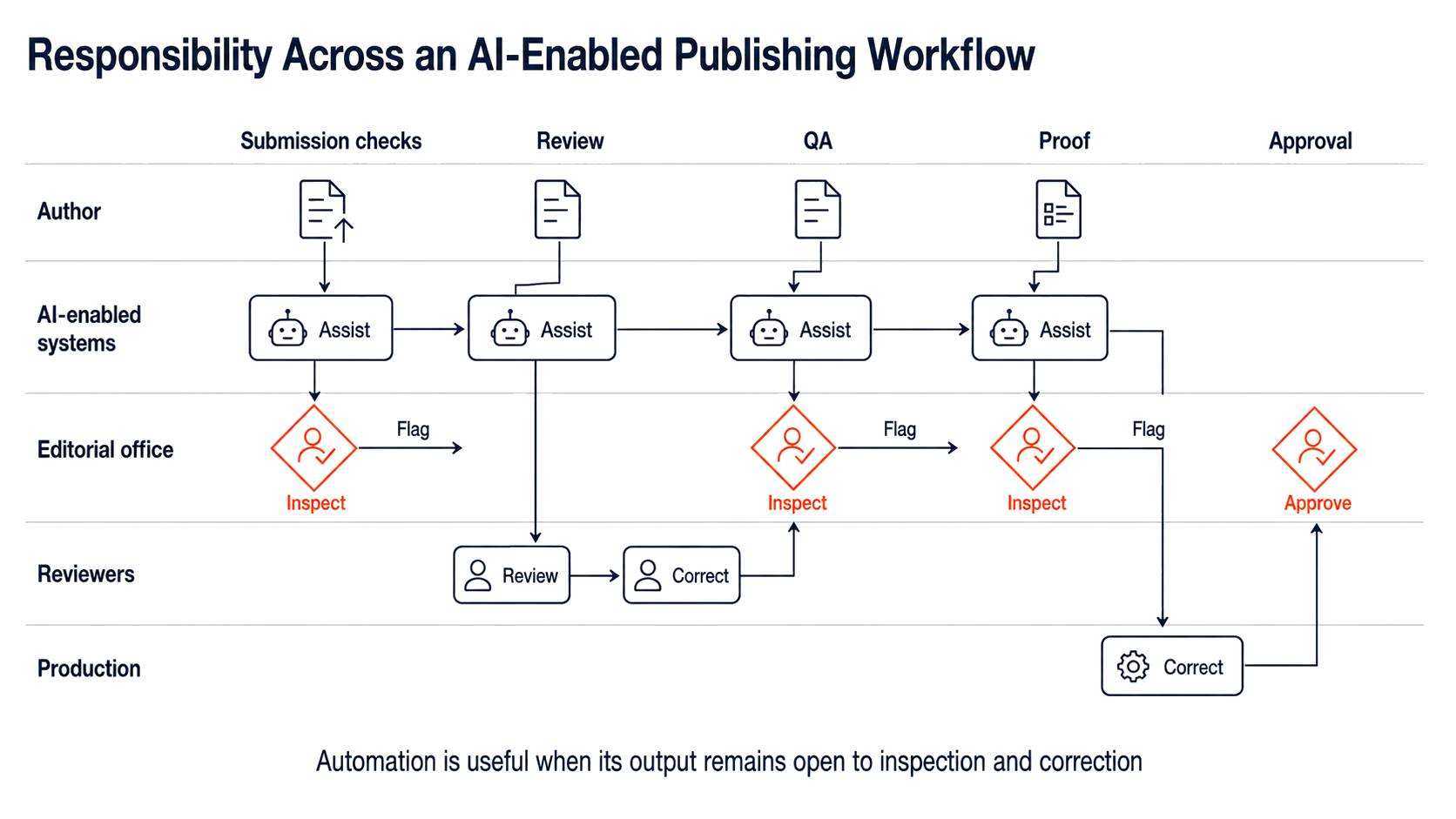
AI-assisted QA can surface broken callouts, reference mismatches, metadata discrepancies, or conversion problems before proof. Production judgment remains important for specialist terminology, complex mathematics, scientific figures, and late author corrections that affect content elsewhere.
Promoting Your Published Research Using AI-Powered Content Tools
Some papers are difficult to find because the title is opaque, the abstract buries the finding, or the terminology differs from what researchers search.
AI can help test titles, identify candidate keywords, and prepare plain-language or promotional versions of published work. The article itself remains the reference point. A cautious association should still be cautious in a conference description, institutional post, or social update.
Ethical Considerations for Using AI in Research
Can an unpublished manuscript be entered into the tool? Can confidential reviewer material leave the peer-review environment? Who checks a citation introduced during rewriting? What happens when an integrity system raises a concern?.
Current journal, publisher, institutional, and funder policies matter. So do confidentiality and the consequences of error. Researchers should understand what happens to material placed in an AI system.
Best Practices for Using AI in Research
Researchers should be able to trace important claims to sources and see what changed in their text. Editors need enough information to assess a recommendation rather than accept a ranking at face value. Production teams need to understand why an item has been flagged.
Publishers should follow the effect downstream. Time saved at submission is of little value if the same issue returns as a production query or another proof correction.
The Complete Author Success Framework
Author success and publishing efficiency are related, but they should be measured separately.
For an author, improvement might mean fewer preventable submission returns, less repeated information, clearer manuscript status, fewer avoidable proof queries, and a smoother route to publication. Publisher-side measures can include first-pass submission completeness, reviewer invitation cycles, query volumes, proof correction rounds, and acceptance-to-publication turnaround.
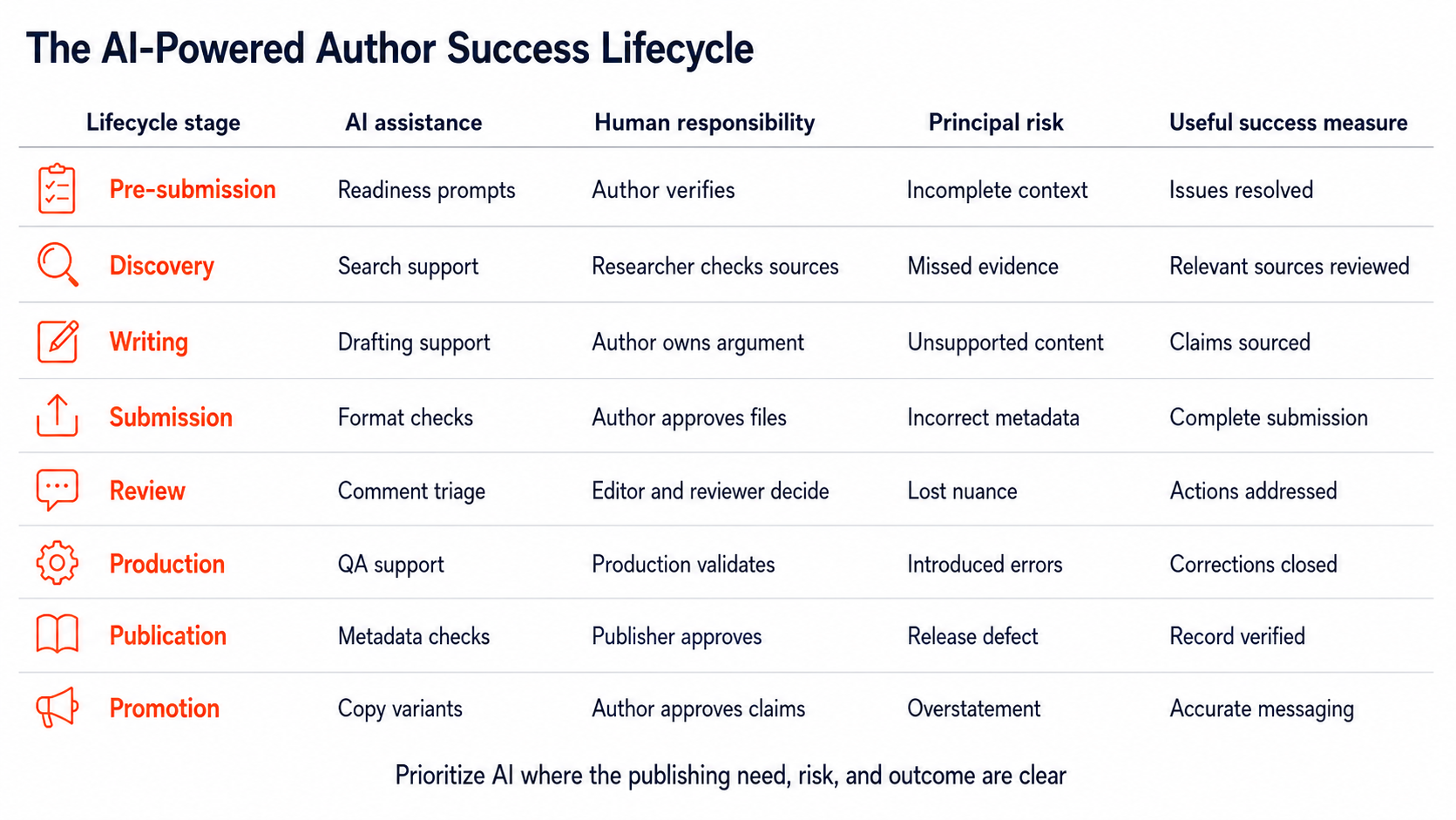
Putting the two views together shows whether an operational gain is improving the author’s journey.
Conclusion – The Future of AI-Powered Research Publishing
A complete submission reaching the editor the first time matters. So does finding an appropriate reviewer sooner or catching a reference mismatch before proof.
After implementation, publishers should look for what changed in practice. Are authors receiving fewer avoidable queries? Are editors getting better information? Are production problems genuinely decreasing?
Those answers say more about the value of AI in research publishing than the amount of automation deployed.

Associate VP, Account Management


