
Posted on: August 31st 2026
The 16th Shared Services and BPO Week in Manila was framed as From Scale to Control: Redesigning Shared Services and GBS in an AI-Enabled World. After several days with GBS, Finance, Operations, and Transformation leaders, one question stood out: How does a captive center remain relevant in an AI-enabled enterprise?
This question is now more important than individual discussions about automation or productivity. Scale built the captive model. As AI moves into live operations, centers also need clear ownership, governance, and accountability. But their long-term relevance will depend on whether they can build capabilities the enterprise needs next.
A center that focuses only on scale may deliver more work, but it will not necessarily create more value. A center that manages AI responsibly but does not build new capabilities will remain a cost line. Cost lines are easier to relocate, automate, or consolidate.
The inflection point
For years, captives and Global Capability Centers earned their place through labor arbitrage, process standardization, and predictable delivery. Those strengths still matter, but they are no longer enough.
Headquarters will not keep a center relevant simply because it runs existing processes at a lower cost. Relevance will come from the center’s ability to use AI to build new capabilities, take on new work, redesign processes, and create greater value for the enterprise.
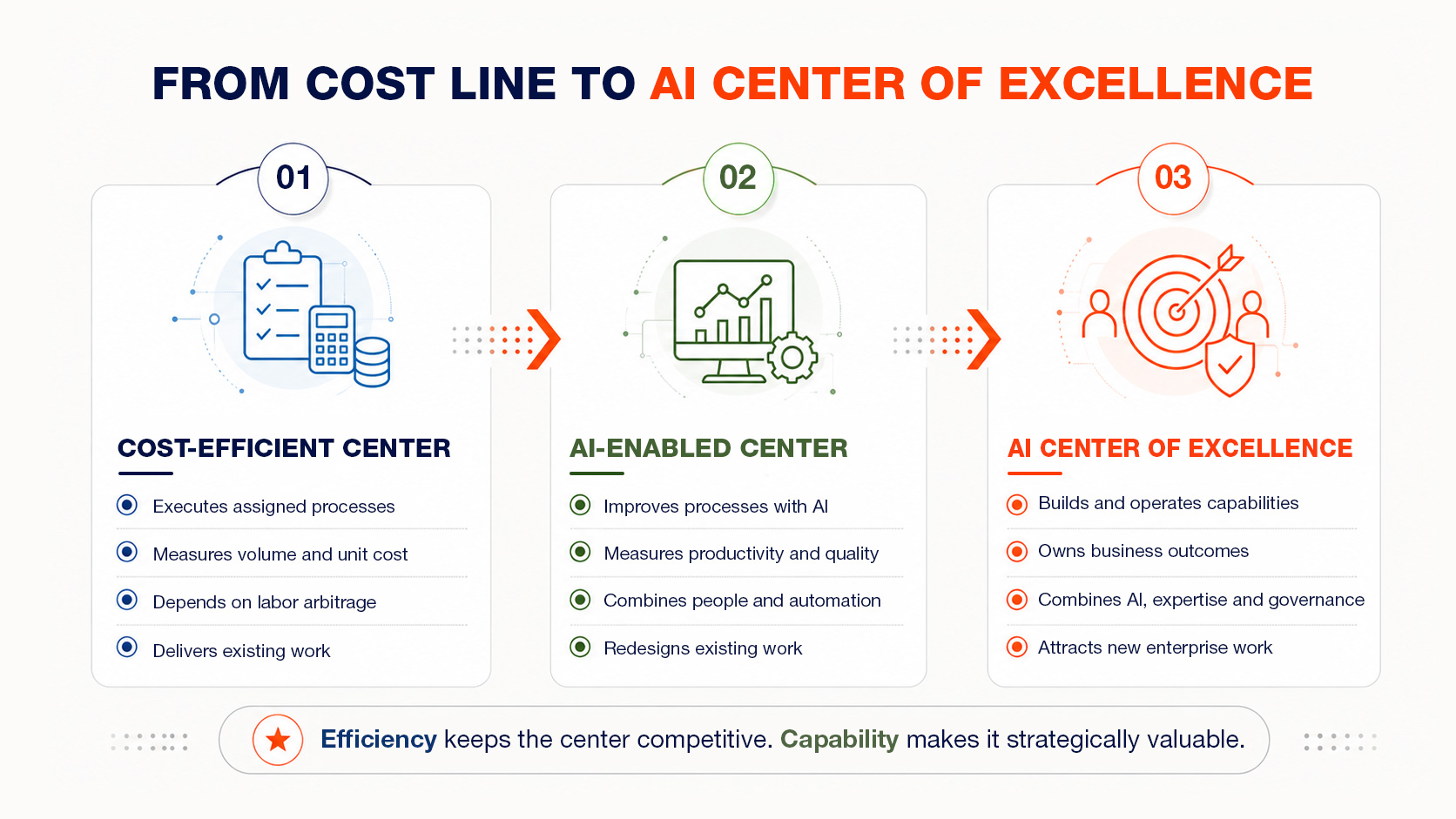
The goal is not simply a more efficient back office. It is an AI Center of Excellence: a captive that embeds AI into real workflows, owns business outcomes, and becomes the place the enterprise turns to when it needs a new capability built and operated.
AI pilots are easy. Operationalizing AI is the real work.
Most organizations no longer need convincing that AI has potential. They already have proofs of concept, copilots, and innovation programs. Many stall for the same reason: the technology works in a test environment but never becomes part of the way the process runs.
The harder questions are practical:
- Can the solution become part of a live workflow?
- Who is responsible for its performance when something goes wrong?
- How will IT, risk, and business teams govern it?
- Where is human expertise still required?
- Can its impact be measured through cycle tim, quality, risk, or revenue, rather than a demonstration score?
A successful pilot proves that the technology can work. An operating capability proves that the organization can rely on it every day.
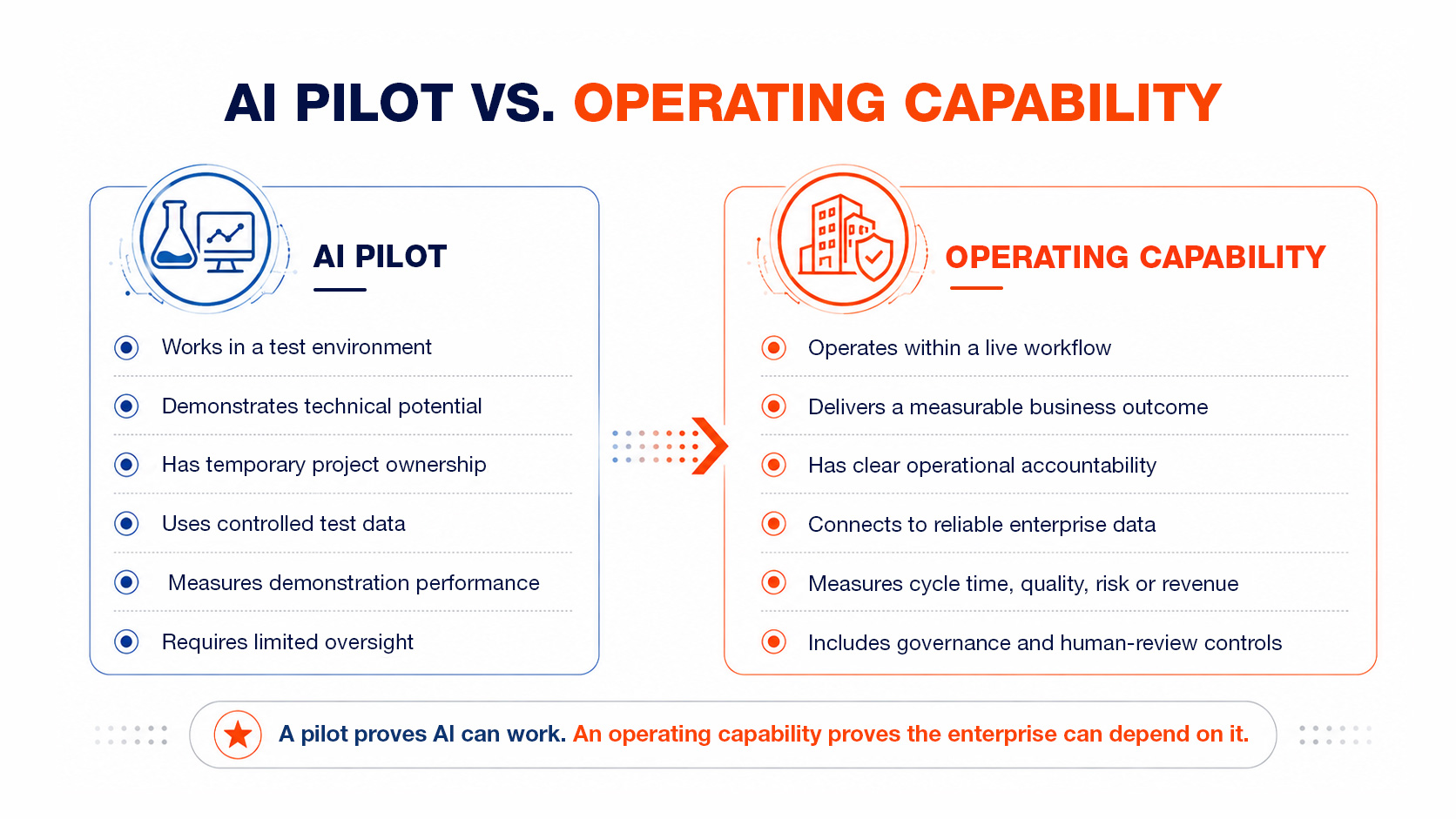
This is what effective control means in an AI-enabled GBS. It means clear ownership, strong governance, and expert oversight. These safeguards allow a center to scale AI while protecting quality, auditability, and the trust of headquarters.
The same principle applies as AI systems become more autonomous. Systems that can plan and act across several steps still need reliable data, clear process ownership, and human review for high-risk decisions. Without these safeguards, AI can repeat mistakes at scale. The advantage will not go to the center with the most AI agents. It will go to the center that can increase autonomy while keeping people accountable for outcomes.
Scale without capability has a ceiling
Scale was once a clear advantage. Today, scale without a distinctive capability can hold a center back.
When a center is defined mainly by volume, headcount, or unit cost, it is always compared with a cheaper alternative, including the AI it is being asked to implement. Cost savings can only go so far. New capabilities can continue to create value.
Leaders should change the questions they ask of the center:
- Which business outcomes can we own from start to finish?
- Which capabilities can we build once and reuse across the enterprise?
- Which processes are we ready to redesign, rather than simply make faster?
- What new work can the business send here because the required capability now exists here?
A captive that can answer these questions becomes a strategic hub. One that cannot, will continue to defend its role through last year’s savings.
Cost still matters. It cannot be the whole value story.
AI will continue to reduce the cost of high-volume work, and captives should pursue those savings. But a lower cost baseline should not be the final goal. Once achieved, it simply becomes the next benchmark the center must beat.
A stronger model is to own a business outcome, such as recovering cash, clearing exceptions, reducing cycle time, or improving risk coverage. At the same time, the center should build a capability it can reuse elsewhere. Efficiency helps the center remain competitive. Capability makes it strategically valuable.
This is also a stronger value proposition than cheaper hours. The price of an hour can only fall so far. Outcomes and new work create room for continued growth.
Making AI work: process, people, and solution design
AI tools alone do not transform operations. Processes, people, and solution design must evolve together.
Process. AI cannot fix a process that works differently across teams or locations. Before introducing AI, leaders need to agree on who owns the process, standardize the important steps, and decide where the process itself should change. Otherwise, AI will simply make existing inconsistencies move faster.
People. An AI Center of Excellence is not just a technology team. As AI takes on repetitive tasks, employees need to move toward exception handling, quality oversight, process improvement, and accountability for outcomes. Roles, skills, and career paths must change with the work.
Solution design. AI must work with the systems and processes the center already uses. It must also be easy to update and govern. This means building reusable elements, such as data connections, workflow integrations, testing methods, security controls, and human-review checkpoints. These elements can then be adapted for new use cases instead of being rebuilt each time.
The goal is not a long list of separate AI projects. It is a repeatable way to take an AI idea into production, make it reliable, and apply the same approach in another function without starting again from the beginning.
What this looks like in practice
A global media and streaming capability center wanted to reduce lengthy content review cycles, speed up document analysis, and move promising AI use cases into production faster. The work could not stop at testing individual tools. The client needed a clear and governed way to evaluate ideas, connect approved solutions to live workflows, and give business teams usable analytics.
Straive helped establish that path from idea to production. AI was embedded into day-to-day content and document operations, with clear review and approval steps. The same approach was extended to analytics that business teams could use. Review cycles became shorter, document analysis became faster, and new use cases moved from request to approval several times faster.
The result was not simply an AI concept presented to leadership. It was a working capability that remained within the captive and could be used by the enterprise.
A practical sequence, not a new label
Calling a center an AI Center of Excellence does not make it one. The change requires a clear mandate; solutions that are properly designed, tested, secured, and maintained; and people with the right skills, and measures tied to business results. The work should happen in a clear order.
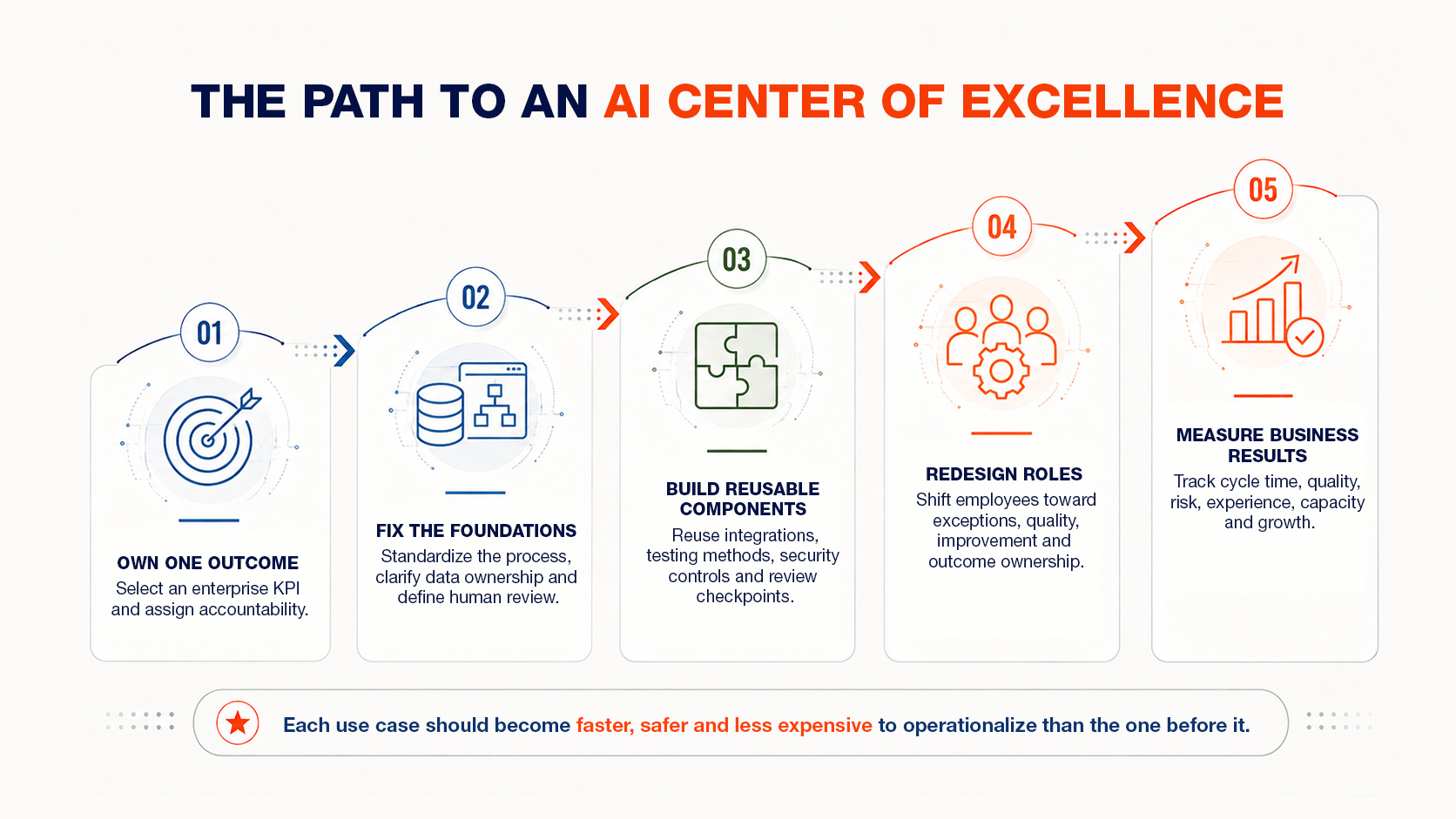
- Own one outcome. Choose a process with a KPI the enterprise already cares about, such as working capital, exception turnaround time, audit coverage, or regulatory cycle time. Give one team responsibility for adoption, integration, governance, and results. If no one owns the outcome, the initiative is still a pilot.
- Fix the foundations. Standardize the process enough to automate it, clarify who owns the data, and identify the decisions that still require human review.
- Create reusable building blocks. Reuse data connections, workflow integrations, model testing, security controls, and human-review checkpoints. This should make each new use case faster and less expensive to launch than the one before it.
- Redesign roles around the new work. Move employees from repetitive processing into exception handling, quality review, process improvement, and outcome ownership. Update training, responsibilities, and performance goals to reflect these roles.
- Measure business results. Track cycle time, quality, risk reduction, customer or employee experience, capacity created, and contribution to growth. Do not judge success only by the number of transactions completed, hours worked, or people assigned to the process.
Stop funding copilots that never become part of the workflow. Stop creating an AI Center of Excellence that does not own a live business outcome. Stop using last year’s reduction in headcount as this year’s strategy.
The leadership question
The question for captive and GCC leaders is no longer whether their centers can adopt AI.
It is whether they can operationalize AI repeatedly, with the right safeguards, and use it to create capabilities the enterprise cannot easily build elsewhere.
That is how a captive stays relevant. It does not accumulate pilots or defend its scale. It turns AI into new work, better processes, and greater value within an operating model the business already trusts.
That is the move from a cost line to an AI Center of Excellence. Manila made the urgency clear. The work begins with the processes leaders are prepared to own.

SVP, Advanced Digital Solutions


