
Posted on: August 25th 2026
Imagine owning the ancient Library of Alexandria—only to discover that every priceless volume has been left uncataloged on the floor. That is where many associations find themselves today.
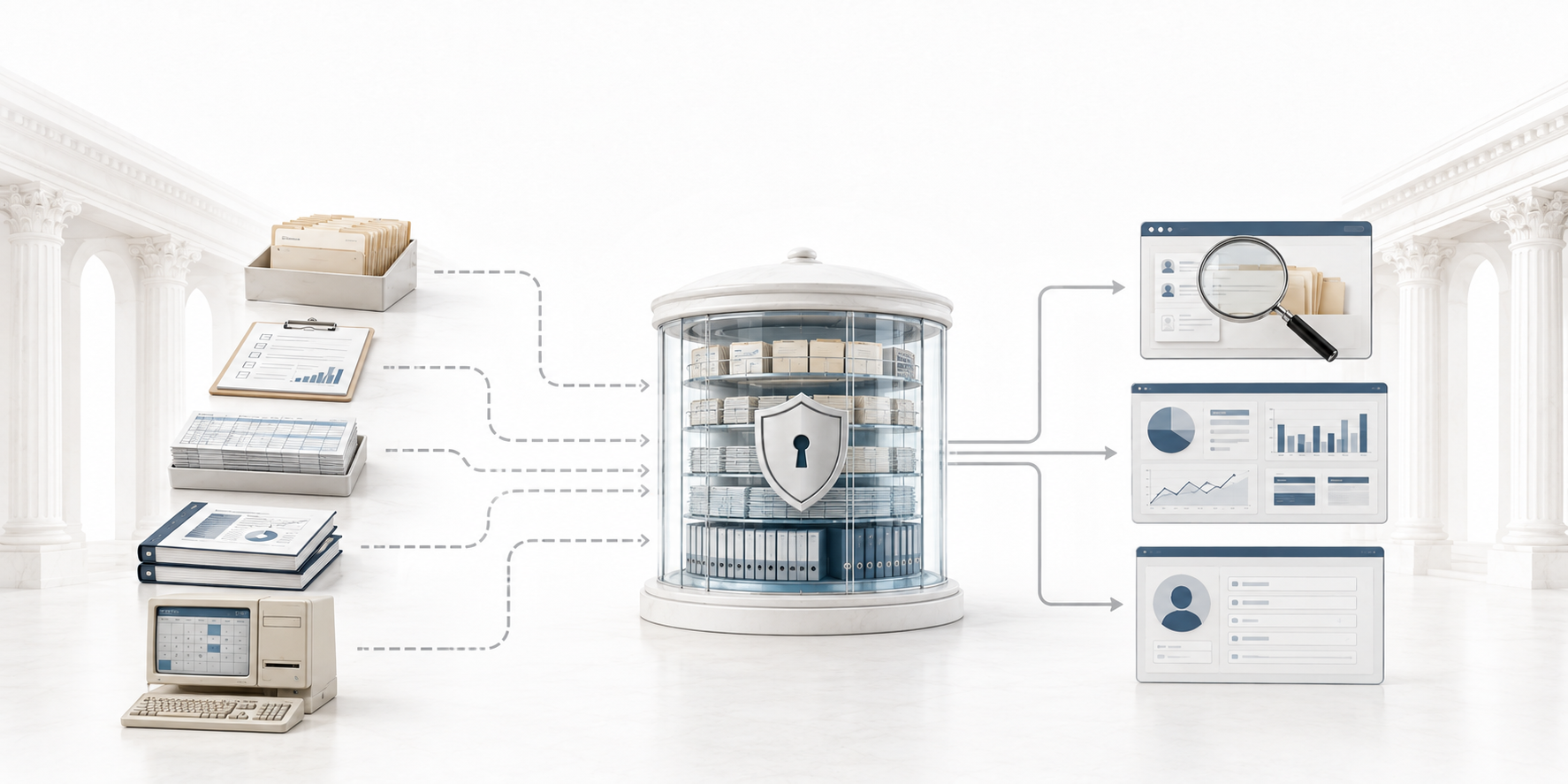
Figure 1: A centralized data exchange platform connects fragmented institutional data to improve search, analysis, and member services.
Over the years, your enterprise has accumulated vast institutional knowledge: member records, survey results, public datasets, research findings, and event logs. Yet much of its value remains locked away in disconnected spreadsheets, private folders, and legacy systems that cannot communicate with one another. As a result, your team struggles to find the right information when it matters most.
A centralized data exchange platform serves as a master catalog for this scattered knowledge. By connecting disparate sources through a single, secure flow, it reduces daily friction, improves research quality, and enables better-informed decisions.
Ultimately, this unified approach lowers operational risk, strengthens member services, and delivers a greater return on investment.
The Hidden Cost of Scattered Data
Fragmented data rarely creates a sudden emergency. Instead, it imposes a slow, continuous drain on an organization. Routine tasks such as cleaning files, reconciling conflicting figures, and chasing delayed reports may seem minor in isolation. Their effects however accumulate over time by eroding staff productivity, leadership confidence, member satisfaction, and financial credibility.
Consider how this plays out in everyday operations. A researcher spends half a day cleaning a single spreadsheet, while two departments present conflicting figures to leadership. Elsewhere, an important report arrives too late to inform a critical decision. This cause minor frictions at first.
However, as that friction builds, the consequences become increasingly costly. Staff duplicate work instead of advancing priorities, leaders begin to question the reliability of their own metrics, and members receive inconsistent service. What begins as an operational inconvenience ultimately becomes a barrier to effective decision-making.
For associations involved in research or advocacy, the consequences can extend even further. Inaccurate or delayed data may weaken a funding request, stall an important study, or contribute to flawed policy decisions. In these settings, data fragmentation affects not only internal efficiency but also the organization’s ability to fulfill its mission.
The U.S. Government Accountability Office’s March 2026 report, illustrates the broader problem. The GAO found that manually verifying forms requires staff time and resources while increasing the risk of backlogs and delays. It concluded that direct access to data and improved data-sharing technologies could make the process more efficient and help prevent fraud, waste, and abuse.
Even the greatest library loses its value when its contents remain uncataloged. Organizing your data transforms that disorder into clarity, enabling sharper insights, better decisions, and sustained momentum.
Creating One Clear Current Across Your Systems
A centralized data exchange platform provides that missing catalog. It works with your existing technology rather than replacing it. By connecting your member management system, survey tools, research files, financial software, and policy platforms, it creates one cohesive data ecosystem.
Instead of managing information in isolated systems, your organization can use the platform to:
- Integrate data from disparate sources.
- Deduplicate data and match records automatically.
- Standardize formats and rules across the organization.
- Control access based on user roles.
- Deliver clean, trusted data to dashboards and reports.
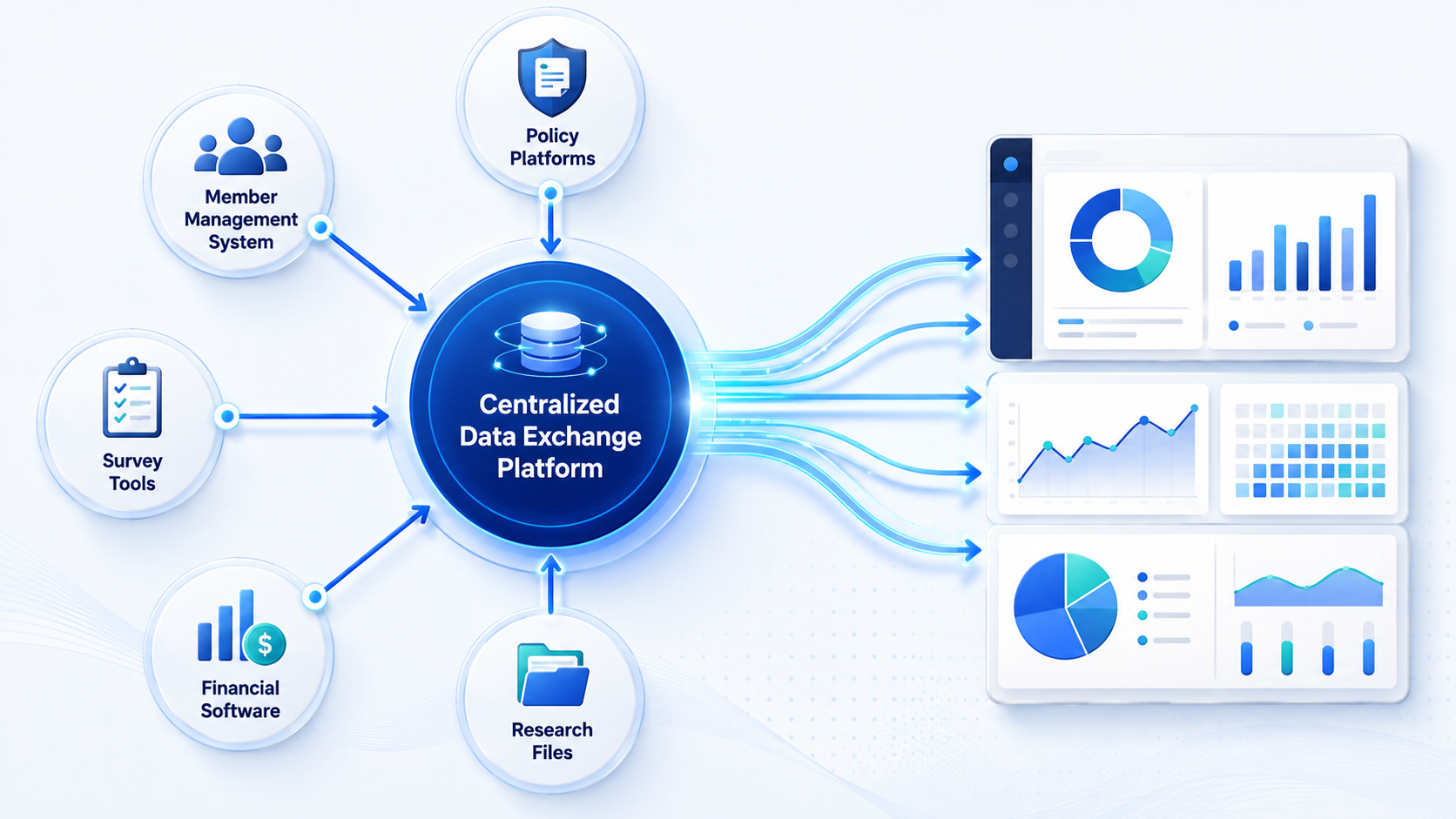
Figure 2: A centralized data exchange platform connects once-siloed systems, transforming member, survey, financial, policy, and research data into unified streams for clear, actionable dashboards.
Real-World Impact: The NIH Example
The NIH Center for Information Technology developed the Biomedical Research Informatics Computing System (BRICS), a platform that collects, validates, harmonizes, and analyzes research data. One BRICS-based program, the Federal Interagency Traumatic Brain Injury Research (FITBIR) program, supports more than 160 studies and houses data from over 100,000 research subjects. According to NIH, BRICS helps make research studies and clinical trials faster, simpler, and more collaborative.
Like NIH, your organization can build a strong data foundation that allows you to spend less time searching for information and more time putting it to work.
The 8x ROI Blueprint
A centralized data exchange platform does more than improve efficiency. By connecting systems and enabling trusted data to move securely across the organization, it can turn fragmented information into measurable financial and operational value.
An 8x return is achieved when the combined value of cost savings, recovered staff capacity, new revenue, and reduced risk reaches eight times the platform’s total cost. Although results vary, a centralized data exchange platform creates multiple pathways to that return:
- Reclaim Staff Capacity: Automate data preparation, validation, and reconciliation so employees can focus on strategic work.
- Reduce Technology Costs: Consolidate redundant tools, eliminate unused licenses, and minimize expensive custom integrations.
- Accelerate Research: Give researchers faster access to clean, standardized data from across the organization.
- Enhance Member Value: Connect member information across systems to deliver more relevant and timely services.
- Create Data Products: Transform appropriately aggregated and protected data into benchmark reports, industry insights, and subscription dashboards.
- Strengthen Grant Applications: Use clear, verifiable evidence to demonstrate impact and support competitive funding requests.
- Mitigate Risk: Centralize access controls and governance rules to protect sensitive information and support regulatory compliance.
- Improve Decision-Making: Feed consistent, trusted data into dashboards so leaders can act with greater speed and confidence.
Together, these gains can transform fragmented data and disconnected systems from a recurring expense into a source of measurable organizational value.
Building Your Foundation
Technology cannot compensate for unclear goals. Before selecting a centralized data exchange platform, define what you want it to achieve.
Start by asking five essential questions:
- Which decisions matter most? Identify the strategic decisions that should become faster, easier, or more reliable.
- Where is the greatest value? Prioritize the use cases and datasets that can deliver the strongest near-term impact.
- Who is accountable for the data? Assign clear ownership and stewardship for maintaining data quality.
- Who should have access? Define role-based permissions for viewing, editing, and sharing sensitive information.
- How will you measure success? Establish clear metrics for efficiency, data quality, adoption, and return on investment.
Start Small, Then Scale
Begin with one clearly defined problem. For example, you might automate member reporting or give policy researchers faster access to trusted data.
Before implementation, record current processing times, costs, error rates, and other relevant measures. Without this baseline, demonstrating the platform’s impact becomes much harder.
Next, connect a small number of high-value data sources. Test the exchange, measure the results, and address any gaps. Once the approach delivers reliable value, expand it to additional systems and use cases.
A strong data foundation begins with a clear purpose. The technology should support that purpose and provide a practical path to measurable results.
Unlocking the Value
Your association does not need more data. You need information that moves safely to the people who need it.
A centralized data platform transforms scattered files into a living catalog. It allows researchers to move faster, staff to work smarter, and leaders to decide with confidence.
The ancient library was lost to history. Your institutional knowledge does not have to share that fate.
It is time to bring your pages together, organize your master catalog, and unlock the true power of your data.
Straive helps clients operationalize the data> insights> knowledge> AI value chain. Straive’s clients extend across Financial & Information Services, Insurance, Healthcare & Life Sciences, Scientific Research, EdTech, and Logistics.


