
Posted on: March 11th 2026
Generative AI is no longer a future concept; it is transforming how enterprises process information, build products, and serve customers.
As organizations adopt large language models and AI-driven workflows, the importance of data governance has become critical. According to the PEX Report 2025/26, 52% of organizations cite poor data quality and availability as the biggest barrier to AI adoption, while only 43% have formal AI governance policies.
Data governance is critical to ensuring data is accurate, secure, and reliable, and it forms the foundation for determining whether AI initiatives deliver value or create risk. This blog discusses the top seven must-have enterprise data governance priorities for GenAI.
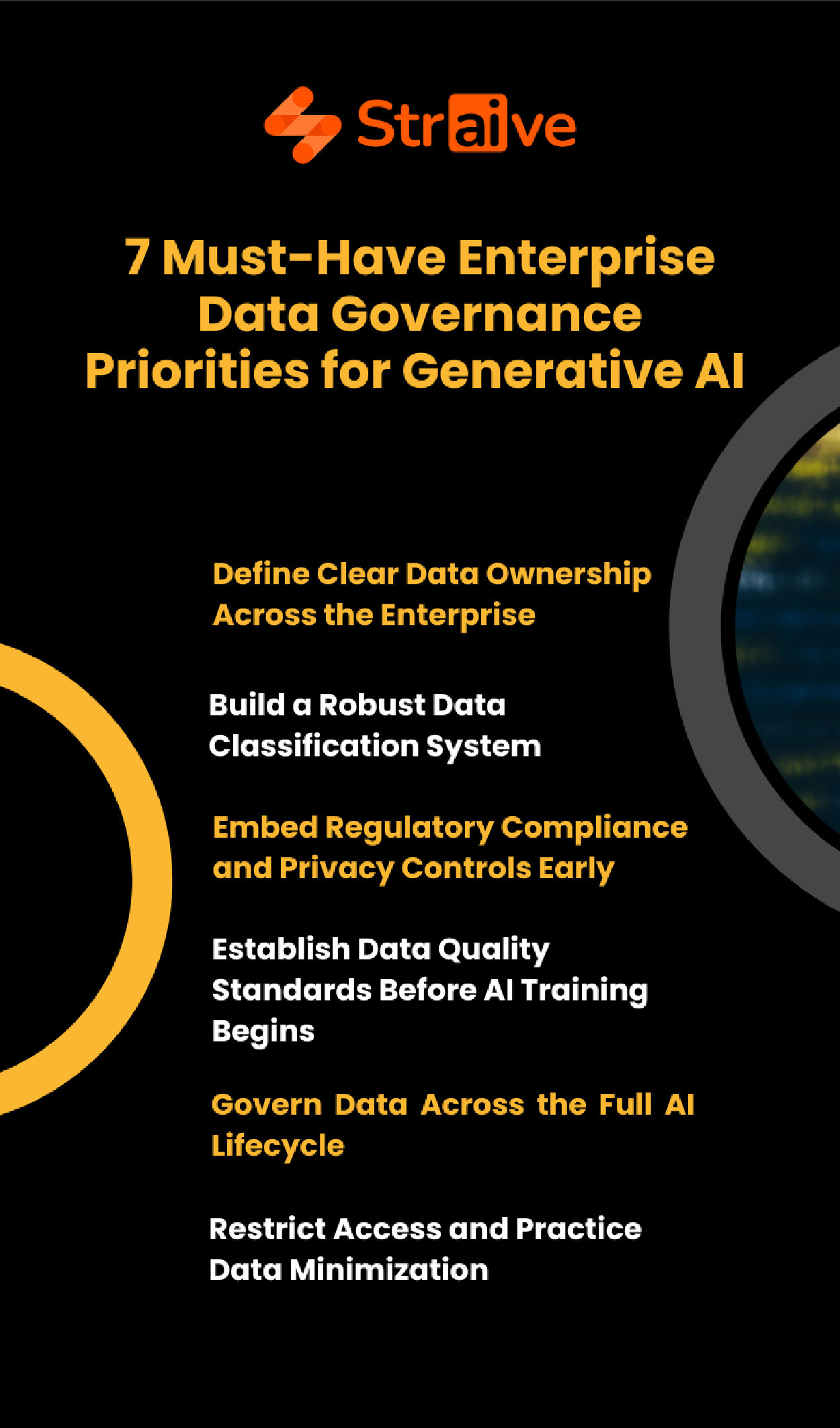
Define Clear Data Ownership Across the Enterprise
Knowing who owns what sounds basic. In practice, it is one of the hardest problems large organizations face. Data moves across departments, vendors, cloud environments, and third-party integrations continuously. When a generative AI model ingests this data for training or real-time inference, any ambiguity around ownership creates accountability gaps that are difficult to close after the fact.
Enterprises need to assign data stewards, establish clear accountability chains, and document data lineage from origin to consumption. As data volumes grow and AI use cases expand, ownership records must evolve alongside them. Teams building AI workflows should treat data ownership verification as a standard checkpoint, not an afterthought. Once ownership is established, the next question becomes what that data contains and how sensitive it is.
| Read also A Leader’s Guide to Operationalizing AI Across Departments explores how organizations can move beyond experimentation to scale AI across functions, align teams around data-driven strategies, and build the governance, workflows, and capabilities needed to deliver measurable business impact. |
Build a Robust Data Classification System
Not all data belongs in an AI pipeline. Some information is safe to use openly. Some require masking. Some should never be used for model training under any circumstances. Without a classification system, teams are left making judgment calls that introduce inconsistency and risk.
A well-structured classification framework helps organizations decide quickly what data can be used, under what conditions, and with what safeguards. This kind of discipline, where every asset is labeled, organized, and understood in context, is central to how Straive approaches content and data operations across publishing, research, and information services. Bringing that same rigor to AI data preparation significantly reduces the likelihood that problematic inputs reach a model.
Embed Regulatory Compliance and Privacy Controls Early
Regulatory expectations around AI are tightening. The EU AI Act, GDPR, CCPA, and sector-specific rules such as HIPAA all have direct implications for how AI systems collect, process, and retain personal or sensitive data. For enterprises serious about AI compliance and data privacy, the only viable approach is to build these controls in from the start, not layer them on after deployment.
Early integration means conducting privacy impact assessments at the design stage, applying data minimization principles to training datasets, and maintaining audit trails that satisfy regulatory scrutiny. Consent management also needs to be part of the pipeline from day one. Treating compliance as an engineering requirement rather than a legal formality is one of the clearest markers of a mature AI program. Privacy and accountability are not constraints on innovation. They are what make it sustainable.
| Read also 5 Must-Have Elements of a Winning Enterprise AI Strategy highlights the essential building blocks organizations need to successfully scale AI, including strong data foundations, governance frameworks, cross-functional collaboration, and clear business alignment to ensure AI initiatives deliver measurable value. |
Establish Data Quality Standards Before AI Training Begins
The outputs of any generative AI model are only as reliable as the data it was trained on. Poor-quality inputs produce models that hallucinate facts, amplify biases, or generate outputs that cannot be trusted. Establishing clear quality thresholds before a dataset enters any AI workflow is a basic requirement of responsible data compliance.
Quality standards should address completeness, accuracy, consistency, timeliness, and domain relevance. Automated validation helps at scale, but human review remains essential for nuanced or high-stakes content.
Straive’s work in content enrichment and data annotation is grounded in exactly this kind of structured preparation, turning raw or inconsistent data into assets that AI systems can actually rely on. But quality at the entry point is only half the picture. Governance must also follow the data once it is inside the model.

Govern Data Across the Full AI Lifecycle
Effective data governance for generative AI models does not stop once training is complete. Data continues to flow through AI systems during fine-tuning, inference, output generation, and user feedback loops, each stage introducing new questions around retention, deletion rights, and third-party data handling. Enterprises need policies that govern data throughout this entire journey, including controls on synthetic data creation, model output storage, and which user interactions can feed into future updates.
Cross-functional governance committees, bringing together legal, compliance, data engineering, and business stakeholders, are the most practical structure for making these ongoing decisions at speed and keeping accountability clear.
| Read also Why Agentic AI Belongs on Every CIO’s Strategic Roadmap explains how autonomous AI systems are reshaping enterprise technology strategies, enabling smarter automation, faster decision-making, and more adaptive operations across complex business environments. |
Restrict Access and Practice Data Minimization
Enterprise AI systems should only access the data they genuinely need. Broad, unrestricted access to sensitive datasets is a risk multiplier. It widens the attack surface, increases the chance of inadvertent exposure, and makes it harder to demonstrate data compliance when regulators come asking.
Role-based access controls, dynamic data masking, and attribute-based policies are practical tools that limit exposure without slowing teams down. Data minimization, using only what is necessary for a defined task, should be a design principle baked into every AI workflow from the beginning. For organizations like Straive that work with large, complex content ecosystems, scoping data precisely to its intended purpose is already part of daily operations. That discipline translates directly into safer, more defensible AI systems. Restricting access manages risk at a point in time. Keeping risk low over time requires something more continuous.
Monitor, Audit, and Refine Continuously
A governance framework written once and left on a shared drive is not governance. It is documentation. Real governance is active. Models change, regulations shift, new data sources are added, and risk profiles evolve. Organizations that treat their governance policies as living systems will adapt far more effectively than those working from a static rulebook.
Continuous monitoring means tracking how AI systems consume and produce data in production, running audits for bias or anomalous outputs, and maintaining feedback channels so issues surface before they escalate.
Straive works with organizations to build content and data operations designed to evolve, and that same principle of iterative improvement is exactly what effective AI governance requires.
How Straive Can Help You Get AI Governance Right
The organizations getting the most from generative AI are not necessarily those with the largest budgets. They are the ones that invested early in the structures that allow AI to operate reliably, accountably, and at scale. Managing AI data responsibly, from classification and quality standards to privacy controls and lifecycle oversight, is not a compliance obligation. It is a strategic foundation.
Straive brings deep expertise in data structuring, content operations, and information management to help organizations build that foundation in a way that holds up under real-world pressure. Understanding what data governance means in practice, and acting on it before problems emerge, is where durable AI programs begin.
Using AI responsibly is not a constraint on ambition. It is what makes ambition achievable.

Straive helps clients operationalize the data> insights> knowledge> AI value chain. Straive’s clients extend across Financial & Information Services, Insurance, Healthcare & Life Sciences, Scientific Research, EdTech, and Logistics.


