
Posted on: July 15th 2026
Series Introduction: Welcome to this three-part series on scaling global accounts receivable, written by Priya Roy, Vice President • Delivery Leadership • SPi-Global. In Part 1, Priya explores the data architecture required to manage complex multi-region billing. In Part 2, she examines how localized financial infrastructure enables faster global payments. Finally, in Part 3, Priya presents a CFO framework for balancing AI automation with human expertise to optimize international collections.
Language Routing Belongs to the Node, Not the Parent
Imagine this: Your billing platform automatically sends a collections reminder for a significantly overdue invoice. Because the parent corporation is headquartered in Paris, the workflow defaults to French. However, the invoice belongs to a subsidiary in Tokyo, where the accounts payable clerk works only in Japanese. The reminder goes unread, payment is delayed, and Days Sales Outstanding (DSO) quietly increases—not because the customer is unwilling to pay, but because the communication is delivered in a language the recipient cannot understand.
This is a common consequence of legacy enterprise data models. Many ERP and CRM systems still inherit communication settings from the parent company, assuming that corporate headquarters accurately represent every subsidiary. As Deloitte notes, enterprise information models that are not designed to evolve with changing organizational structures often lead to inconsistent master data and operational inefficiencies during finance transformations.
In reality, procurement decisions may be centralized, but invoice processing is almost always decentralized across regional finance teams, shared service centers, and local business units.
Multi-entity global enterprises rarely operate through a single finance function. A single customer relationship may involve multiple legal entities, regional billing teams, treasury contacts, and payment approvers, each responsible for different stages of the receivables lifecycle. When enterprise data models fail to distinguish between these operational roles, automation simply scales the mistake. Incorrectly routed reminders, invoice approvals, and payment notifications create avoidable delays, increase manual intervention, and slow cash conversion.
Effective global receivables automation begins not with AI, but with a master data architecture that accurately reflects how customers actually operate.
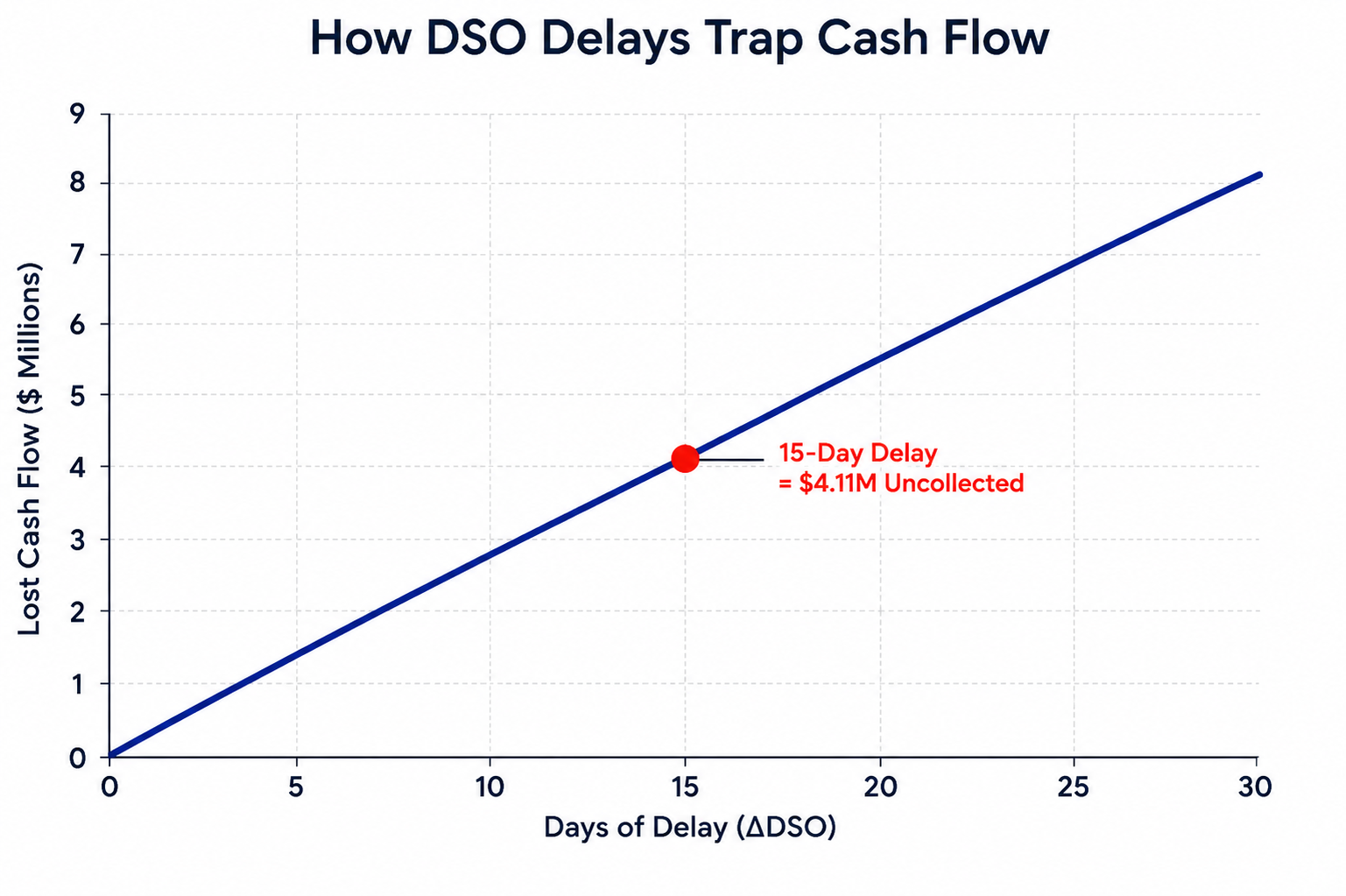
Figure 1. A standard $100M enterprise illustration showing how incorrect language routing delays invoice processing, increases manual intervention, and slows cash conversion.
| “Language routing should follow the bill-to entity—not the parent company’s headquarters.” |
Why Parent-Centric Data Models Break Global Collections
For Revenue Operations (RevOps) and IT leaders, associating communication preferences with a global corporate headquarters is a fundamental architectural flaw. During automated collections, enterprise systems often confuse the legal owner of the customer relationship with the operational team responsible for processing the invoice.
When collections workflows query parent-level account records instead of invoice-level metadata, reminders inherit incorrect language, currency, and communication preferences. What appears to be a simple configuration issue quickly becomes a cascading series of operational failures that grows more expensive as organizations expand internationally.
The solution is straightforward: communication preferences should be anchored to the localized billing entity and the operational contact responsible for processing the invoice—not the corporate headquarters.
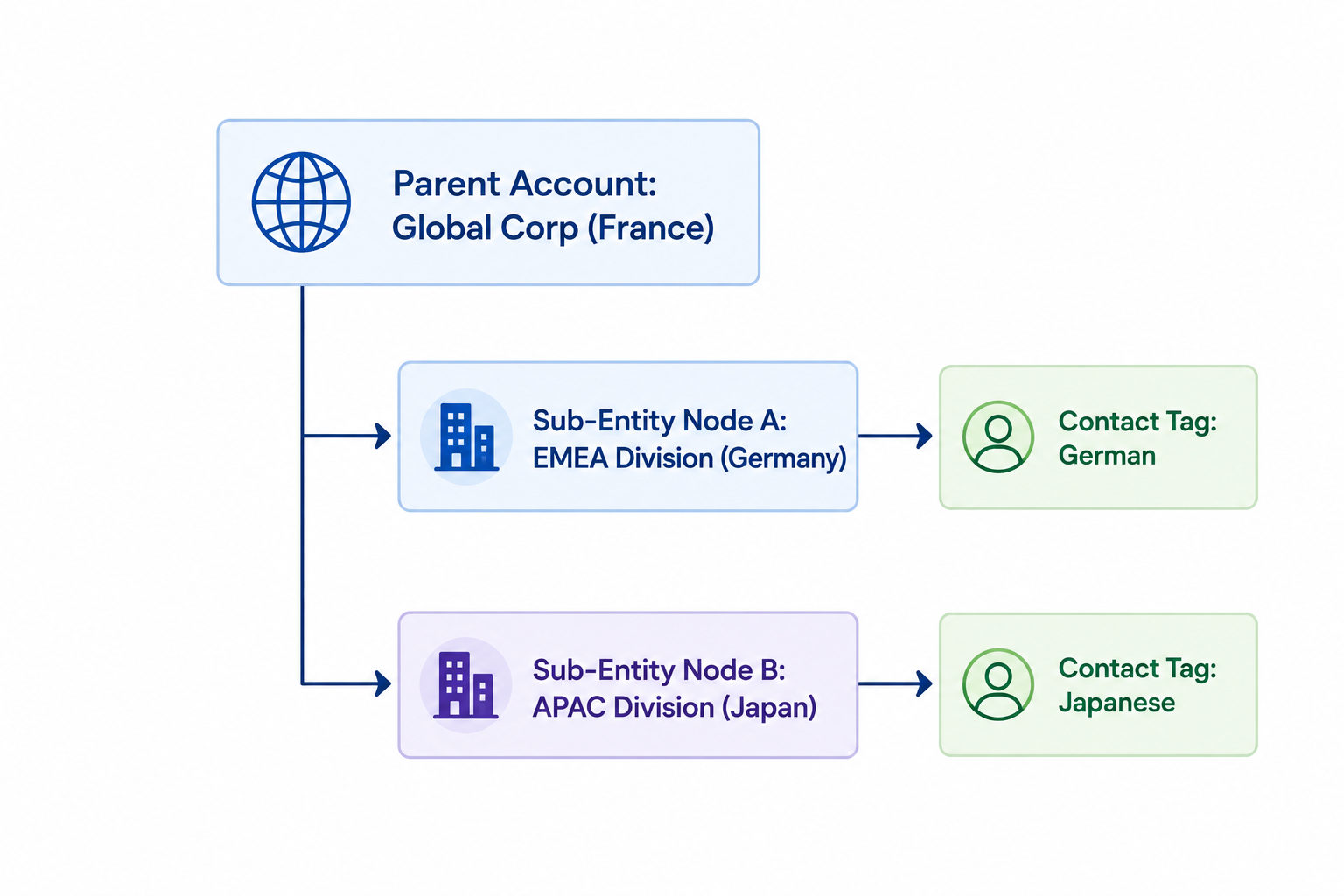
Figure 2. Language preferences, billing attributes, currencies, and operational contacts are mapped to localized billing entities rather than inherited from parent organizations.
| “The AP clerk processing the invoice is rarely the executive who signed the global Master Services Agreement.” |
The Architectural Fix: Designing a Multi-Region Data Hierarchy
Once the root cause is understood, the next challenge is designing enterprise systems that prevent these failures from occurring.
Scalable international receivables require ERP and CRM platforms that prioritize operational metadata over parent-company defaults. Rather than inheriting communication settings from headquarters, every automated interaction should be driven by the metadata associated with the invoice, billing entity, and operational contact.
This architecture rests on three foundational design principles.
1. Isolate Account Sub-Entities
Every regional subsidiary should exist as an independent child account with its own localized metadata.
Localized metadata should include:
- Tax identifiers
- Billing currency
- Regional business hours
- Legal entity information
2. Implement Contact-Level Preferences
Communication preferences should be stored directly against the operational billing contact rather than the parent account.
Examples include:
- Preferred language
- Notification channels
- Regional communication rules
3. Define a Structured Fallback Sequence
Every collections workflow should follow a consistent hierarchy:
Contact Language Preference → Sub-Entity Billing Country → English
This prevents workflows from reverting to the parent company’s geography whenever localized information is unavailable.
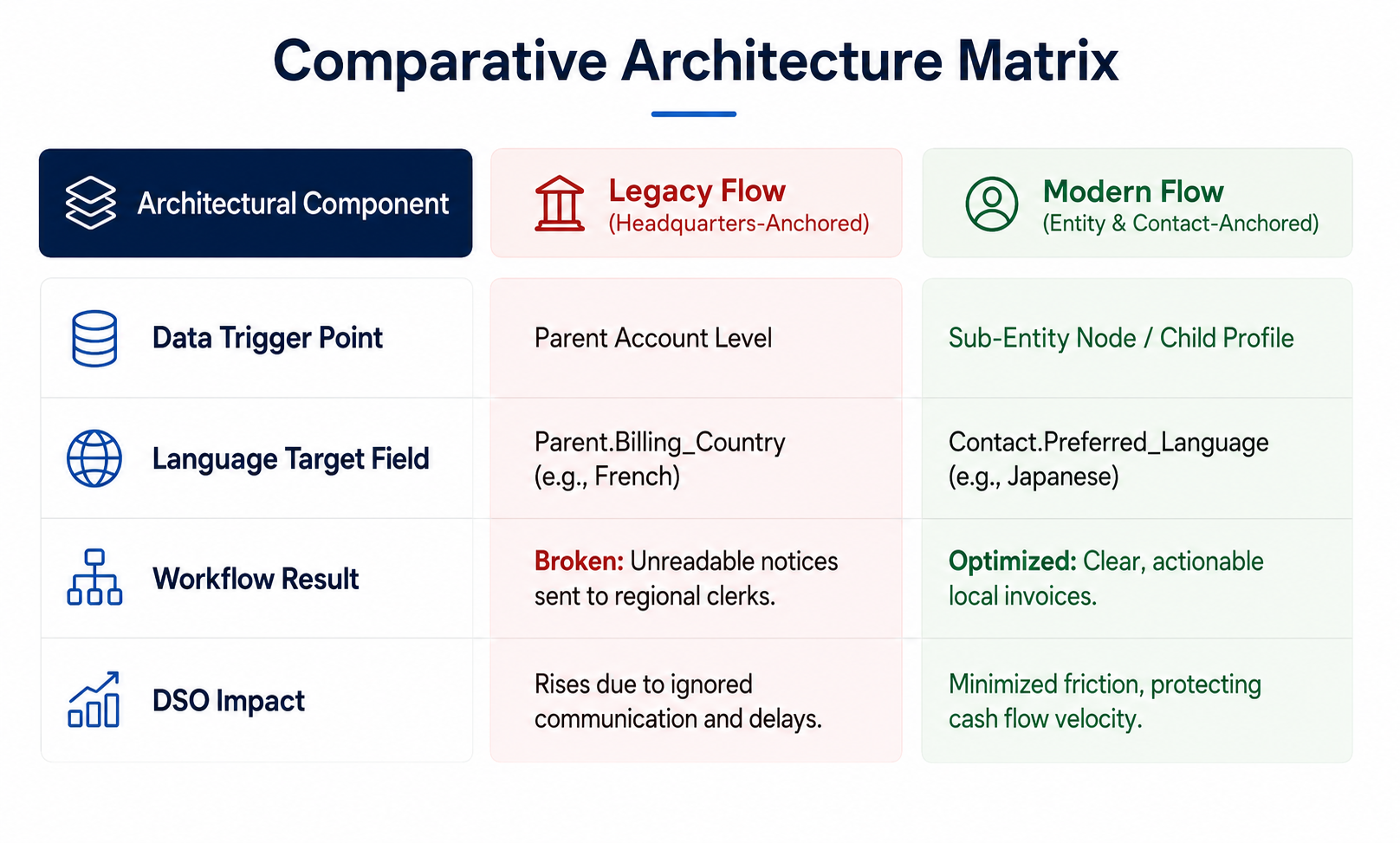
Figure 3. Compares legacy parent-based routing with entity-aware data architecture and highlights the impact on collections efficiency and working capital.
Beyond improving language accuracy, this architecture creates a reusable foundation for every downstream finance process. Once billing entities and operational contacts are correctly identified, organizations can automate payment reminders, dispute routing, credit management, escalation paths, regional compliance checks, and payment method selection using a single global framework instead of maintaining separate country-specific workflows.
The result is simpler ERP administration, more consistent reporting, stronger governance, and greater audit readiness across expanding international operations.
By enforcing these architectural guardrails, organizations transform Accounts Receivable from a centralized administrative bottleneck into a scalable, localized automation engine that accelerates cash flow while maintaining operational consistency.
| “A simple fallback hierarchy protects cash flow: Contact Language Preference → Sub-Entity Billing Country → English.” |
Protecting Cash Flow with Structural Data Hygiene
Designing the right data hierarchy is only the first step. Maintaining its integrity over time is equally important.
As organizations expand through acquisitions, enter new markets, or reorganize regional operations, localized data continuously evolves. Without disciplined governance, critical billing information gradually becomes incomplete or inconsistent, forcing ERP systems to fall back to inaccurate parent-level defaults.
To prevent this, organizations should enforce validation rules whenever a subsidiary or child account is created. Critical localized attributes—including tax identifiers, billing currency, regional business hours, operational contacts, and language preferences—should be mandatory rather than optional.
Maintaining this level of structural precision enables automated billing communications that accurately reflect each recipient’s operational environment.
This includes:
- Regional Currency: Reduces foreign exchange confusion and payment errors.
- Local Tax Structure: Supports VAT, GST, and regional regulatory compliance.
- Preferred Language: Improves comprehension and reduces avoidable payment delays.
When enterprise data accurately reflects operational reality, invoices move directly to the teams responsible for approving payment. Finance organizations spend less time correcting exceptions, regional workflows remain uninterrupted, and collections cycles become faster and more predictable.
Clean data architecture is more than an IT exercise—it is the operational foundation of scalable global receivables. Before organizations invest in AI-driven collections or localized payment infrastructure, they must first ensure that the underlying data architecture accurately reflects how global customers actually operate.
Next in the series, Part 2: Beyond Translation—Bridging the Regional Payment Gap, examines how localized banking infrastructure, virtual accounts, and regional payment rails reduce payment friction, accelerate cash collection, and strengthen global receivables operations.

Priya Roy is Vice President, Delivery Leadership at Straive, where she translates ambitious growth strategy into high-performing customer experience and technology operations. With deep expertise in large-scale transformation, she offers a practical leadership perspective on scaling AI, elevating service excellence, and turning operational complexity into lasting enterprise value.


