
Posted on: Decmeber 1st 2025
2025 became the year enterprises stopped experimenting and began treating autonomy as a strategic priority. As adoption accelerated, the market made one thing clear: agentic AI companies are no longer operating on the fringe; they’re shaping how modern enterprises run.
Leaders moved beyond pilot projects and began embedding intelligent systems into real workflows, seeking solutions that could act, make decisions, and deliver outcomes with minimal intervention. According to McKinsey’s State of AI: Global Survey 2025, 23% of organizations are already scaling agentic AI systems, reinforcing the shift toward autonomy and the growing confidence in AI-driven execution.
Market analyses reinforced this momentum, showing that organizations were replacing traditional automation with more capable, adaptive systems that delivered measurable business impact. Executives no longer viewed Agentic AI as a future concept. It had become a central driver of operational change.
This evolution prompted many agentic AI companies to scale their enterprise deployments and prove value in live environments. Leaders now seek partners who can coordinate agents across complex systems, support end-to-end workflows, and accelerate transformation. Organizations that embrace these capabilities early will enter 2026 with a clear competitive advantage.
Agentic AI Definition
Agentic AI refers to autonomous systems that can make decisions, take actions, and complete tasks without constant human input. They utilize AI agents that sense, plan, and execute tasks within enterprise workflows.
What is Agentic AI?
Agentic AI represents a new class of intelligent systems that can take action, make decisions, and complete tasks with limited human involvement. Instead of waiting for instructions, these systems understand business goals, sense what is happening in real time, and move work forward with purpose.
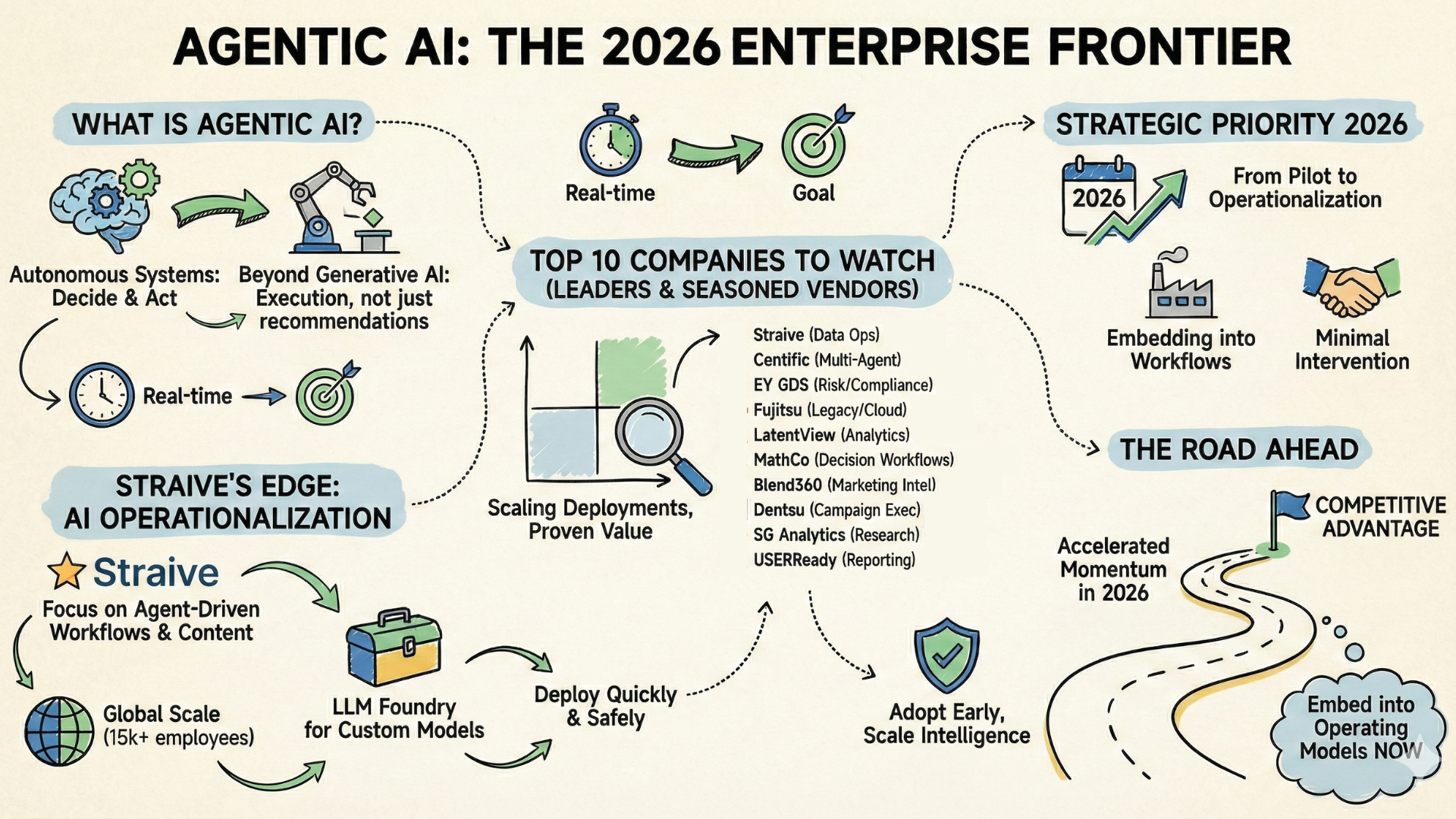
Leaders value this shift because it transforms AI from a helpful tool into a reliable contributor to daily operations. As Namit Sureka, President and Chief Analytics & AI Officer at Straive, explains, “We look at AI as a continuum. The real impact happens when you operationalize it by combining traditional models, machine learning, domain expertise, and GenAI in a way that works for everyday decision-making.”
To understand how agentic AI works, it is essential to examine the role of AI agents. These agents pull information from multiple sources, analyze patterns instantly, and coordinate tasks across enterprise tools.
They learn continuously from interactions, which allows them to adapt, correct themselves, and manage increasingly complex workflows without constant oversight.
This is why Agentic AI goes far beyond traditional generative AI. Generative models create content and insights, but they stop at recommendations. Agentic AI bridges the gap by pairing intelligence with execution.
It runs processes end-to-end, reacts to new data the moment it appears, and supports outcomes that align with real business goals. For leaders, this combination of insight and action is what turns Agentic AI into a strategic advantage.
Top 10 Agentic AI Companies in 2025
In 2025, several organizations advanced the practical use of Agentic AI through scalable deployments, strong integration capabilities, and a proven ability to operationalize AI agents in real enterprise environments. The quadrant separates Leaders from Seasoned Vendors, reflecting their depth, readiness, and outcome-driven performance.
Straive
Straive focuses on AI Operationalization using agents to enhance data-driven operations and content-intensive workflows. Its tool-integrated agents coordinate tasks across varied data and domain environments. The company demonstrates maturity through its global deployments, which deliver measurable gains in speed and accuracy.
Centific
Centific applies Agentic AI to streamline digital operations at scale. Its standout capability is multi-agent orchestration designed for high-volume, data-heavy workflows. Enterprise clients recognize its maturity through consistent impact on efficiency and turnaround time.
EY GDS
EY GDS positions Agentic AI as a core enabler for risk, governance, and compliance functions. Its agents handle structured decision steps, validations, and rule-based processes. The firm’s maturity is evident in deployments across regulated industries that require precision and reliability.
Fujitsu
Fujitsu uses Agentic AI to modernize enterprise operations by integrating agents across both legacy and cloud systems. Its strength lies in orchestrating complex workflows with high operational stability. Its long-standing enterprise footprint reflects strong deployment readiness.
LatentView Analytics
LatentView Analytics applies agentic AI to streamline analytics, data engineering, and insight generation workflows. Its agents manage multi-step data processes and automate decision triggers. The company demonstrates maturity through consistent performance across high-volume enterprise settings, especially in retail, consumer goods, and financial services.
MathCo
The MathCompany uses agentic AI to operationalize analytics and automate decision workflows. Its agents connect predictive models with enterprise systems to enhance forecasting, planning, and execution. The company shows maturity through scalable deployments that deliver strong, measurable impact across diverse industries.
Blend360
Blend360 uses Agentic AI to operationalize analytics, marketing intelligence, and customer insights. Its agents connect data science outputs to execution layers, reducing manual effort. Its maturity is visible through deployments across diverse client environments.
Dentsu
Dentsu applies Agentic AI to marketing and media optimization workflows. Its agents support rapid decision-making and automated campaign execution. Its deployment history demonstrates strong performance across integrated marketing ecosystems.
SG Analytics (SGA)
SGA uses Agentic AI to enhance analytics and data operations. Its strongest capability is the ability to manage both structured and unstructured information flows through autonomous agents. The company’s maturity is demonstrated by the dependable outcomes achieved by its global research teams.
USERReady
USERReady applies Agentic AI to accelerate analytics and reporting workflows. Its agents interact directly with enterprise data systems to streamline insight generation. Rapid, repeatable deployments highlight its operational maturity.
Why Do These Companies Lead the Agentic AI Landscape?
The companies shaping the Agentic AI landscape deliver more than automation. They build intelligent systems that understand goals, coordinate multiple agents, and respond to real business conditions. This enables organizations to operate more efficiently and with greater consistency.
Their advantage lies in creating agents that function in actual enterprise environments. These agents take action, monitor outcomes, and adjust their steps as situations evolve. This creates dependable autonomy that supports everyday operations, rather than relying on limited test scenarios.
Leading companies also have proven execution. Their deployments across high-volume and high-risk processes demonstrate that Agentic AI can deliver real value at scale. This track record helps enterprises adopt the technology with confidence.
Integration strength completes their leadership. Top partners ensure that agents work smoothly with existing tools, data systems, and business platforms. This makes adoption easier, reduces disruption, and accelerates measurable outcomes.
Navigating AI Operationalization: Choosing the Right Partner for 2026
Selecting an Agentic AI partner for 2026 begins with strong AI operationalization. Leaders need partners who can move beyond pilots and deliver reliable performance in everyday operations. This depends on autonomy levels, integration readiness, governance, security, scalability, and clear ROI pathways.
A credible partner must demonstrate success in real-world environments, not controlled demonstrations. Their agents should integrate seamlessly with enterprise tools and adapt to changing workflows. This ensures faster adoption and meaningful business impact.
Straive offers the scale and depth needed for enterprises to confidently adopt agentic systems with operational clarity. It has over 15,000 employees in 30 countries, serving global clients across various sectors, including banking, financial services, life sciences, manufacturing, logistics, research, EdTech, and media.
Straive strengthens AI operationalization through focused assets and expertise. Its workflow-automation capabilities support agent-driven processes, while LLM Foundry enables customized model solutions for complex enterprise use cases. These capabilities help organizations deploy Agentic AI quickly, safely, and at scale.
The Road Ahead for Enterprise Agentic AI
Agentic AI demonstrated its value in 2025, showing that autonomous systems can facilitate faster decision-making, more consistent execution, and enhanced business performance. Leaders now view these capabilities as essential to their digital transformation roadmaps.
Momentum is expected to accelerate in 2026 as enterprises strive for full operationalization. Organizations that adopt early will be better positioned to scale intelligence, improve accuracy, and compete more effectively.
Industry perspectives, including those noted by AIM Research, indicate a clear shift toward enterprise-level autonomy. The next phase of growth belongs to leaders who act now and embed Agentic AI into the heart of their operating models.


Straive helps clients operationalize the data> insights> knowledge> AI value chain. Straive’s clients extend across Financial & Information Services, Insurance, Healthcare & Life Sciences, Scientific Research, EdTech, and Logistics.


