
Posted on: October 28th 2026
Text-similarity screening has long supported plagiarism checks in academic and scientific publishing. Tools such as Turnitin and iThenticate compare submissions against extensive content databases and flag matching passages. These matches require review to determine whether they indicate plagiarism, since correctly quoted and cited text can also produce matches.
However, these checks address only one aspect of research integrity. Other concerns include AI-generated fabrications, inappropriately altered images, and fraudulent manuscripts produced by paper mills. These remain relevant, as reflected in SSP’s October 2026 research integrity report.
Addressing these risks requires checks of content and supporting evidence, alongside analysis of patterns across submissions. Collaborative initiatives such as the STM Integrity Hub support this approach by screening for signals associated with paper mills and other integrity concerns. Editors and research integrity specialists must investigate flagged concerns and assess the evidence before drawing conclusions about misconduct.
Why Text Similarity Alone Cannot Establish Manuscript Integrity
Text-matching tools such as iThenticate compare a manuscript with sources in their databases and flag matching passages. They also generate a similarity score showing the percentage of text that matches those sources. Since correctly quoted and cited text can also produce matches, editors must assess whether the flagged passages indicate plagiarism.
However, text-similarity checks address only one aspect of manuscript integrity:
- Reworded or translated content still requires attribution. Rephrasing or translating another author’s work does not remove the need to credit the source. Some tools offer cross-language comparison. For example, Turnitin’s optional Translated Matching service compares submissions in supported non-English languages against English-language sources. Editors still need to assess whether the original work has been properly acknowledged.
- Images and underlying data need separate checks. Text-similarity reports cannot establish whether experimental images faithfully represent the underlying experiments. For example, PLOS One requires original, uncropped, minimally adjusted images supporting blot and gel results. These laboratory techniques are used to study proteins, DNA, or RNA. The original images help reviewers assess how published figures were prepared and investigate possible manipulation. They do not, by themselves, establish the validity of the research findings.
- AI-generated writing raises questions beyond text overlap. Similarity checks identify matching text, while AI-writing detectors estimate whether text may have been generated or altered by AI. Neither establishes whether the research is accurate. Detection results can be wrong and should not be treated as proof of misconduct. The International Committee of Medical Journal Editors (ICMJE) recommends disclosure of AI use and holds human authors responsible for the submitted content. Screening therefore needs to examine claims, references, and supporting evidence alongside compliance with disclosure requirements.
- Paper mill activity may become apparent across multiple submissions. Reviewing manuscripts individually can miss signs of coordinated activity. PLOS’s editorial guidance explains that identifying potential paper mill involvement typically requires examining trends across a series of submissions. Comparing manuscripts can reveal recurring features that warrant investigation. These patterns are warning signs, rather than proof of paper mill involvement.
For publishers, the priority is to connect findings from text, image, data, and submission checks so that experts can assess them together. This approach aligns with STM’s 2026 report on publisher research integrity practices, which emphasizes screening technology, specialist teams, clear protocols, and collaboration.
This combined assessment matters because a low similarity score does not establish that a manuscript is trustworthy, and an isolated warning sign does not prove misconduct. Clear escalation criteria can help editorial teams decide which concerns need further investigation, what supporting evidence to request, and how to document their decisions.
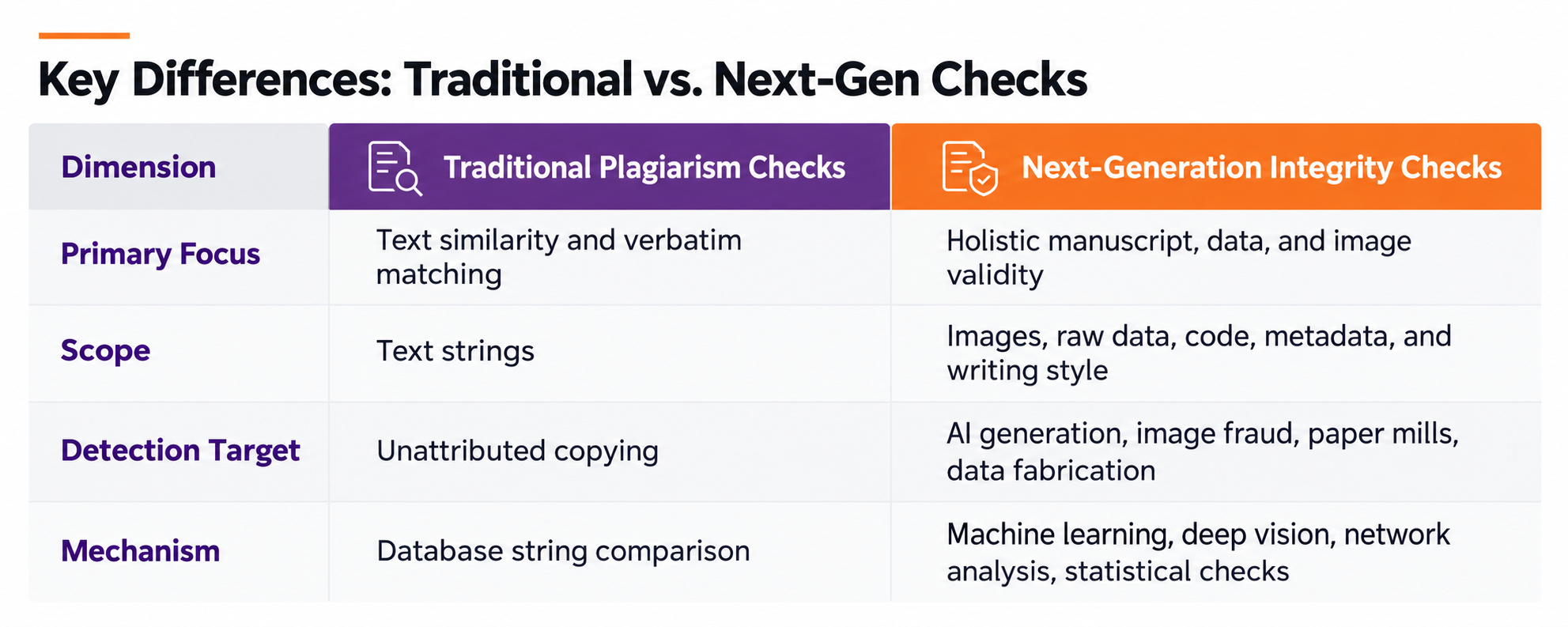
Figure 1: Traditional plagiarism checks focus on text similarity. Next-generation integrity checks extend screening to manuscript content, images, data, code, metadata, and writing style.
Four Complementary Approaches to Research Integrity Screening
The limitations of text matching point to a broader screening approach. Publishers can combine image analysis, paper mill detection, writing-style and AI analysis, and data and statistical checks. Each examines different signals that experts can assess together.
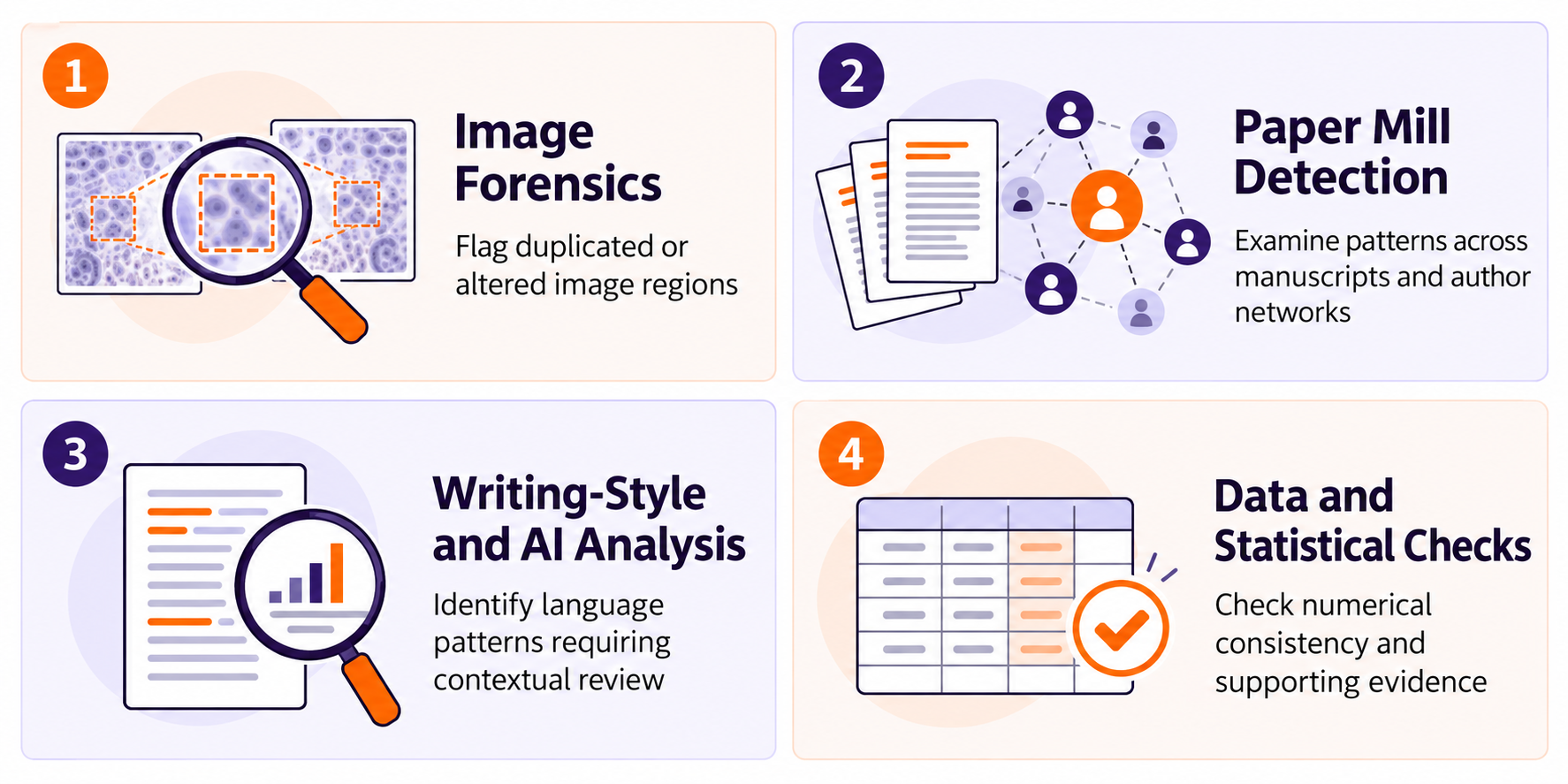
Figure 2: Four complementary approaches to research integrity screening help flag concerns for further editorial investigation.
1. Image Forensics
Inappropriate image manipulation can misrepresent laboratory results. PLOS One’s figure guidelines identify unacceptable practices such as combining images without clearly marking the changes and adjusting contrast to conceal information. Another concern is copying bands, the visible signals in blot or gel images, and presenting them as results from different samples.
Specialized image-analysis tools can flag duplicated regions and reused panels within figures and across papers. For example, a 2018 study in Cell Death & Disease demonstrated automated checks for cloned gel features and duplicated image panels.
These tools help reviewers locate potential problems, but their findings need interpretation. Reviewers can compare flagged figures with original images, figure legends, and supporting data to assess whether reuse is appropriately disclosed or whether the presentation misrepresents the experiments. Duplication checks alone cannot establish that an image is authentic or that the research findings are valid.
2. Paper Mill Detection and Network Analysis
Paper mills are commercial operations that manufacture manuscripts for publication or offer authorship for sale, as described in the joint COPE–STM report. Identifying their activity may require examining relationships across manuscripts, authors, citations, and submission records.
Generative AI adds to this challenge by making it easier to produce plausible but false research, a concern highlighted in STM’s 2026 report on publisher research integrity practices. Polished language therefore cannot be taken as evidence that a manuscript is trustworthy.
Potential warning signs include:
- Recurring features across manuscripts. Similar wording, formatting, illustrations, references, or author details can warrant closer examination when they recur across apparently unrelated submissions. PLOS’s editorial guidance explains that identifying potential paper mill involvement typically requires examining trends across a series of submissions.
- Citation patterns that lack a clear scholarly rationale. Repeated citations to unrelated work, excessive self-citation, or unusual concentrations of citations among particular authors or journals may warrant review. Wiley’s publishing ethics guidelines identify irrelevant citations and excessive self-citation as concerns. Such patterns do not, by themselves, establish coordination or paper mill involvement.
- Distorted scientific terminology. Automated paraphrasing can produce nonsensical replacements for established terms, sometimes called “tortured phrases.” In their 2022 study, Lay, Lentschat, and Labbé discuss “counterfeit consciousness” in place of “artificial intelligence.” These expressions remain useful warning signs, but screening should not depend on their presence.
- Author details that cannot be verified. COPE’s guidance on investigating suspected publication manipulation advises checking author email addresses and, where needed, institutional affiliations. Contact details may be falsified or controlled by someone other than the listed author, and affiliations may be fabricated.
The value of network analysis lies in connecting signals that may appear unremarkable in isolation. Editors should assess whether the combined findings have a legitimate explanation, seek clarification where needed, and document the evidence supporting their decisions.
3. Writing-Style Analysis and AI-Writing Detection
Alongside image and submission-pattern checks, language analysis can help identify passages that warrant closer review. Writing-style analysis, also called stylometry, examines features such as vocabulary, sentence structure, and punctuation. It can highlight changes in style, but those changes alone do not establish ghostwriting or misconduct.
AI-writing detection separately estimates whether text may have been generated or altered by AI. Its findings require caution. Turnitin’s guidance acknowledges that its detector can misidentify human-written, AI-generated, and AI-paraphrased text. Rewriting and changes in AI models can also affect detection performance.
For publishers, identifying possible AI involvement is only part of the assessment. Editors and reviewers also need to examine whether claims are supported, references are accurate, and descriptions agree with the accompanying figures and tables. These checks address the reliability of the work rather than establish how it was written. The ICMJE’s recommendations reinforce that human authors remain responsible for submitted content, including material produced with AI assistance.
Automated findings should guide further investigation rather than determine misconduct. Editors should explain the specific concern, invite the authors to respond, and request relevant supporting materials where these would help resolve it. As COPE’s investigation guidance advises, requests for original data should have a clear purpose and a plan for evaluating what authors provide.
4. Data and Statistical Consistency Checks
A manuscript can contain original text while reporting results that are inconsistent or unsupported. Data and statistical checks examine whether reported numbers agree and whether the supporting evidence allows reviewers to assess the findings.
Automated tools can help identify specific reporting inconsistencies. For example, statcheck recalculates p-values from certain reported test statistics and degrees of freedom, then flags discrepancies. A study published in Behavior Research Methods demonstrated this approach across psychology papers.
These checks have limits. Their coverage depends on the statistical tests and reporting formats they support, and flagged discrepancies require expert interpretation. A mismatch may reflect a reporting error, an adjustment the tool does not recognize, or an analytical problem. Conversely, internally consistent statistics do not establish that the underlying data are authentic.
Supporting data enable closer examination. PLOS’s data availability policy requires authors to share the data needed to replicate reported findings, together with relevant metadata and methods. This includes values behind reported statistics and graphs, with provisions for legitimate legal or ethical access restrictions. Editors and statistical reviewers can use this evidence to examine discrepancies and request clarification.
For publishers, the priority is to connect numerical checks with access to usable evidence and appropriate statistical expertise. Automated screening can help identify what needs attention. Expert review is needed to determine whether a concern reflects a correctable error, an analytical weakness, or a possible integrity issue requiring further investigation.
Moving Forward: Turning Screening Findings into Informed Decisions
The value of research integrity screening lies in how publishers connect and act on its findings. Image analysis, paper mill detection, writing-style and AI analysis, and statistical checks provide different signals. Assessing them together can help editors identify concerns that a single check might miss.
An effective approach integrates automated screening with expert review throughout the editorial workflow. Screening at submission can identify concerns before external reviewers are assigned. Targeted checks during peer-review preparation and before publication can address unresolved questions or new evidence.
Publishers need clear responsibilities and procedures for investigating alerts, seeking author explanations, requesting relevant supporting evidence, and documenting decisions. The aim is to distinguish correctable errors from concerns requiring deeper investigation, without treating an automated flag as proof of misconduct. This makes screening a practical foundation for timely, fair, and evidence-based editorial decisions.

Straive helps clients operationalize the data> insights> knowledge> AI value chain. Straive’s clients extend across Financial & Information Services, Insurance, Healthcare & Life Sciences, Scientific Research, EdTech, and Logistics.


