
Posted on: April 10th 2026
Customer expectations have never been higher. Today’s consumers want instant answers, clean resolutions, and personalized interactions, not scripted responses or endless hold music. Traditional chatbots, once hailed as the future of customer service, have largely disappointed. They struggle with nuance, stall at complexity, and frustrate users who quickly realize they’re talking to a wall of pre-written responses.
Agentic AI in customer support marks a genuine shift, one that goes far beyond keyword matching and decision trees. Unlike conventional bots, agentic AI systems can reason, plan, take action, and adapt in real time. They don’t just answer questions; they solve problems end-to-end, autonomously navigating systems, tools, and data to deliver outcomes that customers actually care about.
This blog explores how agentic AI is changing the customer support landscape, the key use cases unlocking value today, the challenges businesses must navigate, and what the future holds for organizations ready to move beyond the chatbot era.
Agentic AI vs. Traditional Chatbots
To understand what agentic AI actually represents, it helps to first understand what traditional chatbots can and cannot do.
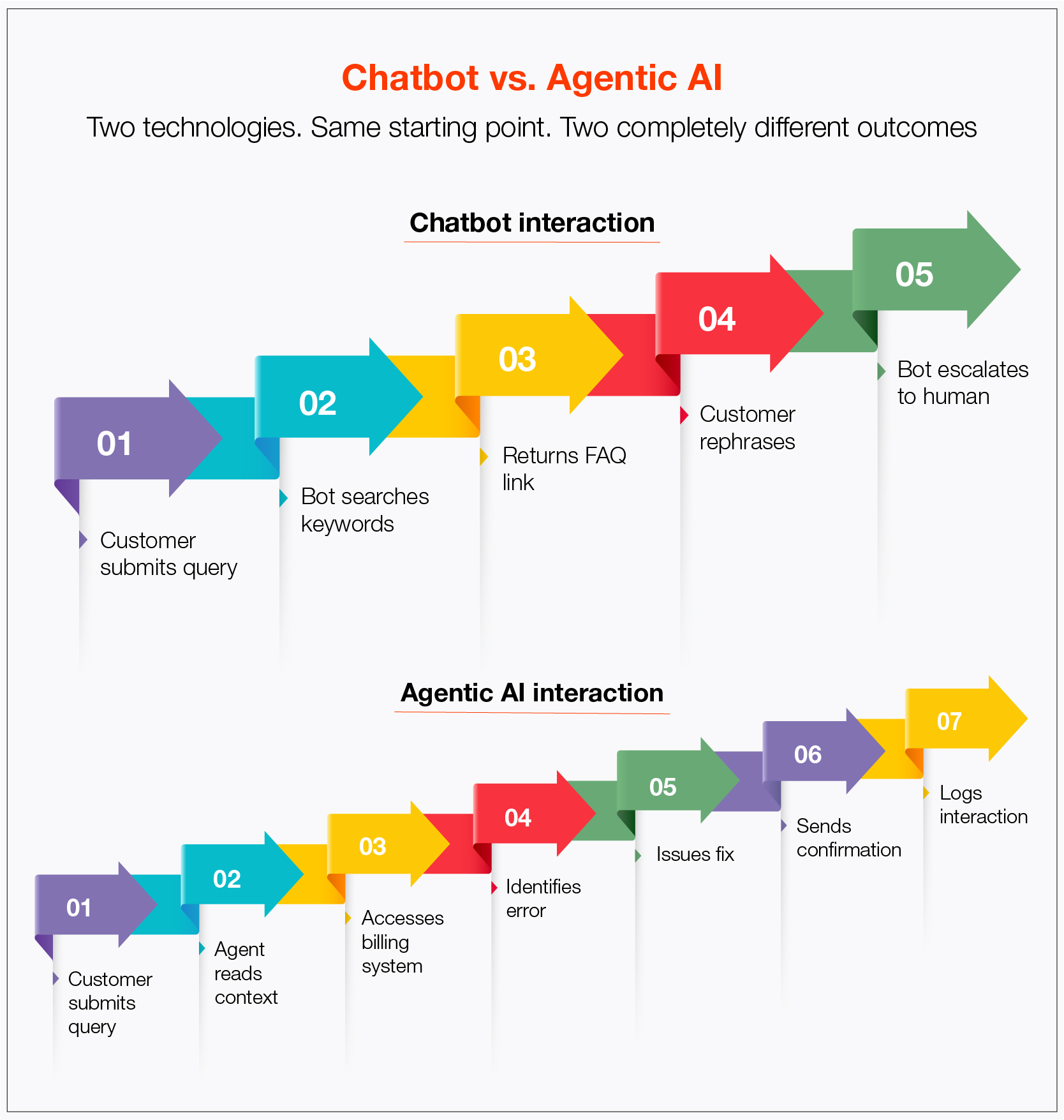
Traditional chatbots operate on rigid, rule-based frameworks or narrow natural language processing (NLP) models. They follow predetermined conversation flows, respond to specific keywords, and escalate queries to humans the moment they fall outside their scripted boundaries. They are reactive, not proactive, and largely incapable of taking meaningful action within external systems. If you’ve ever explained your problem to a chatbot, been cheerfully asked to “rephrase your question,” explained it again, been offered a link to an FAQ page that addressed something completely unrelated, and then given up and called the phone number you were trying to avoid in the first place, then, congratulations, you have personally funded the business case for agentic AI.
Agentic AI, by contrast, is built around autonomous decision-making. AI customer service agents powered by large language models (LLMs) can understand context deeply, break complex problems into subtasks, call external tools and APIs, and work toward a solution without constant human prompting. They maintain memory across a conversation, adjust their approach based on new information, and execute multi-step workflows from start to finish.
In short: chatbots respond. Agentic AI acts.
| Feature | Traditional Chatbot | Agentic AI |
| Decision-making | Rule-based | Autonomous, goal-driven |
| Task complexity | Simple, single-step | Multi-step, complex workflows |
| Tool use | None or limited | APIs, databases, CRM, ticketing |
| Adaptability | Static | Dynamic, context-aware |
| Escalation | Frequent | Minimal, selective |
How Agentic AI Is Transforming Customer Support
AI-driven customer support is going through a substantial shift as agentic systems take over tasks once considered exclusively human. Rather than simply deflecting tickets, agentic AI actively manages resolutions.
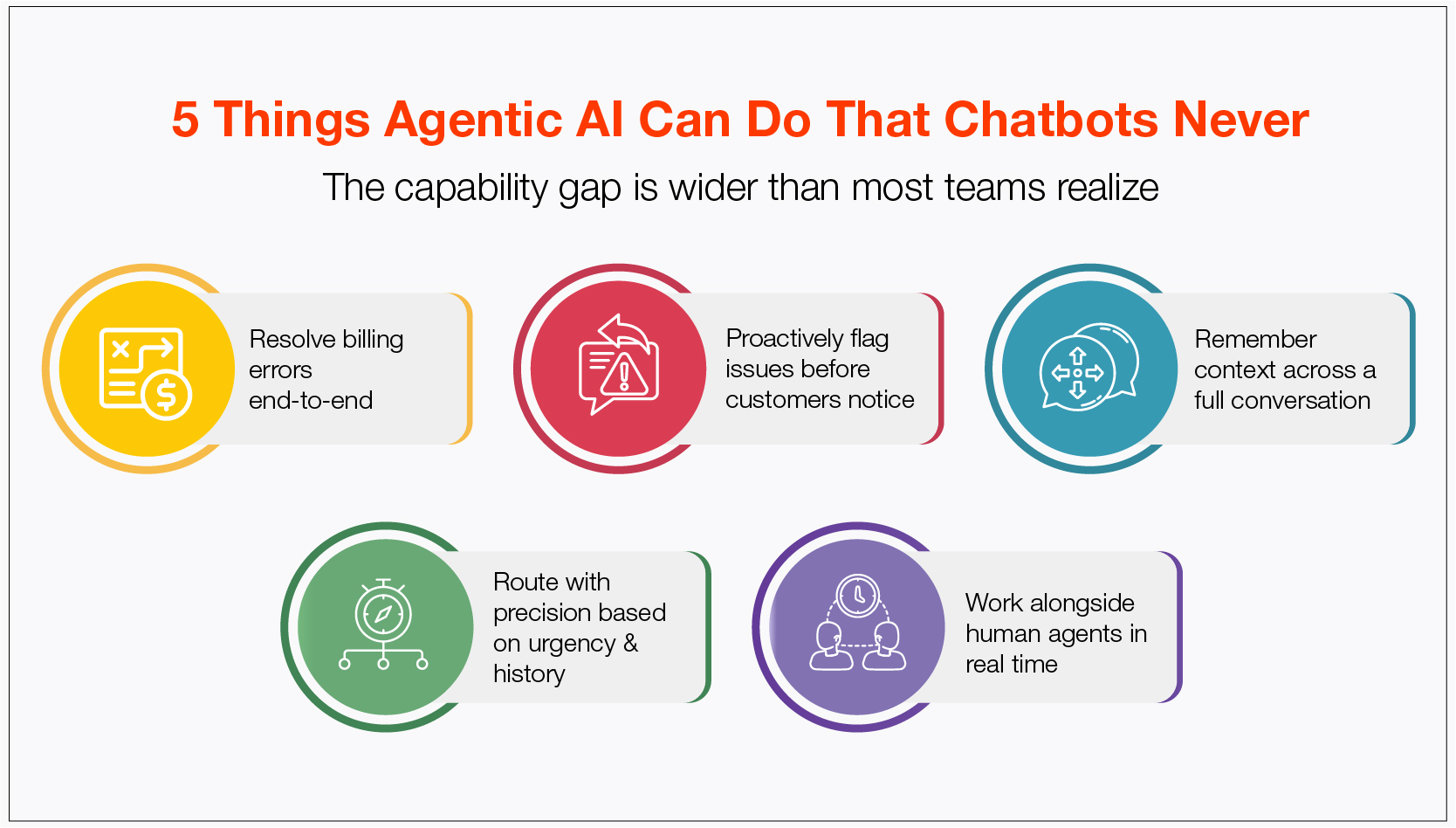
When a customer contacts support about a billing discrepancy, an agentic system doesn’t just retrieve a FAQ article. It accesses the billing database, cross-references transaction history, identifies the error, issues a correction, sends a confirmation email, and logs the interaction, all within a single session. This is the operational shift that agentic AI solutions make possible.
AI customer support automation is also reshaping the economics of support at scale. While traditional automation could handle only simple, high-volume questions, agentic systems can handle more complex cases that require judgment, greatly expanding what can be automated without sacrificing quality. The numbers back this up: according to a March 2025 Gartner forecast, agentic AI is projected to autonomously resolve 80% of common customer service issues without human intervention by 2029 and, in doing so, drive approximately a 30% reduction in operational costs. For support leaders still debating whether to invest, that forecast is less a prediction and more a deadline.
Beyond efficiency, agentic AI is enabling hyper-personalization. By pulling together customer history, sentiment signals, and behavioral data in real time, AI voice agent for customer support can tailor tone, content, and resolution paths to individual customers, something that has always been impossible to do at scale with human teams alone.
Key Use Cases of Agentic AI in Customer Support
1. Autonomous Issue Resolution
From resetting passwords and processing refunds to modifying subscriptions and scheduling callbacks, AI customer support agents can execute end-to-end resolutions without human intervention. They handle the full workflow: understanding intent, accessing relevant systems, taking action, and confirming outcomes.
2. Intelligent Triage and Routing
Agentic AI in customer support can assess incoming queries with far greater precision than keyword-based systems. It evaluates urgency, complexity, customer history, and required expertise before routing, ensuring cases land with the right agent or are resolved autonomously.
3. Proactive Customer Outreach
Rather than waiting for customers to report problems, AI agents for customer support can proactively identify at-risk accounts, shipment delays, or service disruptions and reach out with solutions before customers even notice an issue.
4. Complex Multi-Turn Conversations
Agentic systems maintain conversational memory and contextual understanding across long interactions. They can handle multi-turn troubleshooting sessions, follow up on unresolved issues, and adjust their approach based on evolving context, which are capabilities that traditional bots simply cannot match.
5. Agent Assist and Copilot Functions
Even in human-led interactions, AI customer service agents work as intelligent copilots, surfacing relevant knowledge, suggesting responses, automating post-call summaries, and handling backend tasks in real time, so human agents can focus on empathy and judgment.
Benefits of Agentic AI in Customer Support
Speed and availability sit at the top of the benefits list. AI-powered customer support operates 24/7 with zero wait times, resolving issues in seconds that would otherwise sit in a queue for hours. For global businesses, this means consistent service quality across every time zone.
Scalability without proportional cost is the economic case that resonates most with executives. As ticket volumes spike during product launches, outages, or seasonal peaks, AI customer support scales instantly without the lag and expense of emergency hiring.
Consistency and compliance are often underestimated advantages. Unlike human agents, which may vary in tone, accuracy, or adherence to policy, agentic AI delivers consistent responses every time, reducing compliance risk and quality variance.
Data-driven customer support becomes achievable at a new level of depth. Every interaction an agentic AI handles generates structured data about issue types, resolution times, customer sentiment, and friction points, which then feeds continuous improvement across products, policies, and processes.
Customer satisfaction ultimately benefits when AI customer support automation handles the transactional work efficiently, freeing human agents for high-empathy moments that genuinely require a human touch. The result is a support experience that feels both fast and personal.
Challenges and Risks
Despite its promise, deploying agentic AI in customer support introduces challenges that organizations must address with care.
Trust and accuracy remain the primary concerns. Agentic systems that take real-world actions, such as issuing refunds, modifying accounts, or sending communications, can cause significant damage if they act on incorrect inferences. Robust guardrails, human-in-the-loop checkpoints for high-stakes actions, and continuous monitoring are non-negotiable.
Data privacy and security become more complex as AI agents access multiple internal systems. Every integration point is a potential vulnerability. Organizations must enforce strict data governance, access controls, and audit trails across every system the agent touches.
Integration complexity is a practical barrier. Deploying an agentic AI into a fragmented enterprise tech stack is like giving a world-class pianist a concert grand, then seating them at an instrument where half the keys are silent, a quarter play the wrong notes, and nobody can tell them which is which until they have already started performing. The talent is genuine; the instrument is the problem. Legacy support stacks, fragmented CRM systems, and siloed databases make it technically challenging to grant AI agents the system access they need to realize their potential. Implementation requires significant upfront investment in infrastructure.
Over-automation is a subtle but real risk. Not every customer interaction benefits from autonomous AI handling. Misjudging when human empathy is needed, during complaints, sensitive situations, or emotionally charged contexts, can erode trust and damage brand perception.
Bias and fairness require ongoing attention. AI customer service agents trained on historical data can carry forward biases in how they prioritize, respond to, or resolve issues for different customer segments.
Read also: How Are Banks Using AI to Elevate Customer Service? Agentic AI changes how support works. But banking shows how far that change can actually go. See how one of the most regulated, risk-averse industries is using AI to serve customers faster, smarter, and at a scale that was unthinkable five years ago. |
Examples of Agentic AI in Customer Support
Salesforce Agentforce represents one of the most prominent deployments of AI-powered customer support. Salesforce’s agentic platform allows companies to deploy autonomous agents that handle service cases, field inquiries, and execute actions across Salesforce’s ecosystem without human intervention.
Klarna’s AI assistant processed the equivalent of 700 full-time agents’ work in its first month of operation, handling refund disputes, payment plan modifications, and account queries autonomously. This demonstrated the scale potential of AI-driven customer support in financial services.
Intercom’s Fin AI agent uses large language models to engage in nuanced, multi-turn support conversations and escalates to human agents when needed. Its architecture reflects how modern AI customer support agent design balances autonomy with appropriate human oversight.
Zendesk’s AI agents are embedded across ticketing workflows, proactively resolving issues, summarizing context for human agents, and continuously learning from resolved interactions to improve future performance.
The Future of Customer Support with Agentic AI
The direction of AI agents in customer service points toward an increasingly autonomous, predictive, and personalized support model. Several trends will shape this future:
Multimodal agents will handle voice, text, image, and video interactions, allowing customers to share screenshots of errors, speak naturally, or send a video of product issues and receive intelligent, contextual resolutions in return.
Collaborative agent networks will see multiple specialized agents working in parallel, one parsing technical logs, another checking inventory, a third managing communication, all coordinated by an orchestration layer that assembles a complete resolution.
Predictive support will shift the model from reactive to preventive. By analyzing AI customer experience solutions and behavioral signals, agents will anticipate needs and resolve potential issues before customers ever encounter them.
Tighter human-AI collaboration will take shape as organizations learn where the boundaries of autonomous action should sit. Rather than a binary human vs. AI model, the future is a fluid handoff, with AI handling volume and consistency, and humans contributing judgment, creativity, and emotional intelligence.
Read also: Leverage Conversational AI to Transform Your Customer Experience Agentic AI resolves, and conversational AI connects. Read how businesses are using conversational AI to build customer experiences that feel less like support and more like a service people actually want to come back to. |
How Businesses Can Implement Agentic AI in Customer Support
Successful implementation begins with clarity of scope. Start by identifying high-volume, well-defined use cases where agentic AI can deliver quick wins, such as password resets, order status checks, and basic troubleshooting, before expanding to more complex workflows.
System integration planning is the technical foundation. Agentic AI requires reliable, secure access to the systems it needs to act on, including CRM, ticketing, billing, and inventory. This demands careful API design, data governance frameworks, and security review.
Human oversight architecture should be designed from day one. Define which actions require human approval, build escalation logic for edge cases, and set up monitoring dashboards that surface anomalies in agent behavior.
Continuous training and feedback loops separate good deployments from great ones. Regularly audit AI customer support agent decisions, incorporate feedback from human agents and customers, and use production data to refine models and improve accuracy over time.
Change management is often overlooked. Human support teams need to understand how their roles evolve alongside AI, not be replaced by it. Framing agentic AI as a productivity multiplier, not a headcount reduction, drives adoption and surfaces the human insights that improve AI performance.
The Gap Between Knowing and Doing: Straive Bridges It
The era of the traditional chatbot is coming to an end. AI agents in customer service are no longer a concept for the future. They are operational today, handling millions of interactions, executing complex resolutions, and changing what customers expect from support.
AI-driven customer support powered by agentic systems offers a strong combination of speed, scale, consistency, and personalization that rule-based bots could never deliver. But realizing that value requires thoughtful implementation, robust guardrails, and a genuine commitment to keeping humans in the loop where it matters most.
For businesses willing to move past the chatbot and invest in truly autonomous AI customer support, the competitive advantage is real, and the window to move first is still open.

Straive helps clients operationalize the data> insights> knowledge> AI value chain. Straive’s clients extend across Financial & Information Services, Insurance, Healthcare & Life Sciences, Scientific Research, EdTech, and Logistics.


