
Posted on: February 4th 2026
Introduction: Why CIOs Can No Longer Ignore Agentic AI
Agentic AI has reached 35% adoption in just two years, with another 44% of organizations planning deployment soon.
This adoption pace outpaces traditional AI, which took 8 years to reach comparable levels, and generative AI, which needed 3 years. The acceleration is possible because agentic AI builds on existing AI infrastructure. Enterprises are not starting from scratch. They are evolving their current AI stacks into autonomous systems.
What makes this faster than previous waves is the maturity of the supporting infrastructure. Organizations already have cloud platforms, data warehouses, and integration tools in place. Vendors now offer clearer ROI models and pre-built agent frameworks instead of forcing companies to build from first principles. This means implementation timelines have shrunk from years to months. Time-to-value has compressed dramatically, meaning organizations can now move from pilot to measurable business results within 90 days instead of 18-24 months.
What Happens When Your Enterprise Splits Into Two Speeds?
Agentic AI represents autonomous systems that plan, act, and learn independently. These systems can complete complex, multi-step tasks with minimal human oversight. But what matters to CIOs is not what agentic AI is. It is what agentic AI creates in the enterprise.
CIOs delaying agentic AI solutions risk joining the slower group in a two-speed enterprise landscape. Early adopters capture a permanent competitive advantage. Late movers face irreversible disadvantages. Think of it like building a manufacturing plant. If you build the efficient version first, all your competitors will spend years catching up. If you wait, you are building in a crowded space where competitors have already optimized their operations.
The gap between these two groups is not temporary. Understanding why the gap becomes permanent is critical to moving forward.
Why the Gap Between Agentic AI Adopters and Slow Movers is Becoming Permanent?
The Automation Advantage: Organizations with existing automation infrastructure move faster. Enterprises that have invested in IT modernization, cloud platforms, and data governance can layer agentic AI on top of these foundations. Companies still managing legacy monoliths start from a much further position. This creates a structural competitive moat for early movers.
The ROI Question Every Board Is Asking: Early adopters are not waiting for perfect implementation. They are capturing measurable value immediately. Teams using agentic agents report faster issue resolution, reduced manual handoffs, and lower operational costs in their first 90 days. Late adopters will face a harder sell to boards that have already seen what agentic AI can deliver.
Where Capital Flows: Enterprise investment in agentic AI is accelerating dramatically. Budget decisions made in 2025 are already locked in for 2026-2027. Organizations that move now secure vendor partnerships, attract AI talent, and establish governance frameworks before the market becomes crowded. Those waiting until next year will face longer implementation timelines and higher competition for expertise.
The Real Risk: The question is not if agentic AI is efficient. The question is whether your competitors will get there first and optimize their operations before you even begin. Every quarter of delay compounds the disadvantage.
Why Most Organizations Are Stuck in the Pilot Phase?
Adoption-Governance Gap: Imagine giving a junior employee decision-making authority for thousands of transactions daily without any oversight process. That is essentially what happens when organizations deploy agentic AI faster than they build governance frameworks. Agentic AI systems can now execute thousands of decisions daily across multiple departments without human review. Traditional governance models were built for deterministic systems and human workers, not autonomous agents. Organizations are deploying agents faster than they are building the frameworks to manage them. Agentic AI deployment is increasing despite limited transparency about technical components, intended uses, and safety.
The Scaling Reality: 62% of organizations experiment with AI agents. Only 23% actually scale them. This pilot-to-production gap remains massive.
Broad Adoption Does Not Equal Deep Impact: The majority have adopted agents at some level, but most employees have minimal daily interaction with them. Real transformation requires integrated multi-agent systems, not scattered deployments.
CIO Imperative: Organizations lacking governance frameworks now will be left behind as agentic capabilities embed across enterprise software stacks.
How Should CIOs Build an Agentic AI Roadmap That Actually Works?
The gap between leaders and followers exists, but it is not permanent for those who act now. The difference between organizations that scale agentic AI successfully and those stuck in pilots comes down to strategy and timing. Here is how to build a roadmap that actually delivers.
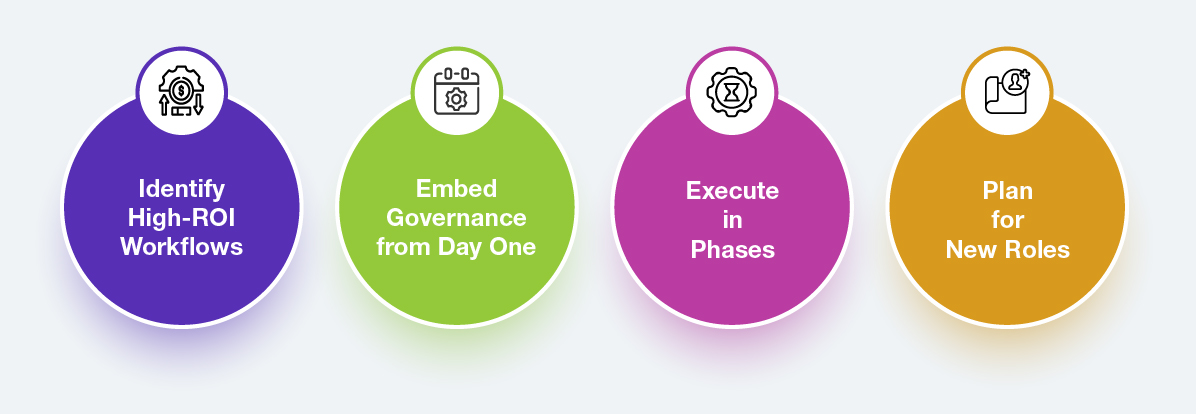
Step 1 – Identify High-ROI Workflows: Focus on internal administration functions such as IT, HR, and accounting, where 52% of agents deploy. McKinsey research found that 40% of workflows include tasks that are too complex or uneconomical for humans to perform, but agents can handle them at scale.
Step 2 – Embed Governance from Day One: Establish clear ownership with dedicated governance structures. Define guardrails and human-in-the-loop thresholds. Gartner predicts that 70% of AI apps will use multi-agent systems by 2028, requiring sophisticated governance frameworks.
Step 3 – Execute in Phases: Phase 1 (Months 1-3): Pilot in one high-impact process.
Phase 2 (Months 4-8): Expand to 3-5 additional workflows focused on administrative functions.
Phase 3 (9-12 months): Full enterprise integration with continuous optimization
Step 4 – Plan for New Roles: 28% of managers are considering hiring AI workforce managers to lead hybrid teams of people and agents. 32% plan to hire AI agent specialists within the next 12-18 months. Budget for training existing IT teams and building internal expertise. Partner with agentic AI solution providers for implementation support.
What ROI Metrics Matter Most to Your Board?
Define Your KPIs Early: Track time-to-task-completion reduction, cost per process, error rates compared to manual processes, revenue impact, customer satisfaction, and SLA improvements.
Success Factor: High-performing companies that treat AI as a catalyst to transform their organizations and redesign workflows are seeing better outcomes. AI high performers are three times more likely than their peers to report that they are scaling their use of agents.
Create Visibility: Establish monthly dashboards for C-suite visibility. Provide transparent reporting on wins and lessons learned. Link agentic AI metrics directly to the overall business strategy.
How Straive Helps CIOs Build Agentic AI Roadmaps That Deliver?
By mid-2026, 40% of enterprise applications will embed task-specific AI agents. Most organizations today lack the governance frameworks, infrastructure readiness, and vendor partnerships to move that quickly. The gap between what the market demands and what most CIOs can deliver has never been wider. This is where the right partner becomes essential.
Where Does Straive Help?
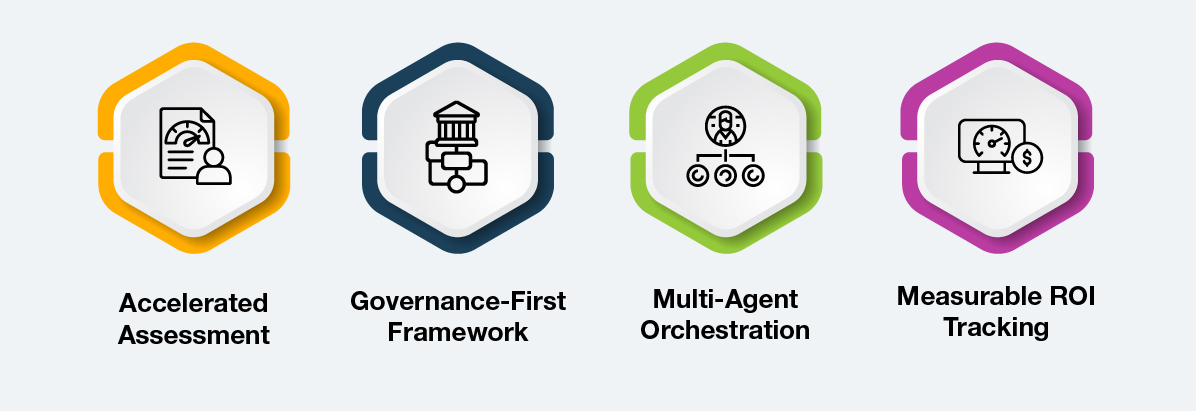
Accelerated Assessment: Identify high-ROI automation opportunities across your enterprise application stack without months of discovery.
Governance-First Framework: Embed compliance, guardrails, and observability into agentic AI deployments from day one, avoiding the pilot-purgatory problem.
Multi-Agent Orchestration: Move beyond scattered pilots to integrated, enterprise-grade AI agent systems that scale across IT, finance, and customer-facing operations.
Measurable ROI Tracking: Establish baseline metrics and continuous visibility into agent performance, cost savings, and business impact. Your board gets a clear line of sight to value.
Why This Matters: Organizations that pair an agentic AI strategy with the right platform and governance foundation are three times more likely to scale successfully. This positions CIOs as architects of enterprise transformation, not just technology enablers.
The infrastructure you build now determines whether your organization leads or follows over the next three years. The question is not whether to adopt agentic AI. The question is whether you will lead the transition or spend the next two years catching up.

Straive helps clients operationalize the data> insights> knowledge> AI value chain. Straive’s clients extend across Financial & Information Services, Insurance, Healthcare & Life Sciences, Scientific Research, EdTech, and Logistics.


