
Posted on: January 9th 2025
Importance of Customer Experience in 2026
If the past decade was defined by digital transformation, 2026 is being defined by something far more human: experience transformation. Companies can no longer rely solely on digitized workflows or modern platforms. The deeper question is: How does our brand make people feel each time they interact with us?
What customers expect today is radically different from what they expected even three years ago. The increasing saturation of digital interactions—across retail, banking, entertainment, education, healthcare, and every imaginable service—has normalized a world where convenience is assumed and friction is a sign of neglect. A single disruptive, intelligently designed experience—such as a smooth tele-appointment—can quietly elevate what people expect from banking support or insurance claims.
This cross-pollination of standards has made customer experience far more consequential. It is no longer a differentiator; it is the very surface on which every competitive battle is fought. When experiences are seamless, predictable, emotionally considerate, and personalized, customers stay longer, buy more, and advocate more strongly. When experiences fall apart, they do not always complain—they simply leave.
By 2026, the relationship between experience and value creation has become deeply measurable. Companies that once depended on brand equity, market position, or distribution advantages are discovering that their fortunes rise and fall with their ability to reduce effort, simplify journeys, and signal respect for customers’ time. The loyalty that once took years to build can evaporate after a single poor interaction.
Three forces are amplifying this reality:
- Digital-first behavior is now universal. Even segments once considered digitally hesitant—older consumers, B2B buyers, regulated industries—now rely on digital touchpoints as their primary interface, not as an extension of the physical experience.
- Data abundance has collided with data fragmentation. Organizations are swimming in data yet starving for insight. Only companies that unify these sources into continuous customer narratives can unlock meaningful advantage.
- Intelligent systems have raised expectations. Customers now expect context-aware recommendations, responsive guidance, and journeys that feel personalized without being invasive. Their tolerance for unnecessary complexity is virtually zero.
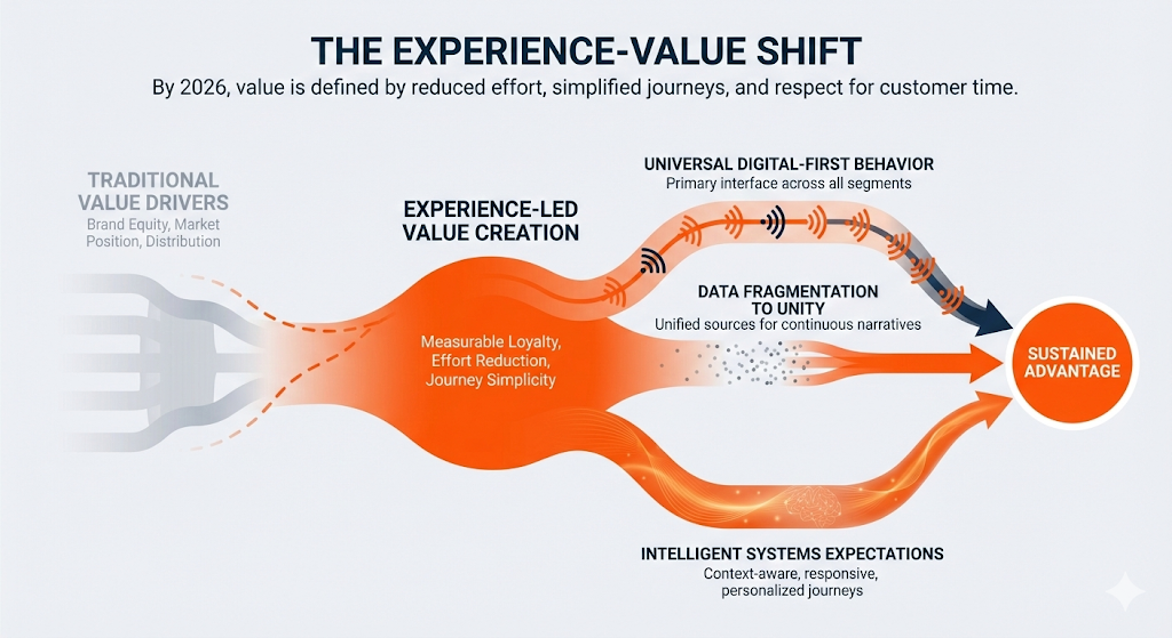
To respond, enterprises are embracing experience ecosystems—integrating data, automation, content operations, analytics, and human-centered design. Straive enables this shift by transforming data at scale, automating knowledge workflows, powering insight-driven decisions, and orchestrating delightful experiences with AI operationalization.
In 2026, CX is no longer a stated priority but a built capability, designed deliberately from the inside out.
Five Behavioral Shifts Fueling the Change in Consumer Expectations
Understanding CX in 2026 starts with understanding the people shaping it. Consumers today are more discerning, more context-aware, and more sensitive to emotional cues in digital interactions.
The desire for personalization has evolved into something more sophisticated. Customers no longer want “targeted messaging.” They want interactions that feel as though the brand genuinely understands them: their needs, their preferences, their frustrations, their pace. When a digital journey reflects who they are—not who a generic segment says they are—they feel seen. When it does not, the experience becomes forgettable or irritating.
At the same time, personalization has boundaries. Customers expect relevance, not intrusion. They want clarity about how their data is being used and expect brands to avoid assumptions that feel presumptuous or invasive. In 2026, thoughtful personalization is about earning trust, not demonstrating technological cleverness. As customers grow used to experiences that feel tailored, they also start to expect the intelligence behind them to be calm, transparent, and reliable.
In this context, AI has become an equally defining expectation. Customers do not explicitly ask for AI; they ask for experiences that simply work. They want faster resolutions, clearer guidance, and minimal repetition. They appreciate chat interfaces that can understand context, but they resent automation that lacks nuance. A bot that recalls previous queries feels intelligent; a bot that simply repeats scripted prompts feels tone-deaf. They want AI that enhances the human experience, not AI that impersonates it poorly.
There is also a growing appreciation for transparency. Customers want to know why they are seeing a recommendation or why a system has taken a particular decision. Clear explanations strengthen trust; opacity weakens it.
Analytics is the quiet force behind these expectations. Customers have learned implicitly that brands “should know better” when something goes wrong. If an organization has access to years of interactions, behavior patterns, and feedback, why does a customer still need to repeat the same information? The issue isn’t intent—it’s architecture. Companies with fragmented systems cannot deliver connected experiences. Organizations with unified, enriched data foundations can.
In short, in 2026 customers want journeys that feel personal, intelligent, and emotionally grounded. They want the benefits of advanced technology without the coldness that often accompanies it. And above all, they want the sense that the company understands them—not statistically, but meaningfully.
Emerging Customer Experience Management Trends in 2026
Across industries, several trends are defining the next era of customer experience. These are not fads; they are structural shifts in how organizations organize themselves around their customers.
Predictive Experience Crafting Becomes Standard
Predictive analytics is reshaping experience design from the ground up. Instead of reacting to problems, organizations can foresee them. Usage patterns signal when customers may need guidance. Drop-offs signal where journeys might fail. Subtle behaviors reveal friction before frustration emerges.
This proactive posture creates experiences that feel intuitive. Customers do not always know what they need next—but they recognize when a brand anticipates it.
Hyper-Relevant Personalization at Every Layer of the Journey
Personalization in 2026 is not just a marketing capability. It influences onboarding pathways, content formats, support flows, renewal cycles, and even tone. Two customers buying the same product may experience entirely different journeys based on preference and behavior.
The sophistication lies not in technology alone but in the organizational discipline needed to sustain personalization—structured data, well-governed taxonomies, dynamic knowledge operations, and responsive content systems. Straive’s strength in processing and contextualizing data at scale underpins this evolution.
The Rise of Customer Experience Operations (CXOps)
Customer experience is becoming an operational discipline in its own right. CXOps teams ensure that experience strategies move from planning to practice. They design and govern journeys, shape measurement frameworks, coordinate with product and service teams, and maintain journey integrity across departments.
For the first time, CX is not being “owned” by one team but “operated” across the organization with clear accountability.
B2B Customer Experience Turns Strategic
B2B organizations are realizing that experience excellence is not just a consumer expectation—it is a commercial advantage. Enterprise clients increasingly prefer partners who reduce complexity, anticipate risks, and communicate with clarity.
Relationship intelligence—integrating contract data, usage insights, service trends, project histories, and communication patterns—allows providers to be proactive rather than reactive. A partner who surfaces concerns early or recommends improvements before issues arise builds trust that pricing alone cannot replicate.
Holistic Digital Transformation Anchored in Experience
Digital transformation in 2026 is no longer about “going digital.” It is about making digital meaningful. Experience-first transformation requires simplifying workflows, redesigning interfaces, integrating content, and reducing effort.
This shift brings technology, operations, data, and design together in a shared mission. It also elevates the role of content intelligence and workflow automation—areas where Straive’s expertise helps organizations build digital ecosystems that reflect human needs.
Emotionally Aware Experience Design
Organizations are finally acknowledging that emotional design is not “soft.” When customers feel respected, guided, reassured, or valued, they stay. When they feel confused or abandoned, they leave.
Emotion-aware interaction design—empathetic language, supportive feedback messages, context-sensitive flows, and transparent error handling—turns digital experiences into something human. Over time, these emotional cues accumulate into a felt sense of reliability and care that no campaign can manufacture.
How Businesses Can Stay Ahead in Customer Experience
Staying ahead in 2026 requires treating customer experience not as a quarterly initiative but as a long-term organizational discipline. CX leadership comes from operating experience as a core business system, grounded in clarity, data, execution, empowered teams, and agility.
The starting point is a clearly defined experience promise. Every organization must articulate the type of experience it wants customers to remember—reliable, fast, intuitive, empathetic, personalized, or effortless—and ensure every function knows how their work shapes that promise. When competing decisions arise, the experience promise becomes a filter for prioritization. It keeps teams aligned and prevents well-intentioned initiatives from drifting away from what customers actually value.
From there, the foundation of any modern customer experience strategy is data. High-quality CX performance depends on high-quality data: unified, structured, enriched, and continuously maintained. Without a strong data layer, companies cannot deliver meaningful personalization, predictive support, or journey intelligence. This is where Straive’s strengths in data transformation, content structuring, and AI-enabled enrichment provide a significant advantage.
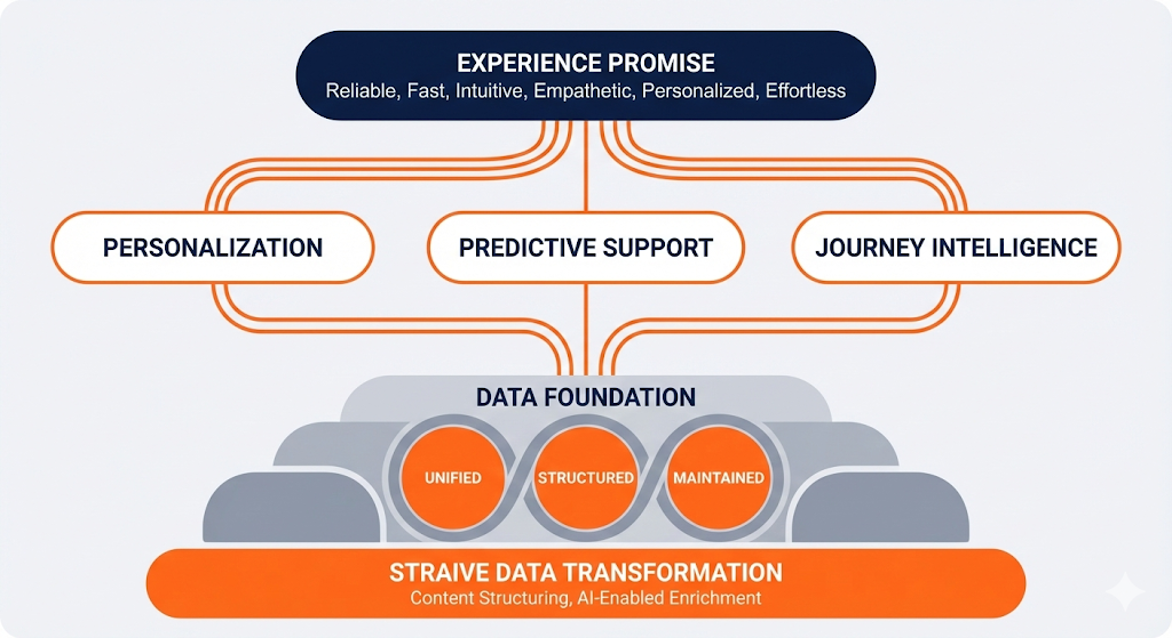
With cleaner, richer customer data, organizations can shift from reactive problem-solving to proactive, insight-driven decision-making—essential for any advanced CX program.
But insight alone is not enough. Execution is what distinguishes CX leaders from the rest. Journey maps, analytics dashboards, and customer insights only have value when they translate into simplified processes, refined content, improved workflows, and better service design. This requires clear governance, dedicated journey owners, and a commitment to continuous iteration in CXOps and training pedagogy.
The most successful organizations manage their customer journeys the same way they manage products—constantly optimizing them based on evidence, not assumption.
Employee experience also plays an important role. Teams who speak to customers daily—support agents, operations teams, sales representatives—hold some of the most valuable real-world insight into customer frustration and delight. Empowering them with unified knowledge, streamlined tools, and opportunities to contribute to journey improvements strengthens the entire experience ecosystem. A disjointed internal experience will always spill into the external one.
Finally, agility is essential. Customer expectations in 2026 are not static. They shift with new technologies, new digital behaviors, and new competitive benchmarks. Organizations that revisit their journeys often, encourage curiosity, and welcome feedback are far better positioned to stay relevant. The companies that consistently excel are not those that aim for perfection; they are the ones that learn fast, respond fast, and evolve fast. In modern CX, adaptability is a competitive advantage in its own right.
By combining a clear CX vision, strong data foundations, disciplined execution, empowered teams, and an agile mindset, businesses can stay ahead of rapidly rising expectations—and build the kind of intelligent, human-centered experiences that define market leaders in 2026.
Conclusion – CX Management Trends in 2026
Customer experience in 2026 is defined by a fusion of intelligence and empathy. The trends shaping this year—predictive journeys, dynamic personalization, CX operations, relationship intelligence, experience-first digital transformation, and emotional design—are all signals of a deeper transformation in how organizations relate to the people they serve.
What makes this moment different is that CX is no longer something that can be delegated to a single team or confined to a specific phase of the journey. It is threaded through strategy, product design, service delivery, support models, data architecture, and even the way internal teams collaborate. Experience has become the connective tissue of the modern organization.
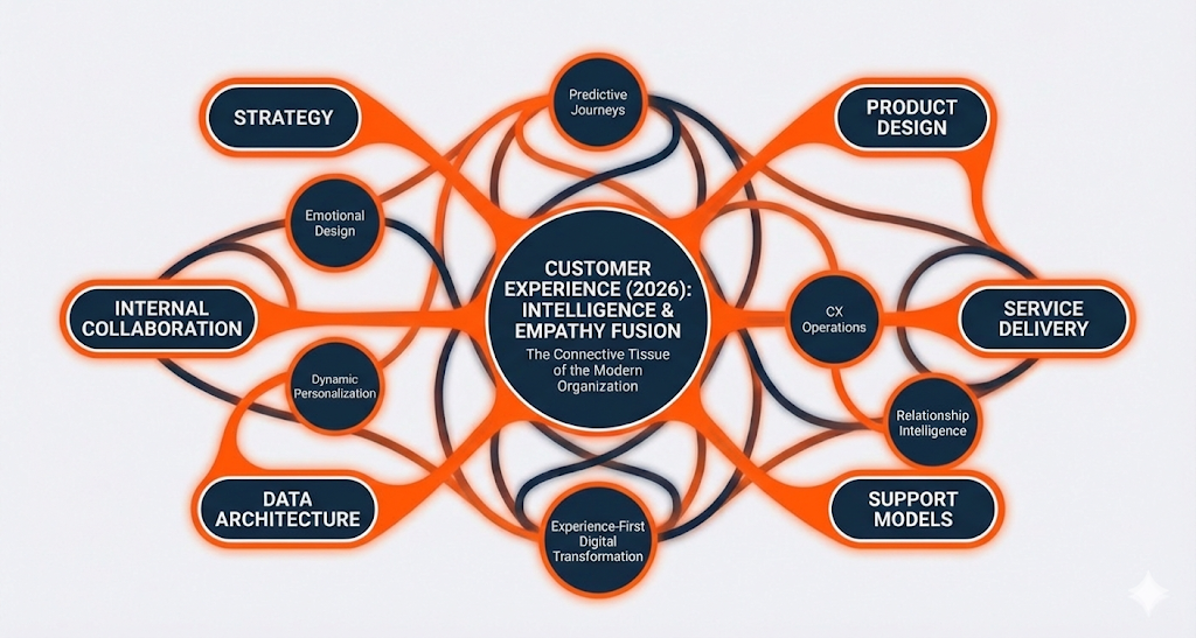
For leaders, this demands a shift in mindset. The question is no longer “What can we do with our technology?” but “What kind of relationship do we want with our customers, and how should our technology, data, and operations serve that?” When decisions are anchored in this question, trends become easier to navigate. Predictive analytics becomes a way to care proactively. Automation becomes a way to respect people’s time. Personalization becomes a way to acknowledge individuality, not to narrow choice.
It is also a moment of accountability. Customers are finely tuned to insincerity. A brand that talks about being customer-centric but structures its processes in ways that create friction quickly loses credibility. Conversely, a brand that quietly and consistently removes obstacles, clarifies journeys, and listens with intent earns a kind of loyalty that cannot be reverse-engineered at the last minute.
Looking across these CX management trends, one theme stands out: organizations that succeed are those willing to see experience not as a veneer, but as architecture. They invest in foundations—data, content, operations, design thinking—and they accept that experience excellence is never “done.” It is a practice, refined day after day, interaction after interaction.
In a marketplace where products are quickly replicated and information is abundant, the quality of experience is becoming the most sustainable form of differentiation. The brands that internalize this in 2026 will set the pace for the decade ahead.
Straive’s Approach to Next-Generation CX
Customer expectations will continue to rise, journeys will continue to evolve, and the most successful organizations will be those that build intelligent, human-centered experience ecosystems. Straive’s AI-powered CX capabilities bring together data intelligence, content and knowledge operations, automation, and journey optimization to help businesses modernize their customer experience with clarity and confidence.
Explore Straive’s approach to next-generation CX:
https://www.straive.com/ai-customer-experience/

Priya Roy is the Vice President of Delivery Leadership at Straive, driving operational excellence and transformative client solutions. She brings deep expertise in managing large-scale customer experience and technology programs.


