
Posted on: September 28th 2026
Enterprises continue to invest heavily in AI models and use cases. Yet turning those investments into reliable business performance depends on something less visible: the enterprise knowledge that supports the AI.
How this knowledge is structured and governed determines what AI can know, which sources it can trust, what content it is permitted to use, and which actions it can take.
In many organizations, this knowledge is scattered across contracts, manuscripts, spreadsheets, emails, databases, repositories, and legacy platforms. Definitions vary across teams, multiple versions coexist, and ownership and usage rights are often unclear.
Experienced employees know how to navigate this complexity. They understand which policy applies, which terminology is outdated, and which source is authoritative. AI does not gain that judgment simply by accessing enterprise content.
Unless these distinctions are made explicit, AI may retrieve outdated policies, combine incompatible sources, or present unverified claims as established evidence. Better prompts and more capable models may improve performance, but they cannot resolve unclear meaning, authority, context, rights, or provenance.
The systems that organize and govern enterprise knowledge are therefore no longer technical groundwork. They are essential business infrastructure, especially as AI moves beyond generating answers and begins taking action across enterprise workflows.
Agentic AI Changes the Economics of Error
As AI gains greater autonomy, the consequences of unreliable knowledge increase.
A chatbot produces a response that an employee can review, revise, or reject. An AI agent can retrieve information, interpret evidence, recommend a decision, update a system, and trigger subsequent actions with limited intervention.
In these workflows, one output becomes the input for the next action. An outdated licensing term, for example, could lead an agent to apply an expired or incorrect usage right and distribute content beyond the scope of the organization’s license.
Each output can inform the next step in an agentic workflow. As a result, an initial mistake can spread through the workflow and lead to flawed business decisions or actions with commercial, regulatory, and reputational consequences.
Greater autonomy increases both the reach and potential cost of an error. A flawed assumption can spread across connected workflows before anyone detects it. A successful pilot may demonstrate performance under controlled conditions, but it cannot establish that the system will remain dependable as content changes, regulations evolve, systems interact, and unfamiliar exceptions emerge.
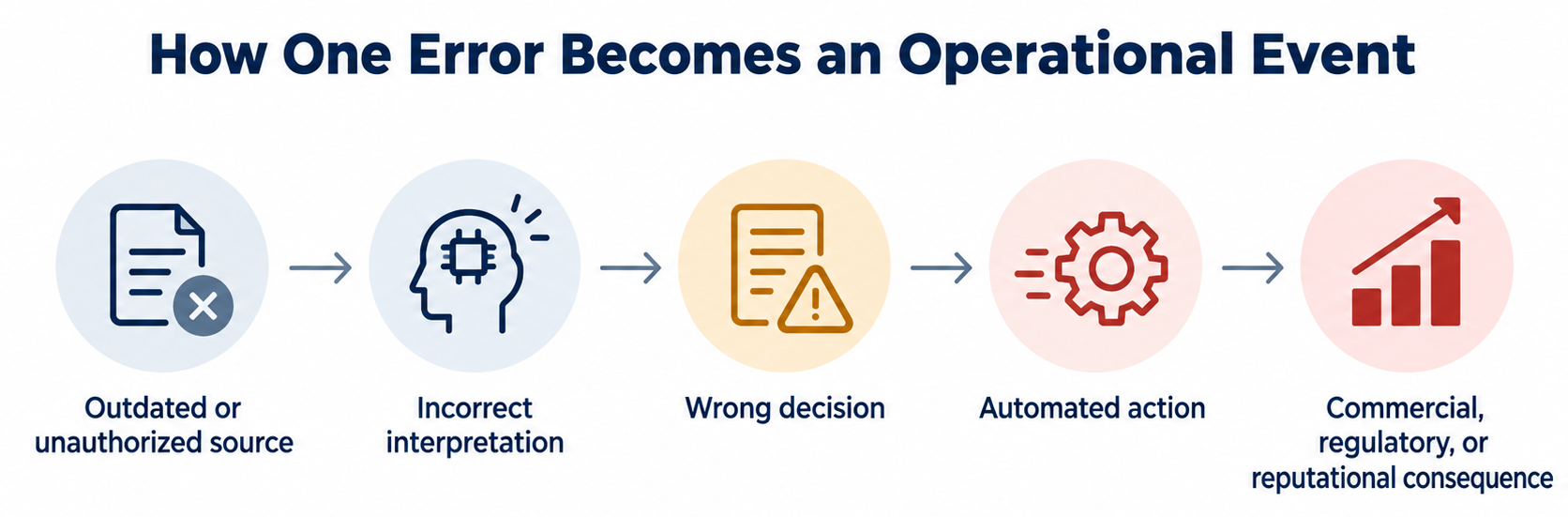
Figure 1:How an unverified source can propagate through an agentic workflow, turning a single error into a commercial, regulatory, or reputational consequence.
When an AI system makes a flawed decision or takes an incorrect action, the organization must be able to determine what went wrong. It should be able to trace what the system knew, which sources it used, what rules it applied, and why it acted. Without this evidence, teams cannot investigate errors, establish accountability, or prevent the problem from recurring.
The system may appear capable, but it cannot be considered reliable in real-world operations. Reliability requires traceability and controls to be built into the workflow from the outset.
Trust Must Be Engineered into the Workflow
Enterprise trust cannot depend on employees reviewing every AI-generated output, decision, or action. Reliability must be built into the knowledge, rules, permissions, and controls that govern each workflow. Doing so requires four core capabilities.
1. Structure knowledge around decisions
Giving AI access to more content does not automatically produce better decisions. Without clear authority, context, usage rights, and relationships, greater access can increase the likelihood of retrieving outdated, restricted, or unverified information.
A trusted knowledge foundation gives AI applications a shared source of governed information. This improves decision quality, reduces the risk of inappropriate use, and avoids rebuilding the same data and controls for every use case.
The result is not simply better retrieval. It is safer and more economical AI scaling.
2. Make decisions traceable
Organizations cannot trust consequential AI recommendations or actions unless they can trace how the system reached them. They must know what information shaped each outcome and confirm that the information was current and authorized for use.
A citation alone does not provide this assurance. Enterprises need provenance that connects each outcome to its sources, ownership, usage rights, and relevant changes.
In an operational AI environment, provenance is a business control. It makes AI-enabled decisions easier to verify, defend, reproduce, and correct when necessary.
3. Apply governance before action
Most enterprises already have policies covering data access, content rights, regulatory risk, and critical decisions. The problem is that these policies often sit outside AI workflows and depend on employees to interpret and apply them manually.
Effective governance converts policy into controls that determine what AI can access, generate, recommend, and execute. It also establishes when human approval or expert escalation is required.
Governance applied after an output supports review. Governance embedded in the workflow prevents unacceptable actions before they create business consequences. This gives the organization confidence that AI will operate within defined boundaries.
4. Direct human judgment where it matters most
Human oversight should be proportional to business risk, not applied uniformly to every AI output. Reviewing every AI-generated output and action adds cost and delay while diverting experts from decisions that require their judgment.
Experts create greater value by defining source priorities, confidence thresholds, escalation rules, and controls for consequential decisions. Their judgment can then be embedded into workflows and reused across the enterprise.
AI handles routine decisions at speed and scale, while experts focus on ambiguity, exceptions, and high-impact outcomes. This approach builds trust by ensuring that human judgment is applied where the consequences are greatest, without undermining the economics of automation.
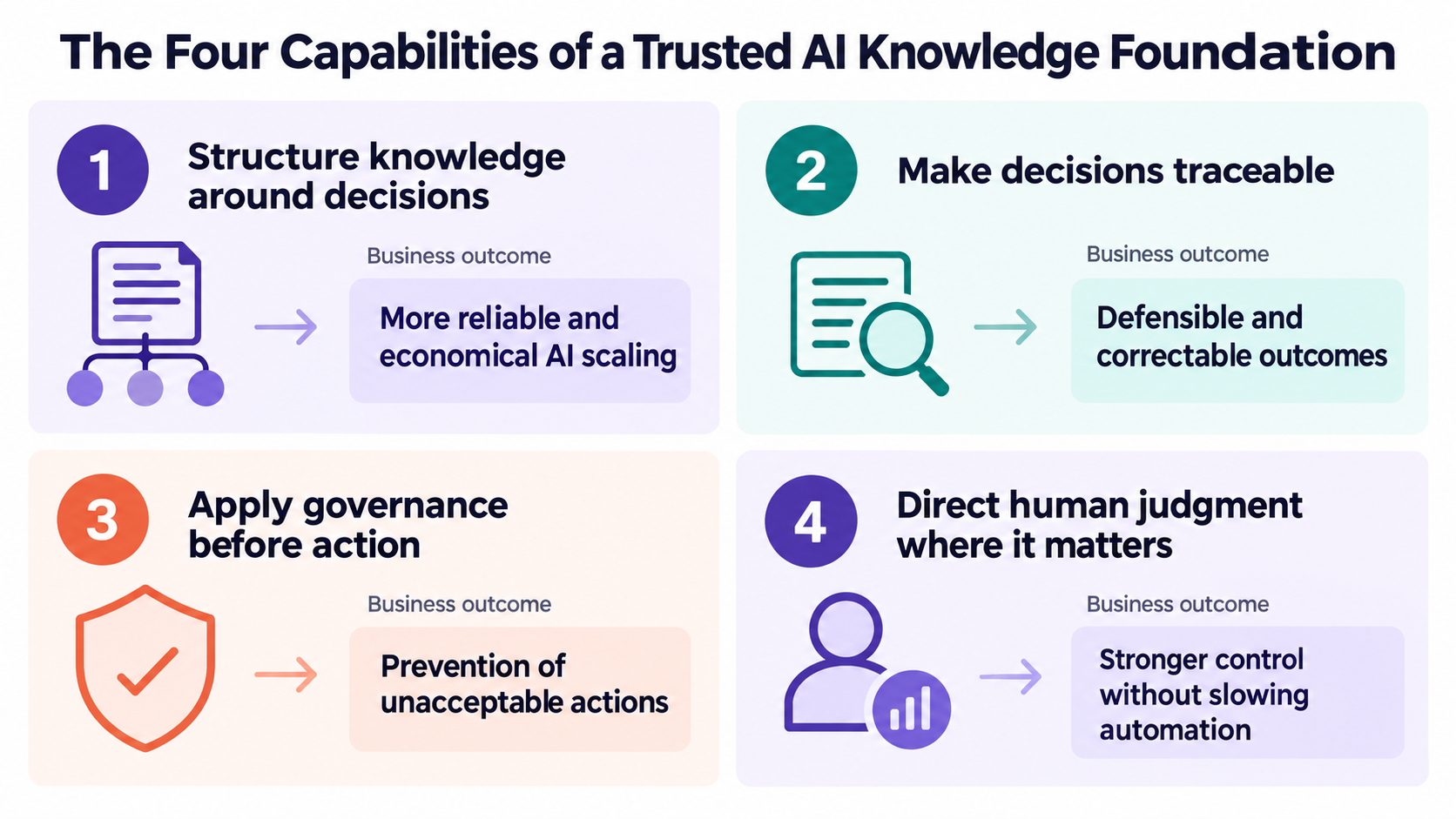
Figure 2: Four capabilities that make an AI knowledge foundation reliable, traceable, governed, and scalable.
Building Trust Requires Executive Ownership
Traceability, embedded governance, and risk-based human oversight do not emerge from technology alone. They require enterprise-wide decisions about ownership, accountability, investment, and acceptable levels of AI autonomy.
Executive leadership must determine which information carries authority, how usage rights are enforced, who is accountable for outcomes, and how much autonomy is appropriate for each workflow.
This does not mean cleansing and restructuring every information asset before operationalizing AI. Not every document warrants equal investment, just as not every workflow carries the same value or risk.
Investment should begin with the knowledge supporting high-value, high-frequency, or high-risk decisions. The underlying systems and controls can then expand as the organization gains measurable value, confidence, and operational insight.
This targeted approach turns knowledge modernization into a prioritized investment program rather than an enterprise-wide remediation effort. Funding can focus on the information and controls with the greatest effect on revenue, cost, risk, customer outcomes, or strategic speed.
Progress must also be measured differently. The number of pilots or models deployed says little about enterprise readiness. More meaningful indicators include decision reliability, rights compliance, traceability, escalation rates, and reductions in avoidable expert review.
These measures show whether AI is earning trust and improving business performance, not merely producing impressive demonstrations.
Competitive Advantage Is Moving Below the Model
Models will continue to become faster, more capable, and less expensive. As similar capabilities become widely available, model selection alone will provide little lasting differentiation.
Competitive advantage will increasingly come from the proprietary knowledge AI can access, the context it understands, and the actions it is authorized to take.
Enterprises that organize their knowledge and preserve its provenance create a more reliable basis for AI. By embedding governance and converting expert judgment into reusable rules, they can scale AI with greater speed, confidence, and control.
They can also improve performance over time. Each decision, exception, and expert intervention provides insights that can strengthen future workflows.
Organizations without these capabilities may automate more activity without making better decisions. They risk allowing weak assumptions to move through the enterprise with greater speed and reach.
The central question is no longer simply which model to choose. Organizations must determine whether their AI can distinguish what is current, authoritative, permitted, and appropriate. They must also be able to verify how the system reached its decisions.
As AI becomes more agentic, trusted knowledge, embedded governance, traceable decisions, and targeted expert oversight will determine whether an enterprise merely automates more activity or improves decision-making at scale.

Straive helps clients operationalize the data> insights> knowledge> AI value chain. Straive’s clients extend across Financial & Information Services, Insurance, Healthcare & Life Sciences, Scientific Research, EdTech, and Logistics.


