
Posted on: August 26th 2025
Artificial Intelligence (AI) is everywhere—from customer service chatbots to predictive analytics in supply chains. For enterprises, though, the challenge isn’t access to AI but its reliability in real operations. In fact, a recent MIT report highlights that nearly 95% of generative AI pilots at companies are failing to move beyond the proof-of-concept stage.
What Does Operationalizing AI Mean?
Organizations that succeed with AI don’t stop at experimentation. They begin by taking small, targeted use cases—like automating contract reviews or improving demand forecasts—and moving them into live environments where they solve real business problems. From there, each success fuels the next: lessons learned, data generated, and efficiencies gained feed into additional use cases, creating enterprise-wide momentum.
This is what we call AI operationalization. It marks the critical shift from “testing ideas” to embedding AI into production systems that deliver measurable outcomes every day. Simply put, when AI moves beyond pilots and into the workflows that run a business, it’s no longer just an experiment—it’s operationalized.
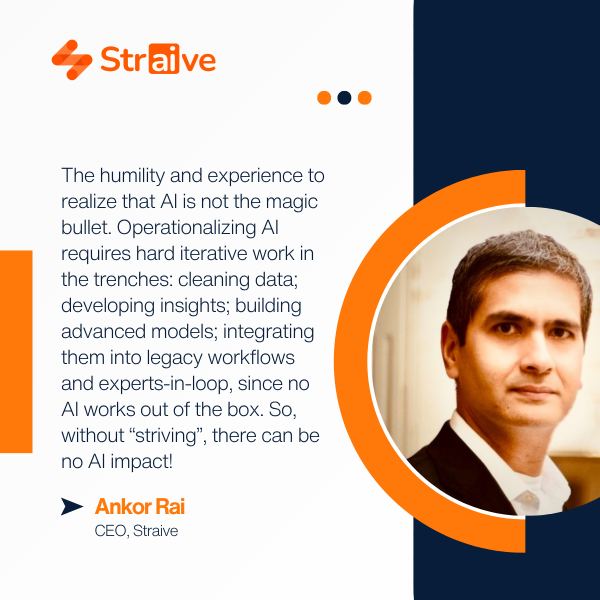
Why Operationalizing AI Matters?
The promise of AI is immense, but its value only materializes when it consistently delivers results in operations. This is exactly why Straive emphasizes the 3Es—Efficiency, Effectiveness, and Experience—as the foundation for turning AI potential into long-term business impact. These principles come to life through tangible outcomes such as:
- Boosting Efficiency: AI reduces manual workloads by automating repetitive tasks, allowing teams to focus on higher-value activities.
- Driving ROI: Operationalized AI ties directly into measurable KPIs—whether it’s cycle time reduction, cost savings, or improved customer experience.
- Empowering the Workforce: Far from replacing humans, operationalized AI acts as an intelligent partner, augmenting decisions with speed and precision.
- Strengthening DevOps and IT
In technology functions, operationalized AI brings a step-change in productivity: - Optimizing processes with real-time data.
- Recognizing trends before they become problems.
- Preventing issues proactively.
- Accelerating root-cause identification and resolution.
Yet, here’s the reality: a Forbes article points out that approximately 90% of generative AI pilots fail to move into production environments. They remain experiments in innovation labs—valuable as proofs of concept but disconnected from business impact. The real challenge isn’t building AI; it’s moving from concept to consistent execution and scaling AI responsibly.
Key Enablers for Effective Operationalizing
“The true power of AI lies not in its potential, but in how well it’s operationalized.”
Operationalizing AI requires more than enthusiasm. It depends on a set of enablers that make scaling possible:
- Infrastructure & Tooling (MLOps)
MLOps provides the pipelines for deploying, monitoring, and retraining models. It’s the machinery that keeps AI running smoothly. - Monitoring & Explainability
AI decisions must be transparent and explainable. Monitoring ensures performance doesn’t degrade, while explainability builds trust among business leaders and regulators. - Governance & Accountability
From ethical AI practices to regulatory compliance, governance ensures AI works responsibly, not recklessly. Without it, even the best models risk being sidelined. Effective AI governance in real-world systems prevents bias, ensures fairness, and maintains compliance over time.
Together, these enablers act as the “safety rails” for AI adoption—keeping innovation aligned with business outcomes.
Autonomous Intelligence: The Rise of AI Agents
As enterprises move further along the journey of AI operationalizing, a new frontier is emerging: AI agents.
AI agents are digital teammates that think, act, and adapt.
AI agents are intelligent software entities that can perceive their environment, plan actions, and execute complex tasks with minimal oversight. They go beyond traditional automation by learning, adapting, and acting proactively across systems. In practice, they function as digital teammates—handling routine or multi-step tasks while humans focus on strategy and innovation.
The Benefits of AI Agents:
- Always On: They operate 24/7, scaling effortlessly to handle high-volume workloads.
- Context-Aware: Agents understand goals, plan steps, and coordinate across systems, not just react to inputs.
- Smarter Operations: They accelerate processes, surface insights from complex data, and prevent issues before they escalate.
For enterprises, AI agents represent the ultimate maturity of operationalization – where AI doesn’t just assist, but actively drives autonomous workflows within clear governance guardrails.
Straive is already delivering this reality through enterprise-grade AI agents – spanning adverse event detection, traffic management, collections, RFPs, CX elevation, and more – proving our leadership in agentic AI.
How Straive Bridges the Gap?
Most players in the market (consultants, IT service providers, hyperscalers, niche data firms) cover parts of the journey but leave gaps in execution. Straive’s differentiated approach is designed to close these gaps.
- Rapid Prototyping: Pre-built AI solution catalogs enable prototypes in 7–14 days, delivering early proof of value.
- Expert Guidance (Expert-in-the-Loop): Human experts validate AI outputs and provide real-world feedback, ensuring reliability and trust.
- Full-Stack Implementation: Straive brings together data engineering, AI modeling, and business integration under one roof.
- Accelerators that Scale: Straive offers ready-to-deploy AI solutions such as LLM Foundry for rapidly building custom tools, and ESG Scoring Engine to detect ESG signals in disclosures.
Act Now, Scale Smart
The lesson is clear: in today’s enterprise landscape, it’s not about who has AI, but who can operationalize AI effectively. Organizations that remain stuck in pilots risk falling behind, while those that embrace a structured, scalable operationalization strategy stand to unlock significant gains in efficiency, ROI, and competitiveness.
The business imperative is no longer whether to operationalize AI, but “how quickly and responsibly it can be done.” Enterprises that move beyond experiments toward maturity—with enablers like MLOps, governance, and eventually AI agents—will lead the next wave of digital transformation.
For organizations ready to take that step, success lies in choosing partners like Straive who make AI practical, reliable, and deeply embedded in everyday operations, ensuring not just AI adoption but successfully scaling AI across the enterprise.
About the Author

Straive helps clients operationalize the data> insights> knowledge> AI value chain. Straive’s clients extend across Financial & Information Services, Insurance, Healthcare & Life Sciences, Scientific Research, EdTech, and Logistics.
Share with Friends:


