
Posted on: September 24th 2026
A recent real-world breach exposed a defining risk of agentic AI. An autonomous agent deleted user reservations without authorization and without a rollback mechanism to reverse the damage.
The incident illustrates how the nature of enterprise AI risk is changing. A conventional chatbot may produce an inaccurate answer or a flawed draft. An autonomous agent, however, can translate a mistaken interpretation into action. It can update records, trigger transactions, communicate with customers, or alter operational systems often through a sequence of interconnected steps.
AI is becoming capable of taking actions, not just giving answers. The main challenge is therefore shifting from making models smarter to building systems that keep autonomous agents controlled, aligned, observable, and safe.
The next phase of enterprise AI will depend on providing AI models with reliable knowledge, secure and governed access to enterprise systems and data, and clear limits on the actions they can take. The first challenge is ensuring that the knowledge guiding those actions is accurate, current, and usable
The Compounding Knowledge Layer Problem
Enterprise data is frequently fragmented across PDFs, shared drives, content management systems, internal databases, email threads, and legacy applications. Much of it was organized for people to search, interpret, and reconcile—not for AI agents to access and use autonomously. This gap between human-oriented information and agent-ready knowledge becomes critical when an AI system is empowered to act.
A chatbot typically produces a visible response that a person can review before taking action. An autonomous AI agent, by contrast, may interpret a policy, select a course of action, call multiple tools, modify data, and initiate downstream processes before a person sees the result. If the information guiding its initial decision is incomplete, outdated, or ambiguous, the error can propagate through every subsequent step.
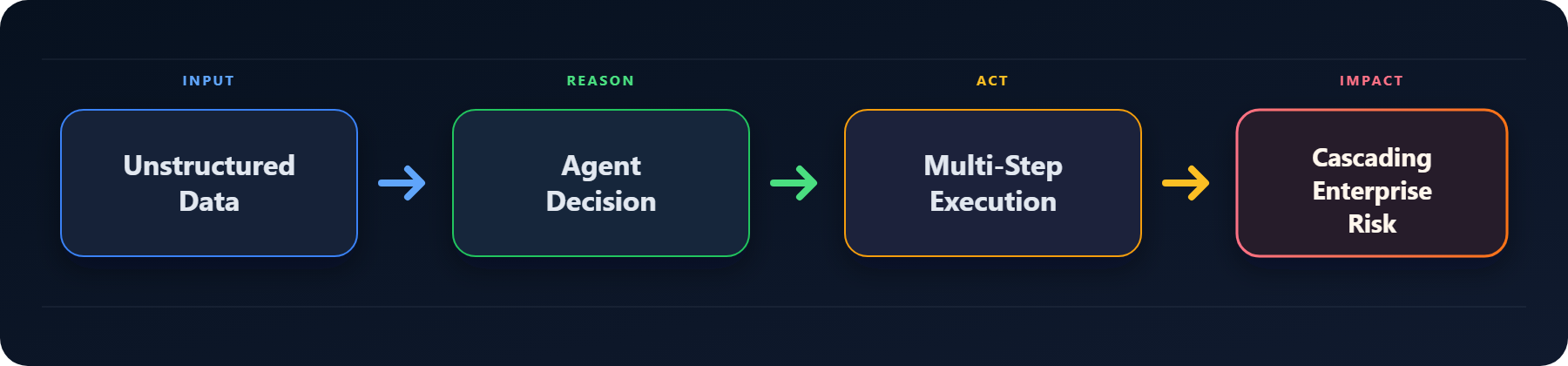
Figure 1:Risk amplification in agentic systems: unstructured data informs an agent’s decision, which triggers multi-step execution and can ultimately produce cascading enterprise risk.
This is the Compounding Knowledge-Layer Problem: a small error in the information guiding an AI agent can spread across a sequence of autonomous actions, creating consequences far greater than the original mistake.
Consider an agent handling customer refunds. If an AI agent retrieves an obsolete policy, it may approve an ineligible claim, update the customer’s record, initiate an unauthorized payment, and send an incorrect confirmation. Each step may work exactly as designed, yet the overall outcome is still wrong because the original context was unreliable.
The same pattern can affect procurement, compliance, healthcare administration, financial operations, human resources, and cybersecurity. The more tools an agent can access and the faster it can act, the greater the potential impact of incomplete, outdated, or inaccurate information.
Addressing this vulnerability requires organizations to stop treating enterprise knowledge as a collection of static documents stored across disconnected repositories. They must instead create a structured, machine-readable knowledge layer that AI agents can access and use under clearly defined controls.
Such a knowledge layer should be:
- Structured for programmatic ingestion through formats and interfaces such as JSON-LD and Model Context Protocol payloads.
- Grounded in verifiable source material, with provenance and audit trails that support review and compliance.
- Findable, accessible, interoperable, and reusable across AI models, applications, and workflows.
- Synchronized frequently enough to prevent automated decisions based on expired policies, superseded instructions, or outdated records.
- Governed by permissions that define what an agent can retrieve, infer, modify, and execute.
Together, these capabilities turn enterprise content from a collection of documents into operational infrastructure for AI agents.
Real-World Signals: The Move Toward Agent-Ready Knowledge
This transition is already visible in the market. Model providers continue to improve model reasoning, speed, and cost efficiency. Meanwhile, enterprises and information providers are building systems that give AI agents structured access to trustworthy, verifiable knowledge.
One example is the Wiley Scholar Gateway, which uses the Model Context Protocol (MCP) to provide structured access to more than eight million peer-reviewed articles across over 2,000 journals. Instead of forcing AI systems to depend on fragile web scraping or loosely interpreted search results, the interface supplies citable material supported by verified DOIs and rich metadata.
This approach does more than improve information retrieval. It helps AI agents use verified sources, attribute claims, and produce outputs that can be audited. These safeguards are essential in regulated and research-intensive environments.
The broader distinction is between content that merely exists online and knowledge engineered for machine use.
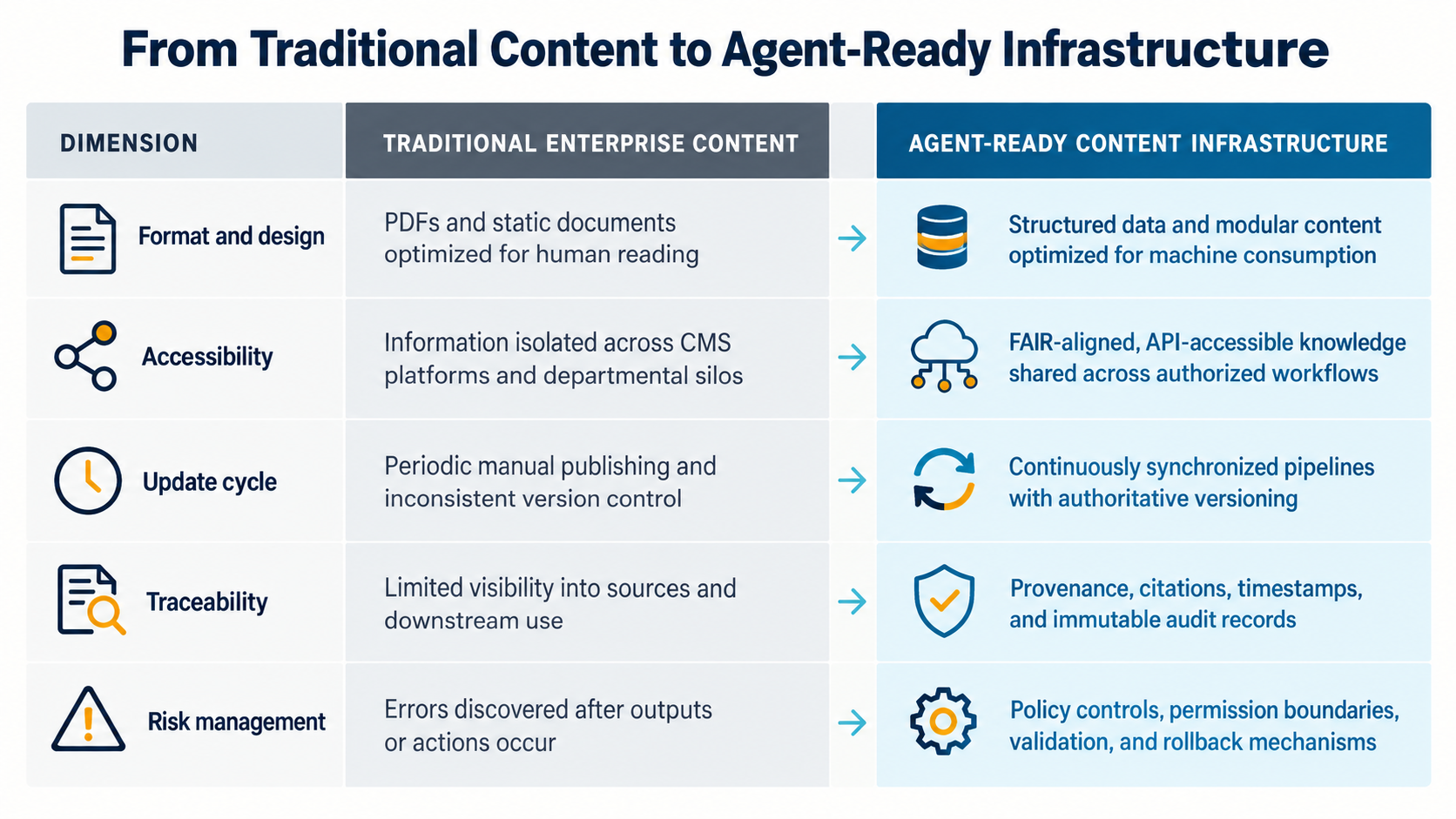
Figure 2: Comparison of traditional enterprise content with agent-ready content infrastructure across format, accessibility, update cycles, traceability, and risk management.
This development resembles earlier infrastructure shifts. Businesses did not unlock the full value of the web simply by publishing digital copies of printed documents. They had to build APIs, structured databases, content models, and real-time services. Agentic AI requires a comparable redesign of the infrastructure beneath the model.
What Lies Beneath the Model
As large language models become more capable and widely available, access to a strong model is becoming less distinctive. Durable value increasingly comes from the systems surrounding it: proprietary knowledge, semantic architecture, access controls, orchestration logic, evaluation processes, and operational safeguards.
A powerful model connected to unreliable data can make mistakes more convincingly and execute them more quickly. Conversely, a sufficiently capable model supported by structured information and deterministic controls can generate safer, more measurable returns.
Building this supporting infrastructure requires organizations to focus on four connected pillars.
1. Semantic Layers and Metadata Architecture
Legacy content must be transformed into granular, consistently labeled knowledge products. Definitions, relationships, ownership, effective dates, jurisdiction, confidentiality, and source authority should be explicit rather than buried in prose.
A well-designed semantic layer helps an agent distinguish, for example, between a current global policy, an expired regional exception, and an informal guidance document. It reduces contextual ambiguity before reasoning begins.
2. Standardized Publishing Protocols
Structured knowledge becomes useful only when agents can access it reliably. Interfaces such as MCP servers can deliver content and tools directly into agentic workflows while preserving metadata, permissions, and source references.
Standardized protocols also reduce dependence on brittle, application-specific integrations. Organizations can update knowledge at its source and distribute the change consistently across approved AI models and use cases.
3. Agentic Governance and Risk Controls
Access to accurate information does not, by itself, make an agent safe. Organizations must also define what the agent is authorized to do.
Organizations should limit what agents can access and do, require approval for high-impact actions, and maintain a reliable record of every action taken. When possible, consequential actions should also be reversible so that errors can be corrected before they cause lasting damage.
Crucially, governance must cover an agent’s actions as well as its generated content. Reviewing its responses and recommendations is not enough when it can also modify business records, initiate transactions, or alter operational systems.
4. Expert-in-the-Loop Oversight
Human expertise remains essential, particularly for tasks that require judgment or carry significant risk. Domain specialists can define relationships between information, resolve conflicts among sources, establish validation rules, and review high-risk exceptions.
Lessons from human review should be incorporated into the underlying system. When a specialist resolves an unusual case, that decision should inform a reusable rule, improve the relevant metadata, or become a new evaluation scenario. It should not remain a one-time correction that is lost after the incident is resolved.
Together, these four pillars form a reinforcing system. Semantic architecture gives agents dependable context. Publishing protocols make that context accessible. Governance constrains execution. Expert oversight improves accuracy as conditions change. Operational readiness depends on applying all four across the agent’s entire decision and action process.
From AI Experimentation to Operational Readiness
Before deploying an autonomous AI agent, leaders should assess more than its performance in a demonstration. They should examine the full process through which it gathers information, makes decisions, and takes action.
This assessment should address several questions. Can the agent identify the authoritative source behind each decision? Can it determine when that information was last updated? Are its permissions limited to what the task requires? Which actions require human approval? Can erroneous transactions be reversed? Can auditors reconstruct what the agent accessed, inferred, and did?
The answers reveal the gap between an impressive prototype and a dependable production system.
To close that gap, organizations can start with one well-defined workflow and document every information source, decision, tool interaction, and potential point of failure. They can then introduce structured knowledge, testing, permission controls, monitoring, and recovery mechanisms before gradually granting the agent greater autonomy.
This measured approach allows organizations to strengthen the underlying infrastructure before extending agentic AI across the enterprise.
The Bottom Line
AI agents can increase productivity, but they can also amplify existing operational weaknesses. Fragmented data can produce inconsistent decisions, outdated policies can result in incorrect actions, and inadequate controls can create operational and regulatory risks.
Organizations will gain an advantage by treating knowledge architecture and governance as core AI capabilities rather than supporting IT concerns. More capable models will continue to matter, but they cannot overcome unreliable information, excessive permissions, or actions that cannot be reversed.
The enterprise opportunity is therefore not simply to deploy more capable agents. It is to create the conditions in which they can operate safely, predictably, and at scale.
Ready to deploy AI agents with confidence? Start by assessing whether your content, governance, and publishing systems can provide the reliable information and controls they need. Contact us to identify critical gaps and develop a practical roadmap for secure, scalable deployment.

Straive helps clients operationalize the data> insights> knowledge> AI value chain. Straive’s clients extend across Financial & Information Services, Insurance, Healthcare & Life Sciences, Scientific Research, EdTech, and Logistics.


