
McKinsey’s 2025 State of AI survey found that 88% of organizations now use AI in at least one business function. Yet only 6% qualify as high performers, capturing meaningful, enterprise-wide financial impact. That gap between widespread adoption and actual returns is not a model problem. It is a data problem.
Unmanaged data, siloed across departments, riddled with duplicates and inconsistently defined, is the quiet saboteur of enterprise AI ambitions. Finance and marketing pull from the same source and arrive at different numbers. AI pilots complete tasks successfully and then fail to scale. Compliance teams discover data assets that no one knew existed. This is what it costs to treat data as a byproduct of operations rather than a strategic asset, and for CXOs making AI investment decisions today, that cost is no longer acceptable.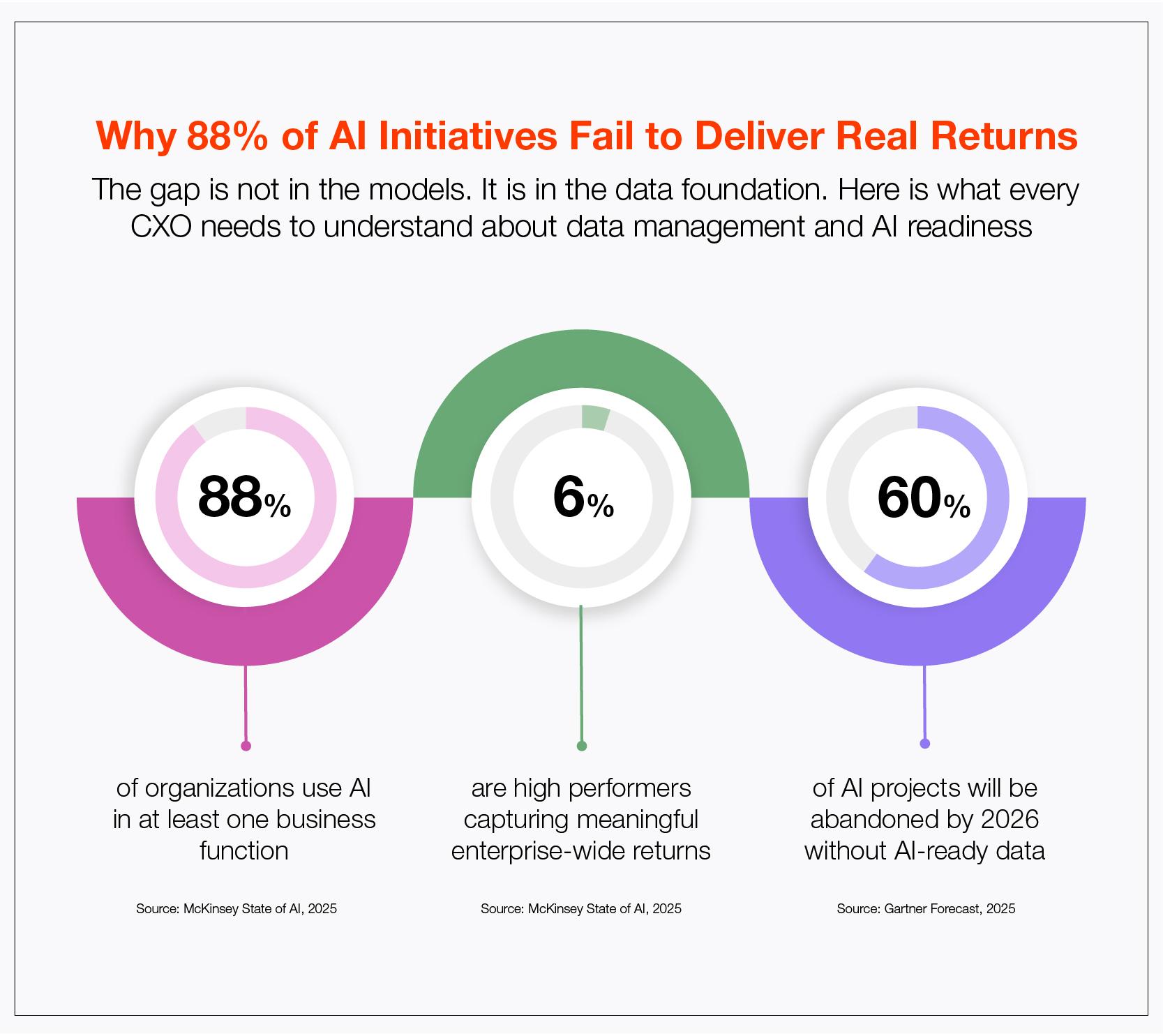
The Real Reason Most Organizations Cannot Trust Their Data
What is data management, exactly? It is the discipline of collecting, organizing, protecting, and maintaining data so it is accurate, accessible, and usable throughout its lifecycle. That definition is the easy part. The harder question is why, after decades of technology investment, most enterprises still struggle to trust the data in front of them. 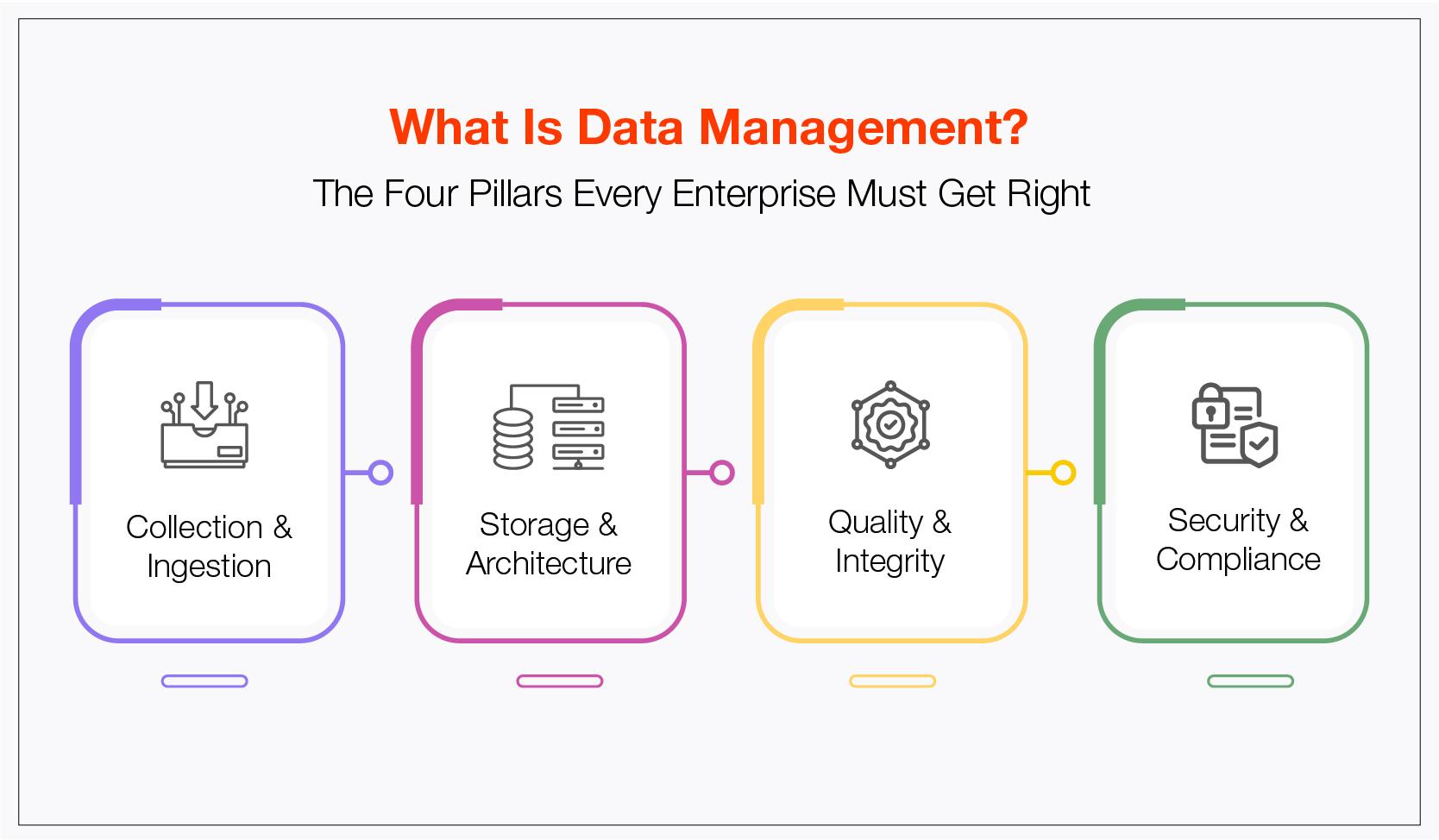
The answer is almost never a lack of tools. It is a lack of organizational commitment to data as a managed, governed asset. Data management spans four interdependent pillars: collection and ingestion, storage and architecture, quality and integrity, and security and compliance. Most organizations have invested unevenly across these pillars. They have built pipelines without quality controls. They have stored data without governing who owns it. The result is a technically sophisticated infrastructure producing fundamentally unreliable outputs.
This matters because unreliable data does not stay in the data warehouse. It flows into executive dashboards, strategic decisions, and, with increasing frequency, into AI models that make real-time recommendations at scale.
| Read also 5 Must-Have Elements of a Winning Enterprise AI Strategy outlines how enterprises can move from pilot plateau to measurable ROI by combining AI operationalization, outcome-first thinking, robust data infrastructure, human-in-the-loop talent strategies, and ethical governance frameworks. |
Data Governance: Where Accountability Meets Infrastructure
Data governance is the layer that transforms well-managed data into trustworthy data. If data management answers how data moves through your organization, governance answers who is responsible for it, who can access it, and what happens when it is misused.
Strong governance frameworks define ownership for every critical data asset, establish classification and retention policies, and ensure compliance with regulations such as GDPR, HIPAA, and CCPA. These are not bureaucratic niceties. As regulators expand their scrutiny of algorithmic decision-making, data governance is increasingly a board-level liability question rather than a back-office function.
The pattern is familiar: an organization invests heavily in data infrastructure, then installs no governance around it. Think of it as building a high-security vault and leaving the door wide open. The data is there, technically. But it is ungoverned, unaccountable, and one misuse away from becoming a liability.
The Hidden Tax on Every AI Initiative You Are Running
Before authorizing the next AI initiative, every CXO should ask one question: Is our data actually ready for this? Because the cost of getting it wrong extends well beyond a failed pilot. The damage is systemic.
Gartner forecasts that, through 2026, organizations will abandon 60% of AI projects that are not supported by AI-ready data. The implication is direct: investment in AI without a governed data foundation is not a strategy. It is a gamble.
AI readiness through data management is not a technical prerequisite that the data team handles before leadership gets involved. It is a strategic investment decision with measurable ROI implications:
- Clean, well-labeled data reduces model training time and directly improves prediction accuracy, shortening the path from pilot to production.
- Governed data pipelines keep AI outputs auditable and defensible. This is a growing compliance requirement as regulators sharpen their focus on automated decisions in finance, healthcare, and hiring.
- A unified data foundation removes the silos that fragment machine learning performance and prevent AI from working consistently across business units.
Each of these advantages depends on one thing: a data foundation that is built with the same rigor the organization applies to the AI sitting on top of it.
| Read also 10 Ways to Improve Customer Experience with Data & AI in 2026 explores how organizations can leverage unified customer data, AI-driven personalization, predictive intelligence, and sentiment analysis to design connected, empathetic experiences that build lasting trust and loyalty across every channel. |
What a Board-Ready Data Foundation Actually Looks Like
Building a data foundation for AI requires more specificity than most organizations expect. A trusted data environment is built on four architectural commitments:
- A centralized or federated data platform that serves as a single source of truth,
- An automated quality monitoring that catches anomalies before they reach decision-makers,
- Metadata cataloging that makes data discoverable without a manual search
- Role-based access controls that enforce governance policies in practice
Together, they exist to produce one outcome.
That outcome is organizational confidence: a CFO and a Chief Data Officer looking at the same dashboard and agreeing on what it means, an AI recommendation that can be traced back to its inputs and defended to a regulator, and a new acquisition absorbed without inheriting its data chaos.
A mature data foundation is not a technology project. It is the infrastructure layer that determines how much of your AI investment translates into real business advantage and how much is lost to data preparation, rework, and model remediation.
What the Risk Actually Looks Like at the Leadership Level
None of that is possible if the foundation is already compromised. And for many organizations, it is. Most organizations have not yet seen it clearly. Data management failures rarely announce themselves catastrophically. They accumulate. By the time they surface as a compliance breach, a failed AI rollout, or an M&A due diligence problem, the underlying dysfunction has usually been in place for years, normalized, worked around, and never escalated.
For CXOs, the strategic risk indicators worth watching are:
- Data preparation consumes 60–80% of AI project timelines, leaving teams with little capacity for the work that actually generates returns.
- Compliance audits reveal undocumented or improperly retained data assets. In regulated industries, this is a material liability, not an administrative oversight.
- Accountability gaps when data-driven decisions go wrong, with no clear owner to investigate or correct the course.
- Conflicting reports from the same data sources, eroding executive confidence in analytics, and slowing decision velocity across the leadership team.
- Acquired or merged entities introduce data environments that cannot be integrated without significant remediation costs.
These are not IT problems. They are strategic risk factors with direct implications for competitive positioning, regulatory exposure, and valuation.
| Read also Operationalizing Generative AI at Enterprise Scale: From Pilots to Production examines why most GenAI initiatives stall beyond the pilot stage. Explore how enterprises can adopt a phased GenAIOps approach, which covers prompt management, output governance, cost controls, and scalable monitoring, to make generative AI a reliable production capability. |
The Strategic Decision: Invest Now or Pay More Later
The organizations that will lead with AI over the next three years are making a specific decision right now: to treat data infrastructure as a strategic investment, not an operational cost. The practical path follows a deliberate sequence: audit what exists; apply data management and governance basics before adding more complexity; modernize infrastructure to match current scale, then commit to continuous improvement rather than treating it as a project with an end date.
The question for leadership is not whether to invest in data management. Every quarter without a governed data foundation is a quarter where AI spending outpaces AI returns. That math compounds.
Professional data management services compress this timeline considerably. The right partner brings tested frameworks, deep technical implementation, and organizational experience to help enterprises avoid the pitfalls that slow most in-house efforts by years. That is precisely where Straive operates.
How Straive Accelerates the Path to AI-Ready Data
Straive’s data management services are built on one conviction: AI value is generated at the data layer, not the model layer. The work starts with governance design and quality foundations, then scales through implementation support calibrated to your AI roadmap and organizational maturity.
Whether you are rationalizing a fragmented data estate inherited through growth, establishing governance frameworks ahead of a major AI deployment, or modernizing infrastructure to support enterprise-wide analytics, Straive brings the domain expertise and operational depth to move at the speed your business requires.
The organizations that lead with AI will not be those that moved the fastest. They will be those that built the right foundation first. The right partner makes that possible sooner than most expect.
| Read also Why High-Quality Data Annotation Is the Foundation of Accurate Media AI Models. Discover why high-quality data annotation is the essential foundation for scalable Media AI. This article explores how expert human-in-the-loop validation and multimodal labeling overcome complexity, ensuring 99.5% accuracy, consistent content moderation, and reliable performance in real-world digital ecosystems. |

Straive helps clients operationalize the data> insights> knowledge> AI value chain. Straive’s clients extend across Financial & Information Services, Insurance, Healthcare & Life Sciences, Scientific Research, EdTech, and Logistics.


