
Posted on: Decmeber 10th 2025
Before AI became a problem solver in business operations, most IT teams faced a critical challenge: “They spend more time putting out fires than improving the business.”
Alerts never stop, dashboards multiply, and despite endless “monitoring,” teams still hear about issues from end users. This constant firefighting doesn’t just slow IT down. It disrupts business operations, affects customer experience, and limits the extent to which technology teams can contribute to overall performance.
In an era where AI in business operations is becoming increasingly essential, AIOps offers a smarter, more connected approach to cutting through operational noise and restoring stability to both IT and business workflows.
Rather than adding more tools or expanding headcount, organizations are turning to AIOps and IT automation to interpret complex system data, anticipate issues, and drive faster, coordinated action across departments.
In this blog, we’ll explore what AIOps really is, how it strengthens AI in business operations, the tangible value it brings to incident management and performance, and where Straive helps enterprises scale intelligent, resilient operations.
What Is AIOps?
At its core, AIOps leverages AI and machine learning in IT to modernize operations. It continuously collects and analyses logs, metrics, traces, events, and service data to build an intelligent view of what’s happening across the technology landscape.
What makes AIOps powerful is its ability to:
- Ingest and normalize data from logs, metrics, traces, tickets, and alerts across tools.
- Utilize ML models to identify unusual patterns before they escalate into outages.
- Correlate related alerts into a single incident, reducing alert noise and fatigue.
- Trigger IT automation workflows, such as scaling infrastructure or restarting services, without requiring human intervention for every alert.
When organizations discuss modernizing IT, they essentially mean allowing AI in IT to handle complexity while teams focus on higher-value work.
AIOps becomes the operational engine that supports uptime, performance, and continuity for every department that relies on digital systems.
Why is AI in IT Operations Surging?
AI is no longer just a side project.
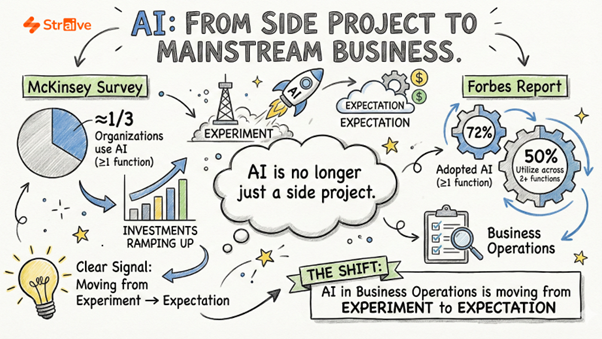
A McKinsey survey reveals that around a third of organizations currently utilize AI in at least one business function, with investments still on the rise.
Forbes reports that approximately 72% of businesses have adopted AI for at least one function, with half utilizing it across two or more functions. That’s a clear signal: AI in business operations is moving from experiment to expectation.
On the IT side, there is an extra push: hybrid cloud, microservices, and always-on digital channels create more operational data than humans can reasonably track.
This is where AI in IT steps in, spotting patterns, predicting incidents, and surfacing the few signals that actually matter from millions of events.
In short, the real opportunity is not “using AI”; it is using AI in business operations to make everyday work less chaotic and more predictable.
7 Ways AIOps Delivers Real Impact Across Business Operations?
1. Smarter incident detection & MTTR reduction
By learning from historical incidents and correlating events, AIOps detects problems earlier and helps teams resolve issues faster. Faster triage leads to fewer escalations and clearer ownership, resulting in a significantly lower Mean Time to Resolution (MTTR).
2. Alert noise reduction
Most environments generate thousands of alerts an hour. AIOps uses pattern recognition to consolidate duplicates, suppress irrelevant alerts, and prioritize what matters. This dramatically improves operator focus and reduces burnout, a quick win for IT operations optimization.
3. Helpdesk Automation & Faster Resolution
AIOps enhances helpdesk efficiency by identifying recurring issues, accurately routing tickets, and expediting responses to ensure timely resolution. Straive enhances this with AI-powered tech operations, including IT Chatbots, Incident Visualization with ITSM, and Policy Simplification, boosting user satisfaction while reducing operational costs.
4. Capacity & performance optimization
By analysing historical usage and performance trends, AIOps predicts demand and helps optimize infrastructure. This directly connects AI in IT with real business value: better performance, lower costs, and fewer surprises.
5. Business-aware operations
Mature AIOps setups map technical incidents to their business impact, including revenue, SLAs, and customer journeys. This shifts operations from “fix the loudest alert” to “fix what affects the business most.”
6. Information Security: Fortify, Detect, Respond
AIOps strengthens information security by enabling real-time threat detection, continuous monitoring, and quicker response to anomalies. Straive enhances this with real-time incident visibility, predictive risk analysis, and policy simplification, helping organizations stay compliant while reducing the risk of breaches.
7. Embedded intelligence powering operational tools
A subtle shift is happening across enterprises, marked by the rise of embedded AI, where AI is built directly into dashboards, monitoring tools, and workflows. In practice, this means insights appear at the exact point where teams make decisions, reducing friction and speeding response times.
Together, these capabilities enable teams to transition from reactive firefighting to proactive, insight-driven operations.
Getting the Foundations Right: AIOps + IT Automation
Successful AIOps programs share a few critical building blocks:
Clean, connected data pipelines
AIOps relies heavily on high-quality operational data. Straive’s data engineering and analytics services help unify fragmented datasets, a common roadblock in automation initiatives.
Clear automation guardrails
IT automation should begin with human-in-the-loop workflows, gradually transitioning to fully automated remediation for well-understood scenarios.
Change management & skills readiness
Many employees use AI tools casually, but few receive structured training. Upskilling SREs, ops engineers, and business owners is essential for real value.
Alignment with business KPIs
The goal of IT operations optimization is not just to reduce alerts; it’s to improve SLAs, minimize downtime, enhance the customer experience, and achieve cost efficiency.
Organizations that redesign workflows around intelligent decision points (rather than adding AI to old processes) consistently extract more value.
Straive’s Edge in Operationalizing AIOps for Business Impact
Straive operates at the intersection of data, AI, and operational excellence, helping enterprises turn AI ambitions into measurable outcomes. It helps organizations move from isolated automation wins to a truly intelligent operations layer.
Data-first thinking
We resolve fragmented, low-quality data across monitoring systems, logs, tickets, and business applications, enabling AIOps platforms to deliver trustworthy insights.
Domain-aware AI models
Our models are designed to understand operational patterns, making them more accurate and more relevant for real-world AIOps use cases.
End-to-end execution maturity
From discovery and design to deployment and continuous delivery, Straive supports the full lifecycle of AI and automation initiatives.
Outcome-based roadmaps
Every AIOps initiative is tied to measurable KPIs such as MTTR reduction, capacity optimization, SLA performance, operational resilience, and customer experience.
AIOps in Business Operations: The Path Forward
AIOps is reshaping how organizations manage and scale digital operations.
By combining AI-driven intelligence with automation, AIOps reduces disruptions, accelerates incident resolution, and strengthens the IT backbone every business function depends on.
As AI becomes more embedded across systems and workflows, AIOps becomes the catalyst that turns digital complexity into operational stability.
With Straive’s data-first approach and deep AI expertise, enterprises can confidently adopt AIOps and build an intelligent, resilient operations layer that is ready for the future.


Straive helps clients operationalize the data> insights> knowledge> AI value chain. Straive’s clients extend across Financial & Information Services, Insurance, Healthcare & Life Sciences, Scientific Research, EdTech, and Logistics.


