
Posted on: July 9th 2026
In publishing and content operations, technology rarely breaks down because it lacks power. It breaks down because it does not understand the conditions under which publishing work is actually done.
The work does not happen in clean process maps. It happens in growing queues, incomplete metadata, unclear rights information, accessibility checks that surface late, taxonomy mismatches that weaken discoverability, localization inconsistencies that travel across markets, compliance questions that require evidence, and editorial decisions that must remain defensible long after the deadline has passed.
This is why the next phase of AI adoption cannot be led by speed alone.
Publishing organizations do not need another abstract promise of responsible AI. They need an operating model for governed autonomy: systems that can support editorial, production, compliance, and content delivery workflows without blurring accountability.
Governance before speed is not caution. It is the discipline that allows scale to be trusted.
AI should not be framed as a substitute for editorial or operational expertise. Its stronger role is as a governed co-pilot: reducing avoidable effort, surfacing risk earlier, preserving evidence, improving handoffs, and helping teams make faster, cleaner, and more defensible decisions.
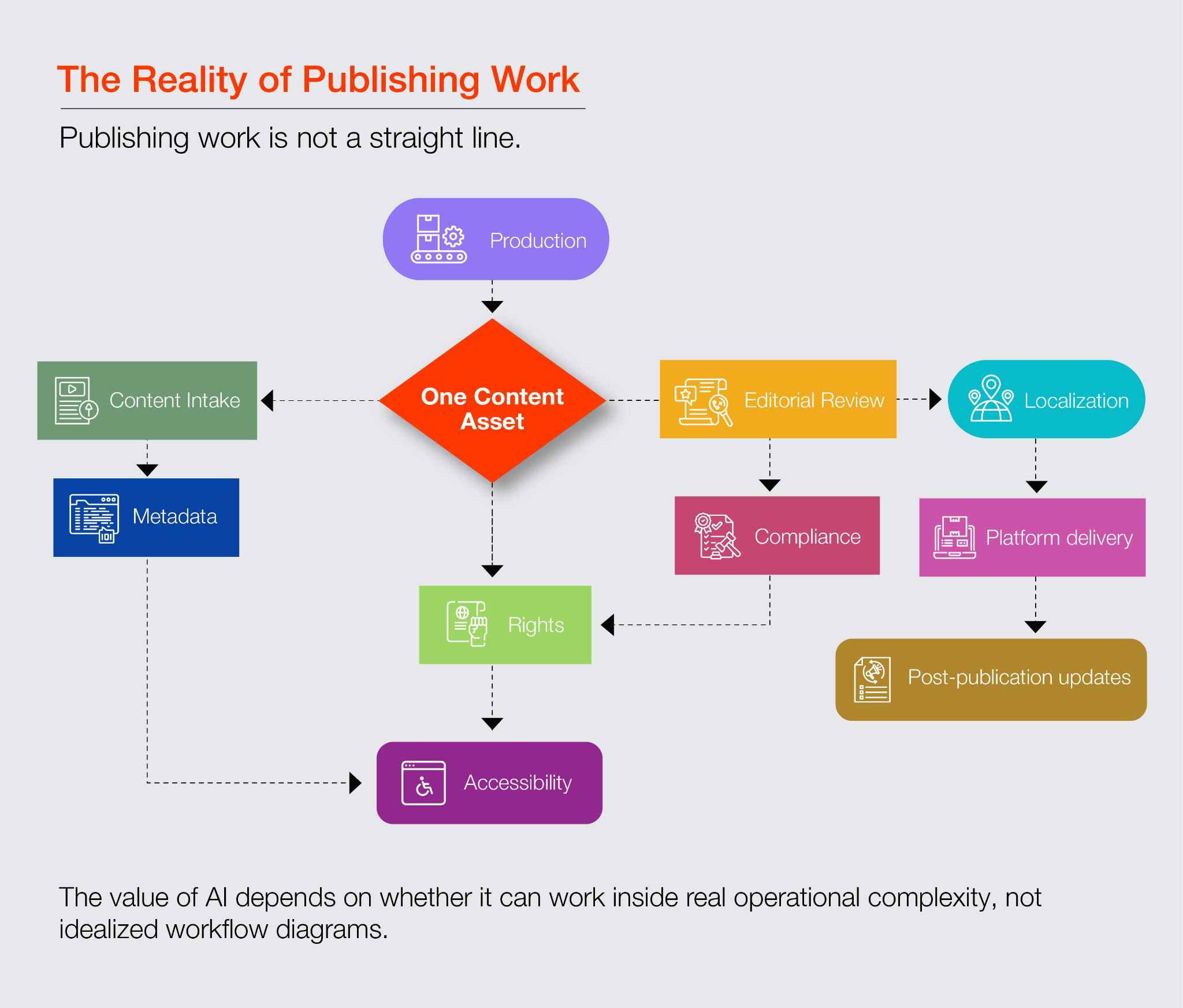
Safe autonomy does not remove people from the workflow. It protects the points where human judgment matters most.
The Real Bottleneck Is Decision Load
Publishing teams are not under pressure only because there is more content. They are under pressure because every content asset now carries more decisions.
A manuscript, article, learning module, report, data product, or digital package may look like a single unit of work. Operationally, it is a bundle of unresolved questions. Is the metadata complete? Are the rights clear? Is the taxonomy correct? Are accessibility requirements met? Are contributor disclosures sufficient? Does the content meet brand, policy, platform, and market requirements? Are references, sources, and permissions reliable? Does it need editorial review, production correction, compliance escalation, or client clarification? Can today’s decision be reconstructed later if challenged?
This is where publishing operations slow down: not always in writing, editing, or production, but in the unresolved space between them.
A missing field, unclear license, mismatched category, weak disclosure, unexplained similarity signal, sourcing irregularity, or accessibility gap may seem small in isolation. At scale, these small uncertainties become a tax on throughput.
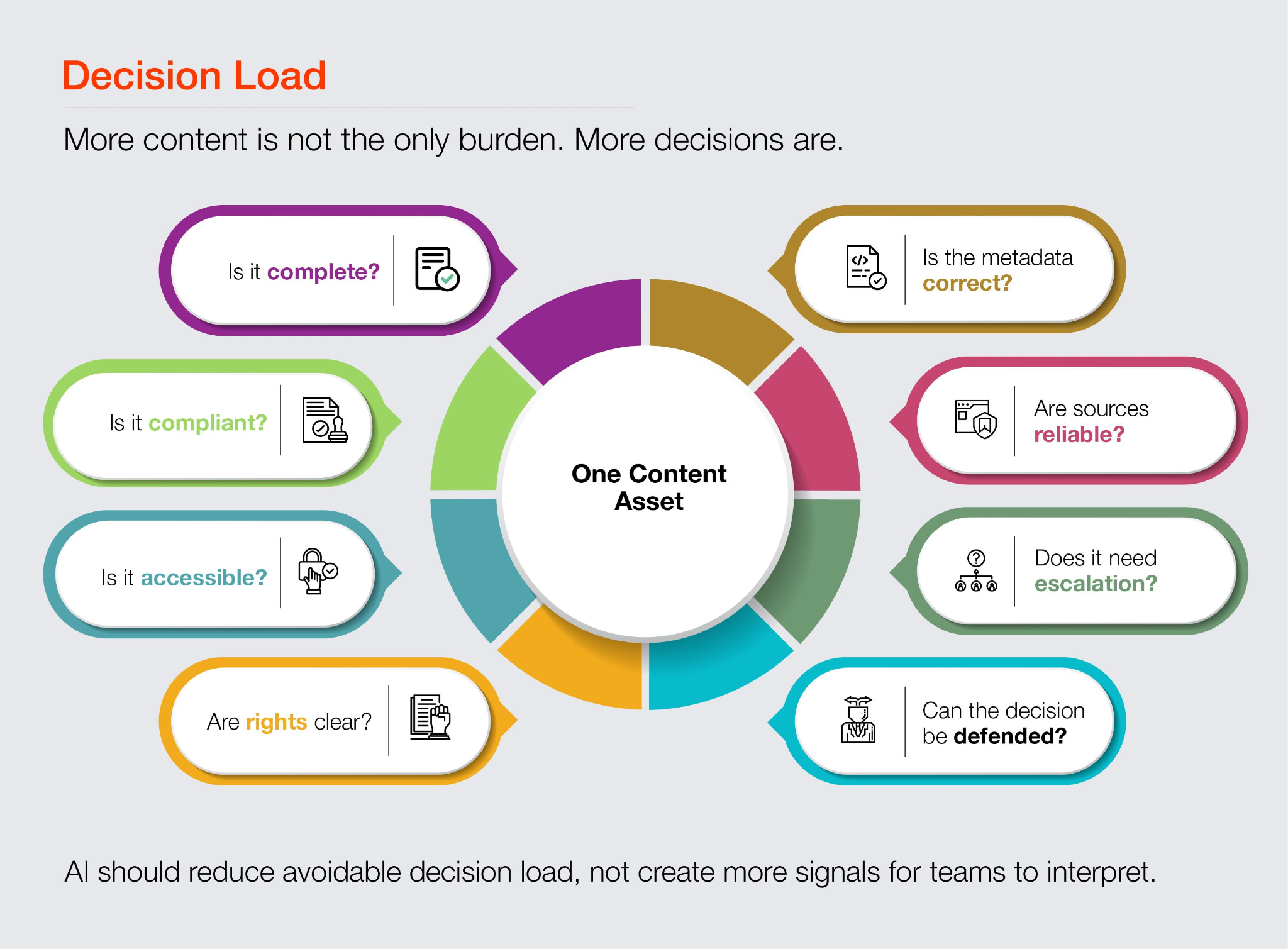
AI is useful when it reduces that decision load. It is not useful when it simply produces more dashboards, more alerts, and more things for experienced teams to interpret.
The better test is simple: does it help teams make fewer, better, and more defensible decisions?
Triage Is Not a Verdict
The most practical role for AI in publishing and content operations is triage.
Triage does not decide the outcome. It decides where attention should go first. That distinction is critical. A similarity signal is not proof of duplication. A missing disclosure is not always concealment. A rights gap does not automatically mean content cannot proceed. A taxonomy mismatch may affect discoverability, compliance, monetization, or platform packaging depending on context. A sourcing irregularity may require review, but it is not a conclusion by itself.
Publishing work is full of signals that require interpretation. AI can surface missing metadata, accessibility gaps, formatting inconsistencies, rights-clearance issues, content duplication, reference or sourcing irregularities, localization mismatches, brand compliance risks, contributor discrepancies, unclear AI-use declarations, and production anomalies. But context must still govern the next step.
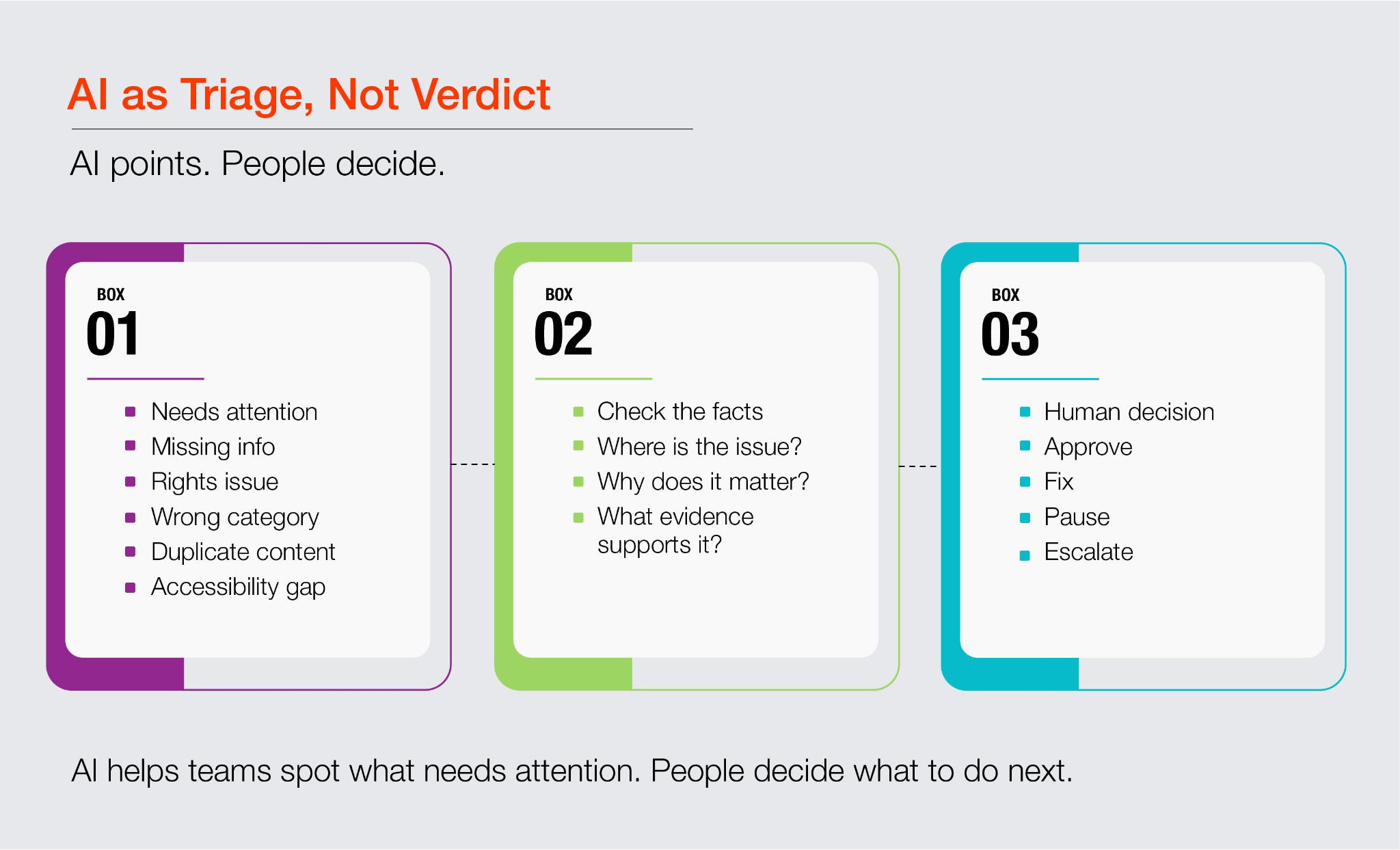
A weak system says, “High risk.”
A useful system says, “This asset is missing rights metadata for two figures, contains three images without alt text, and uses a taxonomy label that does not match the target platform. Route to production QA before release.”
That is not automation replacing judgment. That is judgment arriving better prepared.
Governance Lives in the Handoff
Many AI policies fail because they sit above the workflow instead of inside it.
Publishing risk often appears at handoff points: intake to editorial assessment, editorial review to SME validation, approval to production, production to metadata enrichment, rights clearance to packaging, accessibility review to platform delivery, localization to market release, and vendor output to internal QA.
These are the points where information disappears.
A disclosure captured at intake may not be visible during production. A rights concern may not travel with the asset. An accessibility exception may not reach the platform team. A vendor alert may be preserved as a label but not as evidence. A production correction may never flow back into the editorial record.
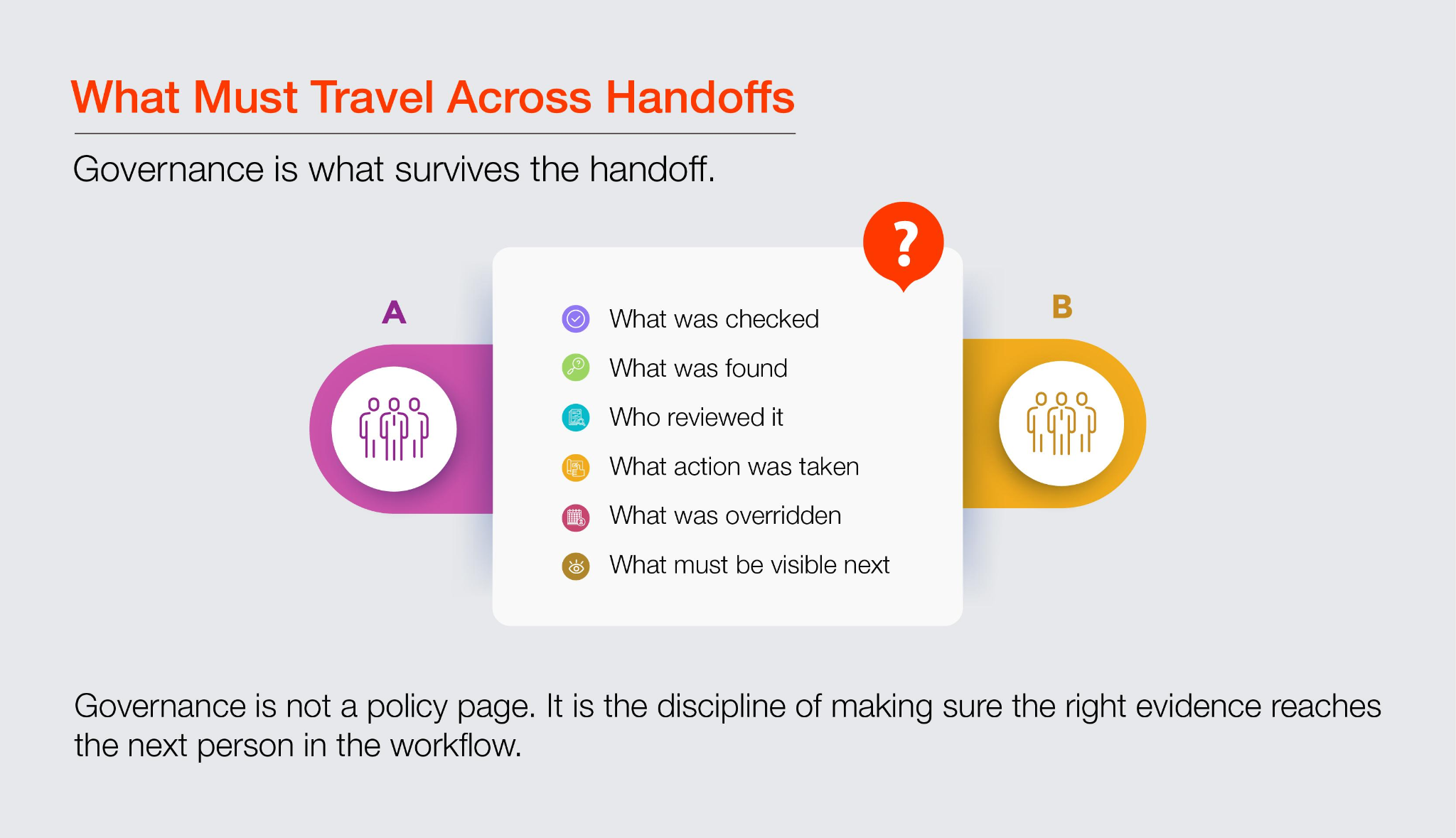
A governed workflow must define what travels across each handoff: what was checked, what was found, what evidence supported it, who reviewed it, what action was taken, what was overridden, what moved forward, what remains unresolved, and what must be visible downstream.
This is not administrative overhead. It is the architecture of trust.
Human Oversight Must Be Worth the Human’s Time
“Human in the loop” is one of the most overused phrases in AI governance. In publishing operations, it is also one of the least sufficient.
A human is not meaningfully in the loop if the system presents a vague score, generic label, or recommendation without evidence. That creates dependency, hesitation, or quiet disregard.
Useful oversight requires useful output.
Editorial, production, compliance, and content operations teams need to see the issue, its location, the evidence behind it, the policy or workflow rule that applies, the strength of the signal, the recommended next step, and a clear path to accept, dismiss, override, escalate, or document resolution.
The output should feel less like an alert and more like a prepared work packet.
Not All AI in Publishing Carries the Same Risk
One of the costliest mistakes in AI adoption is treating every use case as if it carries the same consequence.
Low-risk workflow support then becomes over-governed and hard to scale, while high-risk decision support becomes under-governed and hard to trust.
Publishing and content operations need a practical distinction between operational AI, editorial AI, and consequential AI.
Operational AI supports routine workflow execution: metadata enrichment, file validation, XML structuring, accessibility tagging, duplicate field detection, formatting checks, taxonomy mapping, localization QA, rights metadata validation, and production consistency checks. These uses can often be managed through QA sampling, exception review, and production audits.
Editorial AI operates closer to human judgment: SME or reviewer discovery, conflict prompts, scope suggestions, content classification, disclosure checks, similarity triage, editorial routing, and workload prioritization. These uses require visibility, explanation, confidence signals, and easy override.
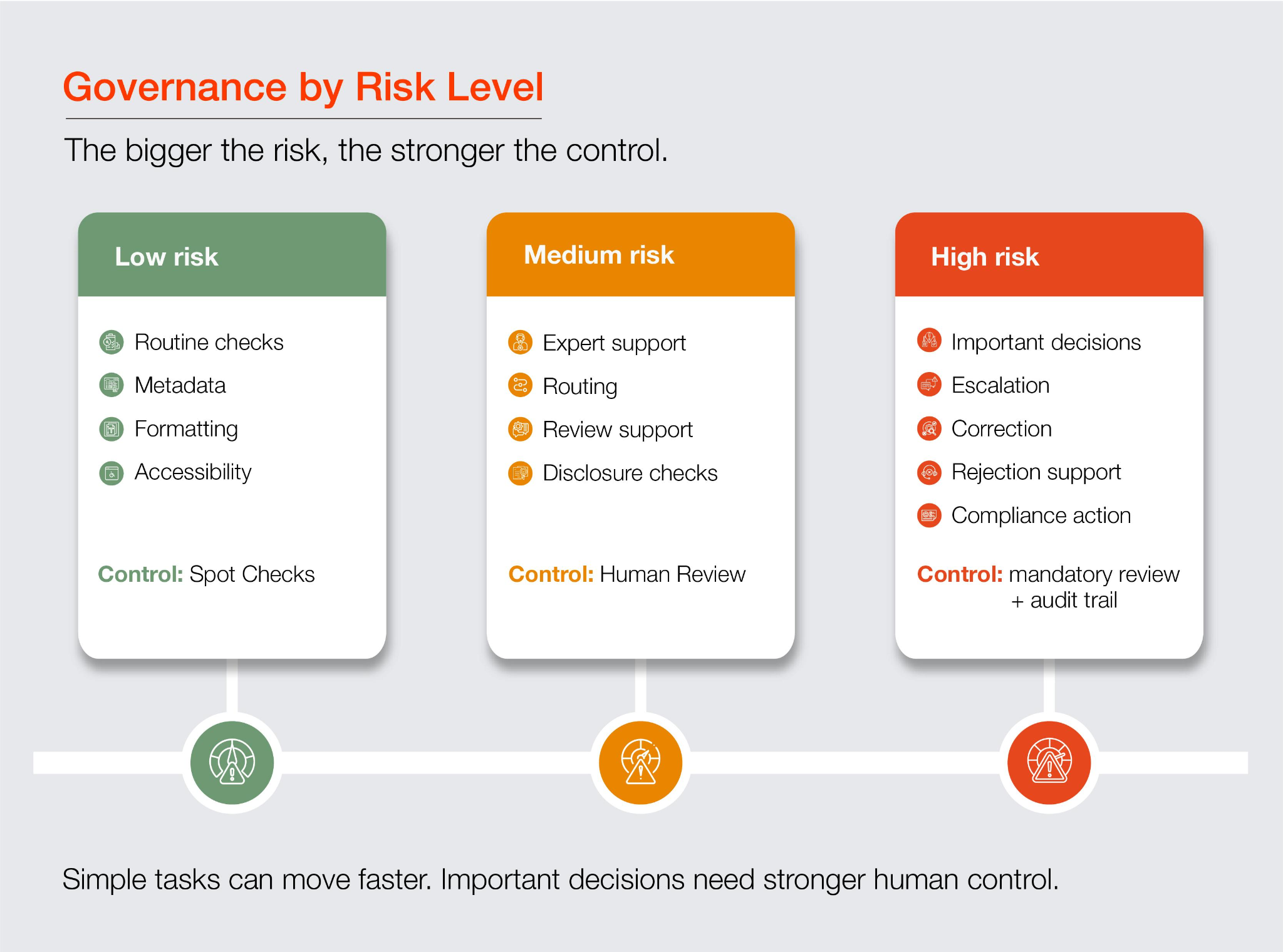
Consequential AI sits closest to trust, reputation, compliance, and publishing outcomes: editorial decision support, content integrity escalation, rejection recommendations, contributor concerns, correction workflows, legal or rights-sensitive decisions, brand-risk escalation, and compliance-sensitive publishing actions. Here, governance must be strongest. Human review should be mandatory. Evidence logs should be preserved. Decision records should be defensible.
Transparency Must Become Workflow Data
AI disclosure is often treated as a statement. In practice, it needs to become structured workflow data.
A sentence buried in a guideline or captured as a yes-or-no checkbox does not tell teams what happened, where it happened, whether it matters, who verified it, or who downstream needs to know.
The real question is not simply, “Was AI used?” It is, “Where did AI touch the content, what did it affect, who verified it, and who needs visibility before this asset moves forward?”
When AI-use information becomes workflow data, it can inform routing, review, metadata, production checks, platform display, audit trails, and downstream maintenance. When it remains vague, it becomes almost impossible to govern.
Protect Confidentiality Before Optimizing Review
Review workflows are tempting territory for AI because the pain is real: reviewer scarcity, overloaded SMEs, uneven feedback, fragmented comments, and delayed decisions.
AI can help with SME matching, reviewer discovery, content summarization, review completeness checks, feedback synthesis, routing, prioritization, and expert database hygiene.
But these workflows contain some of the most sensitive material in publishing and content operations: unpublished content, reviewer identities, SME comments, confidential client material, editorial deliberations, proprietary datasets, contributor communications, regulated information, commercially sensitive assets, and internal decision notes.
Productivity cannot be the first design principle in such an environment. Protection must be.
Measure Reliability, Not Just Speed
AI value in publishing and content operations cannot be measured only by turnaround time.
A faster workflow that creates more exceptions, more rework, more unexplained escalations, or less confidence is not a better workflow. It is a faster way to distribute uncertainty.
For editorial and governance teams, better measures include fewer incomplete submissions reaching review, clearer decision records, stronger evidence trails, more useful escalation packets, and higher trust in AI-supported outputs.
For production and content operations teams, better measures include reduced production cycle time, fewer XML correction loops, improved metadata completeness, faster content discoverability, lower accessibility remediation effort, fewer rights-clearance exceptions, reduced downstream rework, stronger cross-platform consistency, and fewer localization corrections.
The right metric is not how much AI automated. It is whether AI made editorial, production, and compliance workflows more reliable, measurable, and easier to govern.
Safe Autonomy Is an Operating Discipline
AI can help publishing and content operations move faster. But speed alone is not transformation.
The real value lies in seeing risk earlier, reducing manual checking, cleaning up handoffs, preserving evidence, improving consistency, protecting confidential review, strengthening metadata, reducing downstream rework, and focusing human expertise where it has the greatest consequence.
Governance before speed is not a brake on AI. It is how AI becomes fit for serious work.
Publishing operations are not a single workflow. They are an ecosystem of editorial judgment, production discipline, compliance responsibility, content integrity, platform requirements, contributor trust, and brand credibility.
The future of AI in publishing and content operations will not be defined by tools that look impressive in demos. It will be defined by systems that hold up inside real editorial, production, compliance, and content delivery workflows.
In an industry built on trust, the winning model is not unchecked automation. It is governed autonomy: fast enough to change the economics of work, disciplined enough to protect the judgment on which publishing depends.

Straive helps clients operationalize the data> insights> knowledge> AI value chain. Straive’s clients extend across Financial & Information Services, Insurance, Healthcare & Life Sciences, Scientific Research, EdTech, and Logistics.


