
Posted on: January 27th 2025
Introduction – Navigating the Modern Customer Journey
Customer behavior today does not follow a straight line. People move between channels fluidly, often beginning and completing tasks in entirely different places. Someone might discover a brand through a social media recommendation, read customer reviews on a marketplace site, compare pricing on a mobile app, bookmark an item on a tablet, and complete the purchase from a desktop computer a week later. If they need help after buying, they might switch again to a chatbot, a live support queue, or a community forum.
These shifting patterns create enormous complexity for organizations that want to deliver a smooth experience. Customers expect every touchpoint to remember their history, preferences, and previous steps. They do not care about system limitations, team silos, or legacy tools behind the scenes. They expect consistency and clarity wherever they interact.
Positive interactions build emotional trust. A simple checkout, a fast support response, or an intuitive onboarding flow reinforces confidence. Yet a single frustrating moment can undo this trust. Confusing navigation, repeated requests for the same information, slow site performance, or misaligned communication between channels can create friction that causes customers to abandon the journey.
Exhibit 1: Mapping Cross-Channel Customer Behavior and Experience
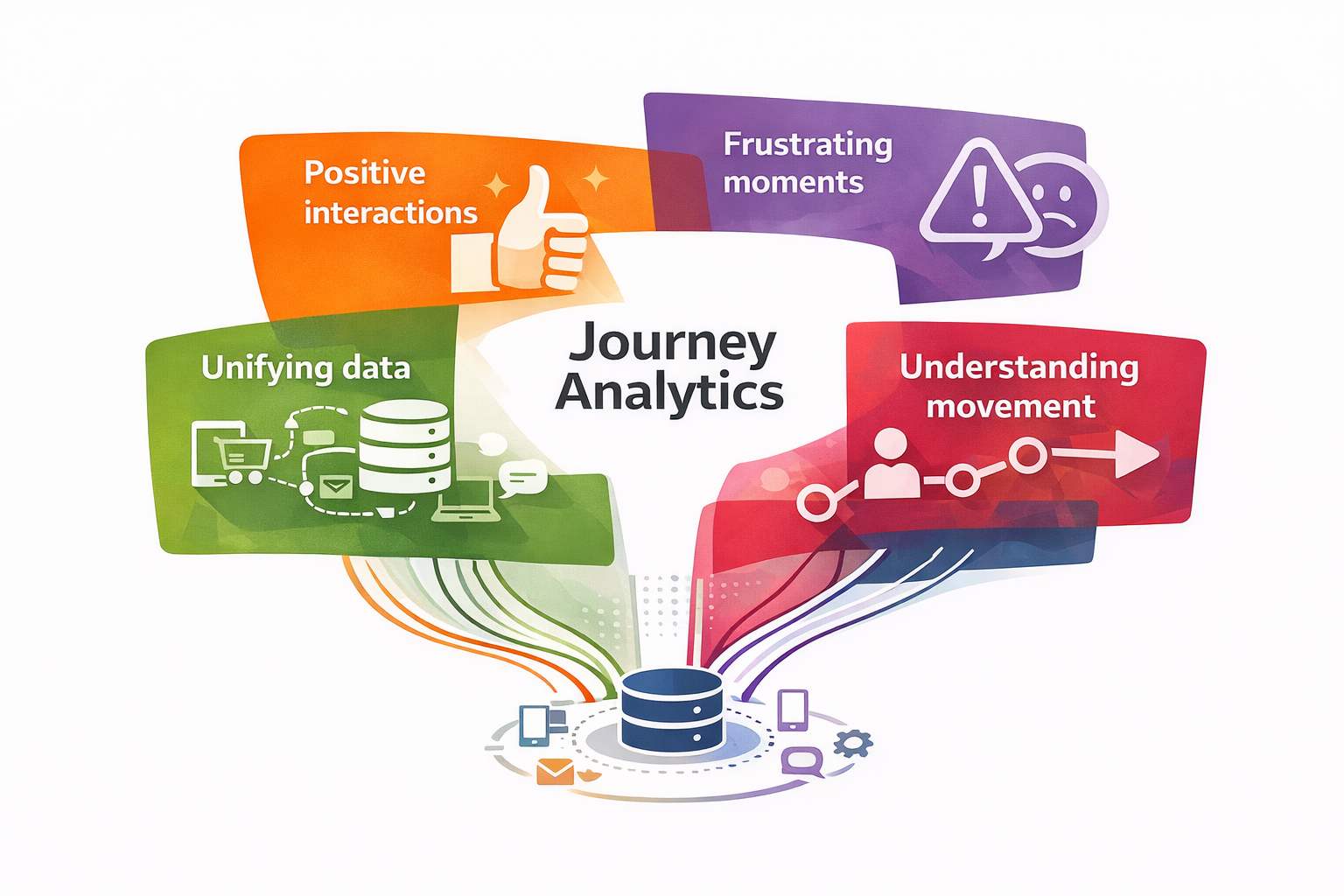
Journey analytics has emerged as a powerful way to understand this complexity. By unifying data from all customer interactions, analytics teams can see how people move, where they hesitate, where they drop off, and what influences conversion or retention. When journey analytics is combined with artificial intelligence, organizations gain the ability to detect issues instantly, predict behavior before it occurs, and personalize experiences in meaningful ways.
This article explores the importance of seamless customer journeys, explains what journey analytics entails, examines how AI transforms customer understanding, and outlines practical steps to design frictionless journeys. It also highlights best practices, emerging trends, and a comprehensive FAQ designed for leaders responsible for customer experience transformation.
Why Seamless Customer Journeys Drive Loyalty and Revenue
A seamless journey is more than a polished interface. It reflects how well an organization aligns its processes, systems, and communication around customer needs.
Customers expect experiences to be uninterrupted. If they add items to a cart on a phone, they expect to find the same cart on a laptop later. If they begin filling out a form online and switch to a support call, they expect the agent to be aware of what they were doing. If they receive marketing messages about a product they already purchased, they question whether the company understands them at all.
These expectations arise from exposure to digital native brands that set a new standard for convenience. If one company provides a frictionless experience, customers expect the same everywhere.
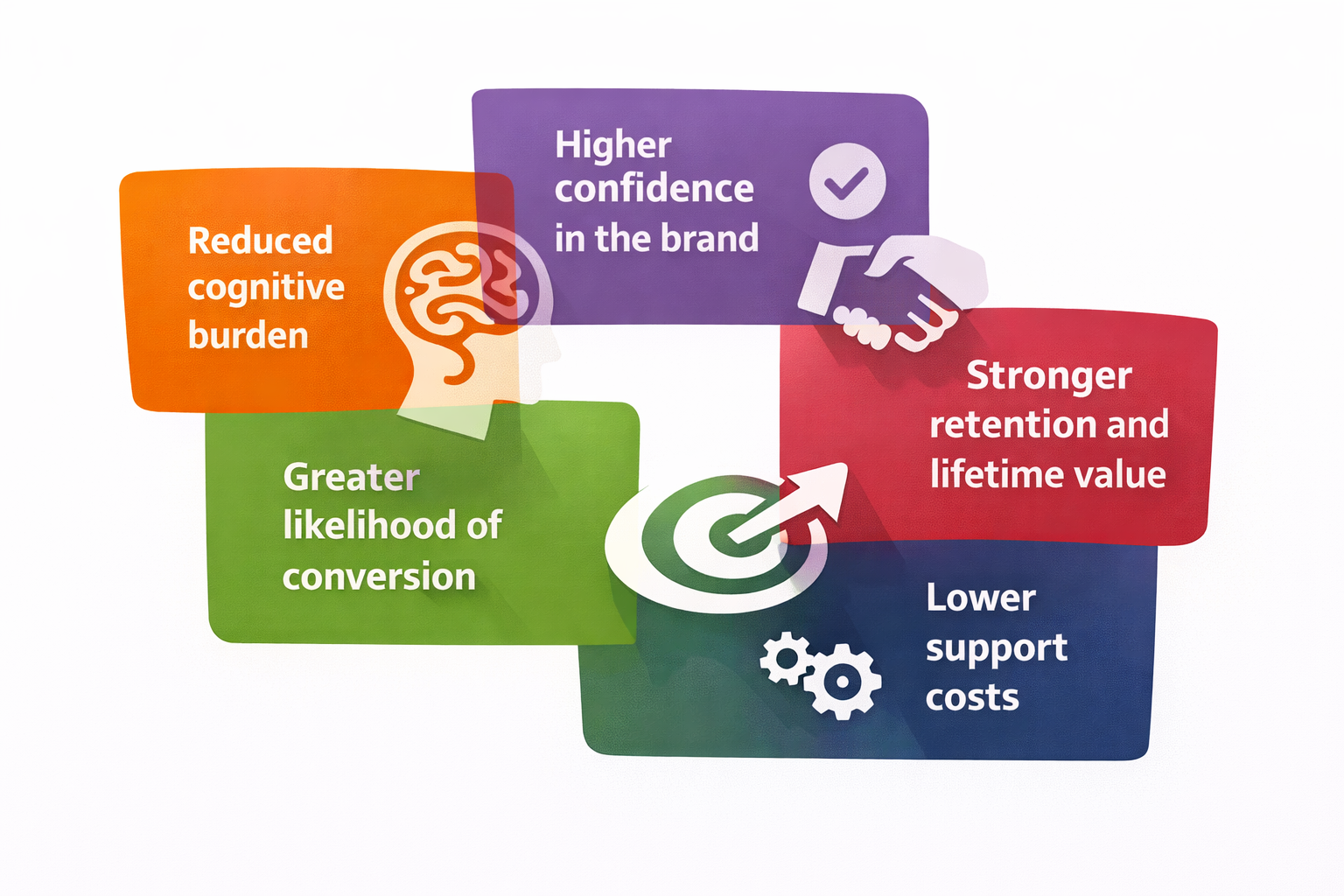
Seamless journeys strengthen customer relationships in several ways:
- Reduced cognitive burden
Customers do not need to reorient themselves, repeat information, or interpret unclear instructions. - Higher confidence in the brand
Smooth transitions signal that the organization is competent and attentive. - Greater likelihood of conversion
When customers encounter fewer barriers, they progress naturally toward completing their goals. - Stronger retention and lifetime value
Customers who feel understood are more willing to remain loyal and explore new products. - Lower support costs
Clearer digital flows reduce unnecessary service requests and escalations.
Exhibit 2: Customer Experience Outcomes Map
Friction, on the other hand, often clusters in predictable areas. Complicated checkout flows, inconsistent messaging between marketing and sales, unclear pricing, slow product onboarding, and repeated authentication requests frustrate customers. These moments may seem minor in isolation but collectively undermine trust.
A well orchestrated customer journey gives organizations a competitive advantage because it transforms every interaction into an opportunity to reinforce value.
Harnessing AI for Real-Time Journey Analytics and Customer Insights
Artificial intelligence changes the nature of journey analytics from retrospective reporting to real time decision making.
Traditional reporting tools offer summaries of past performance, such as weekly conversion rates or monthly churn numbers. These reports are helpful, but they do not allow teams to act at the moment a customer experiences difficulty. By the time an issue becomes visible, the damage is already done.
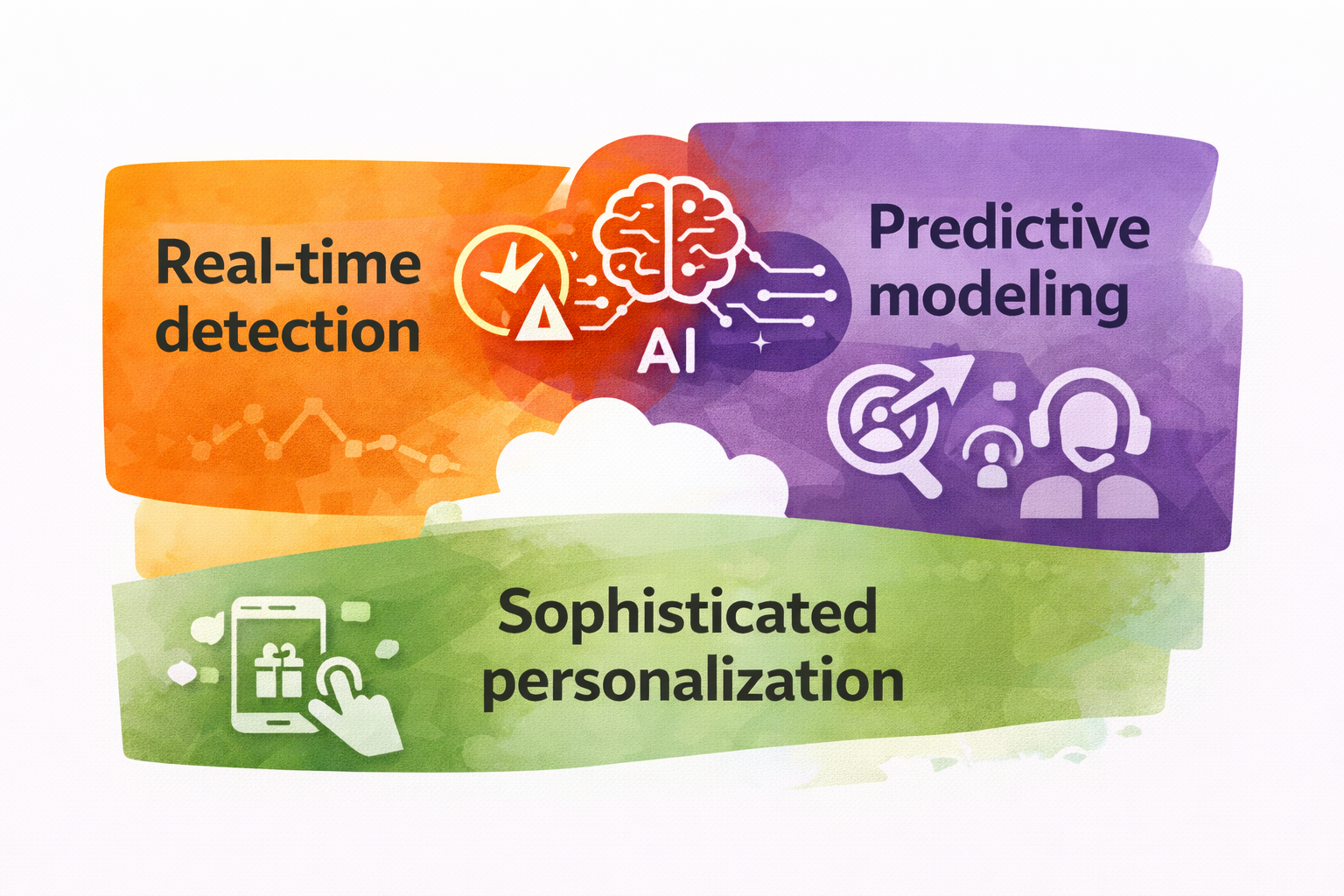
AI introduces three shifts that make journey analytics significantly more effective.
First, AI can process large volumes of data in real time. This includes website clicks, mobile gestures, product usage patterns, customer service transcripts, search behavior, and more. Instead of waiting for a pattern to become visible through manual review, AI can flag anomalies instantly. If customers are suddenly abandoning a page that never used to cause trouble, the system can surface that issue within minutes.
Second, AI can predict what customers are likely to do based on their behavior. Predictive models identify signals of growing frustration, loss of interest, or intent to purchase. If a customer has reduced their logins, stopped using key features, or repeatedly viewed troubleshooting pages, AI can assign a risk score and trigger a targeted intervention. Likewise, if a customer shows high intent through repeated comparisons or advanced browsing, AI can suggest timely prompts to help them convert.
Third, AI supports more sophisticated personalization. Instead of treating customers as broad demographic segments, AI evaluates behavioral context, including how a customer uses a product, what content they interact with, which features matter most, and which support interactions they find most helpful. Companies can then present the right message, offer, or support at the exact moment it is needed.
Exhibit 3: AI-Driven Journey Analytics Capabilities
AI also helps interpret unstructured data, which has historically been underused. Customer feedback, agent notes, chat histories, and long form surveys often contain signals that reveal the real reasons behind churn or dissatisfaction. AI can analyze these patterns across thousands of interactions, surfacing themes that manual analysis might miss.
Customer Journey Analytics: A 360 Degree View
Journey analytics brings together data across multiple systems to form a complete picture of the customer lifecycle. Companies typically accumulate data in silos, such as marketing platforms, e-commerce systems, CRM tools, service desks, and mobile apps. Without integration, each platform provides only a partial view, making it difficult to understand how experiences influence each other.
A comprehensive journey analytics approach unifies these sources to create a single timeline of customer interactions. This enables companies to see how earlier moments influence later outcomes. For example, a confusing checkout stage might correlate with increased support calls. Poor onboarding might correlate with low product usage months later. Journey analytics connects these insights so teams can address causes rather than symptoms.
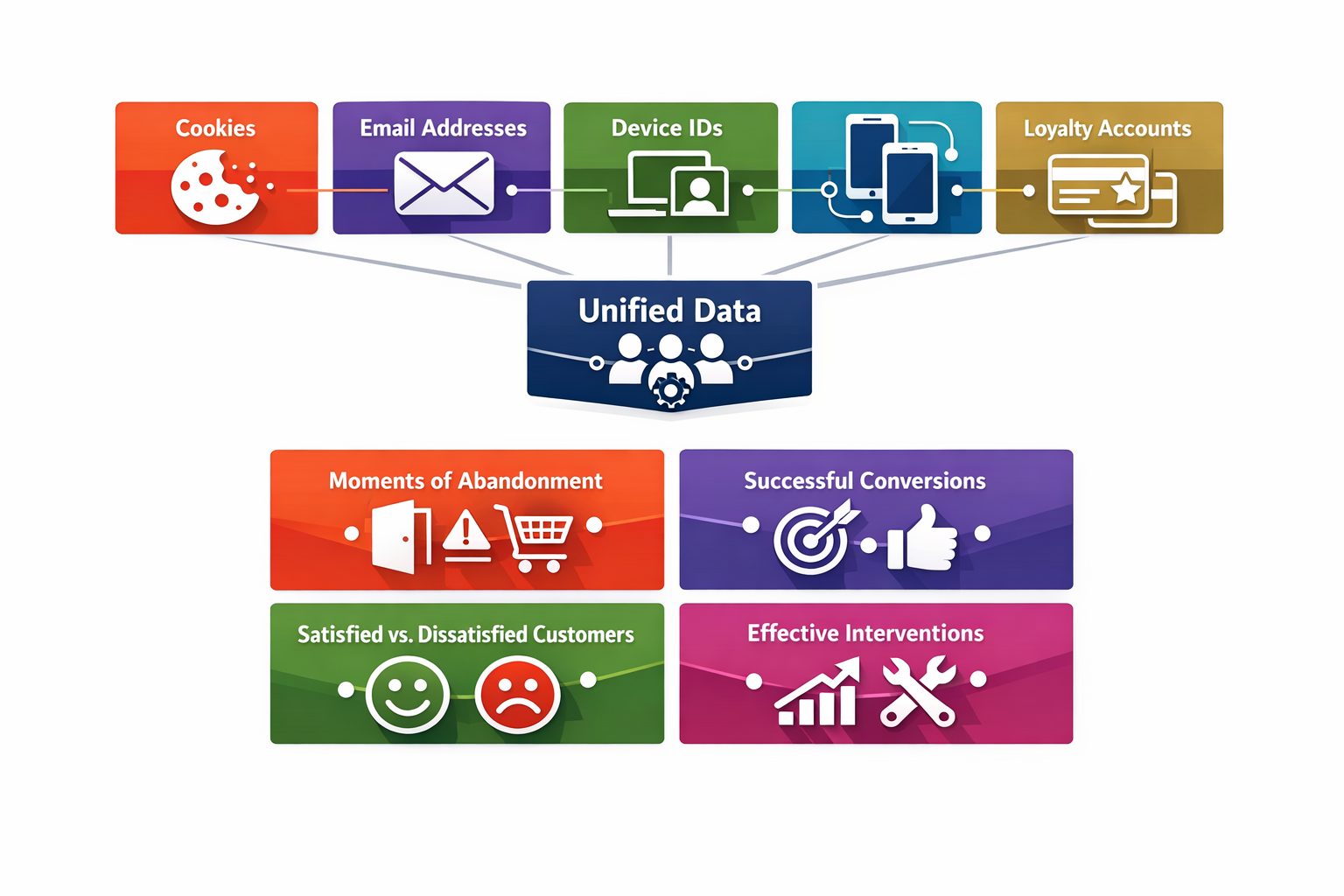
Identity stitching is a crucial component of this process. Customers often interact as different identifiers depending on the channel, such as cookies, email addresses, device IDs, or loyalty accounts. Journey analytics solutions reconcile these identities so that each individual is represented accurately.
With the foundation of unified data, organizations can diagnose questions that matter, such as:
- What moments consistently trigger abandonment
- Which touchpoints lead to successful conversion
- What distinguishes satisfied customers from dissatisfied ones
- Which interventions produce the strongest improvements
Exhibit 4: From Fragmented Identities to Actionable Journey Analytics
This holistic understanding allows teams to make targeted improvements rather than broad generalizations.
Journey Mapping: Visualizing Touchpoints and Pain Points
Journey mapping is a human centered complement to analytics. It translates patterns into stories that teams can easily understand. While journey analytics shows what customers do, journey mapping explains why they behave that way.
A strong journey map includes:
- A well defined persona
- A clear goal the customer is trying to achieve
- Stages of the journey
- Touchpoints across channels
- Questions, emotions, and motivations
- Barriers and frustrations
- Opportunities for improvement
Exhibit 5: Human-Centered Journey Mapping
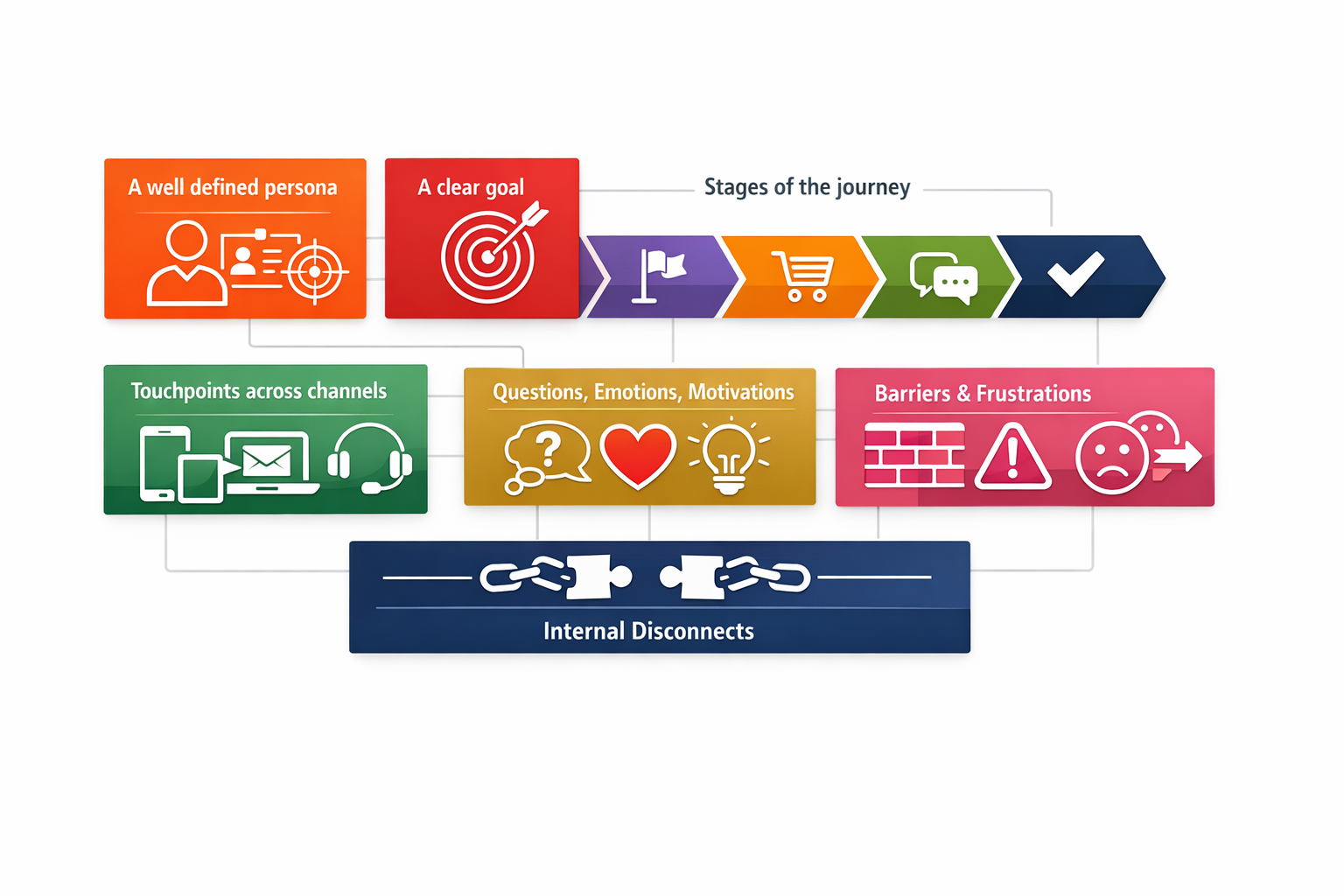
Journey maps reveal internal disconnects. Marketing may promise an experience that product onboarding does not deliver. Sales may use language that support teams do not reinforce. Billing, product, and support might each have their own systems that create inconsistent experiences for customers.
When teams see these disconnects mapped visually, the need for cross functional collaboration becomes obvious. Journey mapping brings departments together around the shared objective of delivering a coherent experience.
Designing Seamless Journeys with AI Powered Analytics
Creating seamless journeys requires a disciplined approach supported by accurate and timely data.
Step 1: Unify Data Across Channels
Start by cataloging all customer relevant data sources. Integrate these systems to create unified profiles that reflect the complete customer journey. Unified data prevents fragmented visibility and ensures that all teams operate from the same foundation.
Step 2: Map Customer Journeys and Clarify Context
Identify the journeys that matter most. Focus on high value or high friction scenarios first, such as onboarding or support resolution. Combine customer interviews with quantitative data to validate assumptions about motivations and obstacles.
Step 3: Use AI to Identify Friction and Opportunity
AI can detect patterns beyond human perception. It highlights behavioral clusters, reveals anomalies, and predicts what customers are likely to do next. These insights help prioritize which journey stages deserve the most attention.
Step 4: Deliver Personalized Experiences in Real Time
Use AI to provide support, recommendations, and content precisely when customers need them. Personalization should focus on solving problems or accelerating progress, not overwhelming customers.
Step 5: Align Teams and Orchestrate Journeys
Each team should understand its role in the journey. Shared metrics help ensure consistency across touchpoints. A unified experience requires coordination, shared accountability, and integrated systems.
Step 6: Continuously Test, Measure, and Improve
Monitor key journey metrics, conduct A/B tests, and refine experiences iteratively. Continuous optimization strengthens both customer satisfaction and operational performance.
Best Practices for AI Driven Journey Analytics
A strong AI driven journey analytics strategy relies on:
- Leadership commitment to customer centricity
- Strong data governance and privacy safeguards
- Clear roles and responsibilities across teams
- Responsible and transparent AI use
- Iterative improvement through measurement and testing
Exhibit 6: AI-Driven Journey Analytics Strategy
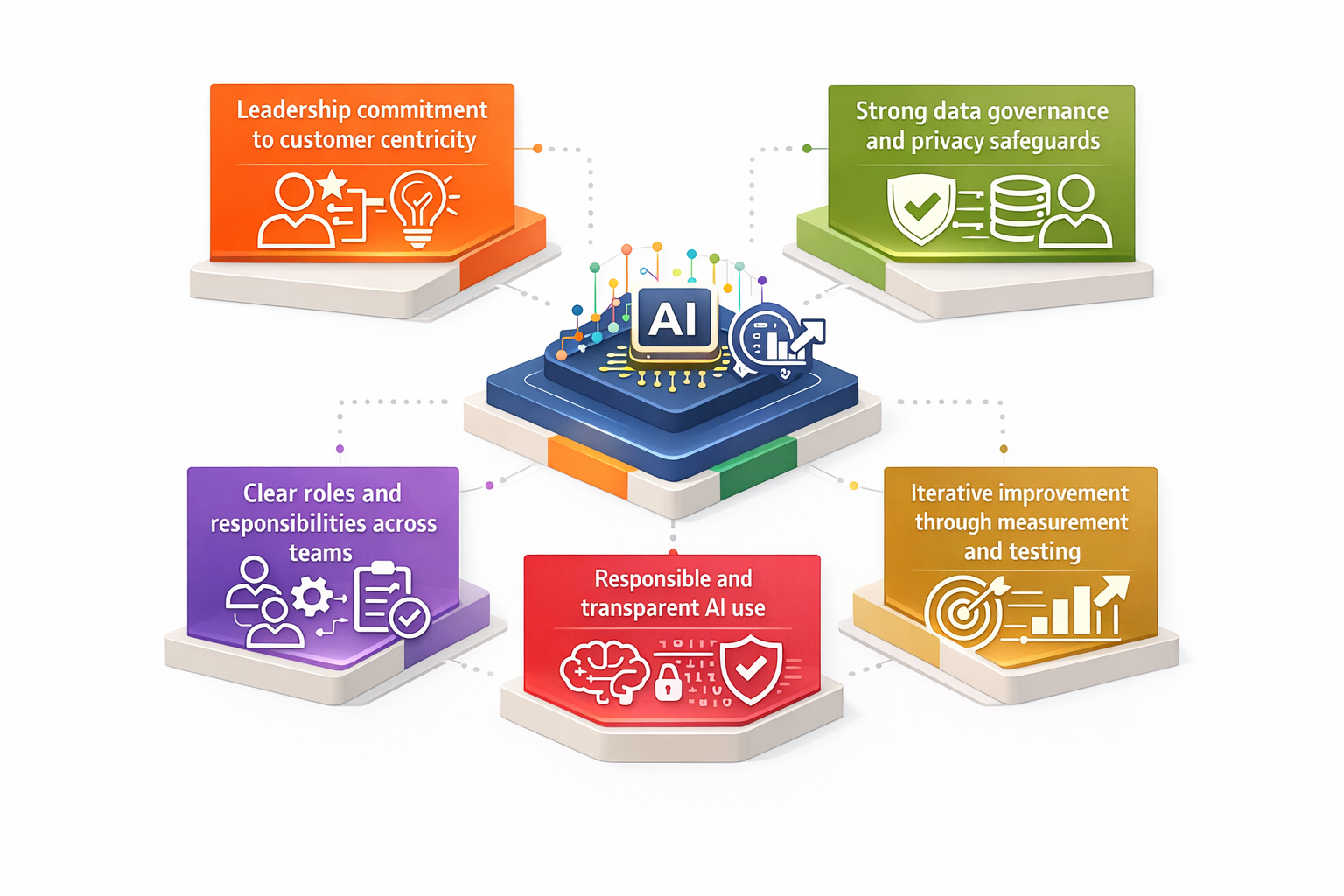
Organizations that excel in journey analytics embed these principles into everyday operations.
Future Trends Shaping Journey Analytics
Several trends are reshaping how organizations understand and design customer journeys.
Agentic AI will take on more autonomous workflows, coordinating tasks without human intervention. Proactive service models will resolve issues before customers encounter them. Unified experience ecosystems will connect predictive, generative, conversational, and analytic capabilities into a single platform. Low code tools will give nontechnical teams the ability to build and refine workflows. Privacy requirements will shape how data is collected and used.
Conclusion – Building Trust Through Seamless Journeys
Customer journeys today span a complex network of channels, devices, and contexts. To build trust, organizations must understand how customer experiences unfold and where friction arises. Journey analytics provides the necessary visibility, while AI elevates insight generation with prediction, personalization, and real time responsiveness.
Exhibit 7: Agentic AI and the Architecture of Unified Customer Experience

When companies unify their data, map journeys, apply AI driven insights, align teams around shared metrics, and optimize continuously, they deliver experiences that deepen loyalty and strengthen long term relationships. Seamless journeys are no longer optional. They are essential for standing out in a crowded digital marketplace.

Priya Roy is the Vice President of Delivery Leadership at Straive, driving operational excellence and transformative client solutions. She brings deep expertise in managing large-scale customer experience and technology programs.


