
Posted on: February 11th 2026
The era of the “AI pilot” has matured. In 2026, the majority of business executives will have a new challenge: demonstrating that AI’s effectiveness is simple. The real challenge is to make it work throughout the entire organization. We’ve seen automated reports function in finance and chatbots thrive in customer service. However, these small victories hardly affect your bottom line.
This gap between a successful pilot and real business value is the “pilot trap”. It happens when good initiatives stall, not because the technology fails, but because the organization lacks the structure, cultural readiness, or data foundation to make it stick beyond the experiment phase. Fixing this requires more than buying new software. You need to treat AI as a core business capability, not as a set of disconnected IT projects.
To bridge this gap and achieve real scale, leaders must execute a strategy built on five critical pillars.
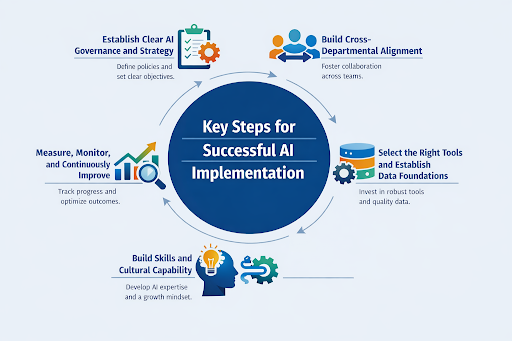
1. Establish Clear AI Governance and Strategy
AI initiatives lose momentum for one reason: no one owns them. Without a clear governance model, departments launch their own projects and compete for the same resources. This mess creates “shadow AI”, tools deployed without security checks or clear data ownership, leading to risk and wasted money.
To build a sustainable foundation, prioritize these actions:
Designate Strategic Leadership: Appoint a Chief AI Officer or a centralized steering committee. Someone needs to own the strategy and resolve conflicts.
Define Clear Ownership: Make department heads executive sponsors. This keeps strategy centralized while letting each unit adapt to its own needs.
Establish Decision Hierarchies: Create a clear process for evaluating projects based on risk, cost, and strategy. Every AI request passes through compliance and security before launch.
Align Strategy to Business Objectives: Stop asking what a model can do. Ask where your business is losing efficiency. Every initiative must have a clear business purpose and measurable results.
Strong governance connects your organization. It makes data from one department useful to the rest of the enterprise. This foundation is what you need to scale.
2. Build Cross-Departmental Alignment
Operationalizing AI is a team sport. Even the best tool fails when departmental silos block data sharing or staff resist change. Alignment starts with shifting your culture. Every part of the organization needs to understand why this change matters.
Effective leaders build this alignment through several practical approaches:
Stakeholder Readiness Assessments: Before launching a new tool, understand what each department fears. Resistance rarely comes from the technology itself; it comes from worry about workflow disruption.
Develop a Shared Roadmap: Each department has different needs, but your overall roadmap must stay consistent. This prevents conflicting standards and incompatible tools.
Empower Internal Champions: Find respected voices in Finance, Operations, and other departments who believe in this change. Peer support beats executive mandates every time.
Secure Visible Executive Commitment: Be transparent about how AI affects workflows. When the C-suite actively learns alongside their teams, it reduces anxiety and builds trust.
Celebrate early wins. Be open about what you’re doing. This turns scattered enthusiasm into organized momentum, the kind you need to push through organizational resistance to big change.
3. Select the Right Tools and Establish Data Foundations
In enterprise AI, data is raw material, and your infrastructure is the refinery. The market overflows with “solutions” looking for problems. Your job is to pick tools that actually work, not just sound good.
To ensure your foundation is solid, focus on these priorities:
Identify High-Impact Use Cases First: Target bottlenecks that cost the most time or money, like automating high-volume document processing or optimizing supply chain logistics.
Prioritize Seamless Integration: If your team must leave their normal work environment to use an AI tool, adoption dies. Evaluate vendors on how well they integrate with your ERP, CRM, and communication tools.
Invest in Data Governance: You cannot scale AI with messy data. Quality checks and clear access rules matter. Your AI is only as smart as the information it sees.
Build for Flexibility: Don’t lock yourself into a proprietary stack that will be outdated next year. A modular approach lets you swap out tools as better options emerge.
When technology and data align, teams stop fixing problems and start delivering value.
4. Build Skills and Cultural Capability
Tools only work as well as the people using them. At Straive, we know a “Human-in-the-Loop” (HITL) approach is essential for successful AI work. Humans bring context, ethics, and judgment that machines cannot provide.
As Namit Sureka, Straive’s President and Chief Analytics and AI Officer, says, real operationalization happens when humans and machines work together, not one replacing the other.
Watch: Why the Human-in-the-Loop Approach is Key to Operationalizing GenAI
To build this capability, leaders should focus on:
Analyzing the Skills Gap: Know what your team needs to learn now and what they’ll need in a year. Everyone needs basic data literacy. Specialists need technical depth.
Role-Specific Training: One approach doesn’t fit everyone. Executives need to understand AI risk and strategy. Analysts need hands-on skills.
Fostering Psychological Safety: Let people experiment and learn from mistakes. Create space for teams to try new approaches without fear.
Strategic Talent Management: Hire AI specialists, but also upskill the experts who already understand your business. That combination is powerful.
A team comfortable with AI will drive change faster than any software purchase alone.
5. Measure, Monitor, and Continuously Improve
Measure your impact or justify nothing. Continuous measurement separates successful AI work from failed experiments. Enterprise AI isn’t a project with an end date; it’s an ongoing cycle of testing and improving.
A solid monitoring approach includes:
Defining Success Metrics Early: Set baseline KPIs before launch. Track both hard metrics (cost savings) and soft ones (how many people actually use the tool).
Utilizing Real-Time Dashboards: Monitor usage and identify issues as they occur. Don’t wait for quarterly reviews to discover something is broken.
Regular Review Cycles: Audit monthly and quarterly. Ask if the tool is delivering ROI or if something newer would work better.
Creating Feedback Loops: Listen to the people actually using the tools. They spot problems much faster than management does.
Scaling or Sunsetting: If a project works, roll it out. If it’s not delivering after a fair try, kill it and redeploy the resources.
Partner for Success: How Straive Can Help
Operationalizing AI requires three things: governance that works, tools that fit, and a culture of continuous improvement. Leaders who execute these five pillars become faster, retain better talent, and can grow without hiring proportionally more people.
Scaling across multiple departments is hard. Organizations struggle with data quality at scale, maintaining consistent workflows globally, and staying compliant across regions.
Straive Solutions
Straive helps you bridge the gap from successful pilot to company-wide AI operation. We offer:
Intelligent Process Automation: We streamline workflows and remove manual work. AI works where it adds the most value.
Data Quality and Governance: We ensure your data is clean, accurate, and compliant. This is the fuel your AI depends on.
Scalable Infrastructure: We build a tech stack that grows with you without creating technical debt.
Expert Advisory Support: From building governance to rolling out successful pilots, we provide the expertise you need to move AI from experiment to core business driver.
The leap from testing AI to running it across your organization is the big challenge for leaders right now. Straive can help you get there faster.
Ready to operationalize AI across your enterprise? Schedule a consultation with our AI operations experts today.

Straive helps clients operationalize the data> insights> knowledge> AI value chain. Straive’s clients extend across Financial & Information Services, Insurance, Healthcare & Life Sciences, Scientific Research, EdTech, and Logistics.


