
Posted on: October 29th 2026
Your team is clearing an accessibility backlog when the next journal issue arrives. Course materials need attention before the semester begins. Then an urgent request changes the schedule again.
Progress on older content does not necessarily mean the workload is getting smaller. For someone waiting for an accessible reading assignment, a delivery delay can mean missing the chance to prepare for class.
ADA Title II deadlines make this delivery challenge more pressing for public higher education. Publishers supporting these institutions also need to prepare for accessibility requirements in the content they supply.
Accessibility on demand needs to address both the deadline ahead and the work arriving every day. Combining Agentic AI with human-in-the-loop subject matter expert (SME) review can help coordinate remediation, preserve technical meaning, and direct expert attention where it is needed.
The deadline is approaching and the workload keeps growing
Under the current ADA Title II web accessibility rule, covered web content and mobile apps must meet WCAG 2.1 Level AA by:
- April 26, 2027: Public entities with populations of 50,000 or more, excluding special district governments.
- April 26, 2028: Public entities with populations below 50,000 and all special district governments.
The Department of Justice confirms these dates in its compliance planning guidance. Public colleges and universities are covered; the applicable public entity determines the deadline, rather than enrollment alone.
These dates do not apply universally to publishers or private organizations. However, the rule generally covers content public entities make available through arrangements with others. For publishers supplying covered institutions, this makes accessible delivery an important part of supporting customers’ readiness. The rule includes specific exceptions, while existing obligations to provide effective communication continue.
A remediation batch has an endpoint. Accessibility demand continues. Teams still need to support new publications, revisions, and individual requests after the compliance date.
When every request becomes a separate project, staff repeatedly locate source files, clarify requirements, and negotiate delivery dates. A continuing service gives this work a shared process and accountable ownership.
Make the service promise clear
Accessibility on demand should provide remediation and validation expertise as workloads change, while supporting accessibility within authoring and production.
The service should accommodate:
- Recurring production: Journal articles, course materials, and reports.
- Planned batches: Archive remediation and content migrations.
- Urgent access requests: Specific content needed by a particular date.
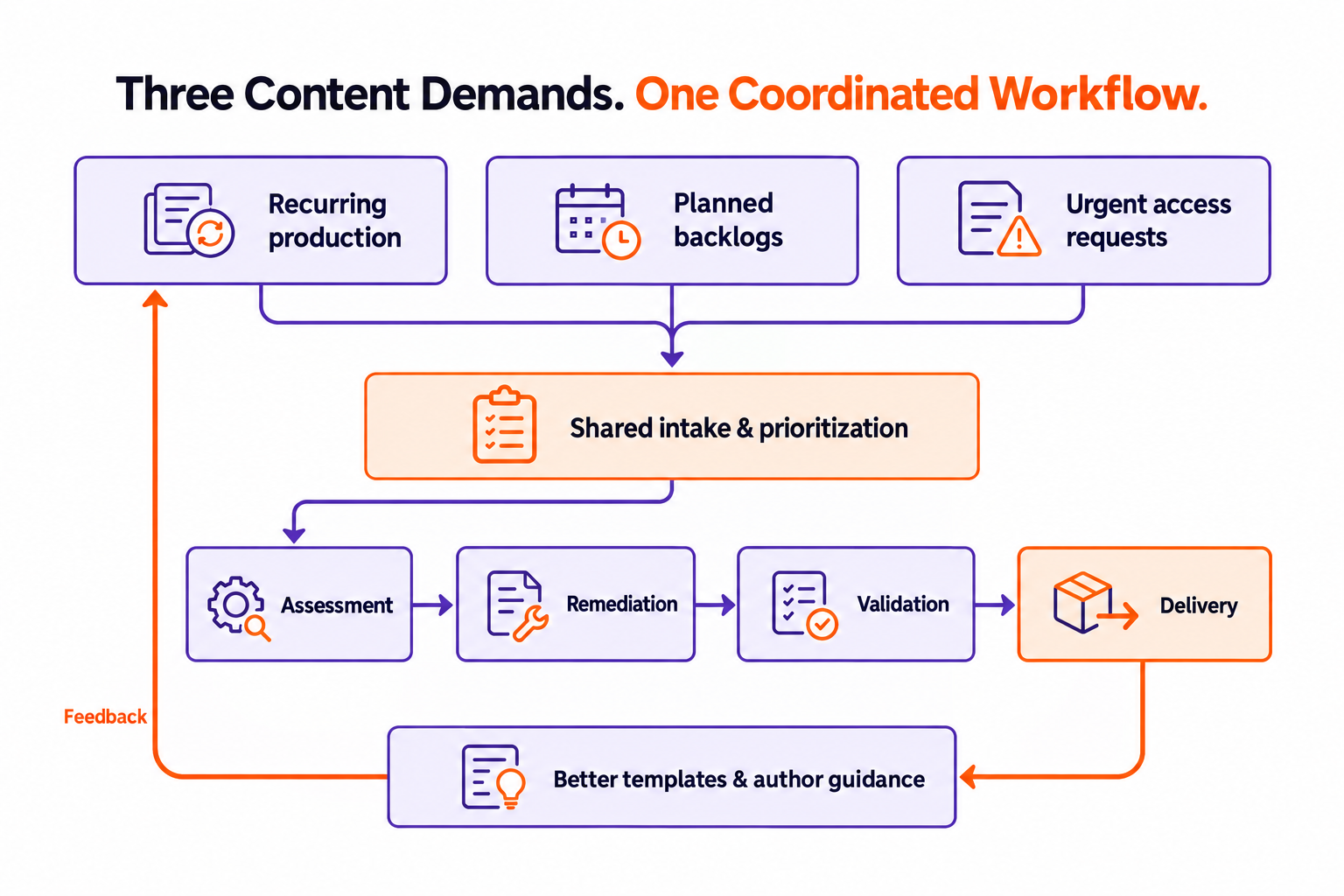
Figure 1: A shared workflow coordinates ongoing production, backlog remediation, and urgent access needs, while feedback improves future content.
Define the formats covered, regular capacity, and arrangements for bringing in additional specialists. Assign one service owner with authority to resolve competing priorities and communicate changes.
Separate response commitments from delivery commitments. Acknowledging a request confirms receipt. Delivering usable content requires assessment, remediation, and validation. Requesters need a clear expectation for both.
This approach reflects W3C’s planning guidance, which recommends integrating accessibility into production with defined responsibilities, resources, and ongoing evaluation.
Commit to dates after understanding the work
Two documents with the same page count can require very different effort. A text-based report may need structural corrections. A scanned scientific article with equations and complex tables may also need specialist remediation and subject matter review.
A shared intake process should establish:
- The material: Format, volume, complexity, and available source files.
- The need: Intended use, required date, and consequences of delay.
- The delivery requirements: Accessibility criteria, current file version, and the content owner who can resolve questions.
Use this information to assign expertise and agree on a realistic delivery date. If the date cannot be met, escalate early and agree on an accessible delivery approach that addresses the person’s immediate need.
Track requests through assessment, remediation, validation, and delivery. Distinguish active work from time spent waiting for source files, approvals, or expert input. This helps leaders identify what is actually delaying access.
Put Agentic AI and SME review into one workflow
Agentic AI can connect activities that otherwise sit in separate tools and queues. Its value comes from coordinating assessment, content creation, validation, and escalation within defined controls.
Straive’s SPACE approach describes three collaborating agents:
- Assessment Agent: Evaluates content purpose, complexity, and domain context.
- Creation Agent: Uses captions, surrounding text, metadata, and other context to generate accessibility outputs.
- Validation Agent: Evaluates quality and confidence, routing outputs that fall below established thresholds to human SMEs.
Human-in-the-loop review is central to this model. Accessibility specialists assess structure, navigation, and assistive technology behavior. SMEs verify scientific accuracy, technical terminology, and instructional meaning. High-complexity or high-impact content may require both.
For example, a chart description may accurately identify its axes yet miss the relationship the reader needs to understand. An equation may be recognized without preserving how its components relate. These are decisions that require content understanding alongside accessibility expertise.
Straive combines Agentic AI with accessibility professionals and domain experts to support this coordinated approach. The objective is to expand processing capacity while preserving the meaning readers rely on.
Build reviewer availability into delivery planning. Define which content requires expert review, how uncertain outputs are escalated, and who authorizes release. Faster automated processing will not shorten delivery if complex items accumulate in a review queue.
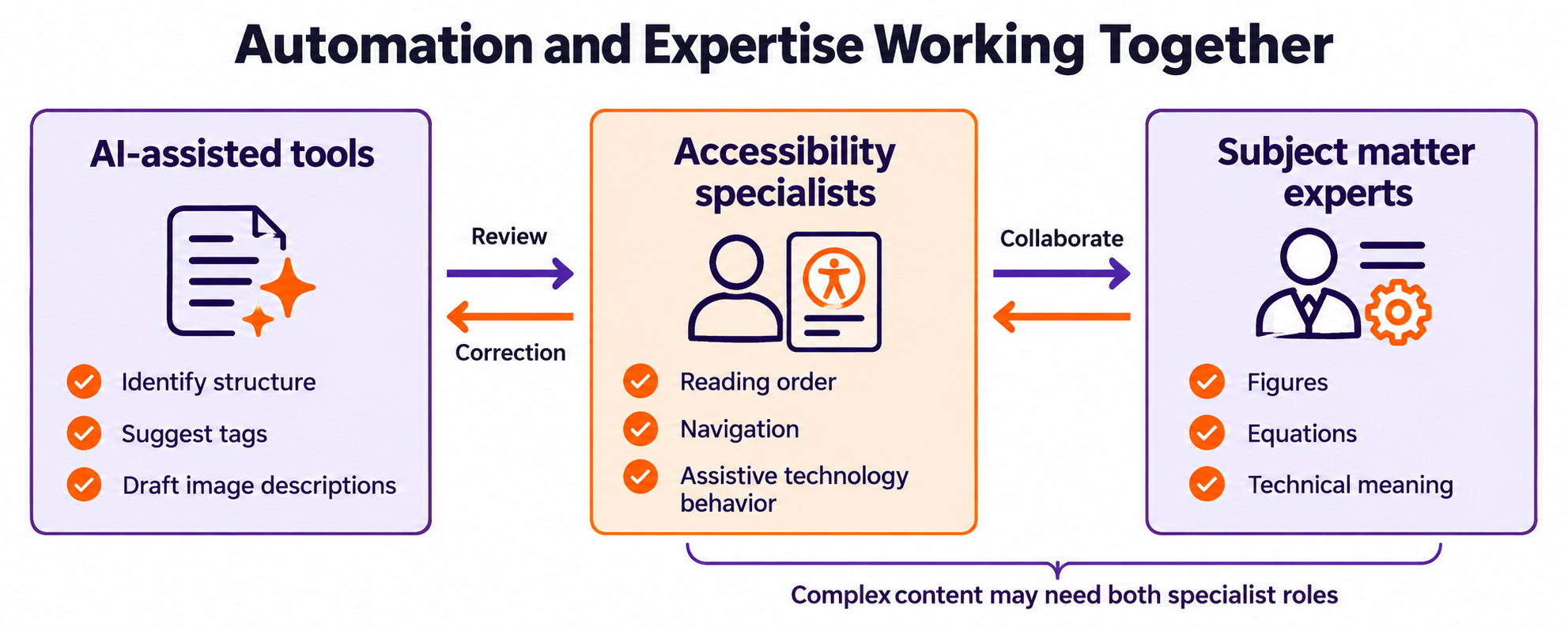
Figure 2: Agentic AI coordinates assessment, creation, and validation, with accessibility specialists and SMEs reviewing content according to its complexity and intended use.
Validate what users will receive
An AI quality score helps route work. It does not, by itself, establish accessibility or legal compliance.
Define completion before remediation begins. Specify applicable requirements, checks appropriate to each format, and accountability for release. Combine automated checks with manual evaluation and assistive technology testing suited to the content.
W3C’s evaluation guidance states that tools alone cannot determine whether a website meets accessibility standards. Although that guidance concerns websites, its emphasis on knowledgeable human evaluation is relevant when planning content validation.
Test meaningful tasks, such as navigating sections, interpreting a table, or completing a form. Where appropriate, include people with disabilities to identify barriers that technical checks may miss.
Resolve identified issues and retest affected content. Check the published output as well as the working file, because conversion or platform processing can affect accessibility features.
Keep a validation record tied to the delivered version, including the testing scope, findings, and release decision. Apply proportionate checks after later changes.
Measure timely access as well as output
Page counts show activity. Leaders also need to know whether people receive usable content when they need it.
Track a small set of measures:
- Demand versus accepted completions: Is the service keeping pace?
- Turnaround and overdue work: Where does time go, including processing and waiting?
- First-pass acceptance and rework: Which issues keep returning?
- Time-sensitive delivery: Did accessible content reach users by the required date?
- Barriers reported after delivery: What was missed, and how quickly was it resolved?
Use consistent acceptance criteria so completion figures represent reviewed deliveries. Examine the causes before adding capacity. Repeated table errors may require better source templates or training. Delays awaiting originals may require stronger intake controls.
Use these findings to improve author guidance and production practices, reducing avoidable remediation in future publications.
Build your accessibility delivery plan now
Start with one recurring content stream or priority collection. Assign an owner, confirm the applicable requirements, and establish intake, expert review, validation, and delivery commitments. Then use several delivery cycles to identify what needs to change before expanding.
For public higher education leaders, this creates a practical route toward the applicable ADA Title II deadline and continuing delivery afterward. For publishers, it strengthens the ability to supply accessible content as institutional requirements evolve.
Straive brings Agentic AI, accessibility specialists, and human-in-the-loop SME review together to support backlogs, ongoing production, and urgent requests.
Book an accessibility consultation with Straive. Bring your priority collection, content formats, and target dates to discuss remediation priorities, review capacity, and a phased delivery plan.

Straive helps clients operationalize the data> insights> knowledge> AI value chain. Straive’s clients extend across Financial & Information Services, Insurance, Healthcare & Life Sciences, Scientific Research, EdTech, and Logistics.


