
Posted on: October 1st 2026
A publisher’s account record can be strangely selective. It shows a researcher the precise status of her submitted manuscript, yet prompts her to create a new profile when another journal invites her to review. Her changed affiliation explains why some details require updating; it does not explain why she must re-enter her basic information and research interests. To bridge these profile gaps, publishers are increasingly adopting centralized tokenized profile hubs and automated ORCID synchronization. These technical architecture choices enable secure data exchange and real-time updates across disparate journal systems without compromising account boundaries.
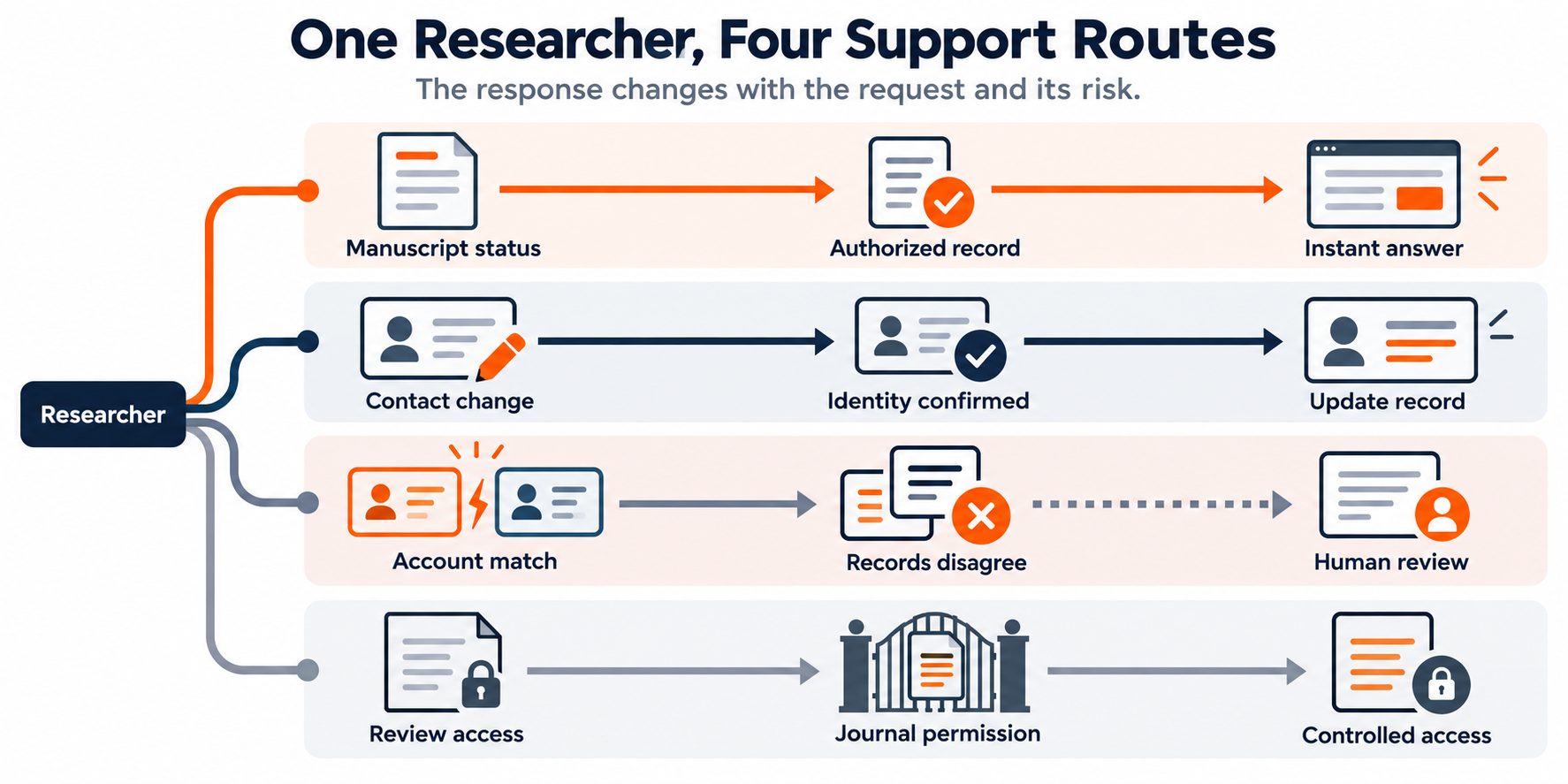
The review invitation also introduces questions her author account cannot resolve: Is she available? Does she have a conflict of interest? Has the journal granted her access to its unpublished manuscript? These checks belong specifically to the assignment. The publisher’s challenge is to spare her redundant introductions while retaining the verification steps that keep peer review trustworthy.
The distinction becomes critical when two accounts conflict. One retains her former institution and a shortened name; the other contains her current affiliation and a new email address. While an authenticated ORCID connection helps establish identity, conflicting details still require confirmation before merging records. A mistaken match is more than an untidy profile—it can mistakenly attribute another scholar’s work or expose confidential material to the wrong recipient. Furthermore, account merging and identity verification must strictly adhere to data privacy standards such as GDPR and rigorous data retention policies, ensuring personal data processing remains lawful, transparent, and bounded.
Support workflows must adapt to these varying scenarios. A routine status inquiry can be resolved directly from the authorized manuscript record, and a confirmed contact update follows a standard procedure. However, an uncertain identity match requires human review to evaluate evidence and resolve discrepancies directly with the researcher. She should be able to reach that support specialist without repeatedly explaining her query, listing the accounts involved, or re-verifying completed checks.
Consider when a researcher accepts a guest-editing appointment: the publisher verifies her identity, but identity is only the first component of access control. The appointment may cover a single collection, a specific set of submissions, or a defined timeframe. If her editorial account remains active beyond that window, the identity match remains accurate while the access permission becomes invalid. These scenarios introduce significant backend workflow challenges for journal administrators, who must continuously audit peer review histories and manage complex multi-journal permission hierarchies to maintain editorial integrity across entire portfolios.
Her records also span different temporal contexts. Her current affiliation belongs in active contact details, whereas the affiliation printed on an earlier publication reflects where she worked when that research was conducted. A review assignment ends, but a published article remains fixed. Forcing these distinct records into a single, continuously overwritten profile risks erasing context vital to the scholarly record.
A smooth support handoff respects these boundaries. If she cannot access a manuscript assigned to her as guest editor, the support team needs immediate context: which link failed, what identity checks were completed, and which appointment is active. The journal team can then evaluate her permissions. Crucially, the support professional resolving the technical issue does not need global access to the collection’s submissions or her confidential review history.
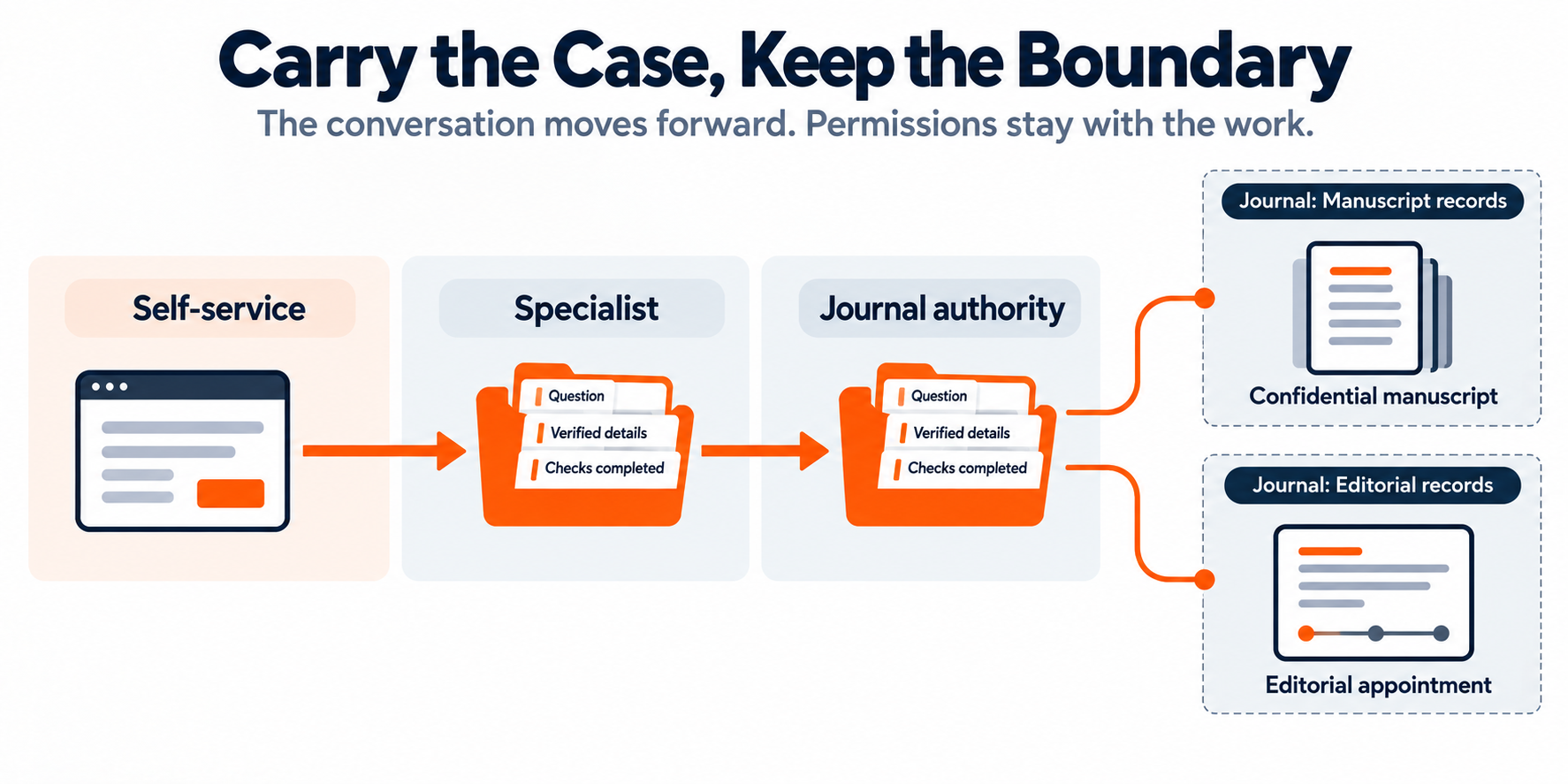
Straive’s support model categorizes inquiries into routine automated answers, supported actions, human review cases, and specialist interventions. In scholarly publishing, these routes depend as much on explicit authorization as on technical complexity. Straive’s Author 360 positioning complements this by identifying researchers across multiple roles. Applied together as an operational framework, these tools ensure support systems retain context and past user actions while individual journals maintain full control over manuscript access and editorial authority.
When this model functions seamlessly, the user experience is effortless. The researcher checks manuscript statuses instantly, updates contact information once, and connects directly with the right specialist when account discrepancies arise. Requiring her to declare conflicts before reviewing new submissions remains an essential safeguard—confirming that the publisher manages account responsibilities with precision.

Priya Roy is Vice President, Delivery Leadership at Straive, where she translates ambitious growth strategy into high-performing customer experience and technology operations. With deep expertise in large-scale transformation, she offers a practical leadership perspective on scaling AI, elevating service excellence, and turning operational complexity into lasting enterprise value.


