
Posted on: September 29th 2026
New discovery technologies can make content more useful through better retrieval, synthesis, and access, but their impact depends on content quality, permissions, and implementation.
The web rewarded organizations that made documents searchable. AI will reward those that make the knowledge within those documents usable.
This shift is leading many content-heavy enterprises toward an understandable but potentially expensive conclusion: every archive must now be converted into deeply structured, AI-ready content.
I believe that is the wrong goal.
Having worked across successive waves of content transformation, I have learned that the most technically complete solution is not always the most commercially intelligent one. The real objective is not to convert the largest possible volume of content. It is to apply the right level of structure to the knowledge that can create the greatest value.
The level of structural investment should follow the value of the content, not the size or age of the archive.
That principle should guide how publishers, research organizations, legal information providers, education companies, and other content-rich enterprises prepare their knowledge for AI.
Yesterday’s Strategy Was Right for Yesterday’s Economics
For decades, organizations made a practical trade-off between discoverability and cost. They captured enough information to help people find content without incurring the expense of structurally enriching every page/asset in their archives.
Academic publishers, for example, often used a Head & Tail approach for large backfiles. Titles, abstracts, authors, keywords, and references were captured as structured data, while the main body remained a PDF.
This approach enabled search and indexing systems to surface publications at a manageable cost. It was not a failure of foresight or an incomplete digital strategy. It was an effective response to the technology, customer behavior, and budget realities of the time.
The person searching for information still completed the most difficult part of the process. Once the search engine surfaced a relevant document, the reader opened the PDF, interpreted its contents, and decided how to use the knowledge.
AI changes that division of labor.
The Shift From Finding Documents to Using Knowledge
AI agents are increasingly expected to do more than point users toward a document. They may need to enter it, locate a specific piece of evidence, compare it with other sources, interpret the context, and apply the result within a research or business workflow.
Consider the difference.
A search engine may identify a technical report using its title and keywords. An AI agent may be asked to extract a result from a table, compare it with findings from 50 other reports, explain the differences, cite the supporting passages, and recommend the next action.
This does not mean PDFs have become obsolete or invisible. Many AI systems can process clean, digitally generated PDFs. The difficulty arises when they encounter scanned pages, multi-column layouts, embedded tables, mathematical expressions, complex figures, footnotes, or inconsistent reading order.
A person can often infer the relationships among these elements visually. A machine must reconstruct them. When the underlying structure is unclear, the AI may still produce an answer, but the enterprise must spend more to establish whether that answer is accurate.
The result is higher processing cost, more validation, greater dependence on human review, and less confidence in automated outputs.
The question is not whether AI can open a PDF. It is whether AI can use the information in it accurately, quickly, cost-effectively, and at scale.
Structured content makes that task easier. It gives sections, tables, figures, equations, entities, references, and relationships explicit identities. Standards such as JATS provide a common XML structure for journal content, while richer and well-maintained metadata improves how digital systems discover and connect content, as reflected in Crossref’s metadata principles.
But the value of structure does not justify converting everything.
Stop Treating the Archive as One Asset
One of the most persistent mistakes in enterprise content strategy is treating an archive as though every document within it carries equal value.
We have seen archives in which a relatively small share of the content accounts for most usage, citation activity, and commercial demand. Treating every document equally would spread investment across the archive rather than concentrating it where structure could create measurable value.
A highly cited research collection, a premium legal database, a technical manual used in daily operations, and a document retained for historical or compliance purposes should not receive the same investment.
Their audiences are different. Their commercial potential is different. The cost of an inaccurate AI response is different. Most importantly, the work each asset is expected to perform is different.
AI readiness should therefore be managed as a portfolio decision. Leaders should evaluate content according to its current demand, strategic relevance, rights status, complexity, revenue potential, and importance to priority AI use cases.
This also creates room for on-demand transformation. Content does not always need to be fully enriched in advance. Some assets can remain in a cost-efficient archival state until customer demand, licensing interest, or a defined workflow justifies further investment.
This is not a compromise in ambition. It is disciplined capital allocation.
Three Levels of Content Investment
A practical portfolio can apply three levels of treatment.
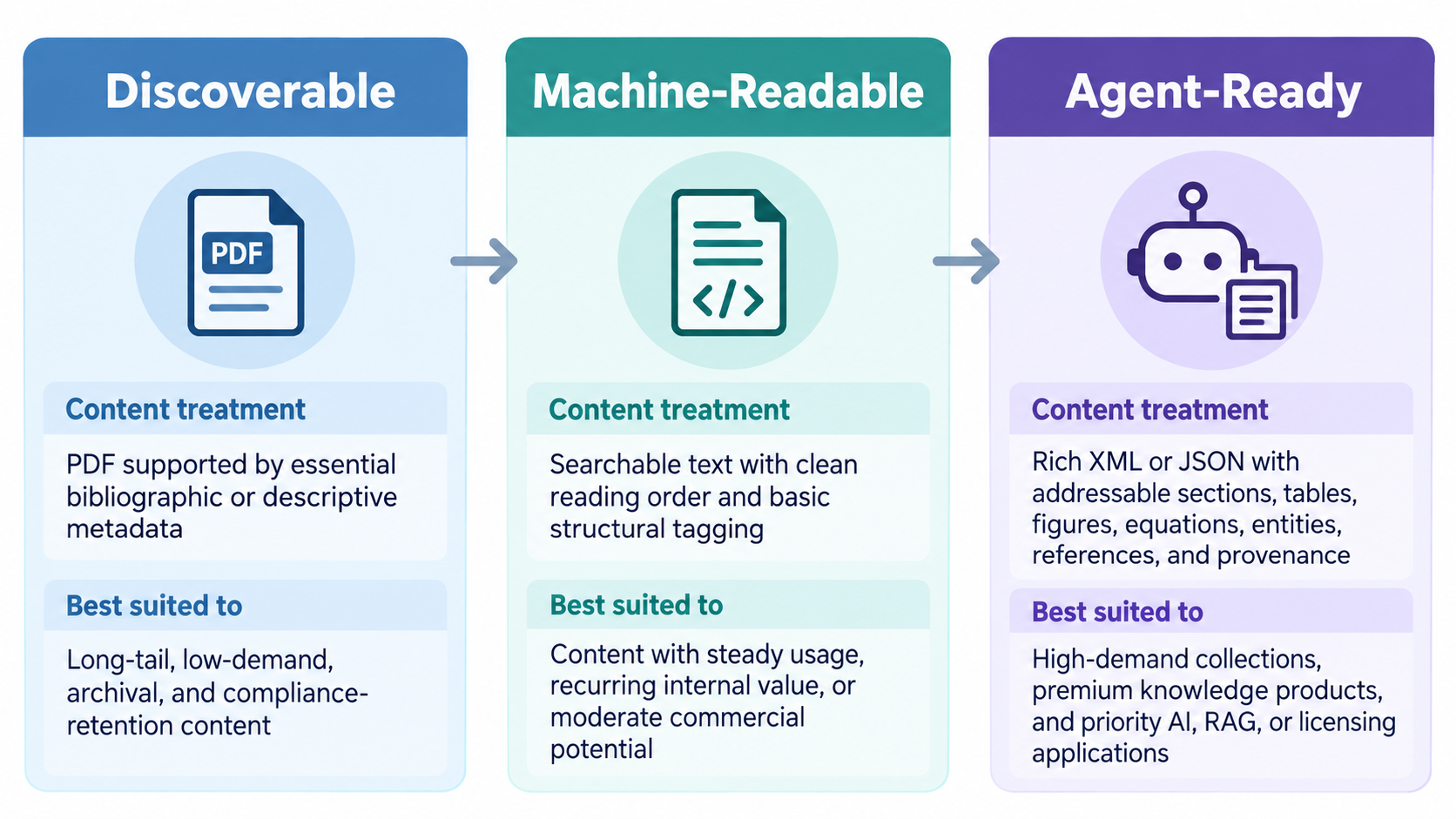
Figure 1: Three levels of content investment progress from basic PDF discoverability to structured, machine-readable content and fully agent-ready knowledge assets.
These are investment levels, not permanent labels.
Usage patterns, citation activity, customer behavior, and product priorities can change the value of an asset. A niche collection may become strategically important when a new field emerges. A technical archive may gain value when connected to a customer-support or compliance workflow. A dormant backfile may warrant deeper treatment when a licensing opportunity appears.
The portfolio should evolve as the value of the content evolves.
The Cost of Inaction Is Also Uneven
Organizations should be equally selective when evaluating the cost of doing nothing.
If low-demand archival content remains minimally structured, the commercial effect may be negligible. If high-value knowledge remains difficult for AI systems to interpret, the consequences can be significant.
Important findings may be absent from AI-assisted answers. Valuable intellectual property may remain buried in tables, figures, appendices, or disconnected repositories. AI products may require repeated document processing and costly validation. Licensing opportunities may weaken because potential partners must first absorb the cost and risk of preparing the content for use.
The greatest risk is not that every document will become invisible. It is that an enterprise’s most valuable knowledge will be harder to use than a competitor’s.
Competing on the Usability of Knowledge
The next phase of content strategy will not be won by the organization that converts the most pages. Nor will it be won by the organization with the largest archive.
It will be won by organizations that know which knowledge matters, what work it should perform, and how much structure that work requires.
For executive teams, that means asking more disciplined questions:
- Which content only needs to remain discoverable?
- Which knowledge is repeatedly used but costly for AI to interpret?
- Which collections could support premium products, licensing, or automated workflows?
- Where would greater structure materially improve accuracy or reduce operating cost?
- Which assets should be enriched now, and which should be transformed when demand emerges?
The purpose of AI readiness is not to create a technically perfect archive. It is to create a commercially intelligent one.
Yesterday, the competitive advantage was making content searchable. Tomorrow, it will be making the right knowledge usable at the moment it is needed.
That is not simply a content-conversion challenge. It is a decision about where the enterprise believes its future value will come from.

Business Head, Science & Research, Straive


