
Posted on: September 16th 2026
The global research ecosystem is facing an unprecedented bottleneck. Submissions continue to climb, editors struggle to secure willing evaluators, and reviewers are exhausted. This precise supply-demand mismatch is why this year’s Peer Review Week theme, “Peer Review Capacity: Volume, Speed, and Quality” cuts directly to the heart of the crisis. How can scholarly publishing handle growing volume and accelerate turnaround times without eroding rigor?
Emerging technology offers a compelling answer. Generative AI offers a promising pathway—a step-by-step journey where rules, ethical guardrails, and standards still need to be laid out. However, it must be deployed as an adjunct rather than a replacement. For instance, Large Language Models (LLMs) can expand reviewer capacity while preserving expert human judgment if they are specifically positioned as a co-pilot.
Here is how this co-pilot model transforms peer review across three core operational areas.
Expanding Capacity to Handle Submission Volume
Evaluating a paper’s scientific rigor, methodology, and validity is what reviewers are trained to do, and it is rarely what exhausts them. The true cause of burnout and delay is the friction surrounding the core science: formatting checks, dense writing, missing citations, and manual administrative tasks.
AI handles time-consuming, non-evaluative chores like grammar correction, formatting checks, and structural summaries. As an immediate benefit, reviewers reduce administrative overhead and process higher submission volumes without burning out. However, the ultimate goal is to free up mental bandwidth, allowing human reviewers to direct their full critical focus toward what matters most: assessing the quality and credibility of the research.
- Rapid Contextualization: AI tools rapidly digest and condense extensive background sections and literature reviews. This helps reviewers establish the study’s context quickly and concentrate on what is genuinely new, including its methodology, findings, and conclusions.
- Structural Auditing: Language models can scan manuscripts to check whether figures match in-text citations, required reporting guidelines (e.g., PRISMA, CONSORT) are met, or key datasets are properly linked. Automating these mechanical checks improves consistency and allows reviewers to devote more attention to scientific rigor.
- Accessibility Across Borders: Academic papers often use overly complex, dense English. Large Language Models (LLMs) can rewrite or simplify that difficult phrasing into clear, plain English without changing the core meaning. This enables non-native English reviewers to interpret manuscripts more confidently and supports broader participation in global peer review.
| AI targets the administrative friction surrounding peer review, preserving human intellectual energy for deep scientific scrutiny and methodological evaluation. |
Reducing Turnaround Times
Delays in peer review create a critical bottleneck with far-reaching consequences—slowing medical advancements, policy decisions, and career progression. AI tools alleviate this friction by streamlining drafting and simplifying dense text, significantly accelerating the feedback loop between reviewers and authors.
Ultimately, using AI to eliminate these delays speeds up the entire pace of scientific progress.
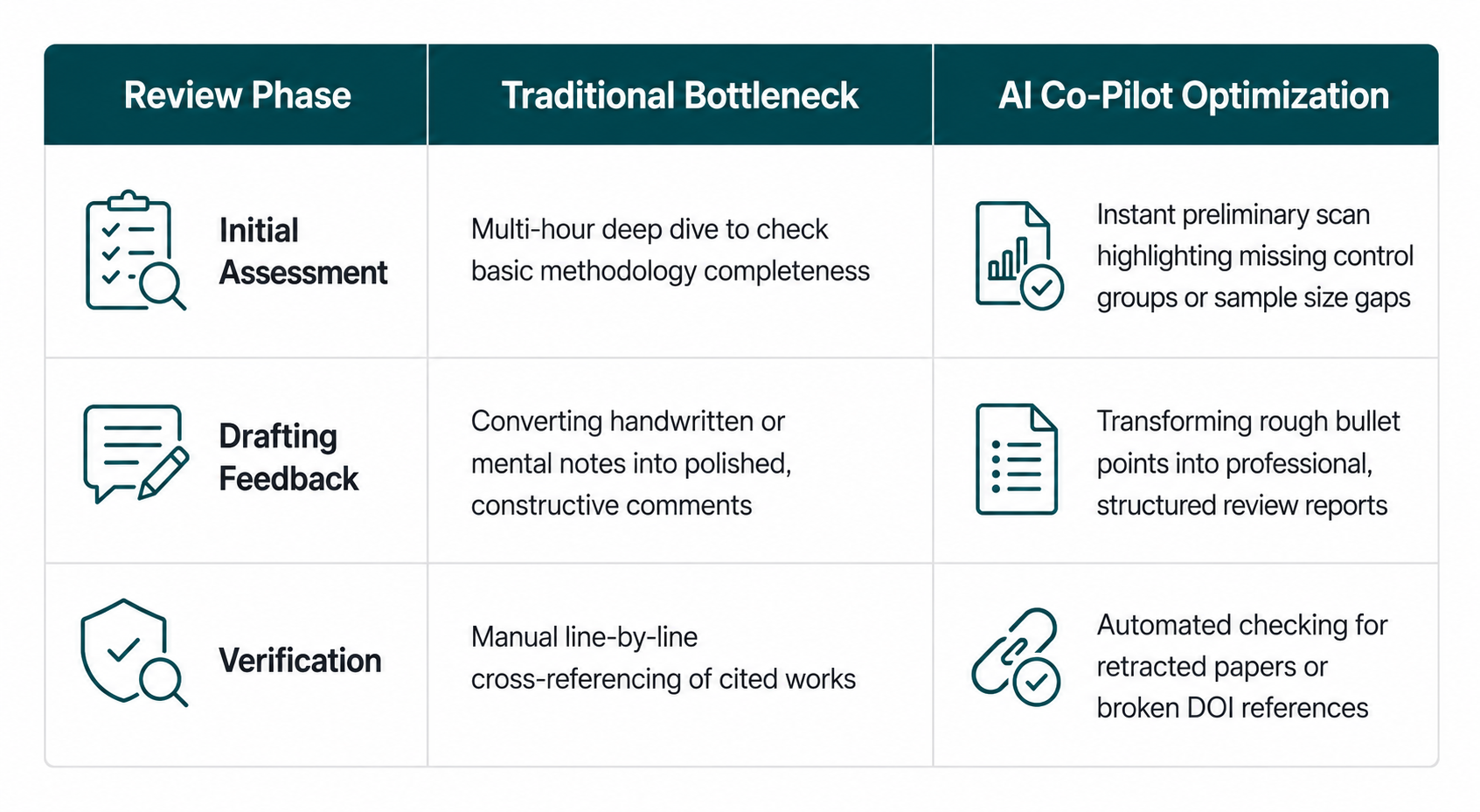
Figure 1: Side-by-side comparison showing how AI co-pilots streamline and modernize the three main stages of the peer-review process.
The Non-Negotiable Human Element
The fundamental boundary when integrating AI into research is clear: efficiency cannot come at the expense of human critical thinking. While processing papers rapidly is valuable, speed is useless if the quality of evaluation drops.
AI excels at mechanical tasks like summarizing data and formatting text. Because AI remains prone to errors and hallucinations, strict ethical boundaries are non-negotiable. These rules serve as essential guardrails for scientific research. By protecting accuracy, trust, and overall quality, they ensure AI enhances the peer-review process rather than undermining it.
To maintain these standards, three key ethical boundaries must be enforced:
- Zero Delegation of Judgment: The AI acts as a fast scanner that catches technical flags or numerical inconsistencies a human might miss. However, because AI lacks contextual understanding, only a human expert can evaluate a flagged error and decide whether it invalidates the research or is merely a harmless typo. Ultimately, AI points out where to look, but humans make the final call.
- Mitigating Hallucinations: AI can accelerate initial screening, but its outputs may contain fabricated references, factual errors, or misinterpreted experimental details. Qualified experts must therefore validate every AI-generated recommendation before it informs an editorial decision. AI may reduce routine work, but it does not eliminate the need for rigorous human oversight.
- Preventing Homogenization: Every human reviewer brings a unique voice, background, and perspective to their evaluation. However, when reviewers rely heavily on the same AI tools to draft feedback, reviews quickly become homogenized. AI models naturally default to safe, generic language, which strips away sharp, field-specific insights and reduces critical analysis to superficial commentary. Ultimately, using AI as a substitute for original drafting destroys the diversity of thought that gives peer review its core value.
| Key Guardrail: Efficiency must never supersede human critical thinking. AI tools can rapidly flag administrative details and technical inconsistencies, but human experts must retain exclusive authority over evaluative judgment, fact verification, and original narrative critique. |
The Ethical Guardrails
Applying these ethical principles to daily review work requires firm operational standards. To safely integrate AI tools into peer review workflows, researchers and publishers must enforce three non-negotiable guardrails:
Strict Manuscript Confidentiality
Uploading unpublished research into standard commercial AI tools exposes sensitive material to third parties. This practice compromises author confidentiality and breaches intellectual property protections. To mitigate these risks, reviewers must rely exclusively on secure, institutionally approved platforms configured for high-level data privacy. Under this mandatory standard, the operating system must guarantee that user input is never retained or used for future model training.
Transparent Disclosure
Editors and authors maintain a fundamental right to complete clarity regarding how an evaluation was produced. Consequently, reviewers must explicitly declare whether AI tools assisted their critique, rather than keeping machine involvement hidden. Transparency requires detailing the exact role the system played, such as refining grammar, generating summaries, or verifying citations. This level of disclosure ensures every participant understands the precise scope of machine assistance.
Ultimate Accountability
Human reviewers remain solely responsible for the contents of their evaluations, as their names, professional standing, and academic reputations are tied directly to the final report. Consequently, reviewers cannot shift liability to software. Should an AI tool overlook a critical flaw, introduce bias, or present inaccurate data, the person submitting the review bears full responsibility. While AI can function as a supportive asset, it can never serve as a scapegoat. Ultimate accountability always rests with the human expert.
| Non-Negotiable Protocols: Secure environments protect manuscript privacy, full disclosure ensures procedural transparency, and human reviewers bear ultimate responsibility for every evaluation. |
The Path Forward
The capacity crisis in academic publishing presents an opportunity to rethink the role of AI in peer review. Its potential is no longer limited to mechanical tasks such as language refinement, structural checks, and information retrieval. Emerging AI systems can also analyze evidence, question assumptions, identify inconsistencies, and uncover errors that have remained undetected for decades. The question is therefore not whether AI can support critical thinking, but whether reliable solutions can apply these capabilities responsibly within peer review. Recent developments suggest that this shift is already underway.
Solutions such as Straive’s aiKira Reviewer Suggest and aiKira Review Assist bring this co-pilot model into the publishing workflow. aiKira Reviewer Suggest identifies suitable reviewers using article information, estimates their likelihood of accepting an invitation, retrieves their publication histories, and checks for conflicts of interest. aiKira Review Assist helps researchers examine manuscripts more quickly and confidently, including papers that extend beyond their primary areas of expertise.
This expanded role for AI does not diminish the importance of human reviewers. Instead, it gives them stronger analytical support while they retain accountability for scientific judgment and final decisions. With clear ethical boundaries, transparent processes, and appropriate oversight, AI can help ease reviewer workloads, strengthen manuscript evaluation, and build a faster, more resilient, and trusted peer-review system.

Straive helps clients operationalize the data> insights> knowledge> AI value chain. Straive’s clients extend across Financial & Information Services, Insurance, Healthcare & Life Sciences, Scientific Research, EdTech, and Logistics.


