
Posted on: September 2nd 2026
Moving Beyond the PDF in the AI Era
For more than three centuries, scientific publishers have served as the custodians of scholarly communication. Their value was built on curating, validating, and distributing knowledge. But in the age of generative AI, intelligence—rather than distribution—is the differentiator.
The next generation of publishing leaders will compete by building intelligent knowledge ecosystems. These ecosystems will go beyond hosting text to structure and synthesize scientific content, helping researchers extract insights in real time.
Value is therefore shifting from the format in which research is delivered to the insights that can be derived from it. As publishing evolves from a content-distribution business into an intelligence business, publishers must reconsider how they structure content, support AI-driven discovery, and protect the integrity of the scholarly record.
Enabling Speed to Insight: Deconstructing the PDF
The traditional publishing model was built for human readers. To find a specific result, a researcher typically had to download, open, and read a PDF. AI-powered research tools are changing this behaviour by enabling users to ask questions and receive synthesized answers drawn from multiple sources.
To answer these queries, AI systems break documents into smaller, retrievable units. When a researcher asks a copilot for a specific methodology, the system retrieves a relevant passage rather than presenting an entire 15-page document.
In this agentic workflow, content delivered as PDF creates clear limitations because its margins, fonts, page breaks, and visual hierarchy were designed for human reading rather than automated processing.
As a result, the long-term value of research increasingly depends on whether its findings, methods, citations, and supporting data can be accurately discovered and interpreted by machines. While the PDF continues to serve as an accessible visual output for human readers, it can no longer function as the core information structure for AI workflows.
To power these workflows and deliver true speed to insight, publishers must focus beyond the article PDF to semantic enrichment and connected data.
Unlocking Supplementary Materials: From “Dead Files” to High-Value Data Assets
Historically, supplementary materials such as raw CSV files, high-resolution imaging, computational scripts, genomic sequences, and extensive tabulations were treated as secondary attachments. Buried as unstructured, non-standardized PDF/ZIP addenda, supplementary data was largely invisible to search engines and completely inaccessible to automated tools.
Today, global research mandates require a fundamental shift. Under frameworks like the NIH Data Management and Sharing Policy and guidelines established by the FAIR Data Principles (Findable, Accessible, Interoperable, Reusable), supplementary data is moving to center stage:
- Machine Actionability over File Storage: AI scientific agents go beyond reading text. They execute code, benchmark data models, and perform cross-study meta-analyses. Machine-actionable, repository-linked research data are designed to improve discoverability and reuse. A large-scale study also associated repository-linked data with up to 25.36% higher citation impact for the related papers.
- Persistent Identifiers (PIDs) for Data Objects: Established repositories such as Dryad and Zenodo assign DOIs to deposited datasets, enabling them to be identified and cited independently of the main manuscript. When repository metadata and version identifiers are indexed and retained by an LLM- or RAG-based system, the system can retrieve and reference the relevant dataset or version more precisely.
- Code and Computational Reproducibility: Platforms such as Code Ocean can package supplementary code, data, dependencies and computing environments into executable workflows, while GitHub integrations support code import and version control. The FORCE11 Software Citation Principles provide guidance for identifying and citing specific software versions. When appropriately configured, agentic AI tools can run scripts and automated tests in isolated environments, helping researchers verify execution and reproduce computational steps.
By decoupling supplementary materials from static PDFs and storing them in standardized, semantically indexed schemas, publishers convert raw secondary files into core AI training and retrieval infrastructure.
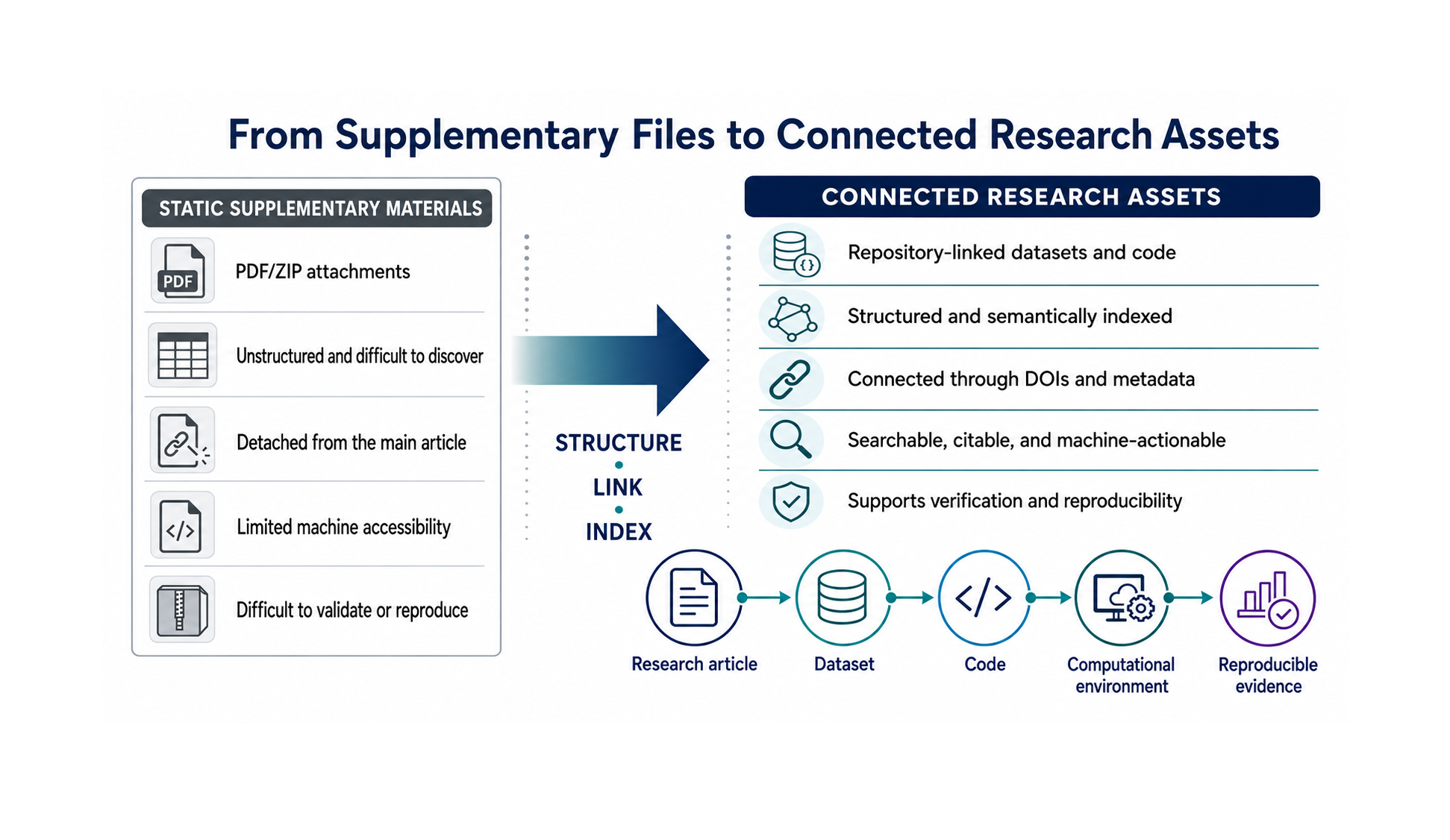
Figure 1: Structuring supplementary files as connected research objects makes them more discoverable, citable, and reusable by researchers and AI systems.
Architecting Content Delivery: Solving AI Challenges with Metadata
While people can infer meaning from headings, references, tables, and surrounding context, AI systems perform more reliably when these relationships are explicitly structured. Large language models (LLMs), scientific copilots, and autonomous research agents can process scientific content through standardized structures such as JSON schemas, knowledge graphs, and vector representations. These structures support more accurate retrieval, validation, comparison, and analysis.
LLMs can produce unsupported answers and generally lack access to proprietary publisher data. To address these limitations, organizations use Retrieval-Augmented Generation (RAG), which allows an AI model to retrieve information from approved sources before generating a response. However, the reliability of a RAG system depends on the quality and structure of the content— and associated supplementary data—it retrieves.
Semantically enriched metadata has therefore evolved from an operational afterthought into essential AI infrastructure. It helps publishers address three practical challenges:
- The “garbage in, garbage out” problem: When an AI system receives poorly structured PDFs or unindexed supplementary spreadsheets, it may misread formatting, overlook context, or generate inaccurate answers.
- The loss-of-context problem: Documents and supplementary files must often be divided into smaller passages or vectors before retrieval. Metadata linking each snippet/dataset back to its parent study, protocol, access rights, and variable definitions helps the AI preserve context.
- The need for controlled retrieval: In high-stakes fields such as medicine, law, and bio-engineering, plausible answers are not enough. Rich metadata constrains AI systems to verified, peer-reviewed, and appropriately governed sources.
Metadata is therefore no longer simply about improving search or managing production. It determines whether scholarly content and supporting empirical data can be used accurately, responsibly, and at scale within AI-enabled research workflows.
The Playbook for the Next Data Revolution
This shift mirrors the defining data transformations of the last few decades:
- Bloomberg transformed raw financial information into indispensable intelligence workflows.
- Google transformed disconnected web pages into a structured search ecosystem.
- Spotify transformed static audio files into a personalized recommendation engine.
Scientific and enterprise publishing is undergoing a similar transformation. Content remains the foundation, but its value increases when articles, supplementary datasets, and research code are structured, connected, and accessible within the workflows where users make decisions. For publishers, a unified semantic data strategy is therefore essential to building a credible AI roadmap.
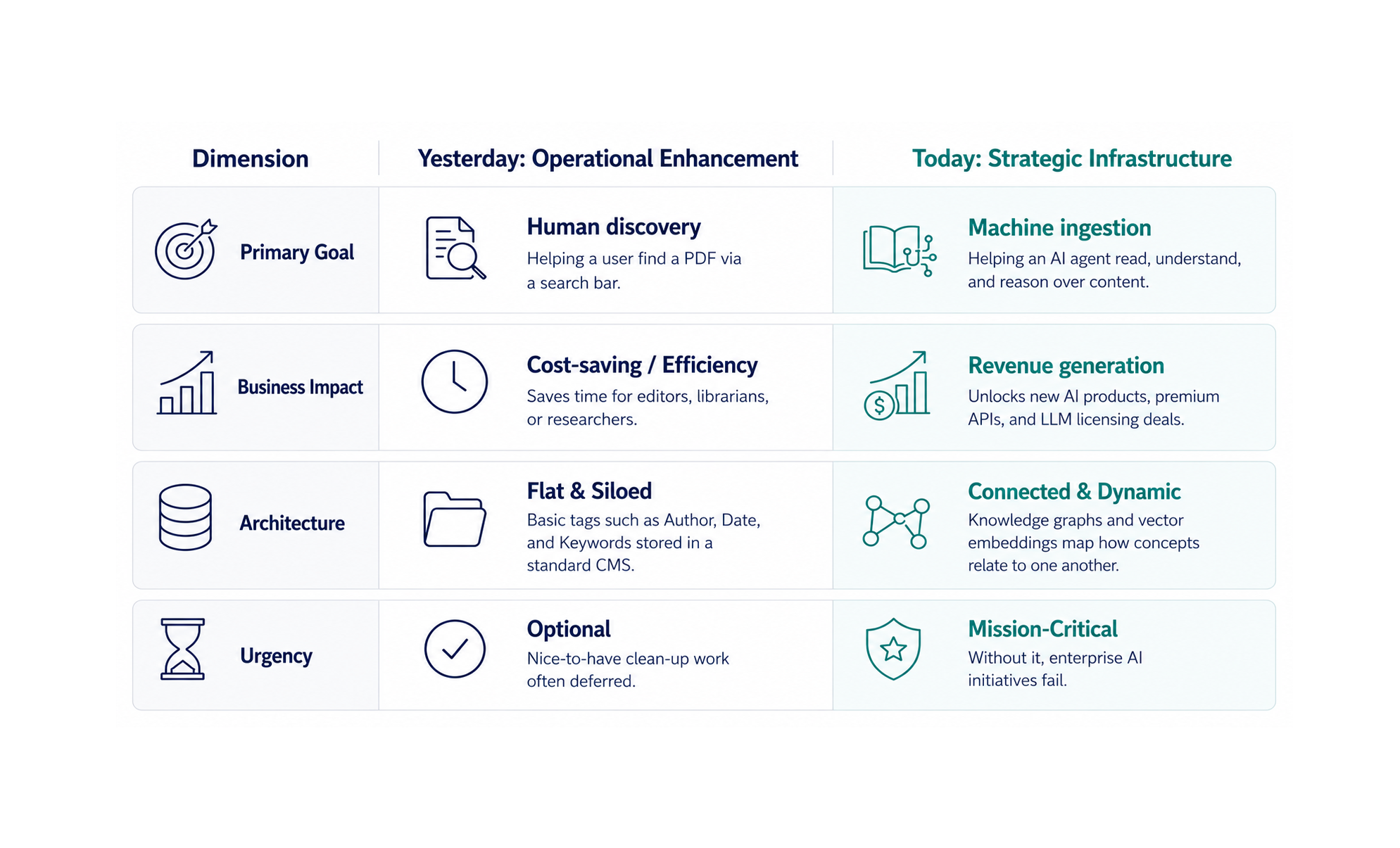
Figure 2: The Shift in Value: Metadata Enrichment Then vs. Now
From Publisher to Intelligence Platform: A Strategic Blueprint
The strategic question for industry leaders is no longer simply, “How do we publish more efficiently?” It is also, “How can we make trusted scholarly knowledge— and its underlying data assets—more useful within emerging research and AI workflows?”
This transformation requires coordinated progress across three areas: technology, organizational design, and trust.
1. Build a structured technical foundation
Moving from text hosting to intelligence delivery requires publishers to invest in:
- Semantic technologies and knowledge engineering: Creating rich metadata that allows both people and machines to understand the meaning, empirical datasets, and context of research.
- Graph-based architectures: Mapping relationships among authors, raw datasets, code repositories, institutions, publications, and concepts.
- FAIR supplementary data integration: Enforcing machine-actionable data submission standards (DOIs, ORCIDs, standardized schema extensions like Schema.org/Dataset).
- AI infrastructure and governance: Building secure environments for LLM and RAG applications while protecting copyright, access rights, and data provenance.
2. Align teams around an intelligence strategy
Technology alone cannot deliver this transition. Editorial, product, technology, and data teams must work toward a shared view of how content and supplementary data are structured, governed, delivered, and monetized.
Editorial teams must evolve from text curators into stewards of accurate, traceable research data objects. Product and technology teams must collaborate on interoperable, API-first data services, while data scientists and domain experts must work together to ensure AI systems consume verified supplementary evidence alongside the paper’s narrative.
3. Turn trust into differentiated value
As AI-generated scientific content proliferates, verification becomes more—not less—valuable. Publishers already possess assets that can provide a trusted foundation for AI-enabled research:
- Editorial rigor, peer-review systems, and empirical data audits
- Provenance controls and domain expertise
- Persistent identifiers (DOIs, RORs), structured metadata, and controlled taxonomies for texts and supplementary files
These assets can help publishers provide reliable inputs for scientific copilots, discovery tools, and other AI applications. They also open new monetization channels via data licensing models where verified scholarly texts and underlying structured data arrays are integrated directly into enterprise AI engines.
Research-intelligence platforms such as Elsevier’s SciVal and Clarivate’s InCites already demonstrate how scholarly information supports the analysis of research trends, performance, and impact. The journal brand remains central to this model—not only as a destination for readers, but as a signal of credibility within a broader network of connected research intelligence.
Conclusion: Structuring the Next Era of Scientific Publishing
Scientific publishing is undergoing a fundamental shift. Published papers are no longer static PDFs meant solely for human readers—they are dynamic networks of raw datasets, code, and interconnected facts that must be parsed by machines.
To bridge this gap, publishers must design for both researchers and AI systems simultaneously. Making content machine-ready requires structuring data behind the scenes—enabling AI to cross-reference findings, extract insights, and verify facts across thousands of papers instantly.
At Straive, we empower publishers to navigate this transition. Through semantic tagging, metadata enrichment, and knowledge graphs, we transform raw research files into trusted, connected knowledge that fuels both human discovery and AI platforms.
In this emerging era, the journal article becomes the hub for research-intelligence capabilities:
- Connected Knowledge: From isolated files to interconnected, machine-ready intelligence.
- Strategic Infrastructure: From a simple label into the foundation of scientific trust.
- New Value Creation: From static research into scalable AI value.
- Intelligence Orchestration: From content distributors to curators of scientific truth.
The organizations that combine verified content with structured, AI-ready delivery will be best positioned to shape the future of scientific knowledge.

Business Head, Science & Research, Straive


