
Posted on: August 26th 2026
AI content licensing has quickly moved from a niche negotiation to a major legal priority.
In 2024, 78% of organizations reported using AI, while global private investment in generative AI reached $33.9 billion. At the same time, AI developers faced dozens of copyright lawsuits in the United States and new regulatory requirements concerning the content used to train general-purpose AI models in the European Union. In response, AI developers and rightsholders are entering licensing deals covering books, images, news, music and other media. These agreements can give developers authorized access to valuable training content, create new revenue for rightsholders and help both sides manage copyright and related legal risks.
Yet executing these deals is far more complex than standard copyright licensing. Traditional IP agreements were not designed for machine learning. In an AI deal, content may be copied, cleaned, broken into smaller units, converted into embeddings and used across multiple models and products. Those models may then generate outputs at enormous scale. Moreover, standard licensing language may not adequately address issues such as permitted uses, exclusivity, data removal, output controls and liability.
Therefore, whether you are monetizing a valuable content archive or obtaining data to develop a proprietary model, the details matter. Before signing your next AI content licensing agreement, ask these nine essential questions.
What content is actually included?
Start with the basic question, what exactly is being licensed?
Treat broad descriptions such as “all content owned or controlled by the licensor” with care. Does that include archived material, metadata, images, user comments, future content or material supplied by freelancers, agencies and syndication partners?
The agreement should identify the covered content through a schedule, catalogue or other verifiable record. It should also explain how new material will be added and how withdrawn, expired or corrected content will be handled.
Remember that access to content does not equal authority to license it. A company may publish, host or distribute material without holding all the copyright, contractual, privacy or other rights required for the proposed AI use.
Deal point: Define the licensed content clearly, maintain an agreed inventory and establish a process for adding, correcting and removing works.
What can the AI company do with the content?
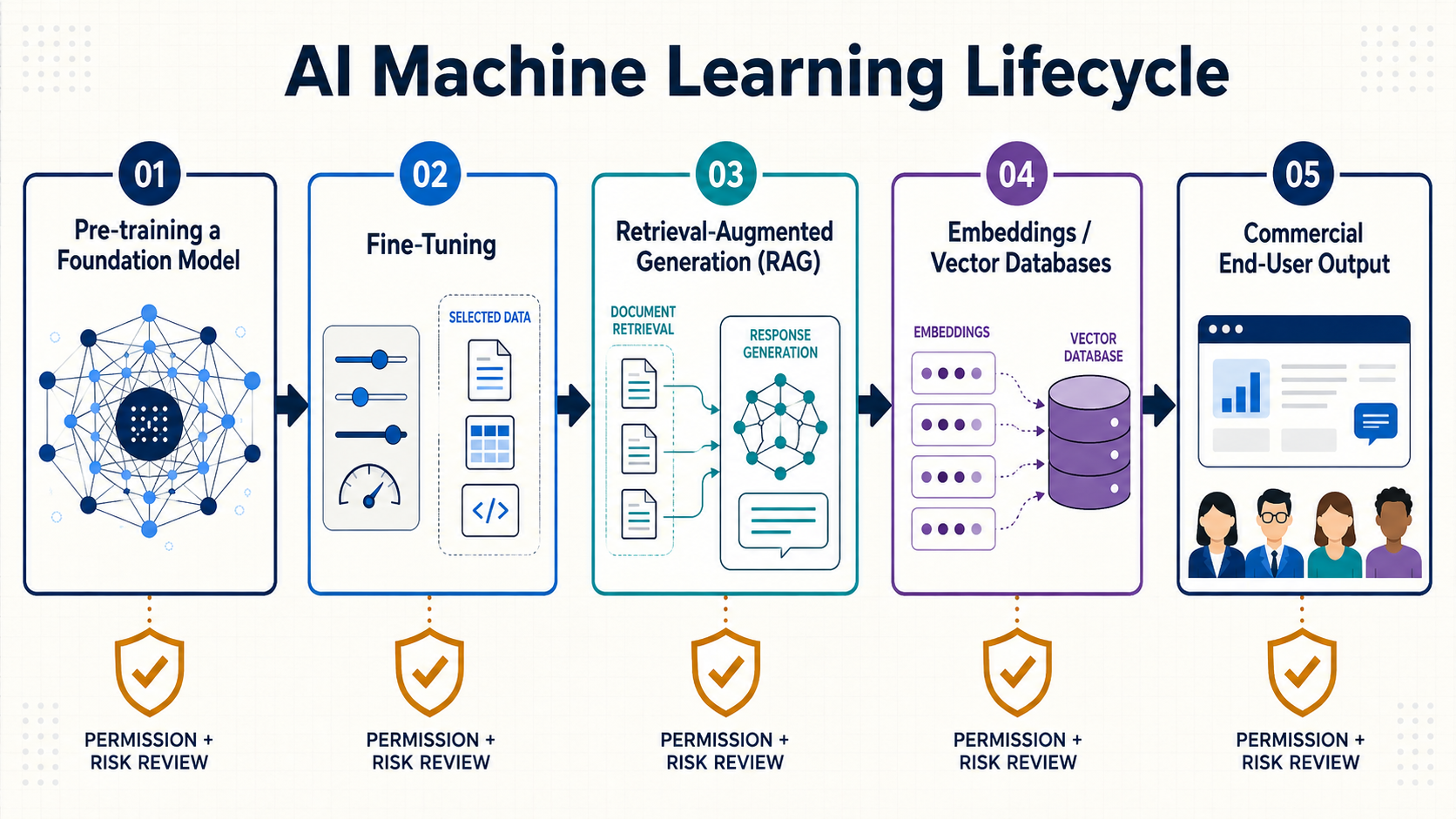
Figure 1: The AI machine learning lifecycle comprises distinct technical stages—from foundation-model pre-training to commercial output—each requiring separate legal permissions, rights analysis, and risk review.
Simply granting rights for AI purposes is far too general even for a normal commercial agreement. As machine learning involves distinct technical stages, a licensor must clearly define how their data will be used across the AI lifecycle.
Specifically, the agreement should distinguish between discrete activities such as:
- Pre-training a foundation model
- Fine-tuning an existing model
- Retrieval-augmented generation (RAG)
- Testing, evaluation, and safety research
- Creating embeddings or vector databases
- Producing synthetic or derived training data
- Improving future models and products
- Displaying licensed material or generated responses to end customers
Distinguishing between these stages is critical because they carry significantly different legal consequences. The U.S. Copyright Office highlights this distinction in its Report on Generative AI Training. It emphasizes that pre-training, fine-tuning, and RAG must be evaluated independently. Consequently, some training methods may qualify as fair use while others fail. The outcome depends on factors like source material, data ingestion, and output controls.
Though non-binding, this guidance reflects the agency’s official enforcement priorities. Therefore, to avoid costly disputes, legal teams should not depend on vague statutory interpretations.
Deal Point: Every agreement must explicitly define each permitted use and clearly state prohibited ones. Crucially, teams using evaluation grants must understand that internal testing rights do not permit training commercial AI products.
Does the licensor have all the necessary rights?
A basic copyright warranty is rarely enough for AI training datasets. Content often carries embedded third-party rights, from trademarks to personal data and publicity. Legacy agreements simply do not cover them.
Media involving voice, image, and video requires more due diligence. Beyond copyright, these formats trigger non-transferable personal rights like privacy, publicity, and biometric data protections.
Recognizing these gaps, the U.S.Copyright Office’s Digital Replicas Report warned that current laws inconsistently protect against unauthorized digital clones, increasing exposure for licensees.
Deal Point: Licensees should pair broad IP and privacy warranties with detailed disclosure schedules, dedicated claims procedures, and unmapped indemnities for AI-related claims.
How will payment be calculated and checked?
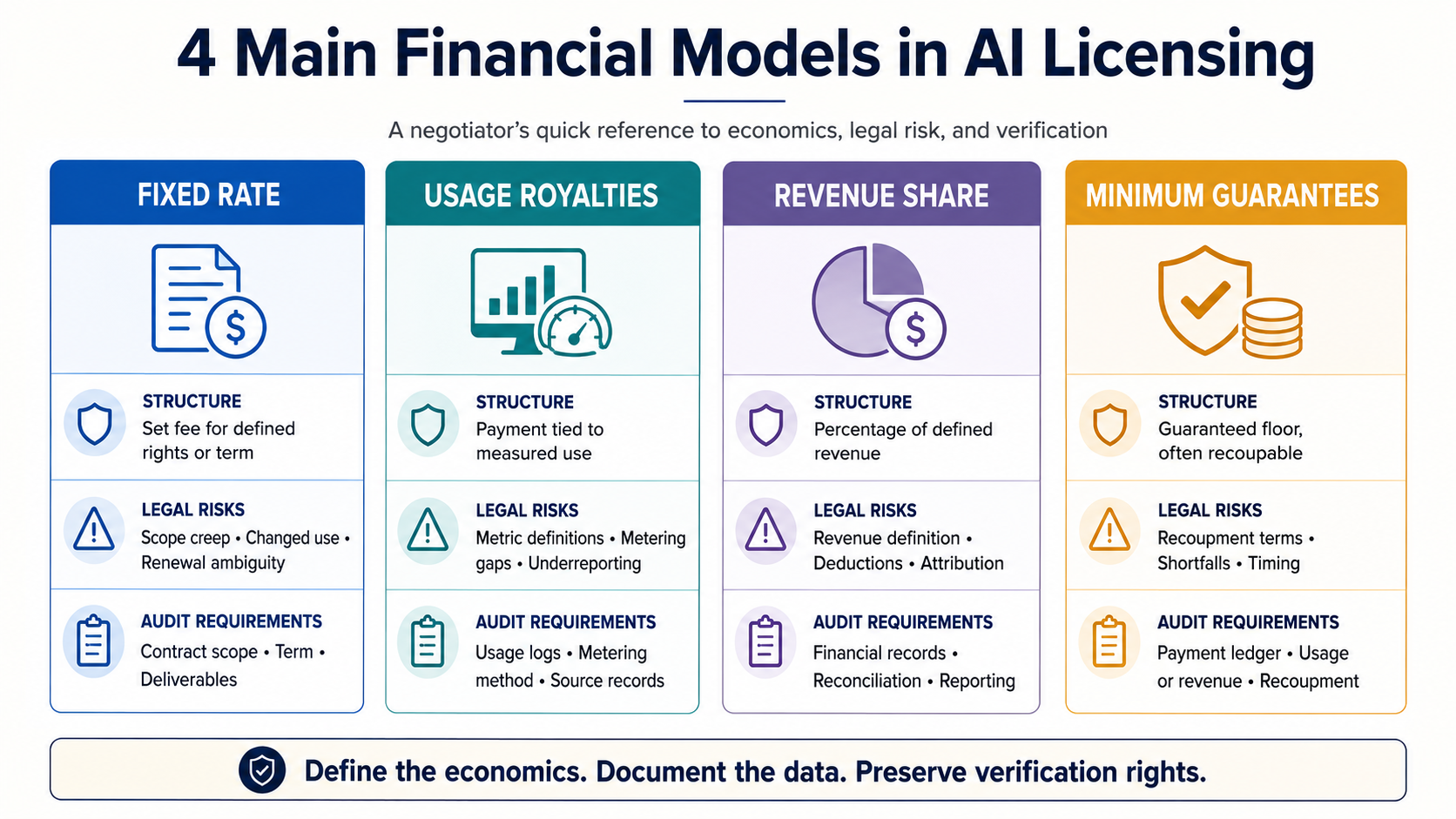
Figure 2: Four common financial models in AI licensing allocate compensation, legal risk, and verification obligations differently
AI licensing fees typically use fixed rates, per-item charges, usage royalties, revenue sharing, or minimum guarantees.
While a fixed fee delivers immediate cost certainty, it risks underpricing content that gets reused across multiple products. Conversely, revenue sharing lets content owners capture long-term upside; provided the underlying contract strictly defines what counts as revenue. Also, when drafting these structures, specify how the fee applies to product bundles, corporate affiliates, downstream users, and allowable deductions.
To make these commercial models work there should be clear reporting. Licensors should be given detailed statements showing exactly which content, models, and products generated each payment. As the U.S. Copyright Office noted, the practice of voluntary AI licensing is growing rapidly, but standard market pricing has yet to emerge. In an evolving market, verification is everything.
Deal Point: Protect contract value by incorporating strict reporting mandates, mandatory record-retention periods, robust audit rights, and clear remedies for underpayment.
Does granting exclusivity lock us out of other lucrative AI deals?
While the prospect of a high-value exclusivity payout is undeniably attractive, accepting sweeping restrictions can curtail a content owner’s future business. The risk often lies in how these commitments are framed. Restrictive covenants routinely masquerade as non-compete clauses, rights of first refusal, or broad promises prohibiting partnerships with rival AI developers.
To safeguard long-term commercial flexibility, licensors must define their limits with precision. Exclusivity granted for a single, specialized research model carries vastly different business consequences than a sweeping ban that blocks content across every global AI product. Beyond purely commercial considerations, overly broad terms can also trigger legal liabilities under antitrust laws, where granting a single company exclusive control over essential training content risks distorting market competition and inviting regulatory scrutiny.
Deal Point: Licensors can navigate these risks by carefully bounding exclusivity by specific use, geographic territory, and duration. They should always couplie these limits with automatic release triggers that dissolve exclusivity if the licensee fails to meet agreed-upon launch deadlines or payment milestones.
Can you track and prove how licensed content was used in the AI model?
If a dispute arises, the parties may have to identify which works were delivered, where they came from, which model used them and whether they were used for training, RAG or evaluation. That’s when provenance emerges as critical evidence.
Furthermore, the NIST AI Risk Management Framework recognizes documentation, transparency and data management as important parts of trustworthy AI governance.
In addition, records can also support regulatory compliance. Article 53 of the EU AI Act requires providers of general-purpose AI models to maintain a copyright-compliance policy and publish a sufficiently detailed summary of the training content.
Deal point: Parties should address these operational and regulatory demands by including clear, enforceable rules and evidence-preservation obligations in the contract.
Does the content contain personal or confidential information?
Training or reference datasets often contain sensitive, protected, or regulated personal information or data belonging to minors. Under privacy laws like the GDPR and global privacy frameworks, publicly available data have privacy protections. Hence, using publicly available information for AI training, must comply with data protection regulations.
Therefore, identify the types of personal data, the legal basis for processing, international transfers, security controls and the parties’ data-protection roles. In this regard, see the UK Information Commissioner’s Office guidance on lawfulness in AI.
Deal point: Include comprehensive privacy, security, breach-notification, data-retention, and deletion requirements directly in the agreement.
How do you control and restrict the AI’s outputs in a licensing deal?
Without clear guardrails, an AI system can produce exact copies or close style imitations of licensed works—creating direct market competition for the original content. As the U.S. Copyright Office warns, when AI outputs substitute for training data, legal risks spike and the license loses value. Therefore, an AI licensing deal must regulate what the model generates and also what it ingests.
To mitigate these risks, the contract must establish precise boundaries around content reproduction, source attribution, and brand usage in marketing materials.
Deal point: Parties should enforce these boundaries by requiring automated testing for content copying, establishing formal complaint procedures, and granting the licensor suspension rights to pause the AI if serious output failures occur.
Machine unlearning is a challenge. Furthermore. deleting source files does not erase their influence from a trained model. For these reasons, the contract must state whether the licensee can retain trained models, embeddings, synthetic data, or past outputs after termination. It should also set clear rules for backups, customer wind-down periods, and certified data destruction.
Given how fast AI laws evolve, agreements should have a flexible process for adapting to new regulations including a fair exit strategy if compliance becomes cost-prohibitive. For U.S. deals, also account for statutory copyright termination (17 U.S.C. § 203), which lets original authors reclaim rights after 35 years regardless of contract terms.
Deal point: Unambiguously, define post-termination asset rights, deletion duties, procedures for changing laws, termination triggers, and liability allocation.
The bottom line
Before signing an AI content licensing deal, legal teams must be able to clearly articulate its fundamental terms. They need a firm handle on what content is covered, what the licensee is permitted to do with it, and who holds the necessary underlying rights.
The agreement must also set clear expectations around financial details, exclusivity parameters, record-keeping duties, and sensitive data protections. Beyond inputs, teams must control what the model generates and establish what happens to the AI model once the contract ends.
Ultimately, if any of these core answers remain ambiguous, the contract drafting itself is likely unacceptably vague.
Straive helps clients operationalize the data> insights> knowledge> AI value chain. Straive’s clients extend across Financial & Information Services, Insurance, Healthcare & Life Sciences, Scientific Research, EdTech, and Logistics.


