
Posted on: August 25th 2026
The gold rush for domain-specific training data is officially on.
If you sit in the C-suite or lead product, engineering, or editorial at a content-rich enterprise, your inbox is probably going ballistic with AI developers, tech giants, and niche research platforms wanting the same thing. They are done digging through the noise of the open web, and they want your validated, rock-solid, expert content to feed their hungry models.
If you think this is just hype consider this. Wiley reported 19 licensing customers across five sectors during the fiscal year ending April 30, 2026. The customer breakdown included 12 in life sciences; 4 in engineering, materials, and chemistry; 2 in financial services; 1 in agriculture; and 4 explicitly described as LLM developers licensing content for model training.Two of the LLM developers were IQVIA, a health data and analytics company, and OpenEvidence, an AI tool built for clinical decision support.
HarperCollins has confirmed that it has signed a licensing agreement with an undisclosed AI company. For those of us in the publishing industry, the most invigorating part of the agreement is that HarperCollins will “allow limited use of select nonfiction backlist titles for training AI models to improve model quality and performance”. This news proves that archival data is the new oil.
Outside of traditional print, news, and book publishers, a growing number of digital platforms, stock media networks, technical forums, and entertainment conglomerates have signed high-value AI content licensing deals.
The hunger for training data and media catalogs is driving a massive wave of high-value AI licensing agreements:
- Reddit secured $203 million from Google and OpenAI to monetize its forums just before going public in early 2024.
- Getty Images opened its vast visual repository to power ChatGPT’s search and media discovery capabilities.
- Universal Music Group capped off two years of joint development with remix app Hook by striking a groundbreaking licensing deal.
Across every one of these categories, the pattern is the same, monetizing decades of research isn’t as simple as handing a hard drive full of PDFs to a buyer. For a risk-free AI licensing deal you need an operational bridge between legacy print-era archives and modern machine learning requirements.
Here is what enterprises across all sectors must execute across legal, technical, and product workflows to ensure their backlists are truly AI-licensing ready.
Legal Audits and the Ownership Imperative
Possessing the digital files or PDFs of a book does not mean you automatically own the legal right to sell them to a third party to train an algorithm.
Standard agreements with authors, faculty, contributors, talent, or vendors were written before generative AI existed. Therefore, courts and legal scholars refuse to interpret broad electronic rights clauses as permission to process text inside an AI algorithm.
If an enterprise sells a backlist without auditing its contracts, the enterprise, rather than the AI buyer, shoulders the financial risk if authors sue over unauthorized AI training. Indeed, tech buyers are so risk-averse that they will simply walk away if a publisher cannot guarantee clean, legal ownership.
This exact situation explains why HarperCollins requested permission from authors to opt in to an AI licensing deal. Because legacy agreements did not cover generative AI, the publisher could not legally hand over the keys without author consent.
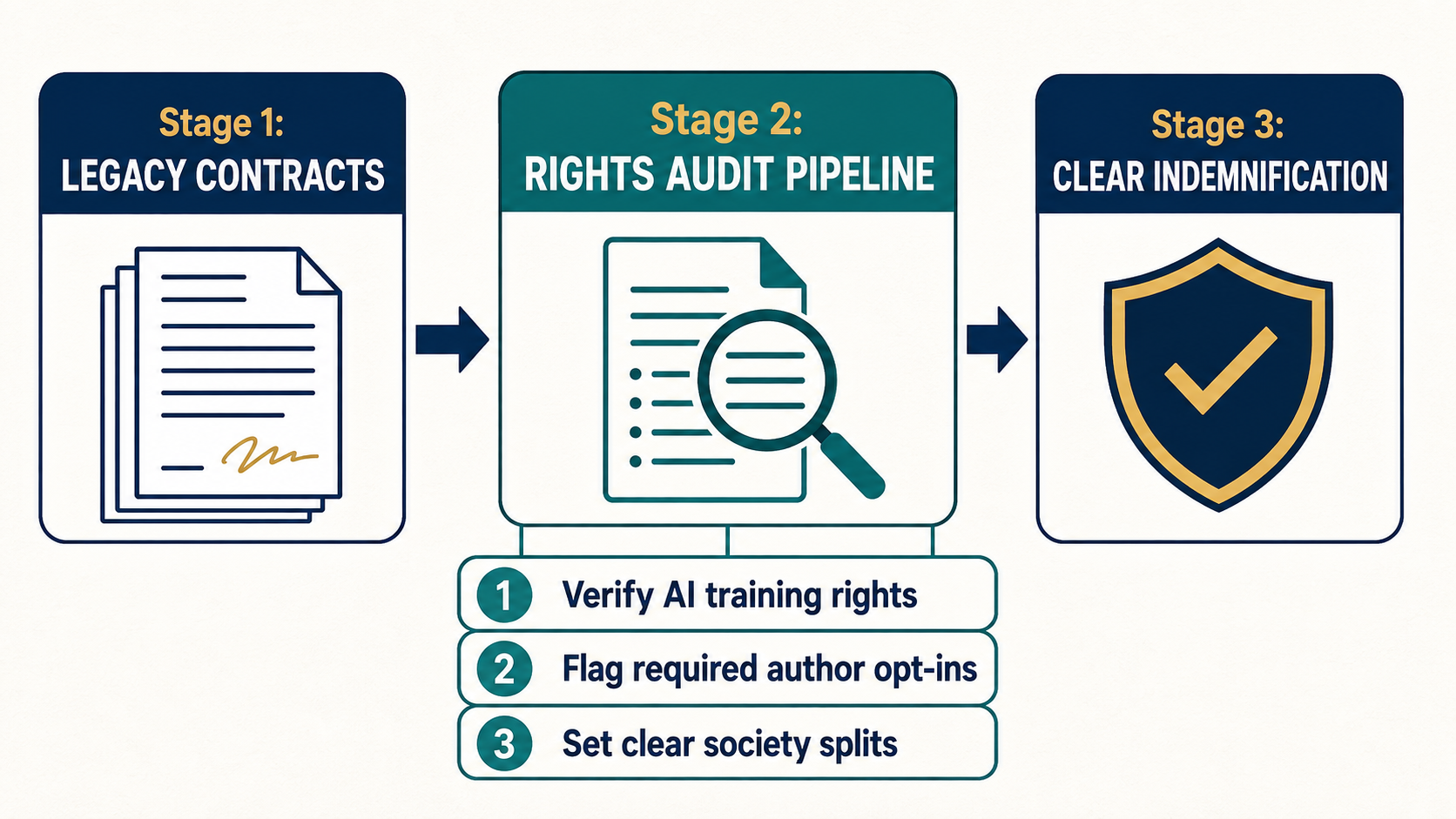
Figure 1: A three-stage pipeline for reviewing legacy contracts, confirming AI licensing rights, and establishing clear indemnification.
What You Need to Do:
- Automate Rights Review: Use document-processing tools to conduct an initial review of and collecting-society agreements. Then, flag ambiguous provisions concerning AI training, derivative works, sublicensing, consent, and compensation for review by qualified legal counsel. These review areas align with the guidance provided by the Authors Guild, the Society of Authors, and CISAC.
- Establish Transparent Royalty Splits: Before closing the deal, define how AI-licensing revenue will be divided and paid to authors. The Authors Guild recommends negotiating these splits separately, aligning each party’s share with its contribution, and paying authors directly rather than applying their share against advances.
- Segment Your Catalog: Before offering content for AI licensing, Straive recommends dividing your backlist into three groups: Ready to License, Requires Author Opt-In, and Restricted. This will help identify which content can be licensed, which requires author approval, and which must not be offered for AI licensing.
Structuring Data for Machine Ingestion
AI developers need clean, structured data to train models and build Retrieval-Augmented Generation (RAG) systems. That is why scanned PDFs and unformatted documents are major red flags during AI licensing negotiations. They force buyers to spend expensive engineering resources building Optical Character Recognition (OCR) pipelines, cleaning extraction errors, and manually adding metadata. Consequently, buyers offset this extra technical overhead by significantly reducing what they are willing to pay for your dataset.
To prevent erosion of value and improve the usability and commercial potential of their content, major data providers are preparing it for machine ingestion.
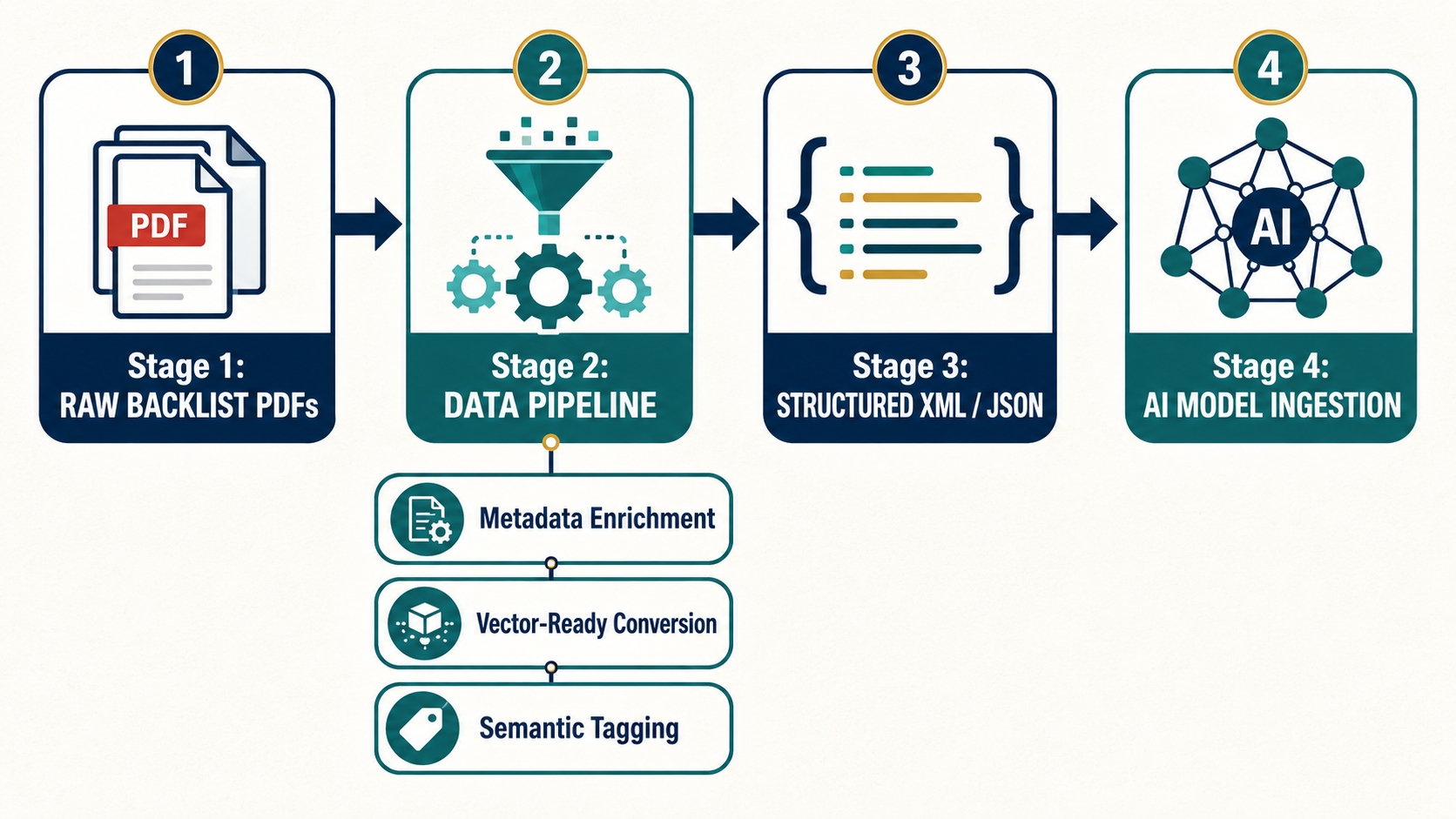
Figure 2: A data pipeline transforms raw backlist PDFs into structured, enriched content for AI model ingestion.
What You Need to Do:
- Transform Legacy Files to Structured Formats: Convert unstructured PDFs into structured, JATS-compliant XML or JSON formats.
- Enrich Metadata & Taxonomies: For AI models to understand the context and reduce hallucinations enrich the content with persistent identifiers (DOIs, ORCIDs), subject classifications, and citation graph linkages—to understand context and reduce hallucinations.
- Provide Secure, Machine-Readable Access: Give licensees controlled access to content through APIs or secure RAG systems when appropriate, instead of relying only on one-time bulk file deliveries.
Guardrails Against AI Cannibalization
A key concern across every sector, institution, and enterprise is model memorization, which can cause an AI system to reproduce copyrighted passages for users. If the AI provides too much of the original content, users may have less reason to buy the publication or maintain a subscription. Enterprises should therefore include technical and contractual safeguards in AI licensing agreements to limit verbatim output and protect their intellectual property and revenue.
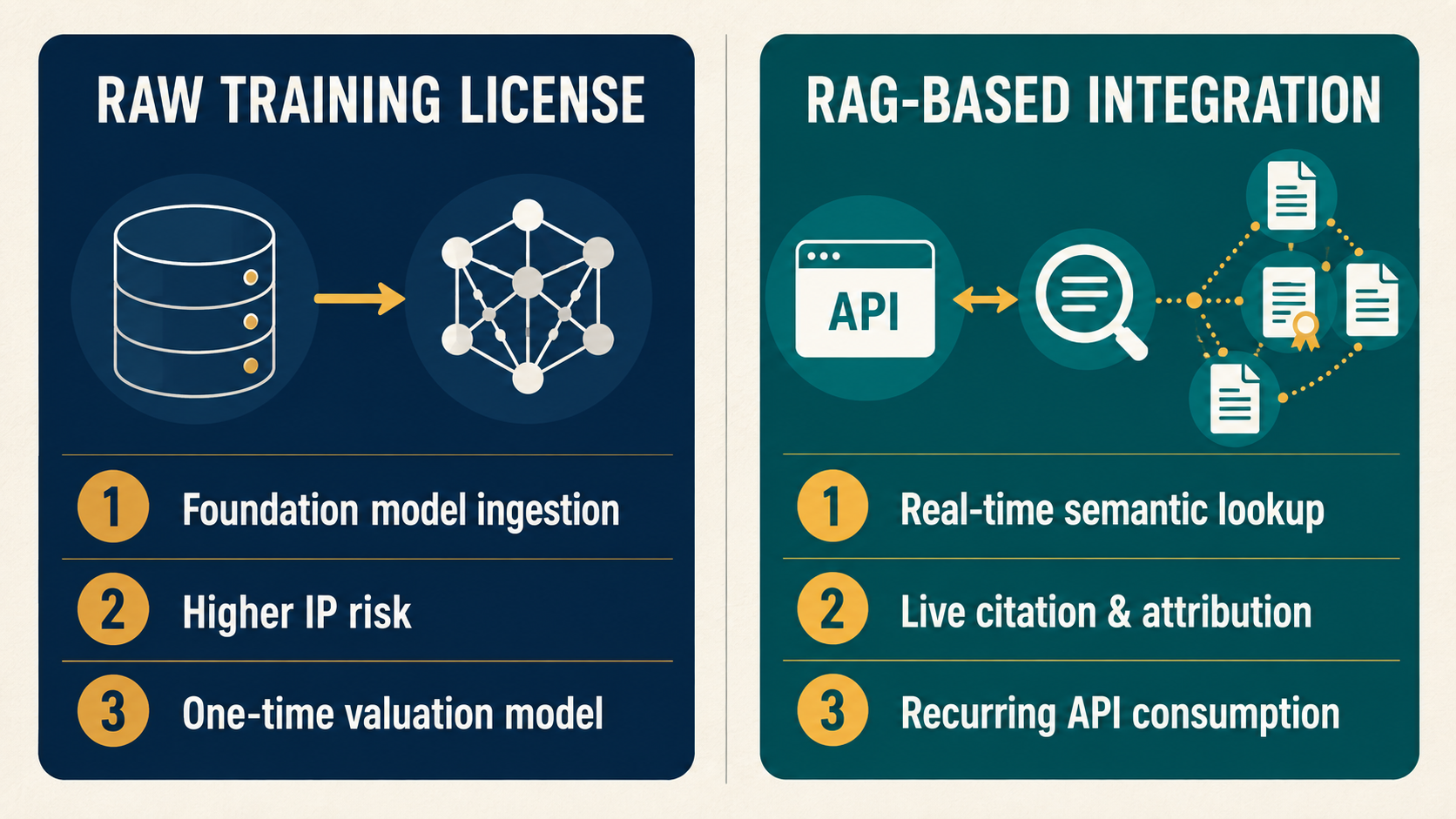
Figure 3: Comparison of a raw AI training licence and a RAG-based content integration model.
Key Contractual Safeguards:
- Limit Model Outputs: Restrict verbatim quotations and substantial summaries. Apply limits across repeated queries so users cannot reconstruct an article or other work.
- Require Citation and Links: Require responses to identify the author and source and provide a direct link to the original content when available.
- Use Renewable Licences: Prefer fixed-term, renewable licences over perpetual grants. Include clear rules for deleting or restricting licensed content, embeddings, and derived datasets when the agreement ends.
- Control Permitted Uses: State whether content may be used for model training, RAG, search, summarization, or other purposes. Do not allow unspecified uses.
- Require Monitoring and Audits: Test for excessive reproduction, maintain usage logs, and give the publisher audit and enforcement rights.
These measures align broadly with the News/Media Alliance’s AI Principles, which call for permission, attribution, accountability, protection of paywalled content, and safeguards against AI outputs replacing publisher products.
The Executive Alignment Matrix
Preparing for an AI licensing deal requires coordination across legal, editorial, technology, product, and publishing operations. Giving each team a clear mandate ensures that every legal, technical, and operational requirement has an accountable owner. Measurable goals help leadership track readiness, identify gaps, and resolve risks before signing the deal.
| Team or Executive Role | Primary AI Deal Mandate | Key Success Metric |
| Legal and Rights | Verify licensing rights, author consent, and indemnity terms | Percentage of titles with confirmed rights |
| Editorial and Scholarly Communications | Coordinate author and society engagement | Author approval and participation rate |
| CTO and Data Infrastructure | Convert content into structured formats and provide secure delivery | Percentage of content that is machine-readable |
| Product and AI Leadership | Set output limits, citation rules, and RAG controls | Rate of compliant outputs with valid citations |
| Publishing Operations | Standardize workflows and manage vendors at scale | Digitization cost and processing time per asset |
Preparing for What Comes Next
Preparing a backlist for AI licensing involves more than converting old files. Enterprises must organize their archives, confirm that they hold the necessary rights, secure author approvals, and prepare content in formats that AI systems can use.
Specialized partners such as Straive can support this work through content conversion, metadata enrichment, structured delivery, and AI-assisted contract review. However, legal teams should still review unclear rights and make final decisions.
With the right technical, legal, and operational processes in place, any content rich enterprise can make legacy content easier to license while protecting authors, intellectual property, and long-term business value.

Straive helps clients operationalize the data> insights> knowledge> AI value chain. Straive’s clients extend across Financial & Information Services, Insurance, Healthcare & Life Sciences, Scientific Research, EdTech, and Logistics.


