
Posted on: July 20th 2026
Collections spent 2025 experimenting with AI. 2026 is when it has to pay off.
In 2025, many finance teams tested artificial intelligence in collections. Risk scores appeared in dashboards. Reminder automation became easier to configure. Collector worklists looked more intelligent. Dispute classification, cash application support, and early agent experiments moved from concept to pilot.
Some of that work helped. Teams gained better visibility into aging, customer behavior, promise to pay (PTP) patterns, disputed balances, and open queues.
But visibility is not operating capability.
A dashboard can show risk without changing ownership. A model can rank overdue accounts without knowing whether cash is blocked by a dispute, missing remittance, unapplied cash, or a credit issue. An automated reminder can increase activity while making the wrong customer experience worse.
That is why 2026 is a more serious year for AI-powered collections.
The question is no longer whether AI can assist accounts receivable (AR). The question is whether finance leaders can trust AI to influence real operating decisions: which accounts to pursue, which to suppress, which to reroute, which to escalate, and which to keep under human review.
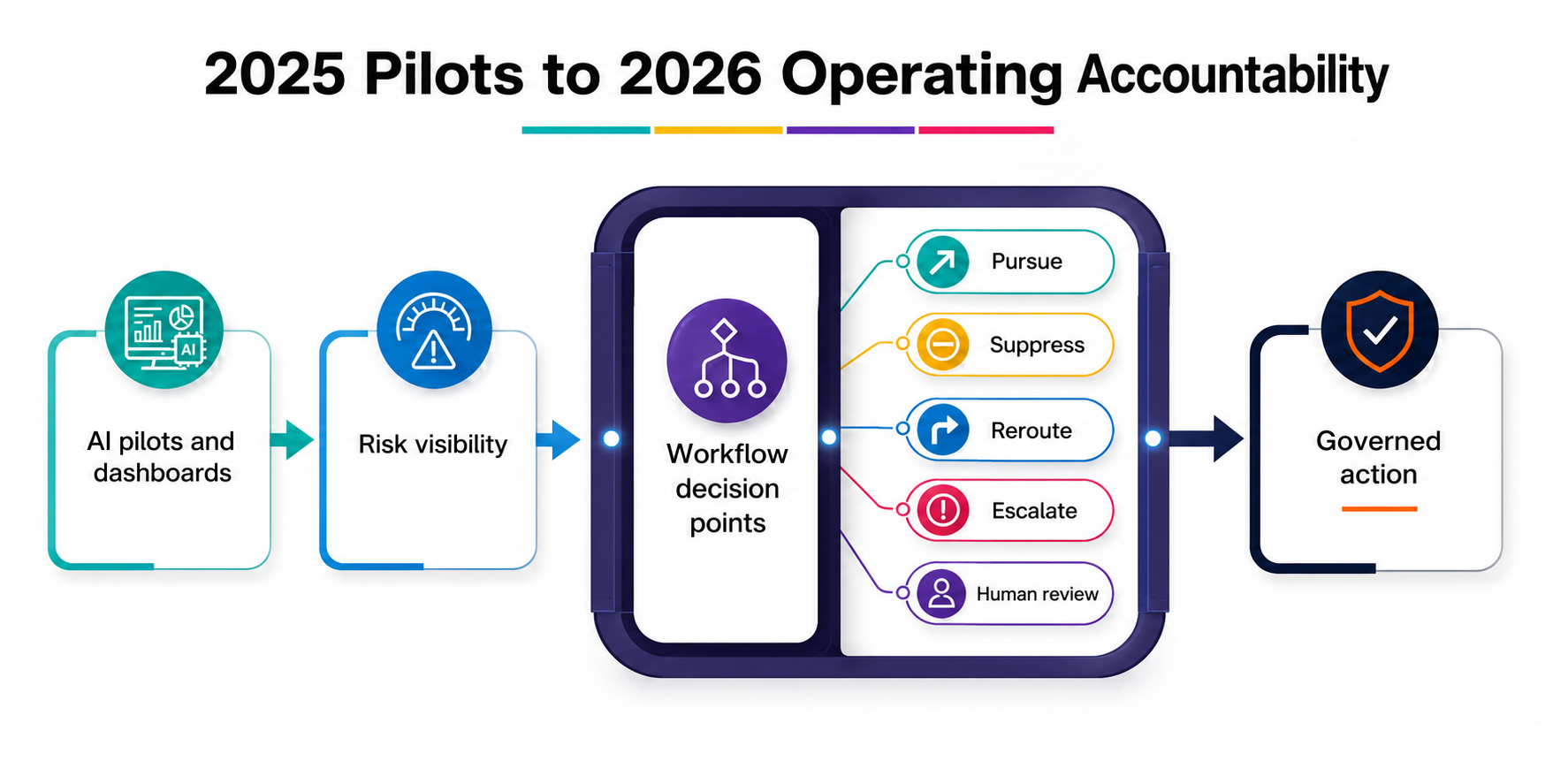
The future of AI-powered collections is not more automated chasing. It is better diagnosis of why cash has not converted.
Overdue Is Not the Same as Collectible
Traditional collections automation has been built around static rules: invoice age, balance threshold, customer segment, fixed dunning cadence, escalation rules, and predefined exception queues.
Those rules are useful. They create consistency, especially in high-volume environments. But they often treat overdue as the whole story.
In real collections operations, an overdue invoice may be collectible, blocked, disputed, already paid, misapplied, awaiting documentation, stuck in a customer portal, or tied to a recurring deduction pattern. Aging tells finance what is late. It does not explain what is blocked.
A team that chases every overdue invoice with the same logic will waste collector time and create avoidable customer friction. A disputed invoice does not need another reminder. Unapplied cash does not need escalation. A missing purchase order may need documentation, not pressure. A strategic account may need relationship handling, not a standard sequence.
This is where learning systems can improve the operating model. AI can help read payment behavior, customer responsiveness, dispute frequency, PTP reliability, partial payment trends, credit exposure, remittance quality, and cash application signals.
But the shift is not from rules to no rules. In finance operations, rules remain essential. They encode policy, approval thresholds, customer treatment standards, audit expectations, and escalation boundaries.
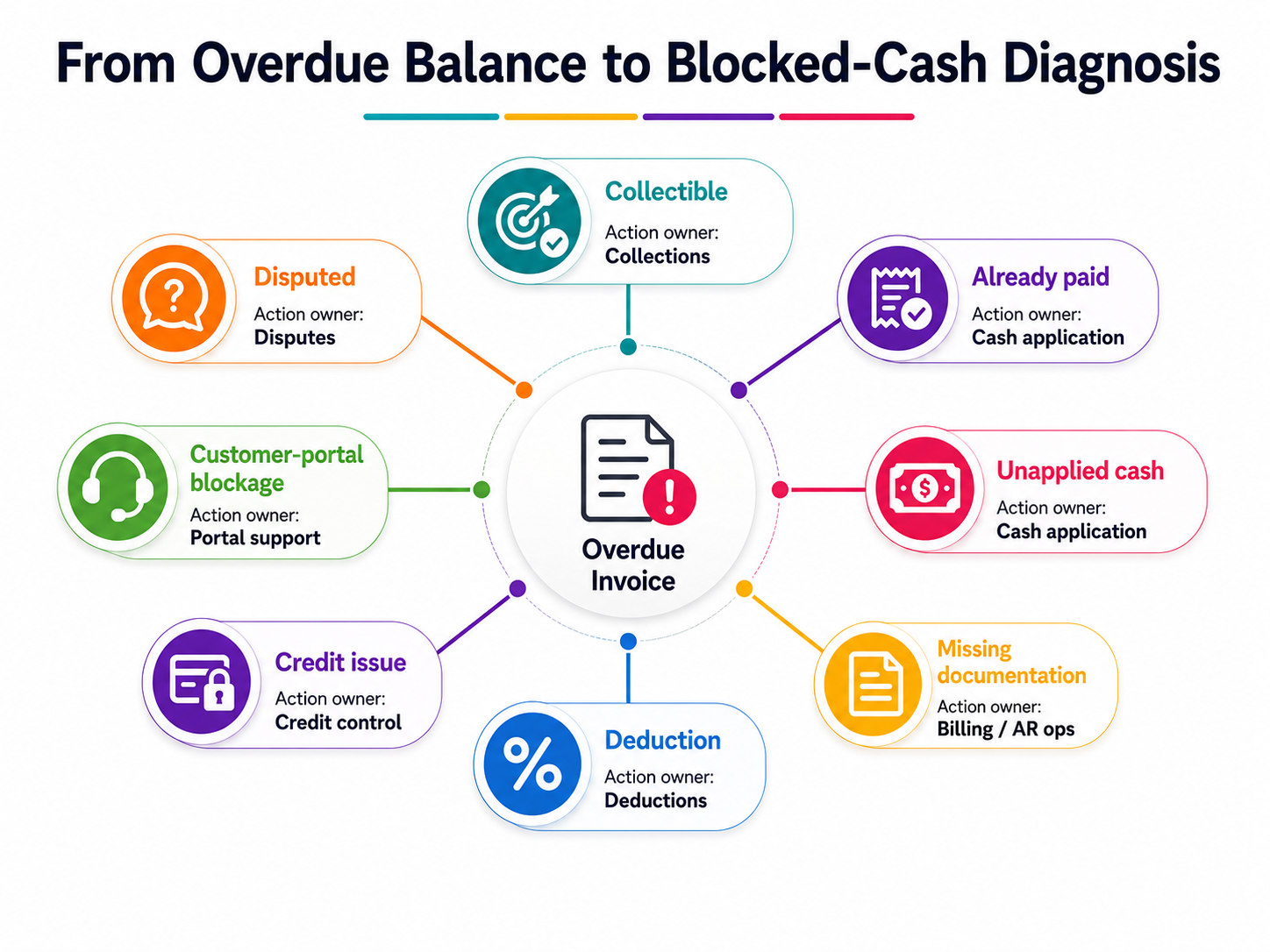
The shift is from rules as the entire operating logic to rules as the control layer around adaptive recommendations.
Agentic AR Starts with Permissions, Not Autonomy
Agentic AI in accounts receivable refers to AI-enabled workflows that can interpret context, recommend next steps, initiate approved actions, monitor outcomes, and escalate exceptions within defined controls.
The practical test is not whether an agent can act. It is what the agent is allowed to do.
A useful maturity path starts with observation. AI reads account, invoice, payment, dispute, deduction, credit, and cash application context.
Then it recommends whether the next step should be to collect, suppress, reroute, escalate, monitor, or review.
Then it prepares: drafting customer follow-ups, summarizing account history, assembling missing-documentation requests, or preparing internal notes.
Then it routes work to the collector, dispute owner, deduction team, billing team, credit reviewer, or cash application queue.
Only then should it act within policy. That may include approved low-risk reminders, internal task creation, PTP monitoring, or standard follow-up where the balance is valid, undisputed, and eligible for automation.
Sensitive decisions must remain governed. Strategic customers, material balances, disputed invoices, credit holds, settlement requests, legal escalation, policy overrides, and relationship-sensitive accounts need approval gates.
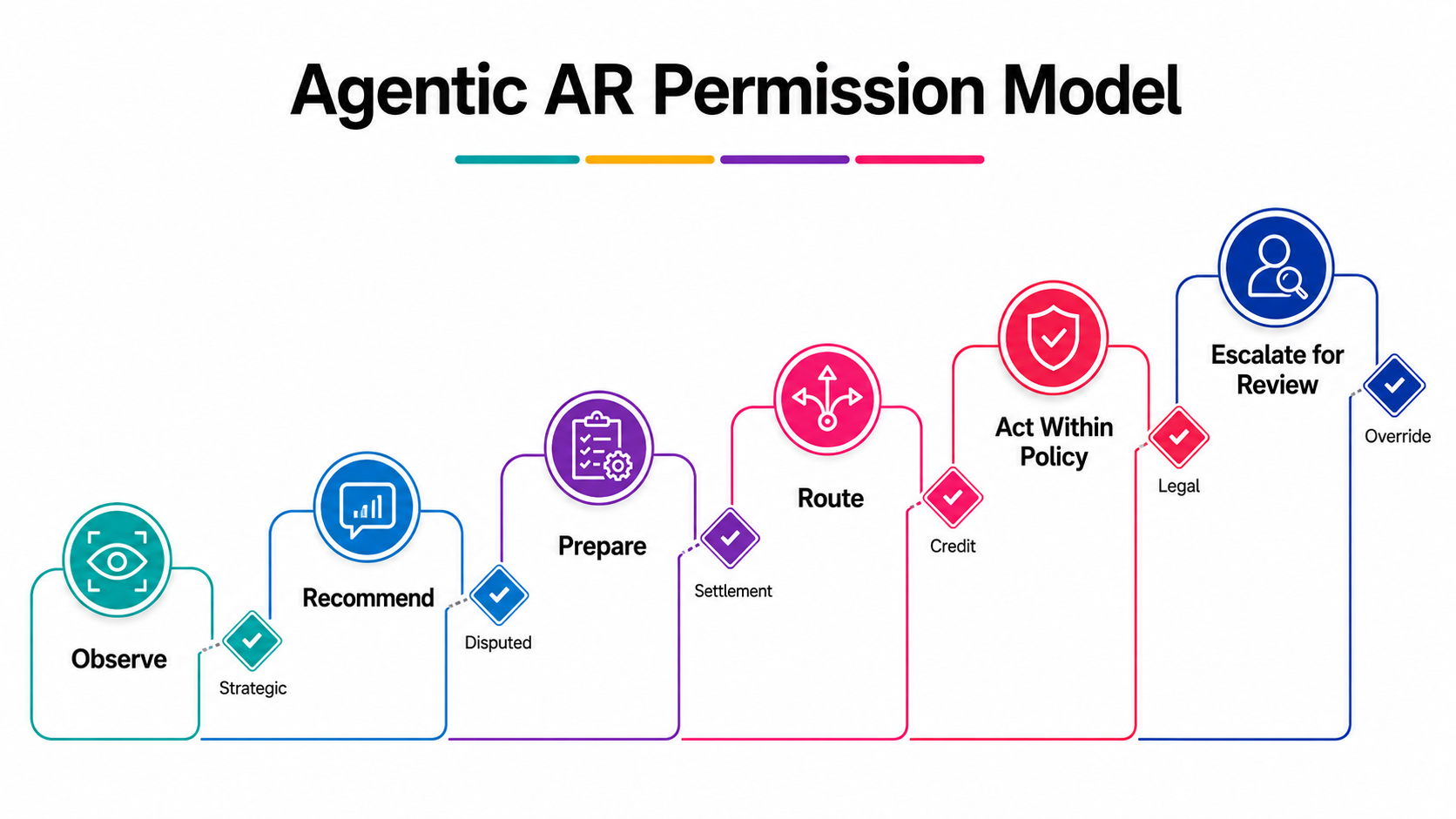
Agentic AR should be designed around permissions before autonomy.
Four Forces Shaping Collections Through 2026 and 2027
Working capital pressure will keep collections visible. Days sales outstanding (DSO), overdue balances, cash forecasting, and exposure management remain closely watched because they affect liquidity confidence and planning discipline.
But the more pressure finance places on collections, the more visible workflow gaps become. Many delays are not caused by collector effort. They sit in unresolved disputes, inconsistent deduction codes, weak remittance capture, customer portal friction, billing errors, credit exposure, or cash application delays.
AI will expose whether AR is operating as one connected process or several disconnected queues.
That is why collections will become more tightly linked with credit, disputes, deductions, and cash application. The future of AR automation is not isolated dunning. It is the ability to identify why cash is blocked and move the work to the right owner.
A risk score has limited value if it does not change the treatment path. A dunning engine has limited value if it keeps contacting customers whose invoices should be suppressed. A worklist has limited value if collectors cannot see dispute status, unapplied cash, or credit context.
Governance will also become a buying and operating requirement. Finance leaders will want to know why AI recommended an action, whether the balance was eligible, which policy applied, who approved the step, and what happened afterward. Audit trails, role-based controls, customer treatment rules, approval workflows, enterprise resource planning (ERP) alignment, and performance reporting will become part of the operating design.
The collector role will shift as a result. AI should remove false positives, poor queues, repetitive sorting, and low-value follow-up. Human collectors will spend more time on complex disputes, strategic accounts, negotiation, escalations, credit-sensitive situations, and customer relationships.
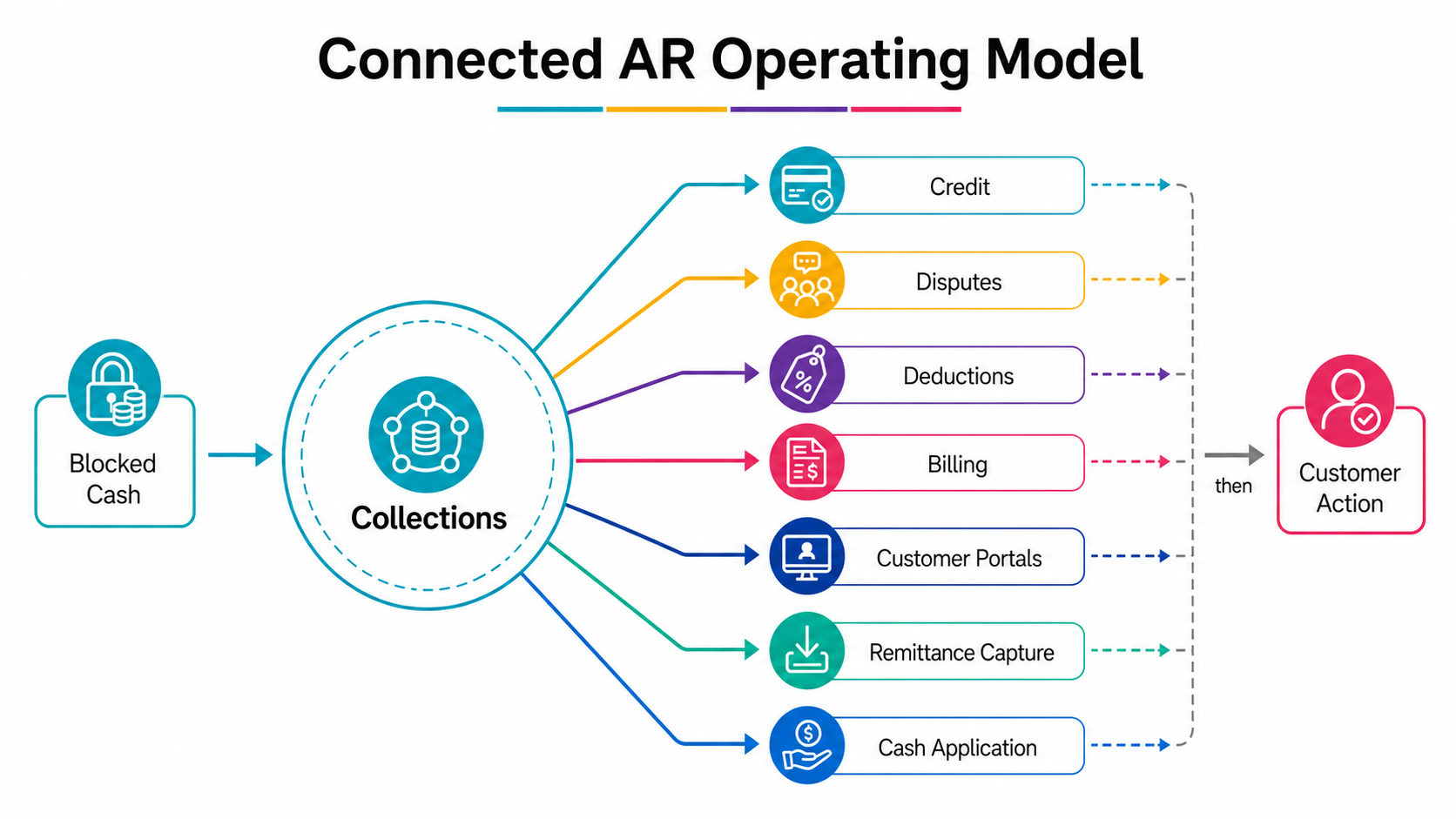
The next phase of AI-powered collections will be won less by teams that automate the most touches and more by teams that understand which touches should not happen at all.
What Stays Human
The future of AI-powered collections is not a collectorless AR function.
Human judgment remains central in major customer relationships, strategic account escalation, settlement and negotiation, dispute interpretation, credit limit changes, legal escalation, sensitive customer treatment, exception handling, policy overrides, and governance review.
AI can show that a customer has broken a PTP. It can display the aging, invoice history, open disputes, credit exposure, prior response pattern, and cash application status. It can draft the follow-up or recommend escalation.
But it should not independently decide whether to pressure a strategic customer, change credit treatment, accept a settlement, or move toward legal action.
AI can prepare the work, surface the risk, draft the action, and monitor the outcome. Accountable decisions still need governed human ownership.
What Finance Leaders Should Do Now
The operating agenda starts before autonomy.
Finance leaders should improve customer and invoice data, standardize dispute and deduction reason codes, strengthen remittance capture, improve cash application, and define customer treatment policies. They should segment accounts by behavior and risk, not only by balance and age.
They should also define what AI may recommend, draft, route, suppress, execute, and escalate. Low-risk reminders may be suitable for controlled automation. Disputed balances, credit holds, settlements, strategic accounts, and legal escalation require review.
Key performance indicators (KPIs) should measure outcomes, not activity. More emails sent is not progress. Better prioritization, faster dispute routing, fewer avoidable touches, stronger PTP follow-up, cleaner cash application, and improved forecast confidence are more meaningful.
The right starting point is not the most autonomous workflow. It is the workflow where the decision can be defined, the action can be controlled, the outcome can be measured, and the exception can be managed.
Straive’s Role in Governed Collections Capability
Straive helps finance and AR teams move from AI experimentation to practical, governed collections capability.
That means connecting collections operations, AR workflow design, customer segmentation, dunning and escalation design, dispute and deduction workflow support, cash application improvement, AI-enabled prioritization, governance reporting, and human review into a controlled operating model.
For finance leaders, the challenge is not simply adopting AI. It is deciding how collections work should be classified, prioritized, routed, escalated, measured, and controlled.
That is where AI becomes useful: not as another automation layer on top of broken workflows, but as part of a more disciplined AR operating model.
A Practical Outlook for AI-Powered Collections
The future of AI-powered collections will not be defined by how many tasks are automated. It will be defined by whether finance teams can use AI to improve collections judgment, reduce avoidable friction, accelerate exception handling, and maintain governance.
The strongest collections teams in 2026 and 2027 will not simply chase faster. They will know when to pursue, when to suppress, when to reroute, when to escalate, and when to keep the decision human.
Ready to prepare your collections operation for the next phase of AI? Contact Straive to see how our collections operations and AI-enabled workflow teams help finance leaders build practical, governed, and measurable AR performance programs.

Priya Roy is Vice President, Delivery Leadership at Straive, where she translates ambitious growth strategy into high-performing customer experience and technology operations. With deep expertise in large-scale transformation, she offers a practical leadership perspective on scaling AI, elevating service excellence, and turning operational complexity into lasting enterprise value.


