
Posted on: July 20th 2026
Aging reports are useful because they make overdue exposure visible. But they do not explain why cash is not moving.
One invoice may be waiting on customer approval. Another may be tied to a pricing dispute. A third may already be paid but still sitting in unapplied cash. Others may be delayed by missing remittance, deductions, short-pays, portal issues, service documentation, broken PTP commitments, or weakening customer payment behavior.
They appear together in the same accounts receivable (AR) view. Operationally, they require different responses.
That is where data and artificial intelligence (AI) can improve collections performance. The value is not in replacing collector judgment or increasing automated outreach. It is in helping teams see the real status of open balances earlier: what is collectible, what is blocked, what is already paid, what is deteriorating, what can be routed automatically, and what requires human intervention.
AI works best in collections when it is grounded in reliable data, disciplined workflows, human review, and clear governance.
The Aging Report Shows What Is Late. It Does Not Show What Is Workable.
Aging remains essential. It gives finance leaders a shared view of overdue exposure and days sales outstanding (DSO). But it cannot explain every reason an invoice remains open.
An invoice may be overdue because the customer is delaying payment. It may also remain open because of a tax issue, missing purchase order, unresolved deduction, short-pay, pricing dispute, portal approval delay, service complaint, or unapplied cash. These situations should not be managed with the same treatment path.
When AR teams rely too heavily on static aging, friction builds across the collections cycle. Collectors may spend time on customers that would have paid without intervention. High-value accounts may be reached too late. Disputed balances may remain in collections queues even when resolution depends on pricing, tax, logistics, sales, or customer service. Unapplied cash can create false delinquency and weaken collector credibility.
Credit risk signals can also be missed. Slower payment patterns, broken PTP commitments, rising exposure, repeat deductions, and dispute frequency should influence account treatment. If those signals remain outside the collections workflow, teams lose context.
Forecasting becomes less reliable as well. Expected cash may be based on historical averages rather than current invoice status, dispute risk, PTP reliability, partial payment behavior, and customer responsiveness. Key performance indicators (KPIs) may track calls made, emails sent, and accounts touched without showing whether those actions improved cash outcomes.
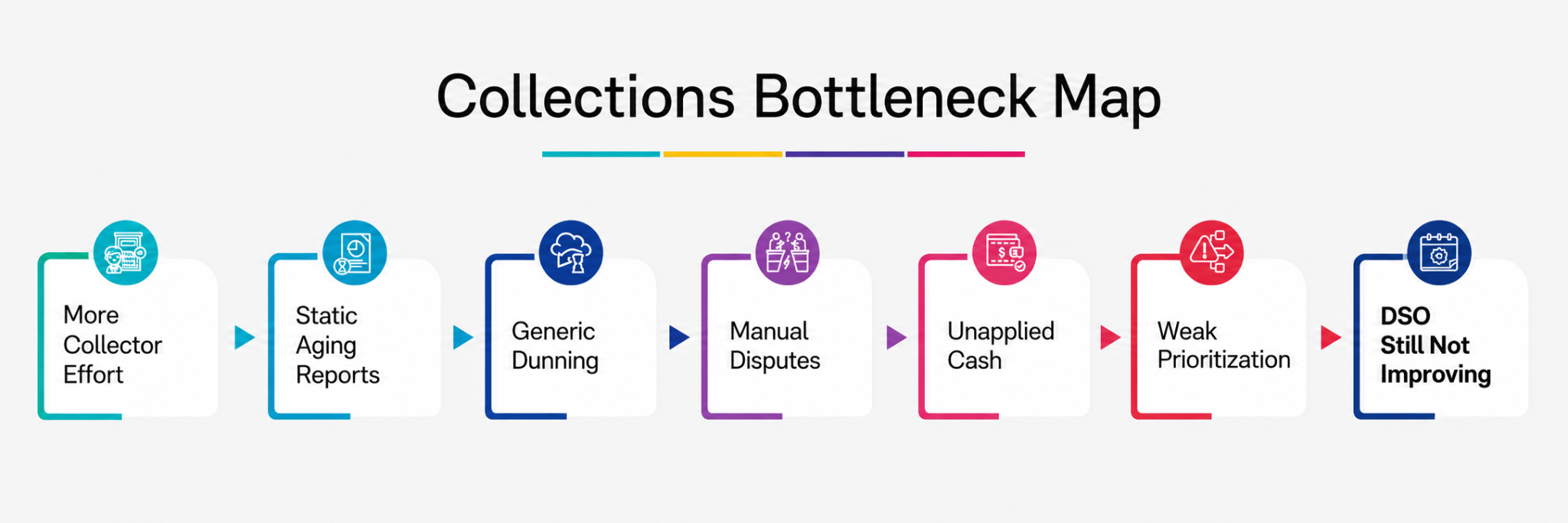
Collections performance improves when open balances are classified, prioritized, routed, and measured with greater operating discipline.
Ten Operating Levers That Change Collections Performance
Improving collections performance with AI starts by strengthening how work enters the queue, moves through the queue, and gets resolved. The following ten levers work best as connected parts of the same operating model.
Predictive risk scoring helps teams identify payment deterioration before invoices move into serious delinquency. Payment history, invoice behavior, dispute patterns, credit exposure, and customer-level signals can help show which accounts deserve earlier attention. The goal is not perfect prediction; it is better prioritization.
Behavior-based segmentation turns risk insight into practical account treatment. Late payment is not one behavior. A customer that pays predictably five days late should not be treated like a high-exposure account with broken promises, repeat deductions, and declining responsiveness. Segmentation by payment consistency, average delay, dispute frequency, portal dependency, account value, and risk profile helps teams apply the right level of attention.
Dynamic dunning is most useful when it functions as cadence control. Timing, tone, channel, and escalation logic should change based on account behavior, value, risk, and dispute status. Standard reminders may work for low-risk segments, while strategic customers, sensitive accounts, material balances, and unresolved disputes still require human review.
AI-assisted cash application improves collections by clarifying what is actually outstanding. Few things damage collector credibility faster than chasing an invoice the customer has already paid. AI can help match payments to invoices when remittance is incomplete, inconsistent, or scattered across emails, portals, bank files, and remittance documents.
Early-intervention triggers help teams act before delinquency becomes harder to influence. Missed PTP dates, partial payments, delayed portal approvals, sudden payment pattern changes, repeat disputes, and exposure increases should prompt earlier review. The earlier the signal is visible, the more options the team has.
Multi-channel cadence matters because the next best action is not always another email. Some accounts need portal follow-up. Others require phone outreach, account manager involvement, customer service coordination, or documentation correction. Data helps determine the channel based on customer behavior and the nature of the blockage.
Dispute and deduction automation improves flow by clarifying ownership. Disputed balances are not truly collectible until the underlying issue is assigned and moving. AI can help classify issues, identify missing evidence, route work to the right team, and track resolution aging. It should support triage and accountability, not auto-resolve material disputes without review.
Predictive cash forecasting becomes stronger when expected receipts reflect current conditions. Open invoice status, dispute risk, PTP reliability, partial payment behavior, and customer history should shape the expected cash view. Prior-period averages alone rarely provide enough precision when customer behavior is changing.
AI-supported credit risk management connects collections signals to account strategy. Broken promises, repeat deductions, slower payments, and rising exposure often appear in collections before they appear in formal credit review cycles. AI can surface those signals, while credit actions remain governed by approval rules and business judgment.
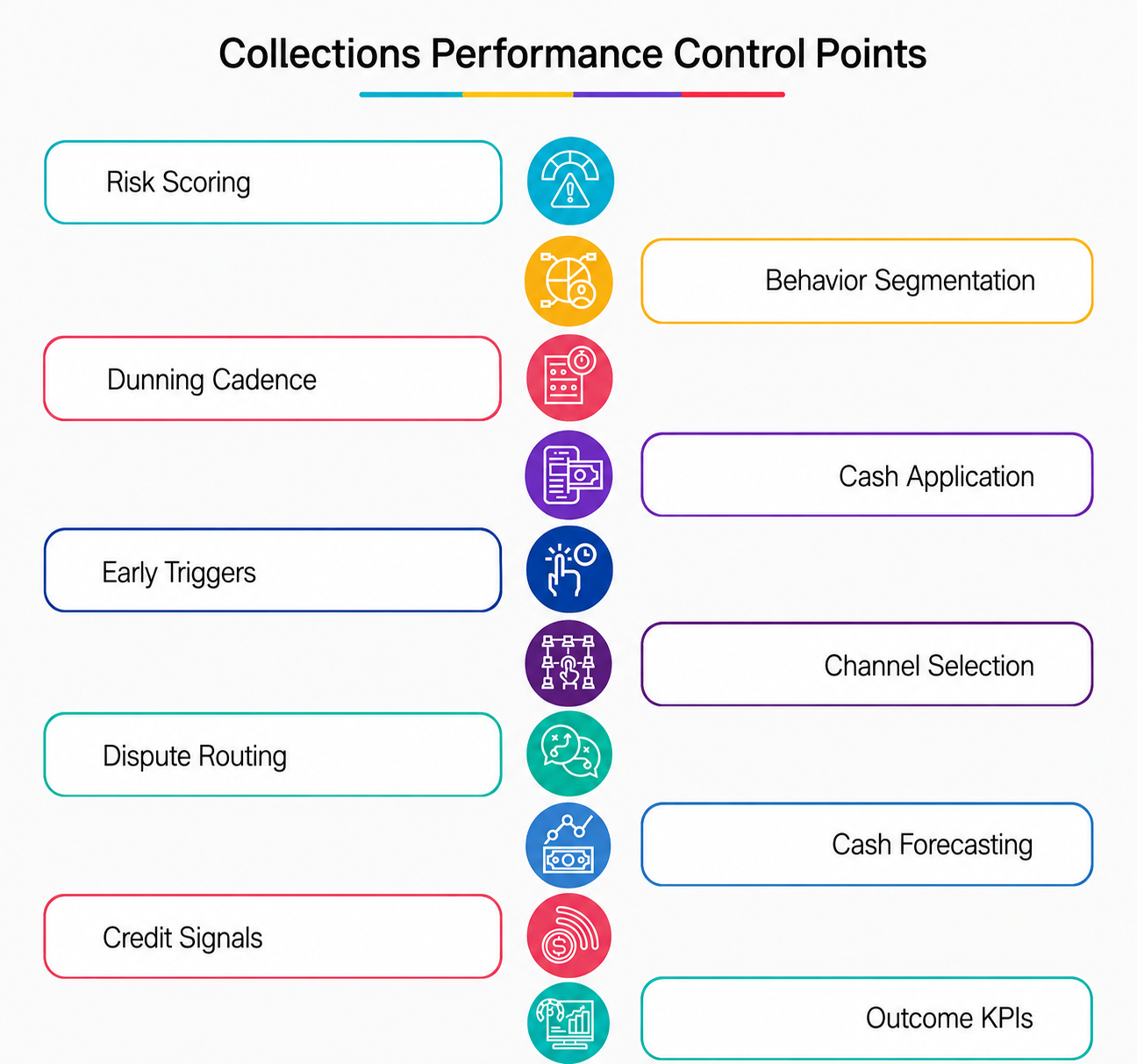
Outcome-based KPIs keep the operating model honest. Collections teams need measures that show cash impact: DSO movement, overdue balance reduction, dispute cycle time, PTP kept rate, cash application turnaround, collector productivity, and resolution rate by segment. Activity matters only when it improves outcomes.
A 90-Day Path from Cleaner Data to Better Control
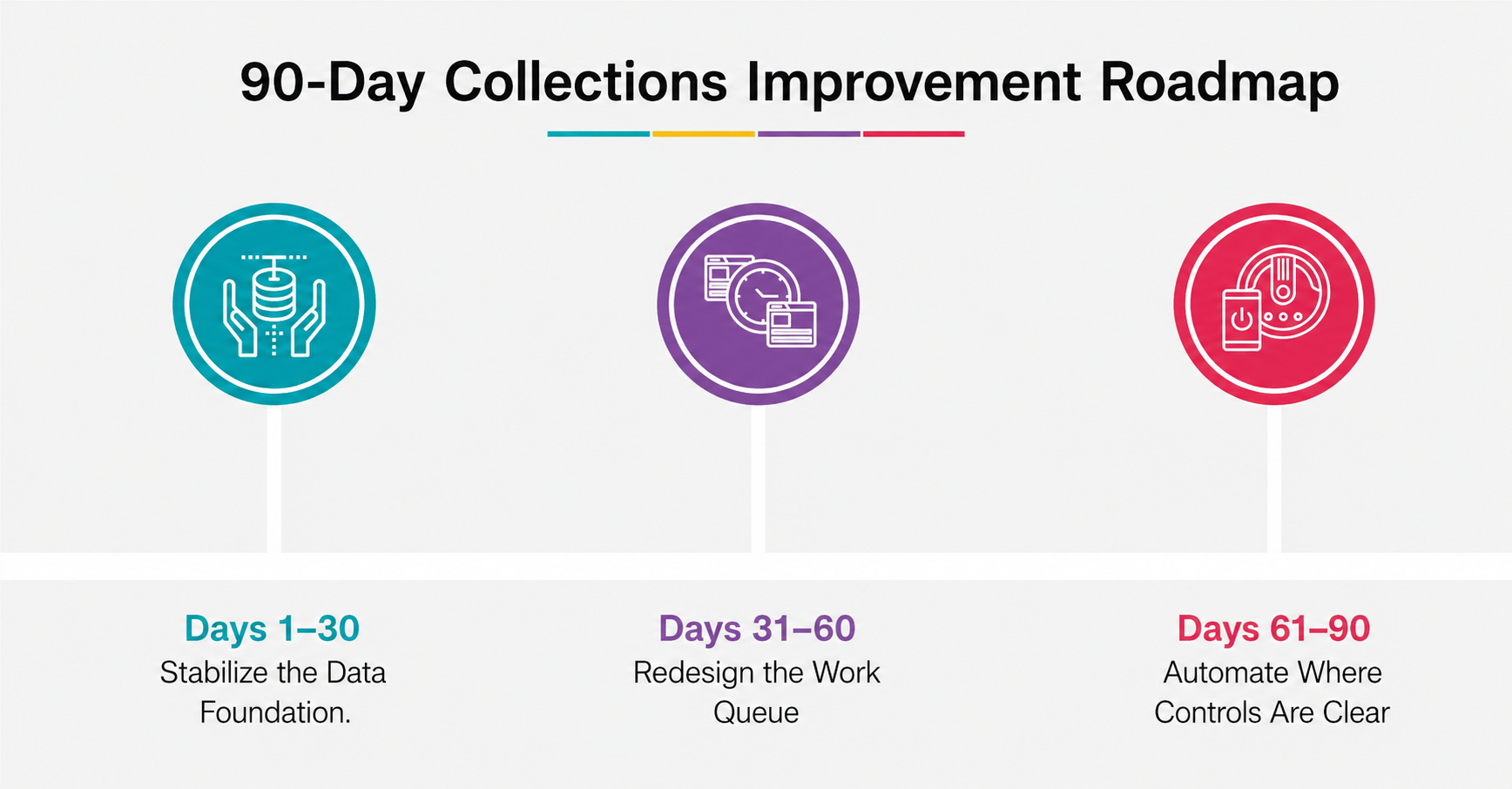
Finance teams do not need to automate the entire collections function at once. A practical rollout starts by strengthening the operating base, then improving prioritization, then automating where controls are clear. This 90-day view is a rollout structure, not a universal implementation guarantee.
Days 1–30: Stabilize the Data Foundation
Start with the data collectors rely on every day. Validate customer master data, payment terms, account ownership, aging logic, dispute categories, deduction codes, and unapplied cash patterns. Establish baseline KPIs before redesigning workflows.
This stage determines whether AI improves decisions or simply moves poor-quality data faster through the process.
Days 31–60: Redesign the Work Queue
Introduce risk scoring and segment accounts by behavior. Build collector worklists that combine invoice age, account value, dispute status, PTP status, exposure, and risk signals. Add early-intervention triggers and begin tracking PTP adherence.
The operating shift is from “oldest invoice first” to “highest-impact action first.”
Days 61–90: Automate Where Controls Are Clear
Deploy dynamic dunning for suitable segments. Automate dispute and deduction routing. Improve forecasting inputs. Connect collections signals to credit review.
Define approval gates for strategic customers, major balances, credit actions, sensitive escalations, and material disputes. Automation should remove low-value manual effort while keeping judgment where it belongs.
Where Straive Fits
Straive helps finance and AR teams improve collections performance by combining collections operations expertise, data-driven workflow design, AI-enabled prioritization, human review, and governance.
For leaders working to reduce DSO and improve recovery performance, the challenge is not simply selecting a tool. It is redesigning how accounts are prioritized, worked, escalated, and measured.
Straive supports collections operations, customer segmentation, dunning and escalation design, dispute and deduction workflow support, cash application improvement, governance, and performance reporting. The focus is practical: helping teams classify work correctly, act earlier, reduce avoidable manual effort, and make better-controlled collections decisions.
Better Collections Performance Comes from Better Operating Discipline
Collections performance does not improve because teams send more reminders. It improves when teams understand which accounts are collectible, which blockers must be resolved, which customers need a different cadence, and which decisions require human review.
Data and AI can strengthen that operating discipline by improving prioritization, routing, matching, forecasting, and control. The best results come when those capabilities are embedded into real AR workflows, supported by clean data, and guided by experienced collections teams.
Ready to improve collections performance with data and AI? Contact Straive to see how our collections operations and AI-enabled workflow teams help finance leaders build practical, governed, and measurable AR performance programs.

Priya Roy is Vice President, Delivery Leadership at Straive, where she translates ambitious growth strategy into high-performing customer experience and technology operations. With deep expertise in large-scale transformation, she offers a practical leadership perspective on scaling AI, elevating service excellence, and turning operational complexity into lasting enterprise value.


