
Posted on: July 14th 2026
An AI collections demo can look convincing for the wrong reasons.
The data is clean. The customer set is controlled. Disputes are limited. Remittance is available. The workflow is narrow. The dashboard ranks accounts neatly and shows how collectors can focus follow-up.
That is not the environment most finance teams operate in.
After go-live, the system has to work with the real accounts receivable (AR) estate: incomplete enterprise resource planning (ERP) records, short payments, deductions, unapplied cash, missing remittance advice, disputed invoices, parent-child customer structures, credit holds, contract exceptions, and collector notes that were never written for machine interpretation.
Weak AI collections implementations rarely fail all at once. They fail through poor prioritization, unnecessary customer contact, disputed balances left in active collection queues, duplicate follow-ups, premature escalation, weak audit trails, and recommendations collectors do not trust.
In 2026, choosing an AI collections partner is not a software procurement decision alone. It is an operating model decision. The wrong partner can scale bad data, weak process design, and unclear governance faster than a manual collections team ever could.
The right partner must show evidence that it can operate inside real AR complexity: ERP integration, customer segmentation, credit policy, dispute handling, human approval, auditability, exception governance, and post-launch accountability.
Why “AI Collections Partner” Means Something Different in 2026
For enterprise finance teams, AI collections is no longer about automating reminders.
Reminder automation has value, but it is not enough for complex AR operations. The harder question is whether the system can improve the quality, consistency, and control of collections decisions.
A credible AI collections partner should support customer prioritization, payment behavior analysis, dispute and deduction routing, collector worklists, promise-to-pay tracking, escalation recommendations, audit trails, human-in-the-loop workflows, ERP and customer relationship management (CRM) integration, and governance controls.
These capabilities only matter if they work together. A collections recommendation is useful only if the system understands whether the invoice is ready for collection, whether a dispute is open, whether cash has been received but not applied, whether the customer has already promised payment, and whether escalation would create commercial risk.
AI should not replace collectors. In well-run AR operations, AI should organize work, identify risk, surface exceptions, recommend actions, and preserve human review where judgment is required.
The Five Dimensions That Separate Real Partners from Impressive Demos
1. Domain and Vertical Expertise
Collections behavior is not universal.
A media or publishing customer may delay payment because of subscription terms, licensing disputes, usage-based billing, or purchase order mismatch. A manufacturing distributor may involve deductions tied to returns, rebates, freight issues, or shipment discrepancies. A healthcare payer may require claims and reimbursement workflows. A business-to-business software customer may delay payment because of renewal terms, service disputes, contract interpretation, or procurement gaps.
A strong AI collections partner should be able to discuss dispute patterns, deduction behavior, billing cycles, customer hierarchies, contract terms, escalation sensitivity, and collector workflows in your sector.
Generic case studies should not carry much weight. Named production references in your vertical matter more than broad claims about finance transformation.
2. ERP Integration Depth
AI collections is only as reliable as the data and workflow context behind it.
A model cannot prioritize accounts correctly if it does not know whether an invoice is disputed, whether a deduction is valid, whether payment has been received but not applied, whether a credit note is pending, or whether the customer is already under escalation review.
Production-grade ERP integration should include open invoices, aging buckets, payment history, credit notes, disputes, deductions, promise-to-pay status, customer master data, collector notes, remittance data, and escalation status.
A spreadsheet upload can make the product look mature. It does not prove the vendor can handle live integration with ERP data, dispute systems, CRM activity, customer hierarchies, and remittance sources.
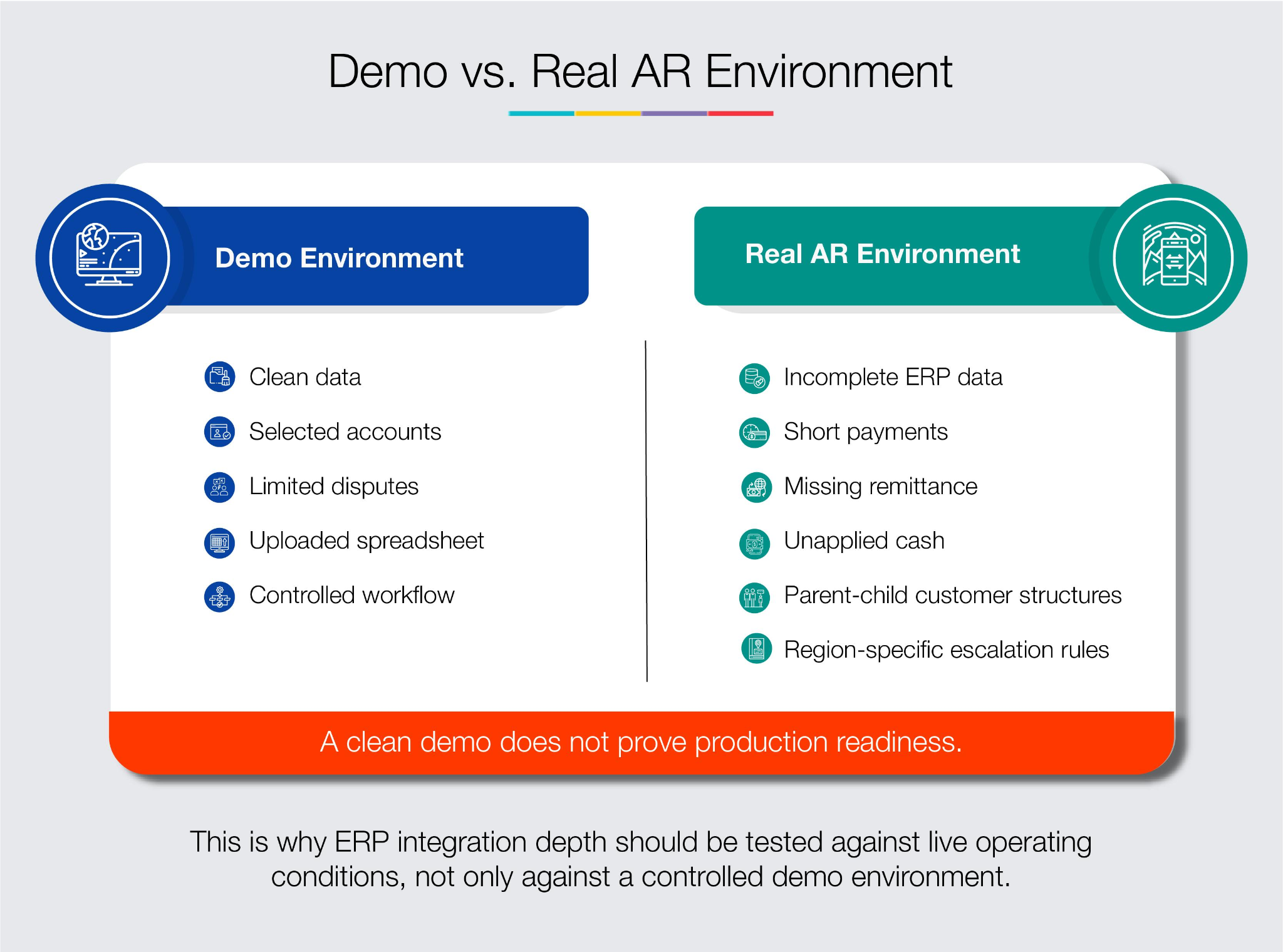
Before shortlisting a vendor, ask what fields are mandatory, how frequently data must refresh, how integration failures are handled, how exceptions are flagged, and who owns data remediation.
3. Implementation Discipline and Governance
This is the most important evaluation dimension.
A serious AI collections partner should define the operating baseline before implementation begins. Without a baseline, finance leaders cannot separate actual improvement from dashboard activity.
Baseline metrics may include days sales outstanding (DSO), overdue balance, collector productivity, dispute cycle time, promise-to-pay adherence, touch frequency, escalation rate, collector override rate, and exception volume.
The partner should also define data quality requirements, human override rules, AI recommendation review thresholds, audit trail requirements, exception handling, model monitoring, change control, and governance ownership.
The practical question is not, “What can the tool do?” It is, “How will we know whether the tool is making better decisions, and who is accountable when it does not?”
If collectors override recommendations frequently, finance leaders need to know why. The issue may be poor data, weak segmentation, incomplete business rules, low model confidence, or recommendations that ignore customer context.
If disputed invoices remain in active collection queues, the workflow is not simply inefficient. It is creating customer friction and wasting collector capacity.
Governance is the difference between a controlled AI program and a process that scales exceptions faster than the team can manage them.
4. Partnership Quality and Post-Launch Support
AI collections does not become reliable at go-live.
After launch, finance teams need to monitor whether the system is prioritizing the right accounts, routing disputes correctly, identifying repeat broken promises, handling low-confidence recommendations, and producing escalation decisions that match policy.
A credible partner should provide named customer success support, collections operations expertise, a defined governance cadence, model performance reviews, adoption support, issue resolution procedures, and a continuous improvement roadmap.
The support model should answer practical questions: Who reviews recommendation quality? Who investigates recurring overrides? Who tunes workflows when credit policy changes? Who resolves integration defects? Who monitors exception volumes?
A vendor that treats go-live as the finish line is not a partner. It is a software provider transferring operating risk back to the buyer.
5. Three-Year Total Cost of Ownership
The platform fee is only one part of the economics.
A serious total cost of ownership (TCO) model should include platform fees, ERP integration setup, ongoing integration maintenance, data cleaning and remediation, storage and data egress costs, model monitoring and retraining, internal full-time equivalent (FTE) effort, governance and compliance oversight, human review for edge cases, change management and training, support costs, and custom workflow configuration.
Low headline pricing can mask expensive execution. A finance team may still need internal analysts to clean data, IT teams to maintain integrations, supervisors to review exceptions, and collectors to work around recommendations they do not trust.
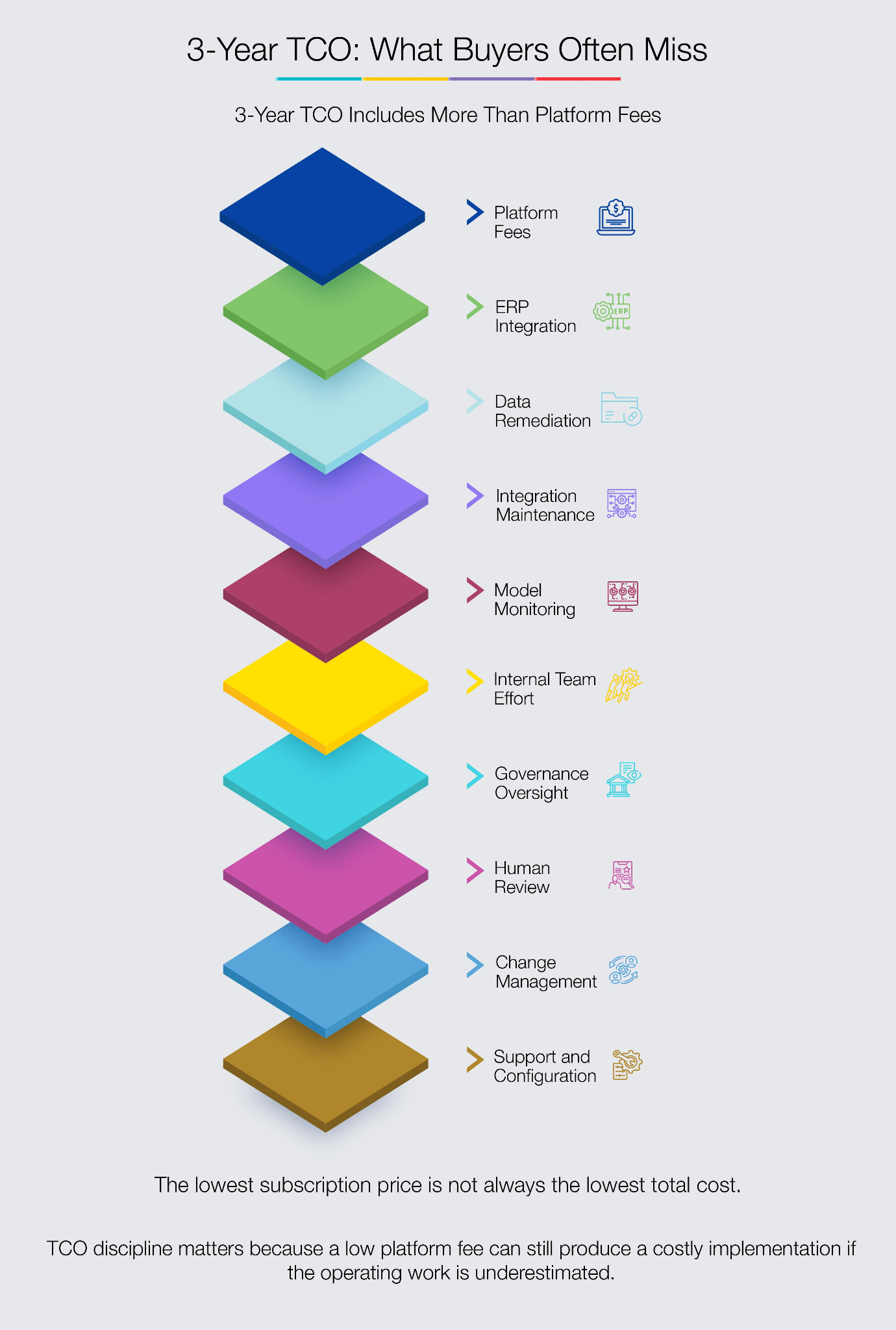
Buyers should model three years, not the first contract year.
Four Non-Negotiables Before Any AI Collections Partner Makes Your Shortlist
1. Named Production References in Your Vertical
Do not rely on sandbox demos, pilot-stage references, or generic success stories.
Ask for live deployment references with similar invoice volume, ERP environment, customer type, dispute complexity, and collections operating model.
The best reference questions are direct: What changed after go-live? What broke? What required manual workarounds? How often did collectors override recommendations? How did the vendor respond when workflows needed adjustment?
2. Documented Data Readiness Requirements
A vendor that says it can work with any data is avoiding the real issue.
Good partners define required fields, data quality thresholds, update frequency, exception handling, and data ownership. They should explain how the system behaves when remittance is missing, customer master data is duplicated, disputes are unresolved, payments are unapplied, or collector notes are incomplete.
3. Clear Human-in-the-Loop Governance
Finance leaders should know exactly when AI can recommend, when it can act, and when a human must approve.
Sensitive actions require defined approval rules. These include write-offs, customer holds, legal escalation, credit limit changes, high-value account escalation, and actions involving strategic or disputed customers.
4. Transparent Audit Trail
Every AI-driven recommendation or action should be traceable.
Finance teams should be able to see what data was used, what rule or model influenced the decision, what confidence level was assigned, who approved the action, what was sent or changed, and what happened next.
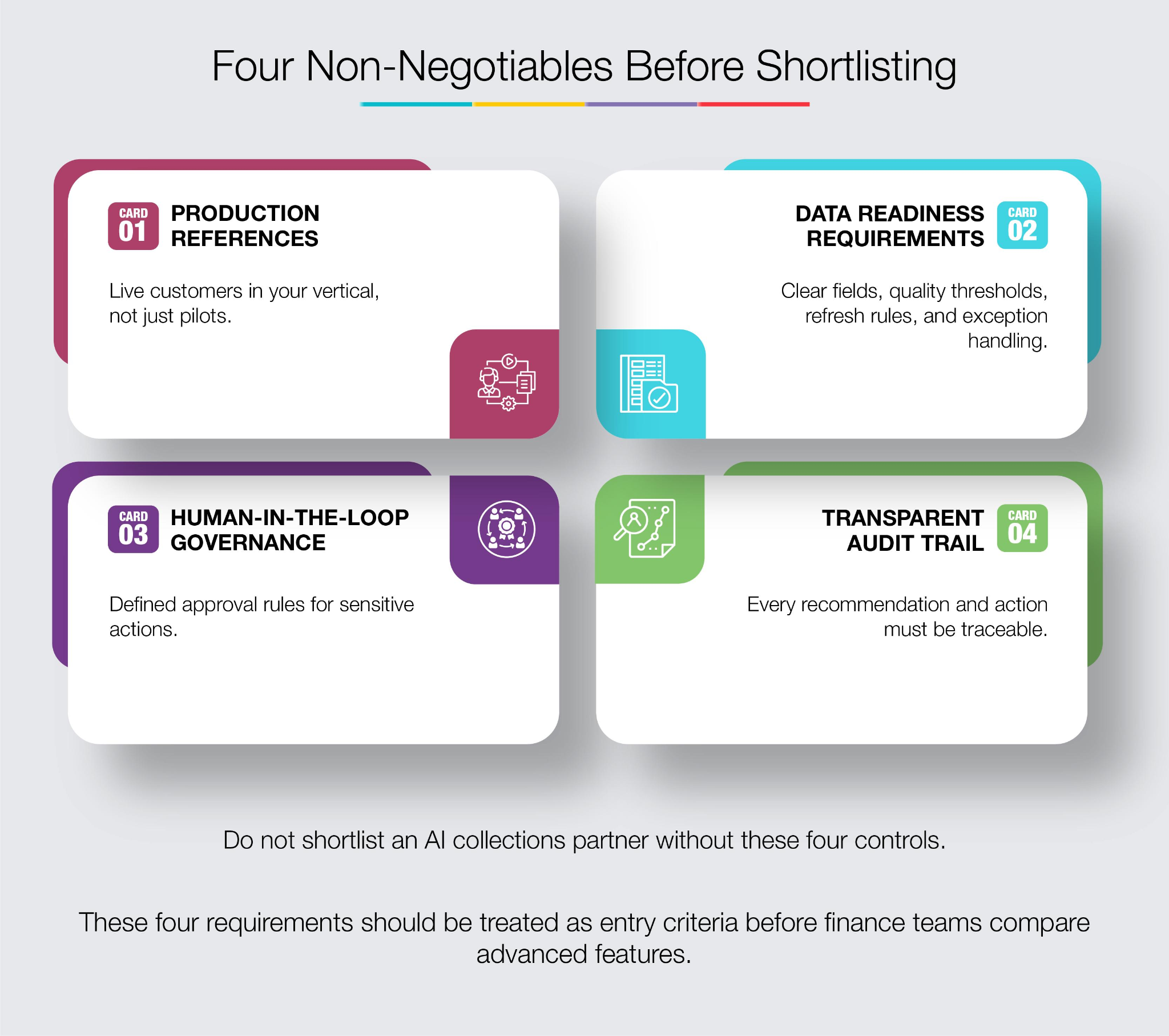
If a customer challenges an escalation, a collector questions a recommendation, or an auditor asks how a decision was made, the answer cannot be “the system recommended it.”
A Practical Shortlisting Scorecard for Finance Leaders
A scorecard does not remove judgment. It prevents the loudest demo from becoming the default decision.
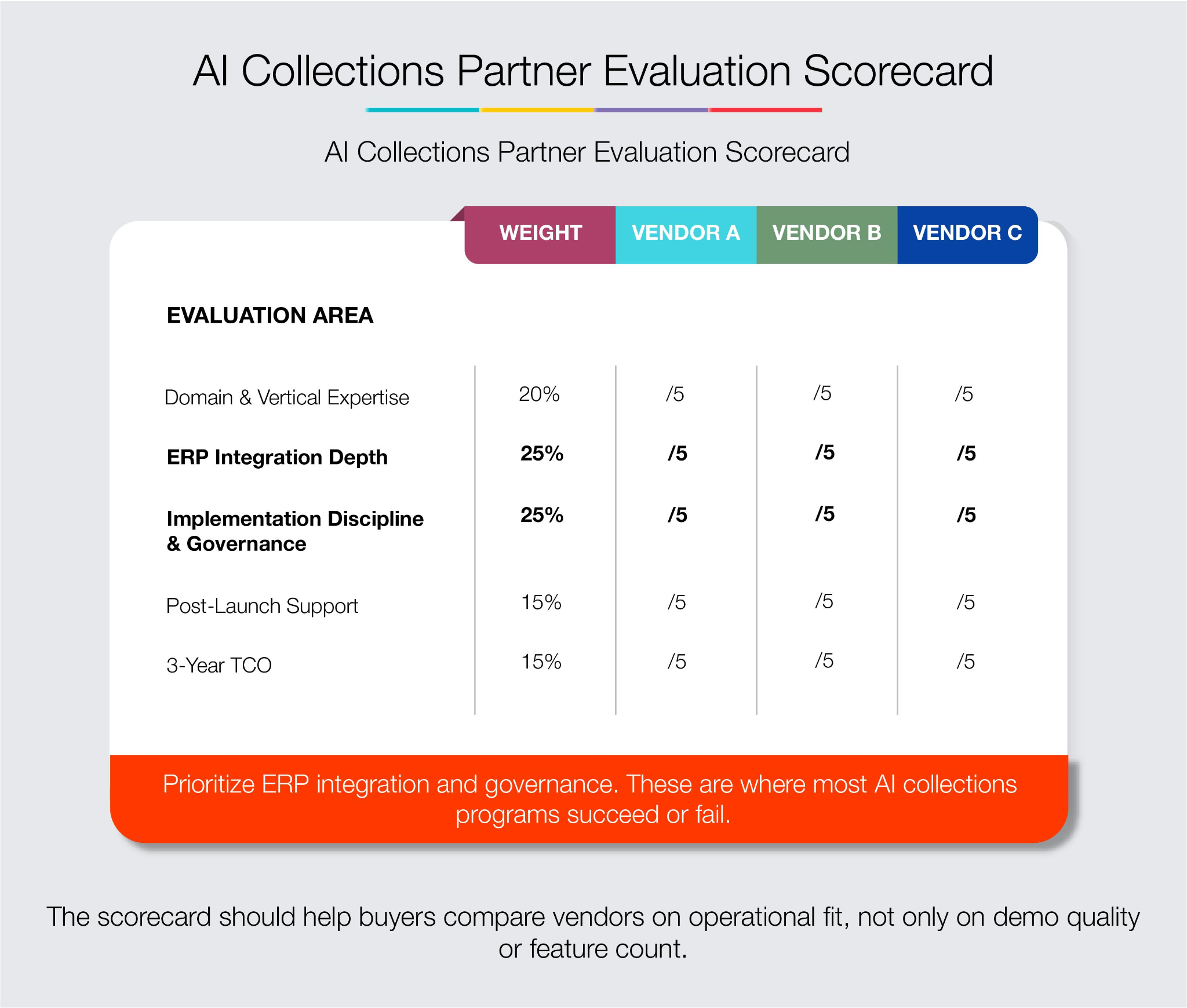
Limit the final comparison to 3–5 serious contenders and adjust the weights based on operating priorities.
Red Flags in AI Collections Vendor Evaluation
Watch for these seven red flags during evaluation:
- “AI-powered” claims without specifics on where AI is used, what data informs recommendations, how confidence is calculated, and how decisions are reviewed.
- Only demoing clean scenarios while avoiding disputed invoices, deductions, short payments, unapplied cash, missing remittance, duplicate customer records, and parent-child account structures.
- No data quality requirements before go-live, which usually means data problems will surface later through overrides, rework, duplicate outreach, or weak reporting.
- Vague service-level agreement (SLA) and governance language that does not clarify issue resolution, integration defects, support availability, escalation paths, and reporting obligations.
- Vendor-defined success metrics focused mainly on automated touches, user activity, or workflow volume rather than AR outcomes.
- Unrealistically short implementation timelines that defer ERP integration, data remediation, workflow design, testing, training, or control review.
- No reference customers in your vertical or at your scale, even though collections complexity changes with invoice volume, billing model, geography, dispute rate, ERP setup, and approval rules.
Questions to Ask Before You Sign
Use these questions during due diligence:
- What is your override rate in live production deployments?
- What data quality requirements do you enforce before go-live?
- How do you define and document baseline metrics?
- What does the audit trail show for each AI-driven recommendation or action?
- Can you provide named references in our specific vertical?
- How do you handle disputed invoices, deductions, partial payments, and missing remittance?
- What actions require human approval?
- What happens when the model confidence score is low?
- What does the three-year TCO include beyond platform fees?
- How often are workflows reviewed after launch?
- What support is included after go-live?
- How do you prevent AI from escalating sensitive accounts incorrectly?
The answers should be concrete. Strong vendors can explain production scenarios, failure points, governance controls, and post-launch responsibilities. Weak vendors return to roadmap language, controlled demos, and generic AI claims.
Where Straive Fits
Straive helps global organizations translate collections policy into workable operating models: segmentation, escalation paths, exception handling, human review, reporting cadence, and performance governance.
For finance teams evaluating AI collections partners, operational experience matters because the hardest work begins where the demo ends: making AI work inside real AR processes.
Straive helps finance and AR teams design practical operating models where AI supports better prioritization, exception handling, review controls, and consistent execution inside complex collections environments.
The Right Partner Makes the AI Work. The Wrong One Makes a Very Expensive Demo.
AI collections success depends less on the promise of the model than on the operating system around it: data quality, ERP integration, governance, review gates, domain expertise, and post-launch accountability.
The wrong partner can automate weak data, scale poor prioritization, escalate sensitive accounts incorrectly, create audit gaps, and leave finance teams with an expensive cleanup.
The right partner helps finance teams make AI operationally reliable in the environment where collections actually happens: imperfect data, disputed balances, complex customers, changing priorities, and decisions that still require judgment.
Ready to evaluate AI collections partners with more confidence? Contact Straive to see how our collections operations and AI-enabled workflow teams help finance leaders build practical, governed, and scalable accounts receivable transformation programs.

Priya Roy is Vice President, Delivery Leadership at Straive, where she translates ambitious growth strategy into high-performing customer experience and technology operations. With deep expertise in large-scale transformation, she offers a practical leadership perspective on scaling AI, elevating service excellence, and turning operational complexity into lasting enterprise value.


