
Posted on: May 18th 2026
- Introduction: A New Era beyond Automation
The publishing industry has long been a pioneer of innovation. But the march toward publishing automation AI 2025 goals has reached a critical crescendo. Today, the global professional publishing sector, projected to grow to about USD 75.2 billion by 20341, is shedding its static, print-heavy legacy.
This evolution has reached a critical friction point. Human-led workflows are struggling under the force of a data fire hose and incremental digitizing is proving to be uneconomical. To meet modern research demands, the industry is pivoting towards intelligent workflow automation, signaling a high-stakes tech inflection point that will redefine the publishing landscape.
At the center of this transformation is autonomous execution. Organizations such as Straive are helping publishers navigate this paradigm shift by enabling the transition from fragmented workflows to intelligent, self-operating publishing ecosystems.
The Infrastructure Shift
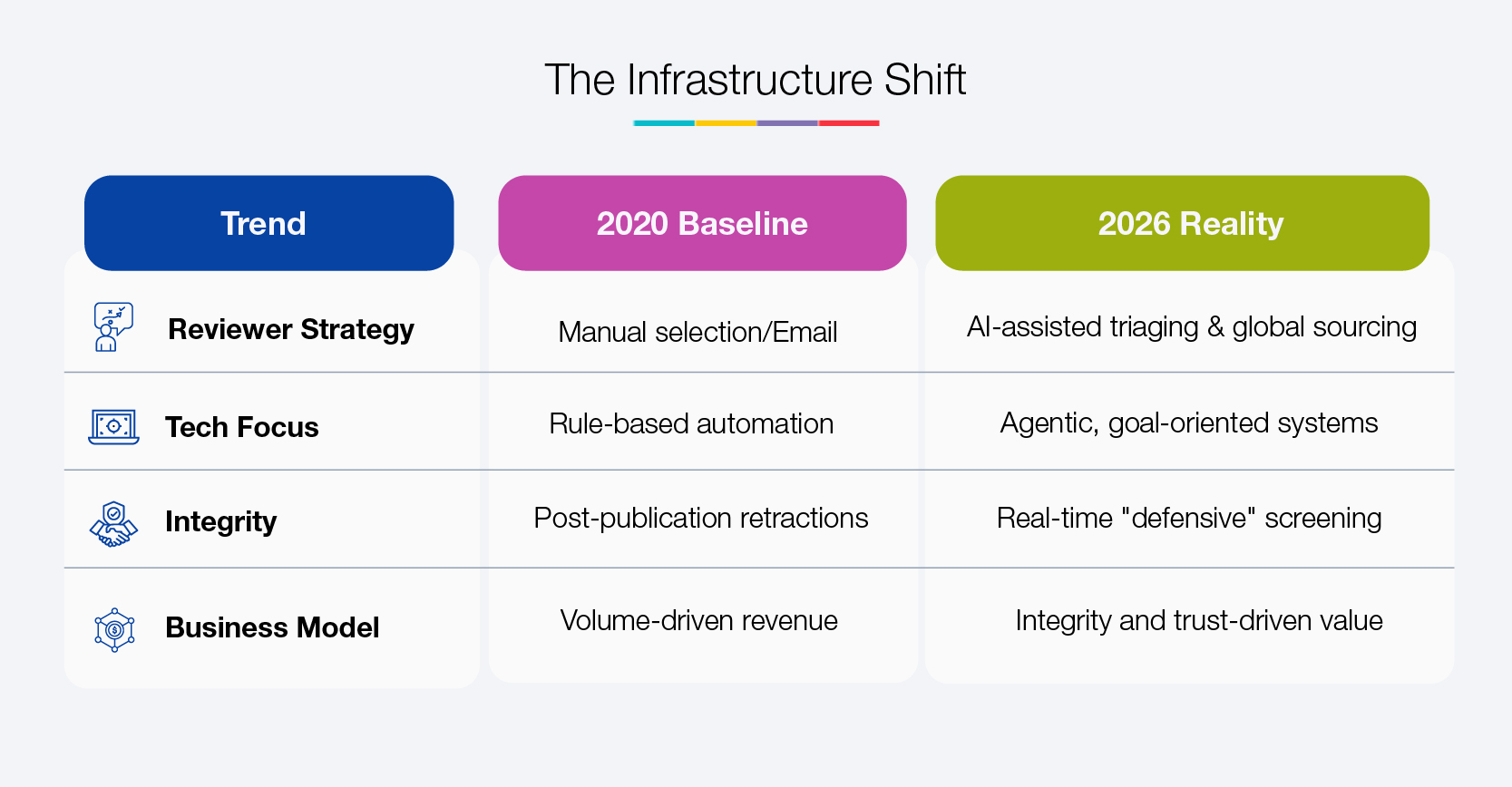
The leap from rule-based workflows to LLM-driven agentic systems requires more than just updated software. Straive is redefining this frontier, providing the AI-native, domain-specific data solutions necessary for publishers to transcend basic automation and embrace high-level research intelligence.
- The Evolution: From Manual Workflows to Intelligent Automation
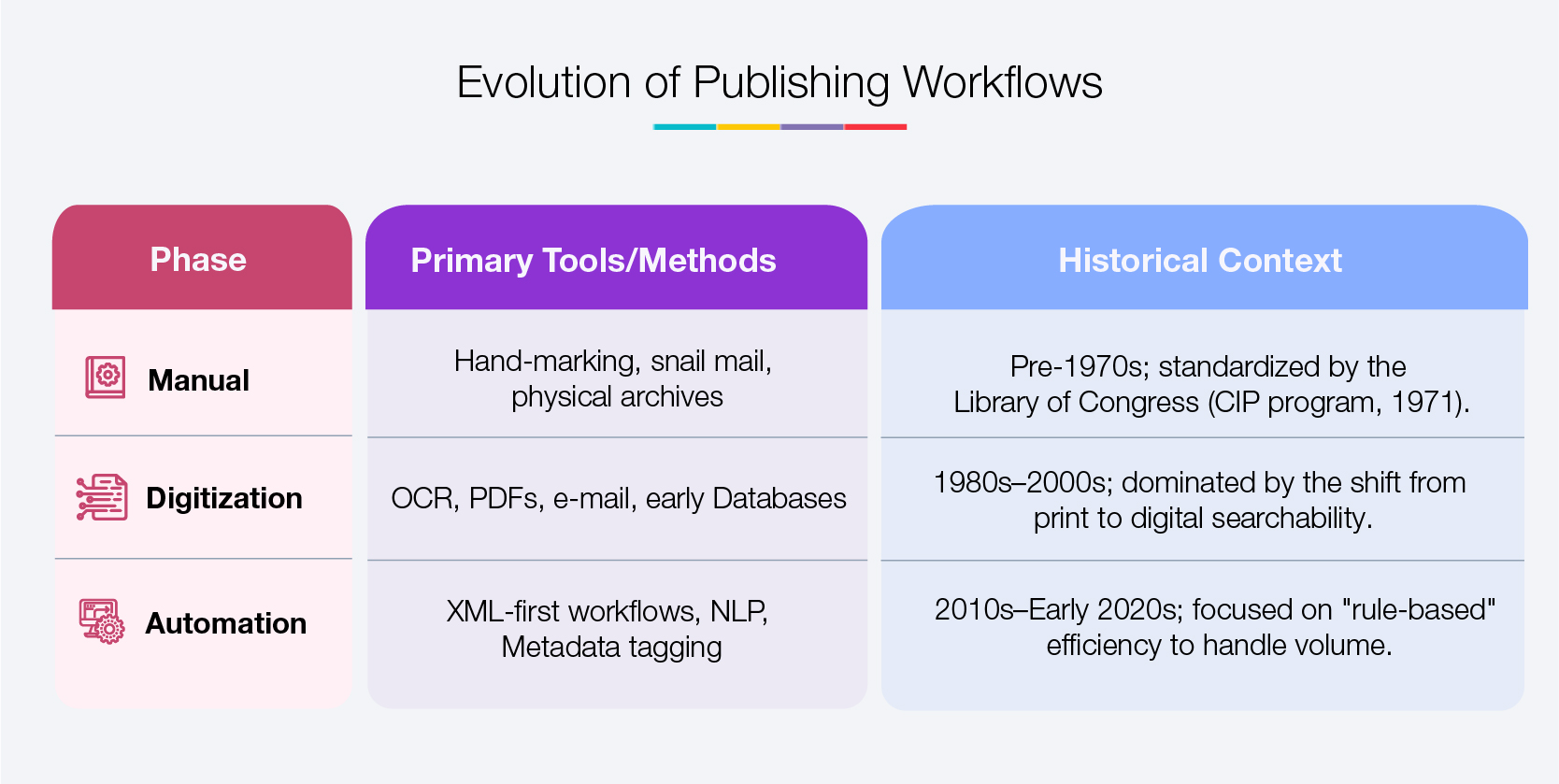
The journey of publishing has been one of constant refinement. Before the mid-20th century, publishing workflows were entirely paper-driven2. Proofs were hand-marked using standard editorial symbols, and manuscripts were physically mailed between authors, editors, and typesetters.
This gave way to the digitization era of the late 20th century (1980s–2000s), a period marked by the transformation of physical documents into digital formats3. Central to this era was Optical Character Recognition (OCR), which enabled computers to read printed text, making content searchable, though not yet intelligent.
The era of intelligent workflow automation, which followed the digitization era, introduced software capable of handling repetitive editorial tasks. By the 2010s, Rule-Based Automation and early Natural Language Processing (NLP) were being used for metadata 4 tagging, basic copyediting, and Quality Assurance (QA).
Evolution of Publishing Workflows
While common in peer review and screening, today’s AI-driven editorial workflows are fundamentally linear and human-triggered, requiring manual intervention at every stage of the process.
Besides the current hyperautomation in media publishing lacks the contextual depth needed for complex research or narratives. While efficient, these workflows remain reactive—stalling at any deviation until a human intervenes.
- Enter Agentic AI: The Shift to Autonomous Execution
Building upon traditional AI, generative AI, and other advanced technologies, agentic AI for content operations takes things a step further. Unlike traditional software, AI agents are designed to plan, decide, and execute tasks independently. In a publishing context, this means moving from automation to autonomy. AI agents in publishing can now handle complex, multi-step processes such as manuscript triaging5, finding the perfect reviewer match based on evolving research trends, and content enhancement.
These agentic publishing workflows rely on multi-agent collaboration—where one agent might check for scientific integrity while another optimizes SEO6, and a third orchestrates the production timeline7.
Agentic Publishing Workflow Roles
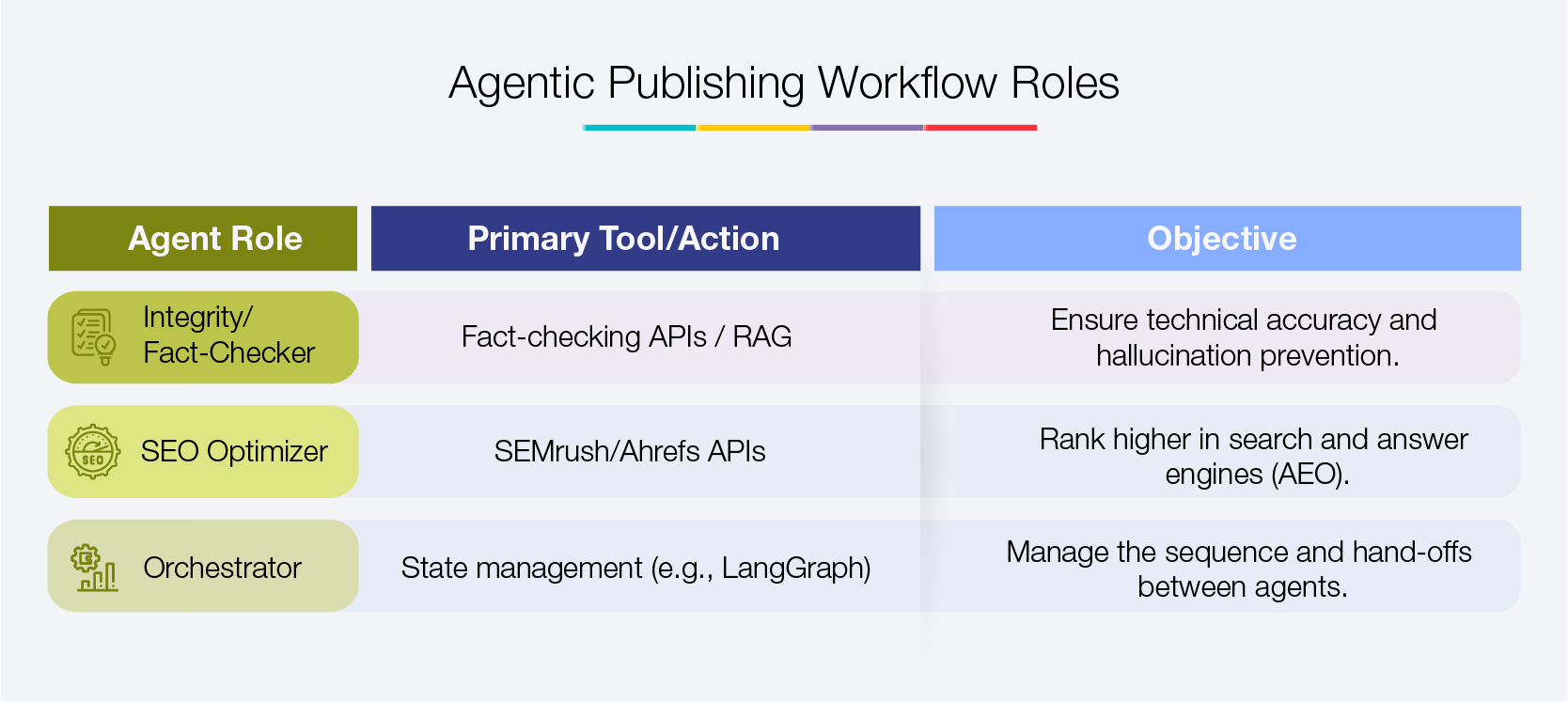
This represents a fundamental shift to autonomous content execution. Instead of a human managing a checklist, a human provides a goal8 (e.g., “Prepare this manuscript for open-access publication by Friday”), and the agentic system determines the best path to achieve it, navigating obstacles with context-aware reasoning.
- What Autonomous Publishing Systems Look Like
Imagine in a future-state scenario a manuscript submission immediately triggers LLM-powered publishing pipelines. The system not only stores the file, it also understands it. AI agents begin a coordinated dance, specifically for epistemic integrity 9, managing everything from editorial checks to production and final dissemination across global platforms.
The Shift
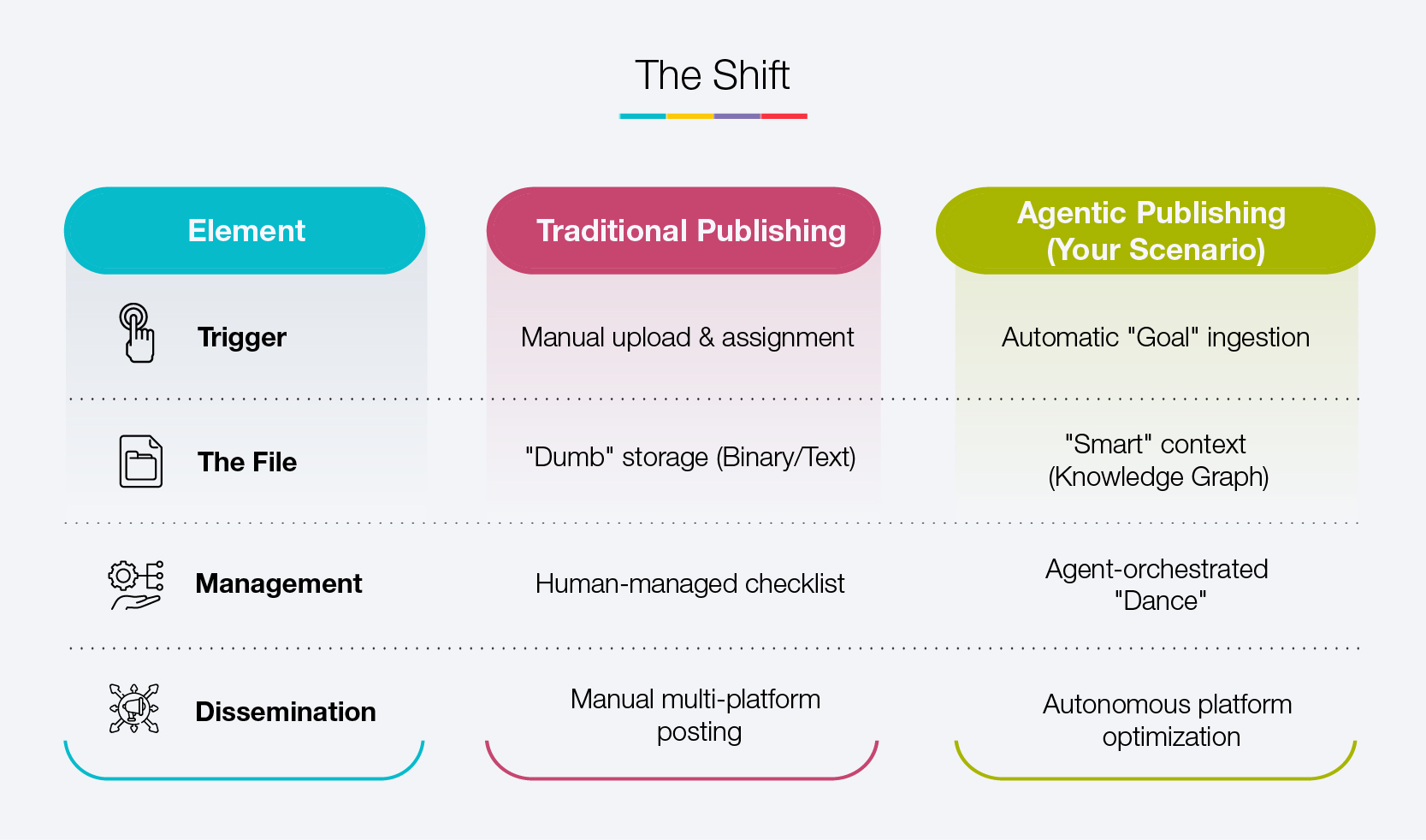
The architecture of autonomous publishing systems consists of three core pillars:
- LLMs: The brain for deep understanding and content generation.
- Orchestration Layers: The nervous system that coordinates agents and tools.
- Feedback Loops: Systems that learn from human corrections to improve future performance10.
The Agentic Architecture
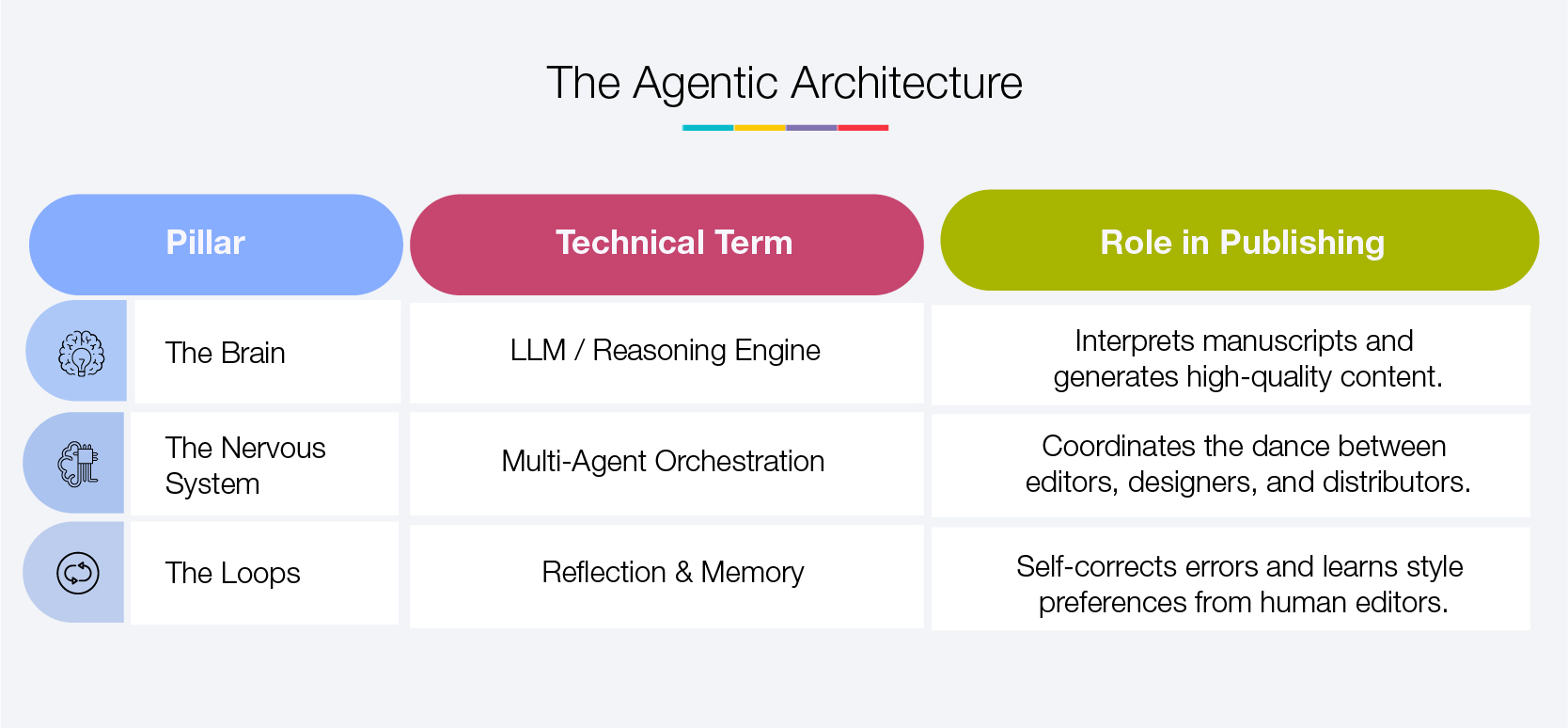
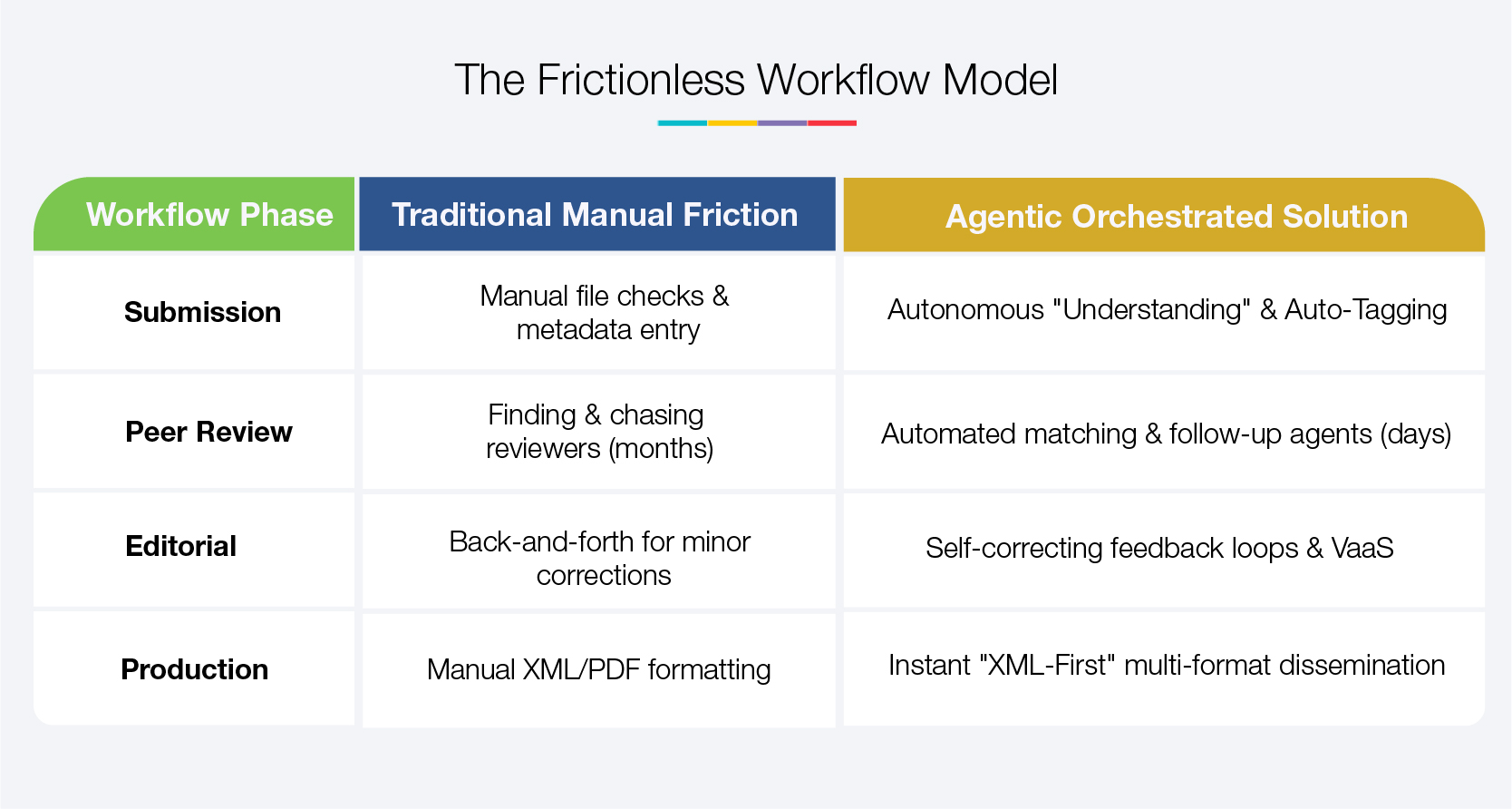
AI orchestration in scholarly publishing means multi-step coordination across authors, reviewers, and editors with minimal friction. While human oversight remains as the vital guardrail11, the heavy lifting of autonomous content execution allows the system to operate at a scale and speed previously unimaginable.
The Frictionless Workflow Model
- The Publishing Automation Maturity Model
To understand where the industry stands, we look at the publishing automation maturity model12:
- Digitization: Transitioning from paper to digital tools and manual data entry.
- Automation: Implementing rule-based, linear workflows for repetitive tasks.
- Intelligent Automation: Integrating next-gen publishing technology and AI-assisted processes (current industry standard).
- Autonomous Execution: Deploying agentic, self-optimizing systems that manage the entire lifecycle.
Publishing Automation Maturity Model
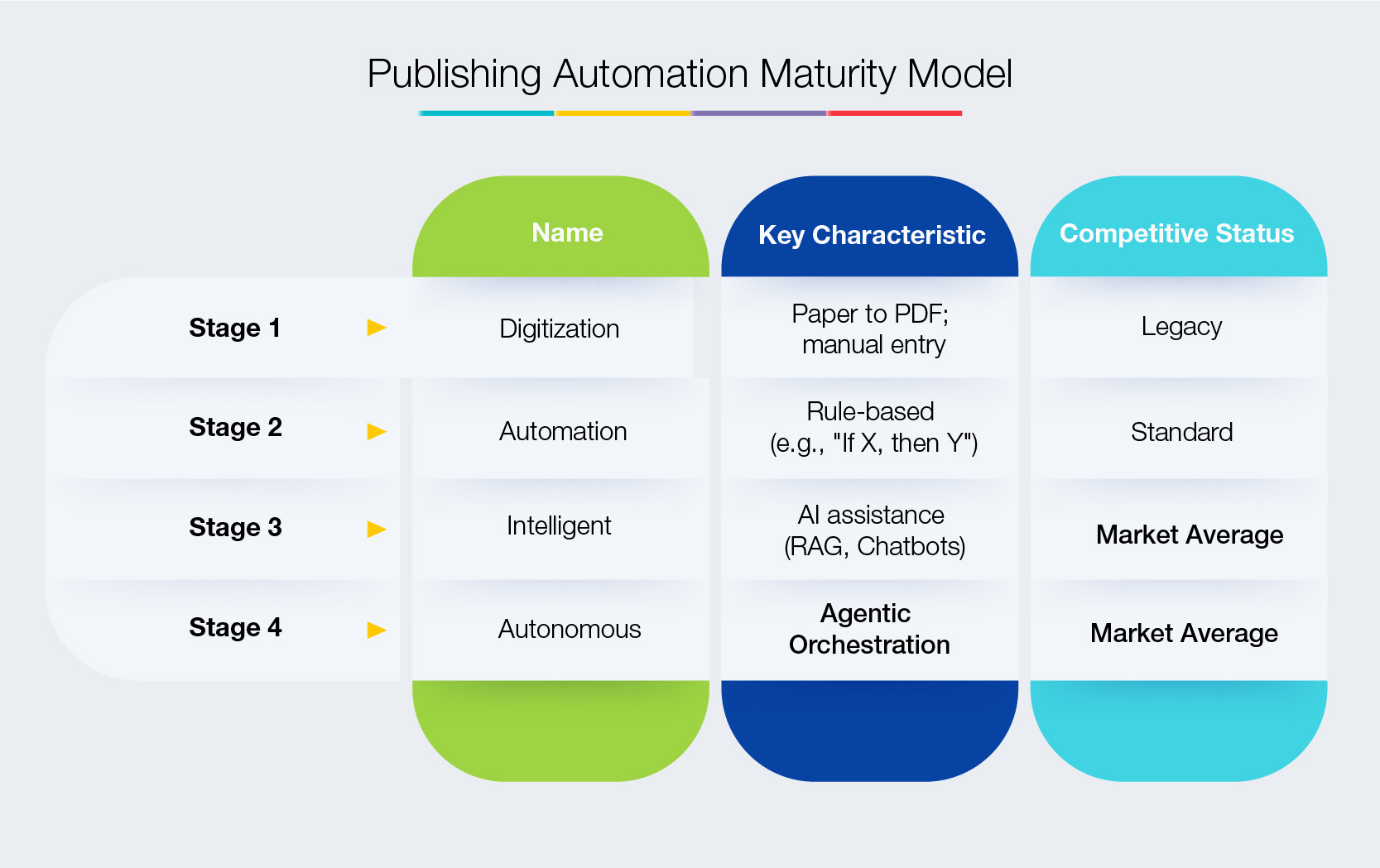
Most publishers currently operate between Stages 2 and 3. The leap to Stage 4 represents the ultimate competitive advantage, transforming publishing houses from content processors into high-velocity, AI-driven content engines.
- Business Impact: Why This Shift Matters Now
In 2026, the publishing industry is facing an unprecedented convergence of volume, speed, and complexity. In this landscape, embracing hyperautomation in media publishing is no longer a matter of efficiency. It is a matter of survival. Autonomous systems offer:
- Faster Time-to-Publish: AI-driven triage and automated formatting can reduce the initial editorial cycle by up to 40-60% 13.
- Cost Efficiency at Scale: Handling massive volumes with AI is more likely to complement and not replace human workers14.
- Improved Quality: Eliminating human error in technical checks and consistency15.
- Personalization: Automatically personalizing content for diverse audiences and platforms16.
Traditional vs. Agentic Publishing (2026)
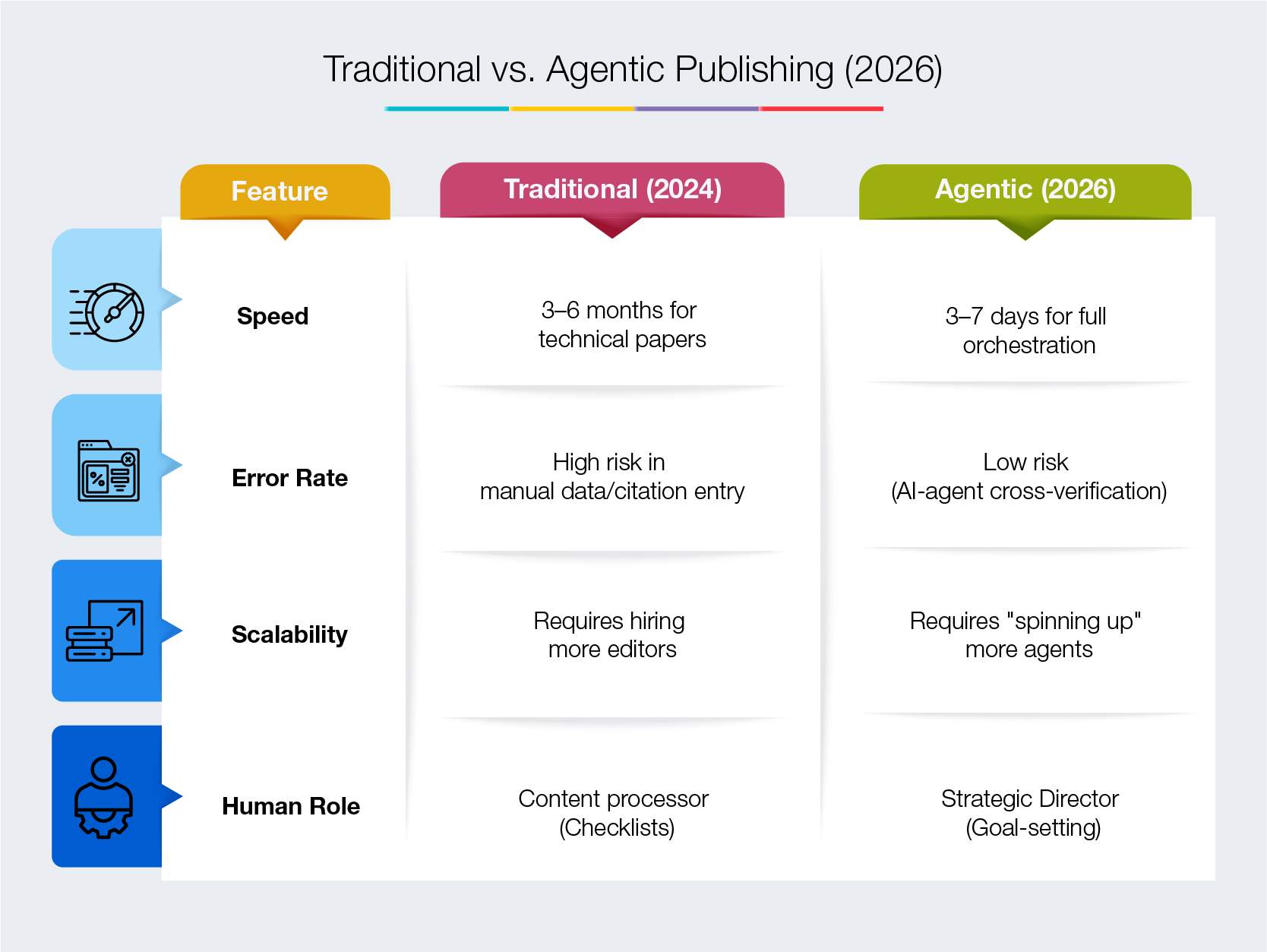
The shift toward publishing automation AI 2025 and beyond ensures that publishers can remain relevant in a fragmented, fast-paced information economy.
- Straive’s Perspective: Enabling the Autonomous Future
At Straive, we don’t just observe the future; we build the infrastructure that powers it. As a leader in AI-driven editorial workflows, we act as the bridge between legacy processes and LLM publishing automation. Our expertise lies in combining deep domain knowledge with sophisticated AI orchestration layers17.
We help our partners design and implement agentic publishing workflows that are both powerful and responsible. By utilizing a “human-in-the-loop” approach, we ensure that while the systems are autonomous, they remain transparent and aligned with editorial standards. Straive enables publishers to transition across the maturity model, turning autonomous publishing systems from a vision into a daily operational reality.
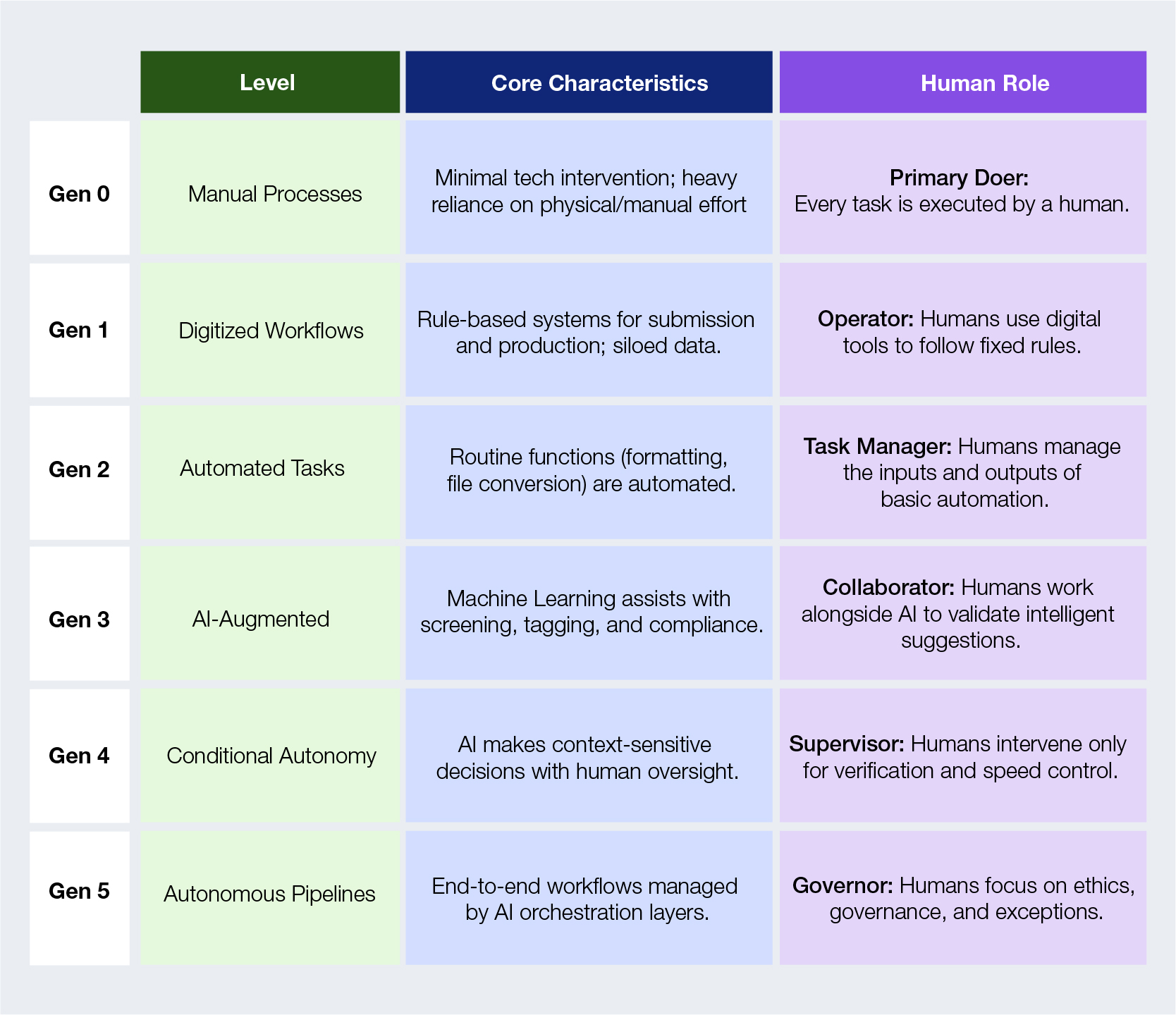
Straive’s AI Maturity Model for Publishing
This model outlines the evolutionary journey from manual labor to a fully autonomous, AI-driven publishing ecosystem.
- Challenges and Considerations
Transitioning to autonomy is not without hurdles. Ethical concerns18 regarding AI bias, the need for absolute transparency (explainability), and the integration with aging legacy systems are significant. Furthermore, change management19 is vital; staff must shift from “doing” to “directing.” However, it is crucial to remember that autonomy does not mean a lack of control—it means having more sophisticated control over the final outcome.
- Conclusion: The Inflection Point is now
The industry has crossed the line from simple automation into the territory of true autonomy. This publishing tech inflection point marks a new era where content is no longer just handled but is strategically managed by intelligent systems.
For publishers, the message is clear: the transition to autonomous publishing systems is inevitable. Those who adopt these self-operating, adaptive technologies today will define the landscape of tomorrow. Publishing is becoming more than a process—it is becoming an intelligent, self-optimizing ecosystem.

Straive helps clients operationalize the data> insights> knowledge> AI value chain. Straive’s clients extend across Financial & Information Services, Insurance, Healthcare & Life Sciences, Scientific Research, EdTech, and Logistics.


