
Posted on: November 17th 2025
The publishing industry is at an inflection point. Traditional workflows—reliable for decades—are struggling to keep pace with the velocity, volume, and variety of content in today’s digital-first world. Whether in scientific publishing, education, or knowledge dissemination, the demand for faster turnaround, greater compliance, and global accessibility is reshaping expectations.
Artificial intelligence (AI) has emerged not as a distant promise, but as a present reality—reshaping editorial decisions, automating repetitive processes, and enabling scale without compromising quality. What was once an experimental technology is now rapidly becoming a critical enabler of competitive advantage.
This blog offers a snapshot of insights from Straive’s latest whitepaper, Reengineering Publishing at Scale: A Domain-Centric Approach. It explores the bottlenecks holding publishing back, the AI-driven paradigm shift underway, and the roadmap to maturity that leaders must embrace.

The Bottleneck Reality
Despite advances in digital publishing, many organizations remain weighed down by fragmented, manual-heavy processes. These bottlenecks do more than slow down operations—they create systemic risks across the publishing value chain.
Key pain points include:
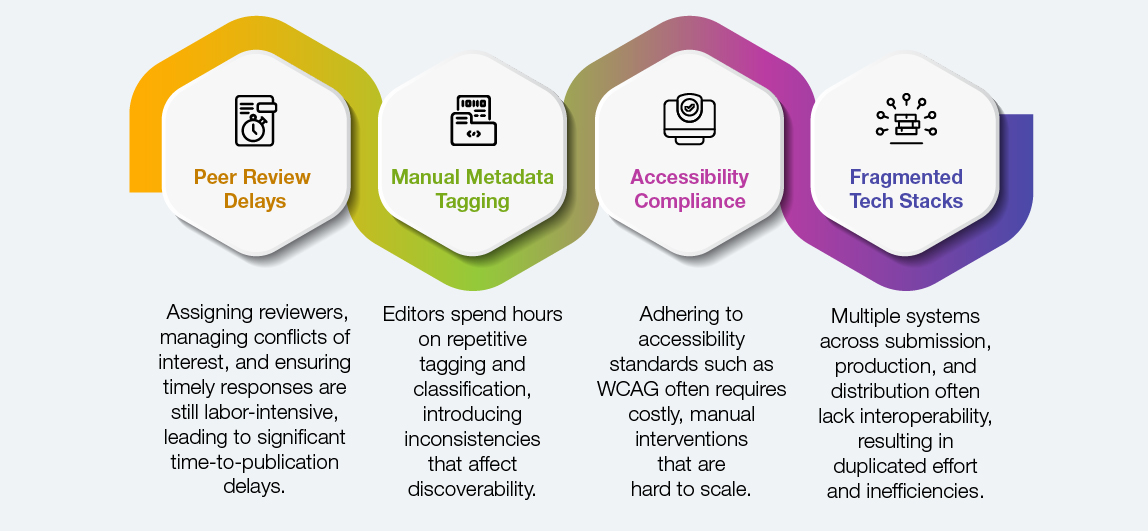
- Peer Review Delays – Assigning reviewers, managing conflicts of interest, and ensuring timely responses are still labor-intensive, leading to significant time-to-publication delays.
- Manual Metadata Tagging – Editors spend hours on repetitive tagging and classification, introducing inconsistencies that affect discoverability.
- Accessibility Compliance – Adhering to accessibility standards such as WCAG often requires costly, manual interventions that are hard to scale.
- Fragmented Tech Stacks – Multiple systems across submission, production, and distribution often lack interoperability, resulting in duplicated effort and inefficiencies.
These operational hurdles have real business consequences. Publishing timelines stretch, costs rise, and errors slip through the cracks. More critically, organizations risk losing relevance in an ecosystem that demands both speed and integrity.
The truth is stark: publishing can no longer rely on processes designed for a slower, print-centric world.
The Paradigm Shift: From Manual to Intelligent Workflows
Enter AI—the “new intelligence layer” powering the next wave of publishing transformation. But not just any AI. The real breakthrough lies in domain-driven AI: solutions trained on publishing-specific data, tuned to industry standards, and designed to complement editorial expertise rather than replace it.
Where AI is already making impact:
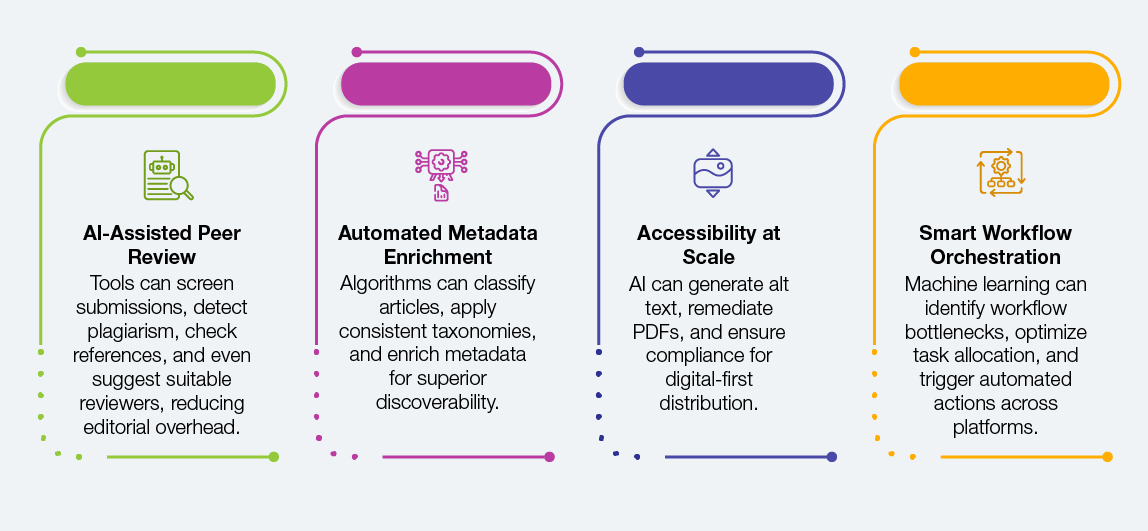
AI-Assisted Peer Review :
Tools can screen submissions, detect plagiarism, check references, and even suggest suitable reviewers, reducing editorial overhead.
Automated Metadata Enrichment :
Algorithms can classify articles, apply consistent taxonomies, and enrich metadata for superior discoverability.
Accessibility at Scale :
AI can generate alt text, remediate PDFs, and ensure compliance for digital-first distribution.
Smart Workflow Orchestration :
Machine learning can identify workflow bottlenecks, optimize task allocation, and trigger automated actions across platforms.
This shift doesn’t replace human editors; rather, it augments judgment with intelligence. Editors remain the custodians of quality, ethics, and rigor, while AI removes friction from repetitive, time-consuming processes.
Yet, realizing these benefits isn’t about flipping a switch. It requires a clear roadmap—an understanding of where your organization stands today, and what steps will move you toward AI maturity.
The Roadmap to AI Maturity
Straive’s whitepaper introduces a Gen 0–Gen 5 framework for AI adoption in publishing—a staged model that traces the journey from manual operations to autonomous, self-learning publishing pipelines.
Highlights of the roadmap:
- Gen 0: Manual Processes – Reliance on human effort, with minimal technology intervention.
- Gen 1: Digitized Workflows – Systems in place for submission and production, but processes remain rule-based and siloed.
- Gen 2: Automated Tasks – Routine functions such as formatting and file conversion automated, though with limited intelligence.
- Gen 3: AI-Augmented Workflows – Machine learning supports editorial functions—screening, tagging, compliance checks—working alongside human experts.
- Gen 4: Conditional Autonomy – AI begins to make context-sensitive decisions under human oversight, significantly accelerating production.
- Gen 5: Autonomous Publishing Pipelines – End-to-end workflows managed by AI, with humans overseeing governance, ethics, and exception handling.
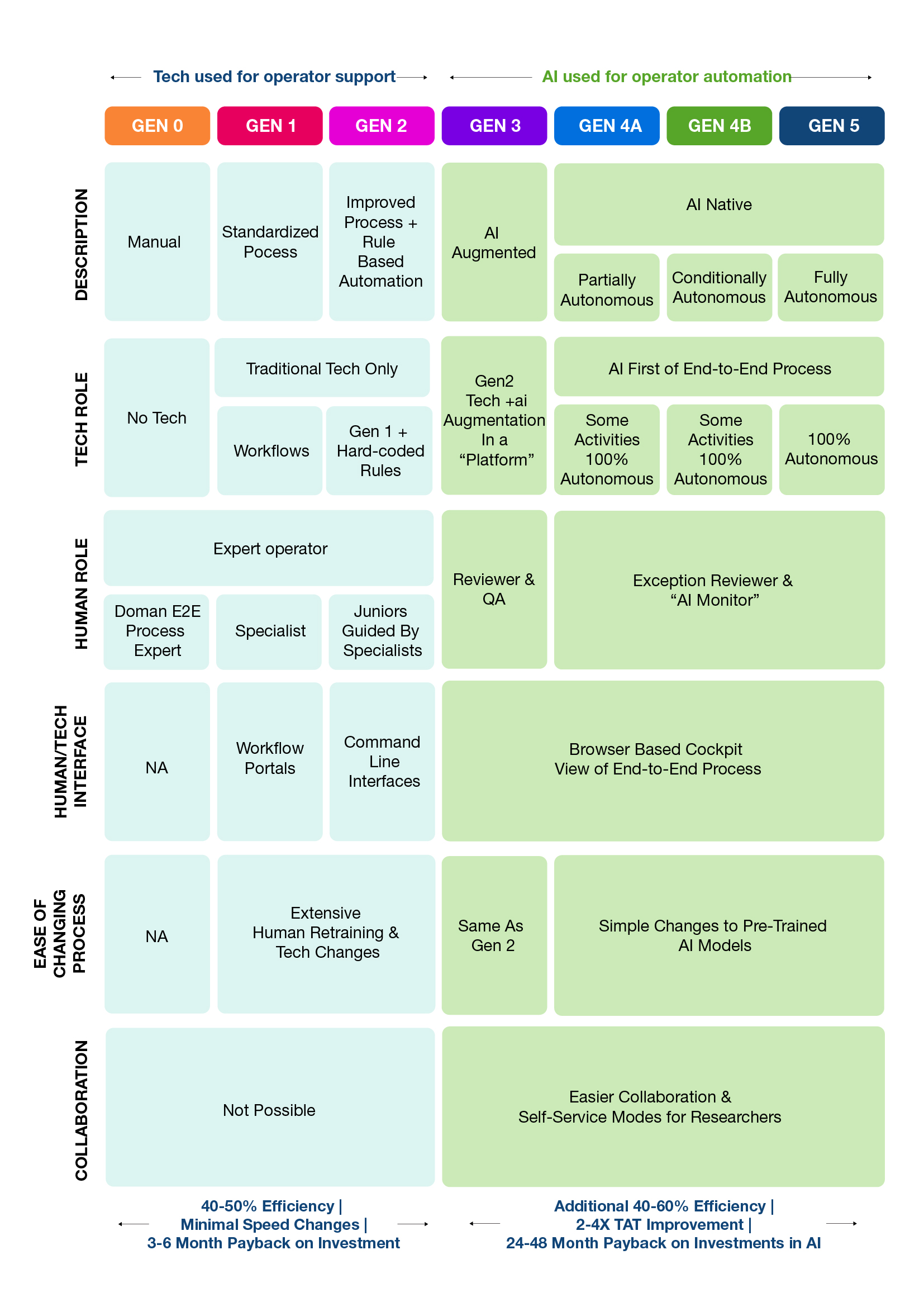
Most publishers today operate somewhere between Gen 2 and Gen 3—benefiting from isolated automations but far from realizing full-scale AI integration. Moving forward requires both technological investment and cultural readiness: the willingness to let AI take on core functions while redefining editorial roles as strategic enablers.
The full whitepaper offers a detailed exploration of this roadmap, including use cases, maturity assessment, and adoption strategies.
The Business Case for Change
For publishing leaders, the AI imperative is no longer theoretical—it’s financial, operational, and reputational. AI-driven workflows are already delivering measurable gains across the industry:
- Faster Time-to-Market – Automating metadata, reviews, and compliance cuts weeks from the production cycle.
- Cost Efficiency – Reduced manual effort translates into lower cost per article, book, or journal issue.
- Compliance and Quality – AI ensures systematic adherence to accessibility, ethics, and integrity standards.
- Scalable Operations – Publishers can handle rising submission volumes without scaling human resources at the same rate.
Ultimately, this isn’t just about keeping up with industry peers. It’s about future-proofing publishing operations in an era of global, digital, and instantaneous knowledge dissemination.
As the whitepaper notes, “The question is no longer whether AI can transform publishing, but how quickly organizations can adapt.”
Conclusion: Reengineering at Scale
Publishing stands at a breaking point. Manual-heavy workflows cannot meet the demands of digital-first, high-volume, compliance-driven content delivery. AI offers the path forward—augmenting editorial expertise, streamlining workflows, and enabling transformation at scale.
But every publisher’s journey is different. The key is knowing where you stand on the AI maturity curve—and what steps will take you closer to future-ready operations.
To explore the Gen 0–Gen 5 roadmap in detail and discover practical strategies for transformation, download Straive’s latest whitepaper: Reengineering Publishing at Scale: A Domain-Centric Approach.

About the Author

Straive helps clients operationalize the data> insights> knowledge> AI value chain. Straive’s clients extend across Financial & Information Services, Insurance, Healthcare & Life Sciences, Scientific Research, EdTech, and Logistics.
Share with Friends:


