
Posted on: October 24th 2025
Omnichannel customer experience was supposed to be the silver bullet—unifying web, mobile, chat, social, and phone support into seamless journeys. Over the past decade, organizations have poured billions into these ecosystems. Yet for many customers, the experience remains fragmented. They switch channels, repeating details. Automated replies feel rigid. Promised “smooth journeys” often stall at critical moments.
This gap isn’t for lack of technology—it’s for lack of intelligence. Most enterprise AI remains reactive: it waits, responds, and resets. But today’s customers expect the fluidity of the best consumer tech experiences, where personalization feels effortless and continuity is assumed.
The Limits of Traditional Omnichannel
The omnichannel model was an upgrade from disconnected multichannel touchpoints, but it never fully solved the context problem. Data silos prevent information from following the customer. Rule-based bots can’t handle ambiguity.
Even advanced routing systems fail when customers switch devices mid-conversation. For service teams, this context switching creates inefficiencies and frustration. Customer experience leaders know they need more than integrated channels—they need intelligence that orchestrates interactions as a whole.
Omnichannel integration standardized access but not comprehension. Most stacks can hand off a session between channels, yet they do not preserve intent, state, and preferences at a granular level. Without a durable context, each interaction restarts, inflating customer effort and undermining satisfaction.
Operationally, teams compensate by manually reconstructing histories across CRM, ticketing, and analytics tools. The result is longer handle times, inconsistent resolutions, and limited visibility into journey-level performance. Leadership cannot reliably connect outcomes—like first-contact resolution or retention—to specific interactions because data remains fragmented.
To progress, organizations must supplement channel integration with systems that continuously capture, reconcile, and apply context in real time. This requires goal-aware orchestration that can interpret intent, maintain state across touchpoints, and dynamically adapt actions—elevating experiences from transactional exchanges to coherent, end-to-end journeys.
Why Agentic AI Redefines Customer Engagement
Agentic AI in CX represents that next leap. Unlike conventional automation, agentic systems act with autonomy. They don’t just perform a task—they interpret a goal, choose actions across systems, and adapt in real time. Crucially, they learn from every interaction. Over time, they refine intent recognition, close feedback loops, and align with business outcomes like NPS or first-contact resolution.
Consider the difference between a chatbot that logs a complaint and one that diagnoses the issue, schedules a technician, follows up for confirmation, and feeds insights back into service workflows. Agentic AI delivers that level of orchestration.
Agentic AI shifts CX from transactional responses to goal directed resolution. The core advances are discussed in Exhibit 1:
Exhibit 1: How Agentic AI Elevates Next-Gen CX
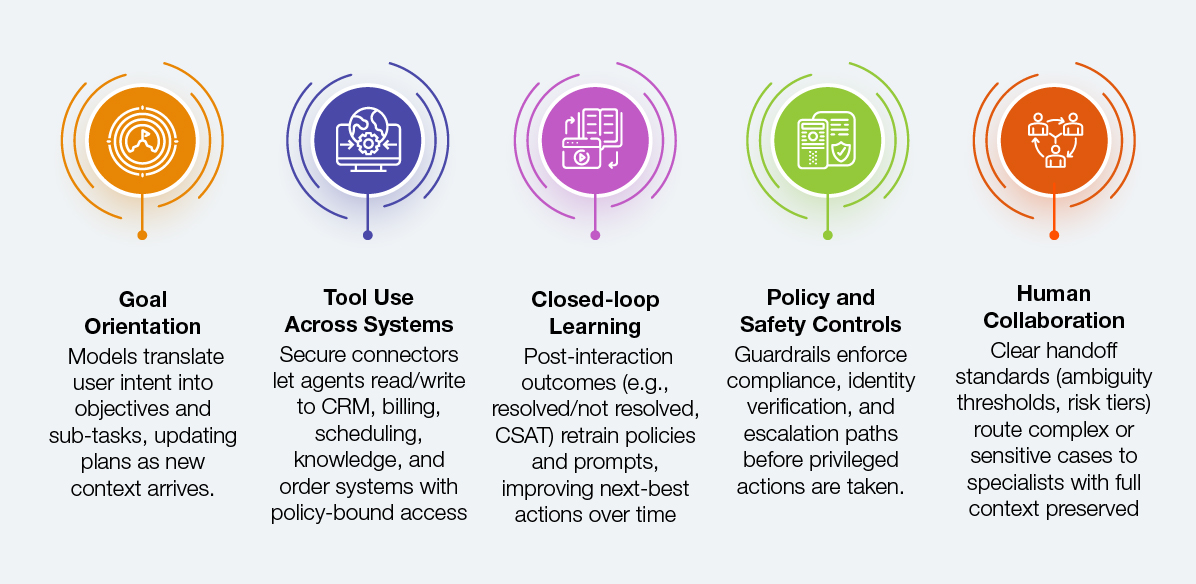
This is the practical distinction: traditional automation completes steps; agentic systems deliver outcomes, learn from them, and improve the next interaction—consistently, across every channel.
Read more: How CX Optimization Drives Business Growth
Four Ways Agentic AI Transforms Omnichannel CX
Agentic AI changes how customer journeys progress across channels. Instead of restarting context with every handoff, systems can reference shared knowledge, coordinate next steps, and adapt in the moment.
The four examples below—carrying context forward, driving end-to-end outcomes, proactive service, and real-time adaptation—are illustrative patterns that agentic AI systems use to reduce effort, prevent repeat contacts, and keep experiences consistent.
Exhibit 2: Agentic AI Transforms Omnichannel CX
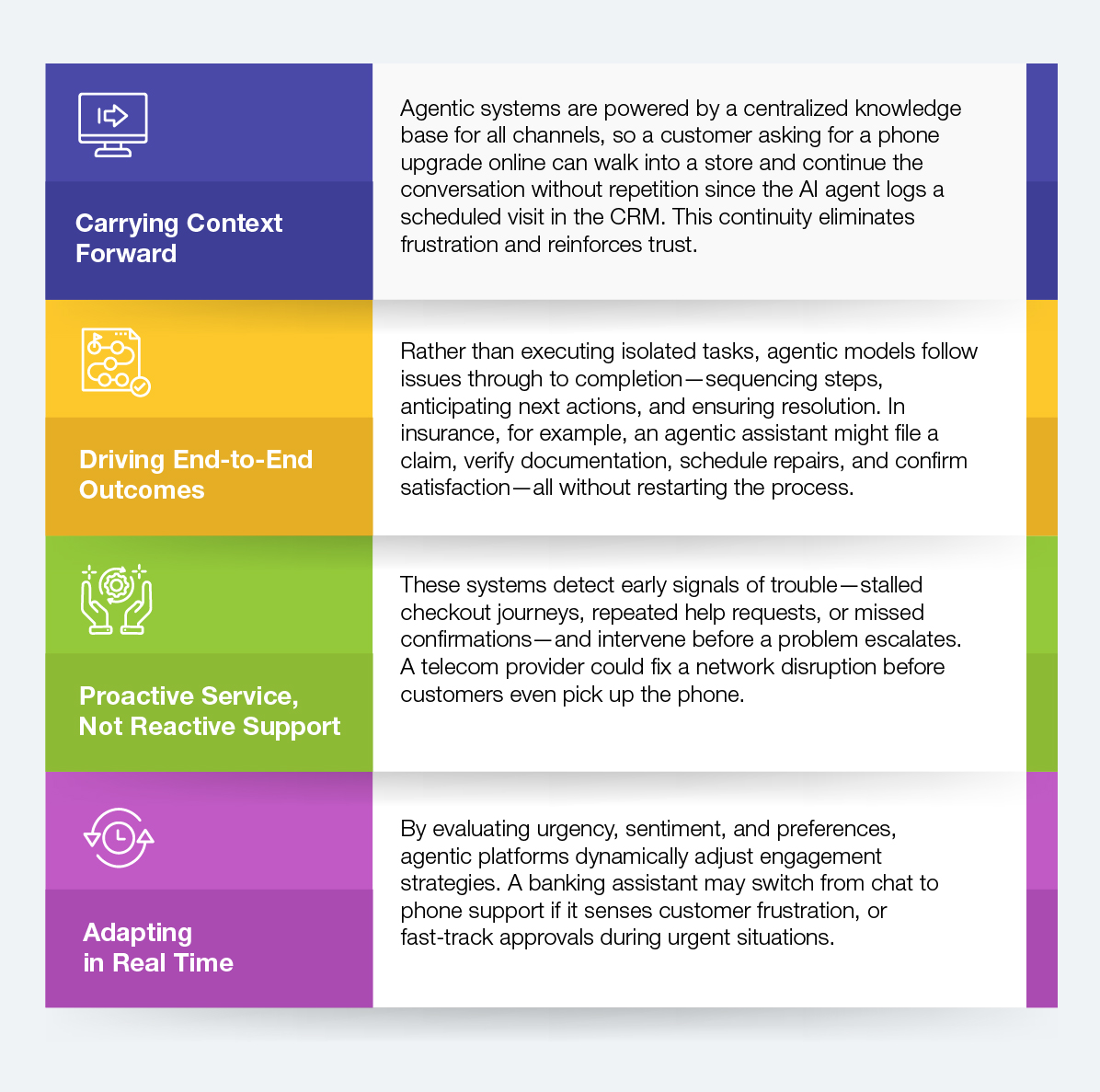
Taken together, these patterns show a simple arc: keep context, coordinate the work, act before issues escalate, and adapt to the customer. When teams apply that arc across channels, customers spend less time repeating themselves, resolutions arrive faster, and trust is reinforced—no matter where the conversation starts or finishes.
The Operational Upside
As omnichannel complexity increases, businesses will need more than connected channels—they’ll need connected intelligence. Agentic systems as first-touchpoints provide that intelligence, enabling customer engagement that is purposeful, fluid, and resilient. The benefits extend beyond customer satisfaction (Exhibit 3).
Exhibit 3: Benefits of Agentic AI in CX
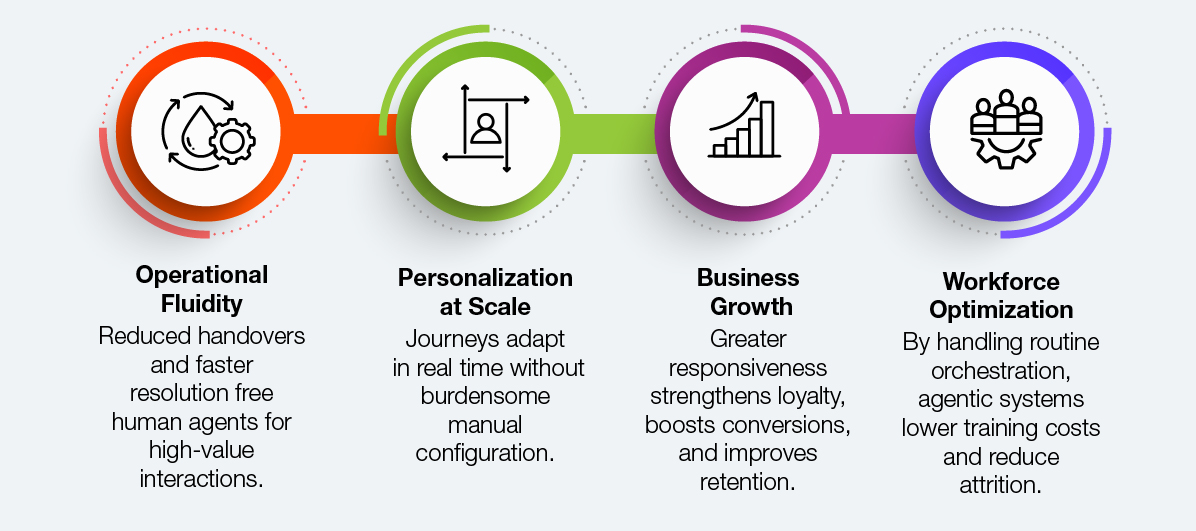
Over time, these systems generate data-driven insights that improve processes and inform better business strategies.
Examples Across Industries: How Workflows Move from Signal to Resolution
Across sectors, effective operations follow a familiar rhythm: detect an issue, verify context, run diagnostics, apply policy-based actions, communicate clearly, and capture learnings.
The following examples illustrate how this plays out in telecom, retail, banking, and insurance—each reflecting typical, policy-aligned steps that move from signal to resolution.
Telecom — Service Restoration
When a likely outage is detected—whether from correlated network alarms or multiple customer reports—the team verifies the affected account and service location. Standard diagnostics are run to isolate the fault, a support ticket is created, and an estimated resolution time is communicated. Once service is restored, confirmation is sent to the customer and the root cause is logged to strengthen future prevention and response.
Retail — Order Issue
When a delayed shipment is identified, carrier tracking data is reviewed to determine the cause. Depending on established policy, the merchant may issue a partial refund or initiate a reshipment. The customer receives proactive communication about the resolution, and the interaction is recorded to help reduce repeat issues and improve process efficiency.
Banking — Dispute Support
The process begins with capturing the customer’s claim and verifying key transaction details such as amount, merchant, and time. Supporting documentation is requested if needed. The dispute is then filed through core banking systems, and the customer receives a clear status timeline. If specific fraud indicators are triggered, the case is escalated according to standard fraud and compliance protocols.
Insurance — First Notice of Loss (FNOL)
Upon receiving a claim, the system gathers incident details and performs a preliminary coverage check. It then schedules inspections or repairs as required and collects necessary documentation. When eligibility criteria are met, the claim moves through straight-through processing; otherwise, it is routed for adjuster review to ensure thorough handling.
Together, these journeys underscore a shared operational blueprint—verify context, act within policy, keep customers informed, and capture insights—to drive faster, more consistent, and more transparent resolutions across industries.
Building Toward Agentic CX
Transitioning to agentic systems isn’t a flip of a switch—it’s a deliberate shift. Organizations can start with small pilots tied to measurable KPIs, such as reducing average handling time or improving first-contact resolution. A robust data infrastructure and governance model are essential to ensure context is consistent across channels.
Equally important is change management: teams need training to collaborate with AI systems effectively. Upskilling staff to focus on empathy-driven problem-solving—while leaving routine orchestration to AI—creates a powerful partnership that drives value for both customers and employees.
Exhibit 4: Early Use Cases and Industry Momentum
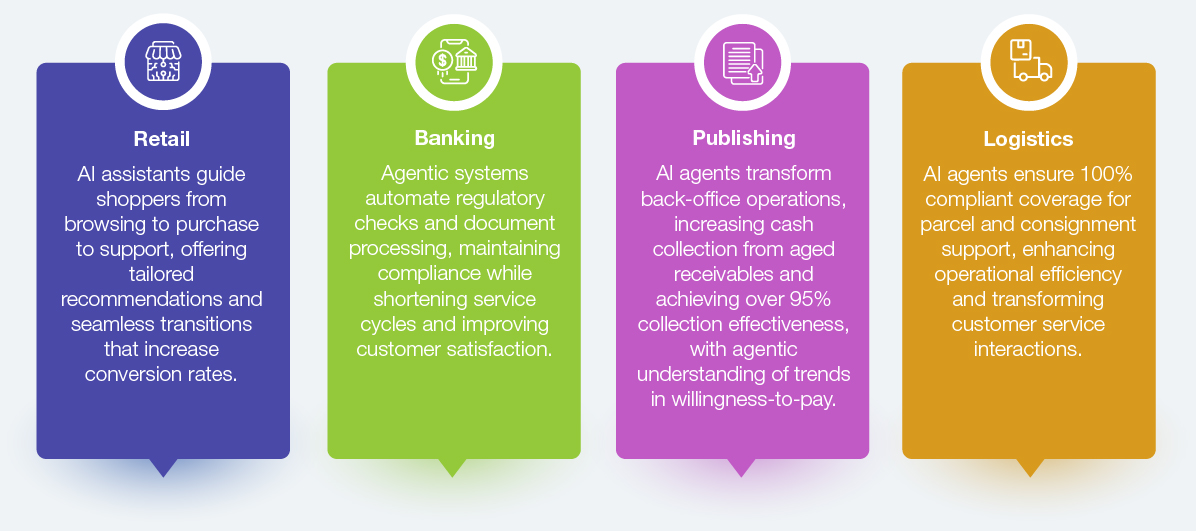
These successes show that agentic orchestration isn’t theoretical—it’s practical and measurable. As these pilots expand, they’ll set new customer expectations across industries.
Agentic AI marks a turning point in customer experience. It brings autonomy, adaptability, and outcome alignment—capabilities legacy systems cannot match.
Read More: How to Maintain Quality in High-Volume CX Operations
How Straive Enables the Shift
The next competitive frontier isn’t just reaching customers everywhere—it’s orchestrating every interaction with intelligent precision. For organizations serious about transforming CX, now is the moment to experiment, learn, and lead—before agentic engagement becomes the standard customers demand.
Straive helps organizations design agentic workflows tailored to their industries—integrating data across silos, embedding adaptive AI models, and ensuring governance frameworks meet compliance and ethical standards. By combining advanced AI with strategic, SME-in-loop insight, Straive equips businesses to move beyond pilot projects and achieve enterprise-scale transformation.
About the Author

Assistant Director, Strategic Programs
Abhishek leads operational excellence and transformative client outcomes, bringing extensive experience in orchestrating large-scale customer experience and technology programs
Share with Friends:


