
Posted on: May 2nd 2025
In today’s fast-paced business landscape, customer expectations are higher than ever. Organizations must deliver seamless, responsive, and high-quality customer experiences (CX) at scale. However, scaling CX without sacrificing quality is a formidable challenge. As customer volumes grow, companies often grapple with maintaining consistency, personalization, and efficiency.
Achieving the right balance requires a strategic blend of cutting-edge technology, streamlined processes, and a customer-first mindset. Advances in automation, flexible workforce models, and data-driven insights have revolutionized the way businesses interact with their customers. I’ve witnessed first-hand the challenges of scaling customer experience without sacrificing its human element. In this post, I share insights and actionable strategies for delivering exceptional, high-volume CX while retaining the human touch.
The Challenges of Scaling CX
Scaling CX isn’t merely about adding more agents or deploying additional technology—it’s about preserving the integrity and quality of every customer interaction. Here are some common challenges businesses face123:

- Maintaining Consistency: As operations expand across multiple channels and geographies, ensuring a uniform CX becomes difficult. Customers expect the same level of service whether they interact via phone, email, chat, or social media.
- Operational Efficiency vs. Personalization: Automation can streamline processes but may risk making interactions feel impersonal. Striking the right balance between efficiency and a warm, human touch is critical.
- Workforce Management: Handling fluctuating customer demands can strain resources. Understaffing leads to long wait times and diminished service quality, while overstaffing can unnecessarily drive up operational costs.
- Quality Control: As interaction volumes increase, maintaining rigorous quality standards becomes more complex. Without robust monitoring, inconsistent resolutions and gaps in service can lead to customer dissatisfaction.
Key Strategies for Delivering High-Volume CX
1. Leveraging Smart Automation & AI
Technology is a linchpin in scaling CX effectively. The right AI-driven solutions help manage large interaction volumes while ensuring both efficiency and personalization.
AI-Powered Chatbots & Self-Service: Automated chatbots and self-service portals handle routine queries efficiently, reducing the workload on human agents. According to Gartner, generative AI, digital customer service, and conversational user interfaces as the three transformative technologies expected to have the biggest impact on contact centers by 20284. This shift allows agents to devote more time to complex, high-value interactions.

- Predictive Analytics for Proactive Support: Utilizing AI to analyze historical data enables businesses to predict customer issues before they escalate. Proactive interventions not only enhance customer satisfaction but also reduce the frequency of escalations.
- Intelligent Routing: AI-driven routing systems direct customer queries to the most appropriate agents, reducing response times and increasing first-contact resolution rates. This strategy improves operational efficiency and personalizes the customer journey.
2. Implementing a Scalable Workforce Model
A static workforce structure can be a significant impediment to scalable CX. Organizations must adopt flexible models that align resources with fluctuating customer demands.
- Blended Workforce Approach: Combining full-time employees with gig workers and outsourced agents provides the flexibility needed to handle seasonal spikes and varying demand levels. This approach ensures that the right talent is available at the right time.
- Workforce Forecasting & Scheduling: Leveraging predictive analytics to forecast peak periods allows for more precise scheduling. This data-driven approach ensures that staffing levels are optimized for maximum efficiency.
- Remote & Hybrid Teams: Embracing remote work and hybrid models expands the talent pool and enables 24/7 support, breaking free from geographical limitations. This model has become even more relevant in light of recent global shifts towards remote work.
3. Optimizing Processes for Efficiency
Efficient, streamlined processes are essential for maintaining high quality in high-volume operations.
- Centralized Knowledge Management Systems: A unified knowledge base ensures that agents have quick access to standardized responses, troubleshooting guides, and best practices. This reduces response times and improves consistency across channels.
- Automation of Repetitive Tasks: Robotic Process Automation (RPA) can take over routine tasks like data entry, ticket categorization, and status updates. By automating these functions, agents can focus on more complex and value-added activities.
- Standardized but Adaptable Responses: While templates ensure consistency, agents should be empowered to tailor interactions to meet individual customer needs. This flexibility enhances customer engagement without sacrificing efficiency.
4. Ensuring Quality through Continuous Monitoring & Training
The seamless integration of AI and SMEs within Quality Control ecosystem follows a structured process:
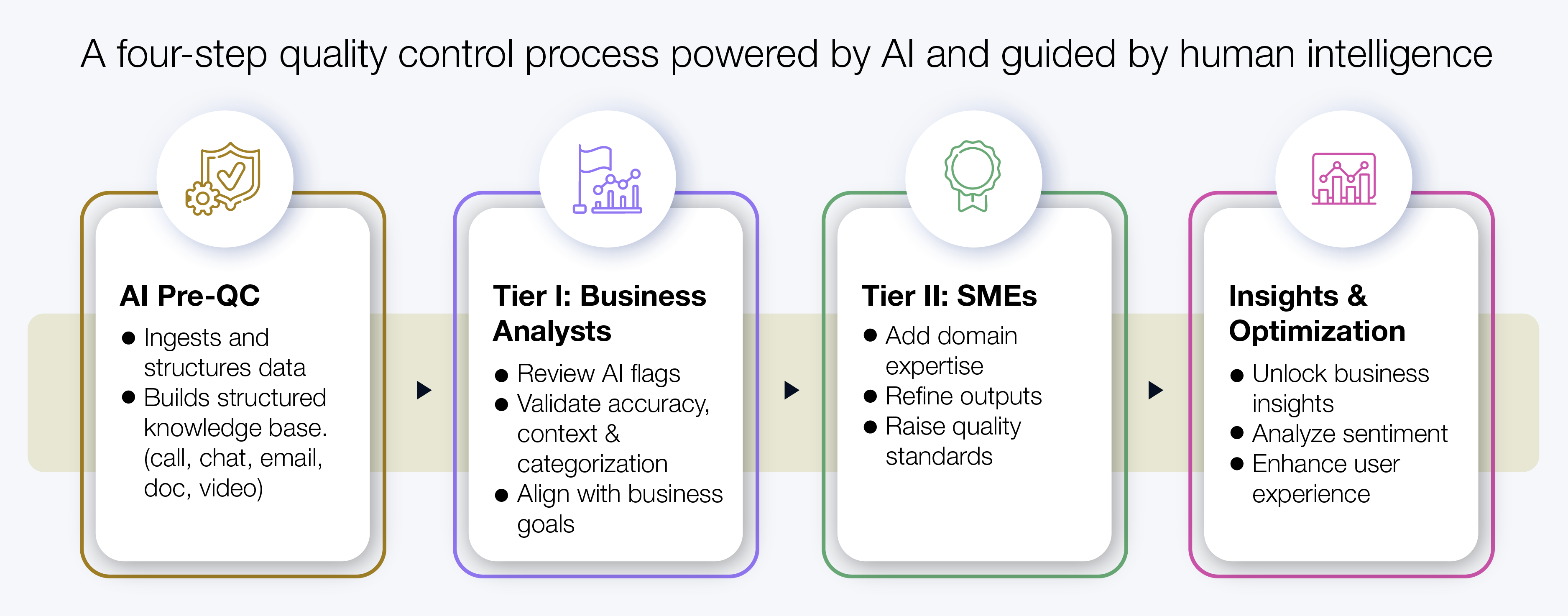
- Step 1: AI Pre-QC: Deploy frontier models to create a structured knowledge base from various sources (call transcripts, chats, mails, web, documents, audio, video, geospatial, etc.).
- Step 2: Tier I, Primary QC (Business Analysts):
Business Analysts assess AI-flagged content for accuracy, context, categorization and consistency, ensuring alignment with objectives. - Step 3: Tier II, SME QC: SMEs provide nuanced insights and validation, refining AI outputs to meet high standards.
- Step 4: Insights & Optimization: Utilize the knowledge base as a structured repository to support analytical models that drive business insights, customer sentiment analysis, and improved experiences.
5. Personalizing the Customer Experience
Even with high volumes and automation, personalization remains key to a successful CX strategy.
- Data-Driven Personalization: Leveraging customer data to tailor interactions ensures that each customer feels valued. Personalization can drive customer loyalty and differentiate a brand in a competitive market.
- Human Escalation for Complex Cases: While AI can handle routine queries, human intervention should always be available for more complex issues. This ensures that customers receive empathetic and nuanced responses when needed.
- Omnichannel Integration: Ensuring that all customer touchpoints—whether chat, email, phone, or social media—are seamlessly integrated helps maintain context and continuity in customer interactions. McKinsey emphasizes the importance of omnichannel strategies for enhancing customer satisfaction and loyalty, which are closely linked to retention5.
How Straive Enables Scalable, High-Quality CX
At Straive, we empower businesses to scale their CX operations without sacrificing quality. Our solutions integrate the latest in automation, workforce optimization, and data-driven personalization to manage high interaction volumes efficiently.

- Automation Solutions: We implement AI-driven chatbots, predictive analytics, and workflow automation to streamline customer interactions, enabling faster resolutions and reducing agent workload.
- Flexible Workforce Management: Our scalable workforce solutions, including hybrid models and advanced forecasting, ensure that businesses can quickly adapt to fluctuating demand without compromising on service quality.
- Quality-Driven Approach: With real-time monitoring, continuous training, and sentiment analysis, we maintain rigorous quality standards across all customer interactions.
Conclusion
Scaling customer experience without compromising quality is a complex but achievable goal. By integrating smart automation, flexible workforce models, streamlined processes, and a focus on personalization, organizations can deliver exceptional, high-volume CX that drives both customer satisfaction and business growth. The intersection of AI and human expertise is essential for maintaining high-quality customer experiences and knowledge management systems. As AI-generated content continues to grow, organizations must adopt a hybrid approach where SMEs enhance AI capabilities through ongoing validation and optimization.
As industry reports continue to highlight the benefits of a balanced CX strategy, it is clear that technology and human touch must go hand in hand. At Straive, we are dedicated to helping businesses navigate this dynamic landscape. If you’re looking to elevate your CX operations while maintaining the highest quality standards, get in touch with us to explore how our innovative solutions can drive your success.
About the Author

Assistant Director, Strategic Programs
Abhishek leads operational excellence and transformative client outcomes, bringing extensive experience in orchestrating large-scale customer experience and technology programs
Share with Friends:


