
Posted on: September 21st 2026
As AI moves from assisting employees to executing business processes, gaps in enterprise AI readiness become increasingly consequential. AI requires reliable data, connected systems, redesigned workflows, and embedded controls to operate safely and deliver value at scale.
According to McKinsey’s 2025 State of AI report, 88% of organizations regularly use AI in at least one business function. Yet only about one-third have begun scaling AI across the enterprise, and just 39% report an enterprise-level EBIT impact.
This disparity points to a larger challenge. Organizations are trying to operationalize AI within environments designed around human-led workflows, fragmented data, and manual controls.
A pilot can temporarily work around these limitations. Production cannot.
For CXOs, the question is no longer what AI can do. It is whether the enterprise has the operational readiness to turn promising use cases into reliable, measurable performance.
Legacy infrastructure is holding back AI operationalization
Legacy systems are often discussed in terms of maintenance costs, outdated technologies, and technical debt. This framing understates their strategic importance. Their larger cost lies in how they constrain the enterprise’s ability to operationalize AI and pursue new opportunities.
When core systems cannot exchange data easily, each use case requires additional integrations, reconciliation rules, and manual intervention. When business units use different definitions, AI cannot form a consistent enterprise view. When rules, exceptions, and decision criteria remain undocumented, AI lacks the operational context needed to act reliably.
These constraints determine:
- How quickly AI can move from pilot to production
- How much it costs to scale successful use cases
- Whether AI-supported decisions can be traced and defended
- How safely AI can act across business systems
- Whether capabilities can be reused across functions
Operationalizing AI is therefore more than deploying a model. It requires creating the enterprise conditions for AI to deliver reliable, governed, and cost-effective performance in production.
AI changes what infrastructure must deliver
Earlier waves of digital transformation could operate despite significant fragmentation because employees bridged the gaps between systems. They transferred information, reconciled inconsistent records, interpreted ambiguous terminology, and applied institutional knowledge before decisions were made.
AI does not acquire this understanding simply by gaining access to enterprise systems. To operate reliably, it needs information that is structured, current, traceable, appropriately permissioned, and connected to the relevant business context. It also requires documented system dependencies, accessible interfaces, and governance embedded within the workflow.
IBM identifies a similar challenge in its analysis of why enterprises struggle to unlock AI productivity. In older technology environments, incomplete documentation and poorly mapped dependencies can prevent AI from understanding how systems operate and interact. The resulting lack of context can lead to inconsistent recommendations and greater operational risk.
The shift can be summarized as follows:
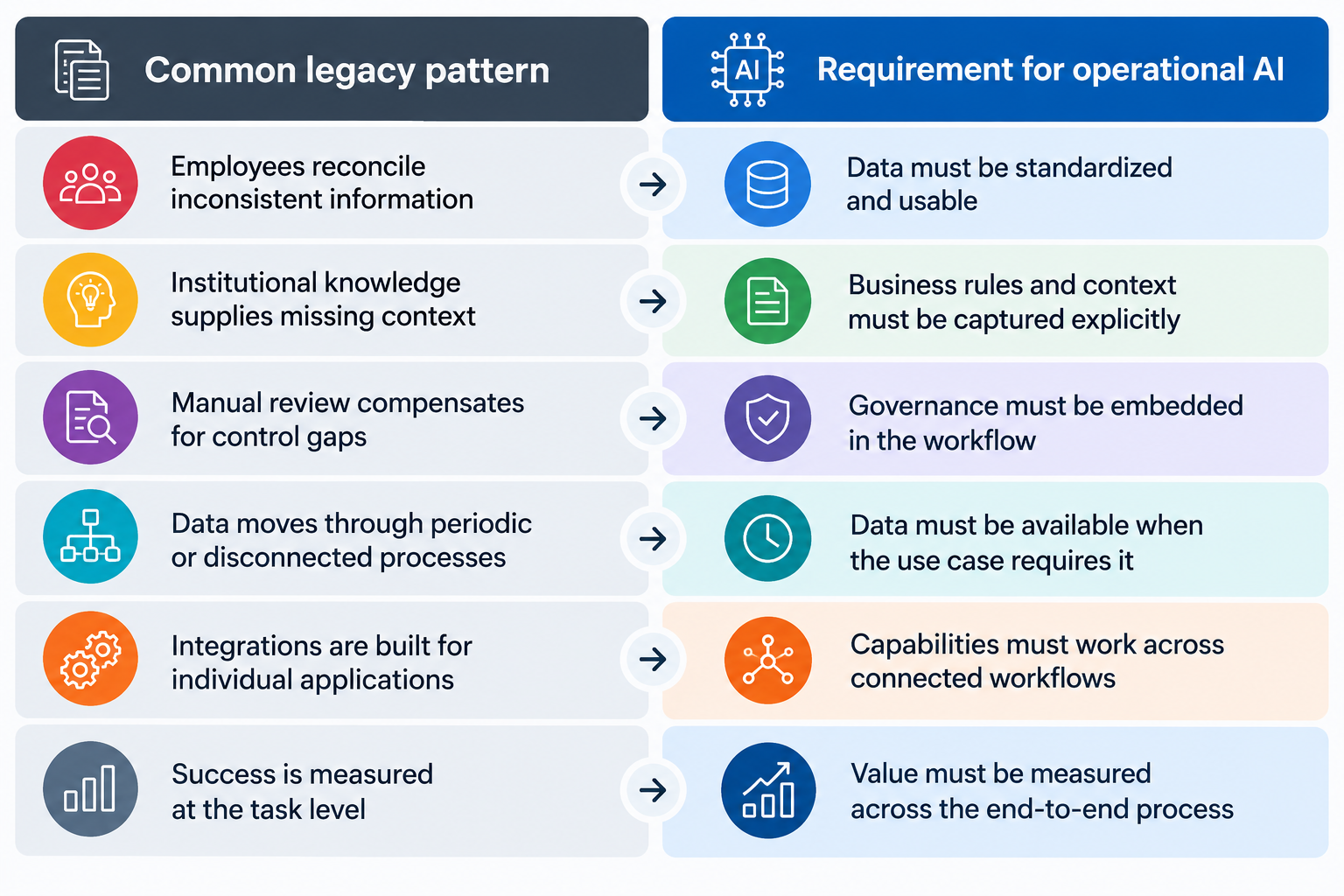
Figure 1: Legacy operating patterns must evolve to support operational AI. Moving AI into production requires standardized data, explicit business context, embedded governance, timely data access, connected workflows, and end-to-end value measurement.
This does not eliminate the need for human judgment. It makes that judgment more deliberate, directing expert oversight toward decisions involving ambiguity, material risk, or specialized domain knowledge.
Why promising pilots fail in production
A proof of concept tests whether AI can perform a defined task under controlled conditions. Operationalization tests whether it can work with live data, integrate with enterprise systems, handle exceptions, and operate securely and reliably at scale. This is where hidden infrastructure debt becomes evident.
Fragmented data limits decision quality
When data is fragmented across systems, AI cannot reliably identify which information is current, authoritative, and relevant. It may combine conflicting records or miss critical context, leading to incomplete or unreliable decisions.
Inconsistent definitions increase the cost of every AI use case
When functions define the same business concepts differently, each AI initiative must reconcile the data and rebuild its context and controls. This duplicates development effort and limits reuse across the enterprise.
Undocumented knowledge constrains automation
Many workflows depend on employees applying undocumented rules, exceptions, and contextual judgment. Without this knowledge and the necessary controls built into the process, AI cannot handle the workflow reliably without human intervention, limiting how much can be automated.
Rebuilding controls for every AI use case raises costs
When access permissions, data-source requirements, approval thresholds, audit trails, and escalation rules are defined separately for every AI use case, deployment becomes slower and more expensive. Establishing these controls once and applying them across workflows makes AI faster and less costly to scale.
Short-term AI workarounds create long-term costs
Custom integrations, reconciliation processes, and manual controls may move one AI use case into production. However, each workaround adds complexity, making subsequent deployments slower and more expensive.
The answer is not to replace every legacy system. It is to modernize the parts of the enterprise that constrain high-value workflows, with each investment tied to a measurable business outcome.
Prioritize modernization around business value
Operationalizing AI does not require replacing every legacy system. It requires focusing investment on the infrastructure needed to improve a high-value business workflow.
For each workflow, determine:
- The measurable outcome to improve
- The decisions and actions that drive it
- The data, systems, and domain expertise required
- The barriers to production deployment
- The controls and human oversight needed
- The specific modernization priorities
This connects each modernization investment to an improvement in revenue, cost, speed, risk, or customer experience. The next step is to validate those priorities before committing to full-scale implementation.
Move from priority to production
A diagnostic-first approach tests where value is being blocked, what must change, and whether the proposed AI use case can succeed in production.
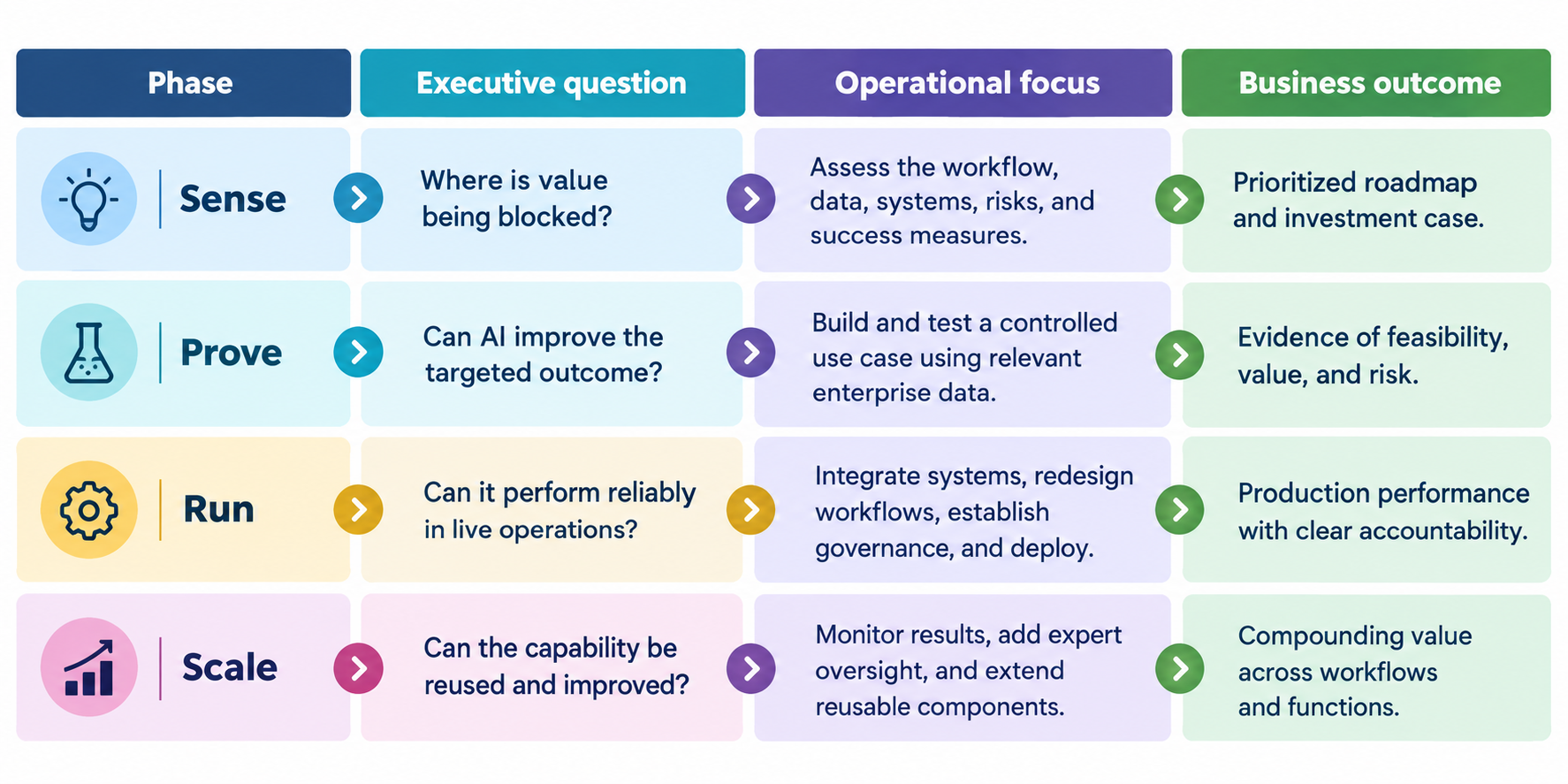
Figure 2: Straive’s Sense–Prove–Run–Scale framework for operationalizing AI, from identifying value opportunities to scaling proven capabilities across the enterprise.
This sequence tests assumptions before significant capital is committed and distinguishes a successful technical demonstration from an AI capability that is ready for live operations.
How Straive operationalizes AI
Straive approaches AI operationalization as an end-to-end business capability rather than a model deployment exercise. The approach brings together four interconnected elements:
- People: domain expertise, ownership, governance, and expert oversight
- Processes: redesigned workflows, risk controls, and escalation mechanisms
- Platforms: AI-ready data, integration, infrastructure, and MLOps
- Performance: monitoring, optimization, and measurable business outcomes
The process begins with Sense, a focused diagnostic of the selected workflow and its operating environment. The objective is to expose the constraints that could prevent AI from delivering value before significant implementation spending begins.
From there, Straive combines data management and AI-ready foundations with AI design, deployment, analytics, GenAI, agentic orchestration, governance, and continuous expert oversight. Its published delivery model targets a working proof of concept in 7 to 14 days and production deployment in 8 to 10 weeks, supported by more than 200 accelerators across areas such as document intelligence, schema generation, data quality, and industry-specific agents. These timelines are described in Straive’s account of operationalizing AI at scale.
The approach has also been applied beyond individual pilots. For a global media and streaming enterprise, Straive combined AI-assisted content analysis, document intelligence, an AI intake and governance portal, a secure experimentation environment, enterprise analytics, and agentic workflow orchestration. The reported results included approximately:
- 72% reduction in content-review time
- Three to four times faster AI use-case approvals
- 60% to 70% faster document-analysis workflows
The significance of this example is not simply the individual productivity gains. It shows what changes when AI is treated as an operating capability supported by shared data, governance, platforms, and delivery expertise.
The CXO mandate is to create the conditions for AI to perform
AI strategy cannot remain separate from data strategy, process design, technology architecture, and operating governance. These are now different dimensions of the same enterprise transformation.
The organizations that create durable value from AI will not necessarily be those with the largest number of pilots or the most advanced models. They will be those that identify where value is constrained, modernize selectively, embed AI into real workflows, and build controls that allow successful capabilities to be reused.
Legacy infrastructure does not make AI impossible. It determines how slowly, expensively, and riskily the enterprise can deploy it.
That makes AI readiness more than an IT priority. It is a question of strategic flexibility: how quickly the organization can convert a new capability into a measurable business result.
Choose one high-value workflow. In 7 days, see what it will take to operationalize AI within it.

Straive helps clients operationalize the data> insights> knowledge> AI value chain. Straive’s clients extend across Financial & Information Services, Insurance, Healthcare & Life Sciences, Scientific Research, EdTech, and Logistics.


