
Posted on: July 30th 2026
The Most Valuable AI Lessons Often Emerge After Deployment
Recently, during a routine review of one of our AI projects, we discovered that token consumption was higher by 60% than projected. The solution was delivering the expected results, users were satisfied, and performance metrics appeared healthy. On the surface, everything seemed to be working as planned.
A closer investigation revealed that a default model setting had been left unchanged during implementation. As a result, the contribution of reasoning-related tokens to the overall usage was far more than estimated. Once the setting was adjusted, we reduced total token usage by 31% without affecting output quality.
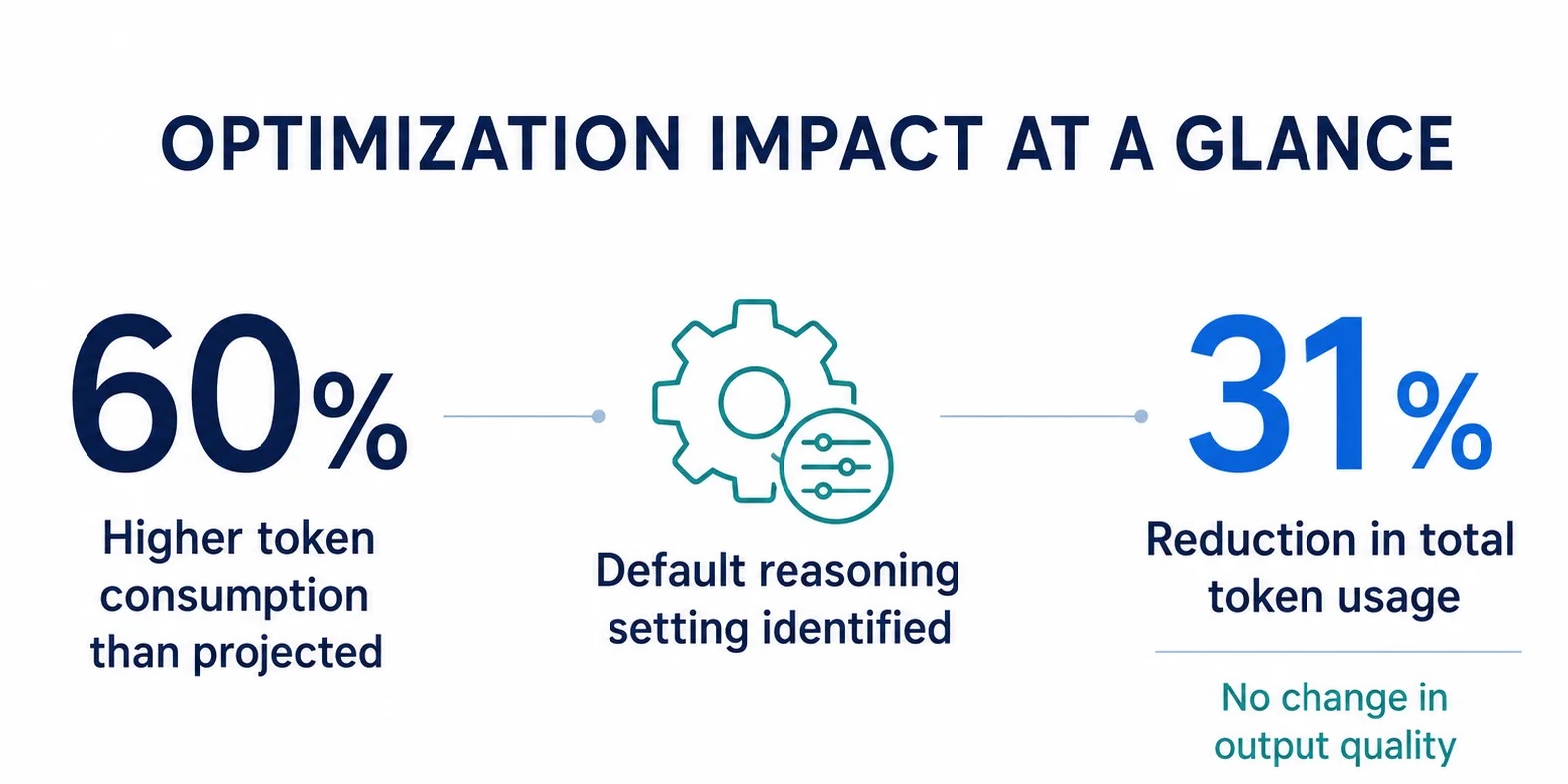
Figure 1: Adjusting the default reasoning setting reduced token usage by 31% after consumption exceeded projections by 60%, without affecting output quality.
The adjustment itself was straightforward. The lesson was not.
Successful outputs do not necessarily indicate an optimized AI system. Cost inefficiencies can remain hidden when teams monitor response quality, latency, and user satisfaction without examining how the model consumes resources.
This experience reinforced that AI deployments are not finished products. Assumptions made during development must be tested against real usage patterns, workloads, and business conditions. The objective is not simply to keep the system working, but to ensure it continues delivering the required outcomes at the right cost.
Go-Live Is a Milestone. Not the Destination.
Traditional technology implementations rely on monitoring, performance tuning, and operational improvements after deployment. Generative AI requires the same discipline—but at a much faster pace.
Unlike conventional applications, AI systems are influenced by model behavior, configuration choices, user interactions, provider updates, and pricing changes. A seemingly minor implementation decision can have a significant impact when multiplied across thousands or millions of interactions.
Go-live should therefore mark the transition from implementation to production optimization. Teams must validate development assumptions against actual usage, establish baselines for quality, cost, latency, and business outcomes, and identify where adjustments will generate the greatest value.
This requires looking beyond whether the system works to determine how efficiently, reliably, and economically it performs at scale. Production evidence can then guide decisions about model selection, reasoning settings, prompt design, routing, caching, and human intervention—turning optimization into a structured business discipline rather than a series of reactive technical fixes.
Why AI Requires a Different Operating Mindset
Most enterprise technologies become more predictable after deployment. Generative AI can become less predictable as its operating environment evolves.
Traditional systems follow predefined rules, making their post-launch behaviour relatively stable. AI solutions operate within a fluid ecosystem shaped by changing usage patterns, model and provider updates, new capabilities, and evolving business requirements.
Consequently, development choices—such as model selection, reasoning settings, context length, and workflow design—should be treated as hypotheses to validate in production rather than permanent architectural decisions.
Enterprise AI success therefore requires more than deploying an effective solution. It requires clear ownership of post-launch performance, agreed thresholds for cost and quality, and defined triggers for intervention. Teams must know not only what to measure, but also who is responsible for acting when results deviate from expectations.
This governance layer turns operational evidence into timely decisions, helping the solution remain aligned with business outcomes as both the technology and its operating environment change.
The AI Landscape Changes Faster Than Most Organizations Realize
Models, capabilities, pricing structures, and provider offerings evolve rapidly. A deployment approach that was appropriate six months ago may no longer offer the best balance of performance, cost, and reliability.
Organizations should therefore incorporate regular reviews of model performance, usage patterns, configurations, and provider offerings into their operating rhythm. These reviews should evaluate whether workloads could be routed to smaller models, prompts or context windows simplified, redundant calls eliminated, or newer capabilities adopted.
The goal is not to change the technology whenever a new option appears, but to identify when the potential benefit justifies the cost and risk of migration. Without this discipline, technical and economic efficiency can gradually erode—even while the solution continues to meet its original performance expectations.
The Goal Is Business Value, Not Maximum Capability
A common mistake is assuming that the most advanced model or configuration will automatically deliver the greatest value. In practice, capability and business impact do not increase at the same rate.
More reasoning, larger context windows, or sophisticated configurations may improve performance on complex tasks. For many enterprise use cases, however, consistency, reliability, speed, and cost efficiency matter more than maximum model capability.
Instead of asking, “What is the most powerful model available?”, leaders should ask:
“What combination of accuracy, speed, reliability, and cost best serves this use case?”
The answer will vary by task, risk level, and business objective. A tiered architecture may therefore be more effective than a single-model strategy: routine requests can be routed to efficient models, while complex or high-risk cases receive greater reasoning capacity or human review.
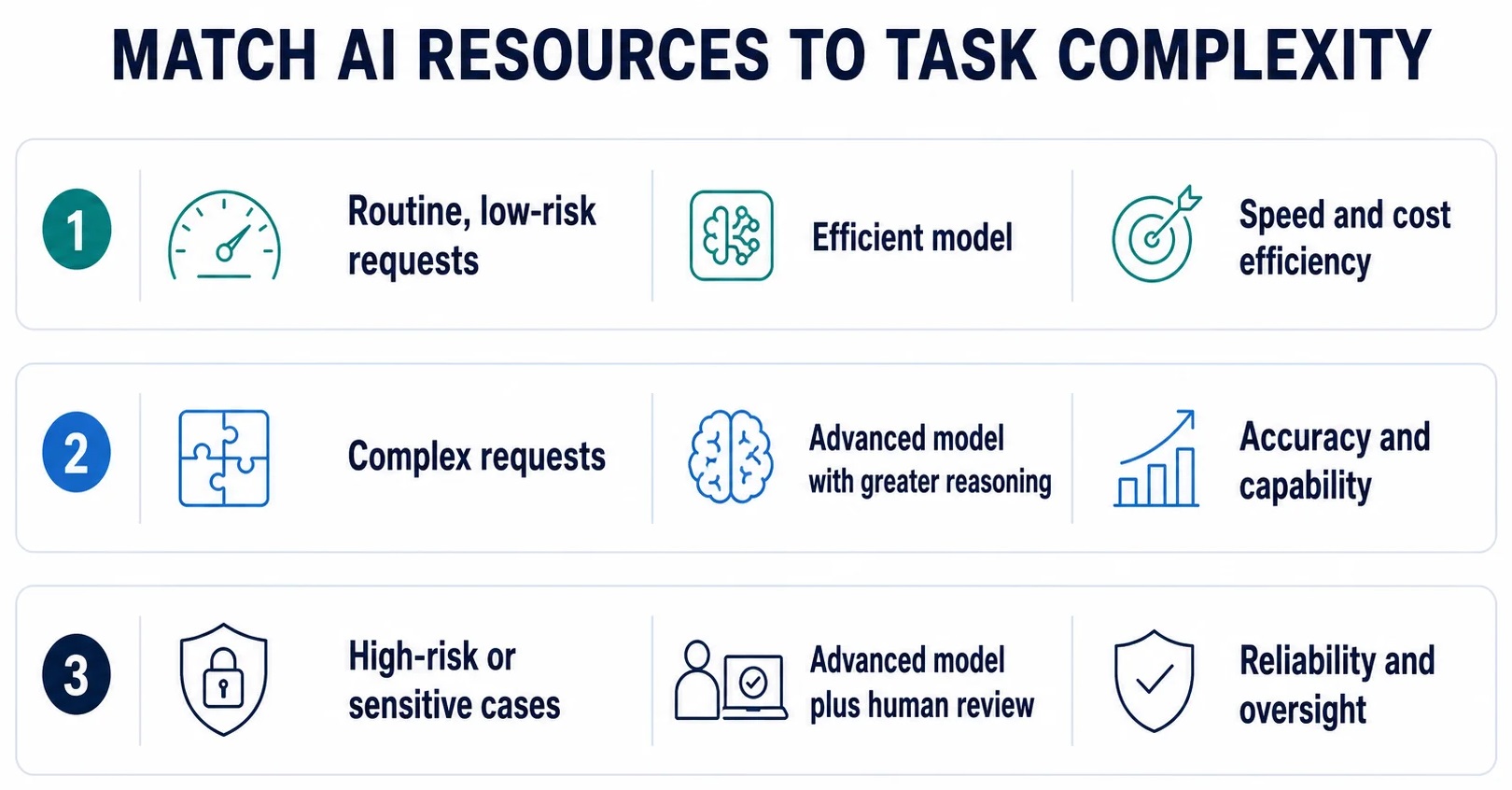
Figure 2: AI resources aligned by task complexity: efficient models for routine requests, advanced reasoning for complex tasks, and human review for high-risk cases.
This approach aligns resources with the value and complexity of each interaction. It also gives organizations a clearer basis for deciding where additional AI capability will generate a meaningful return—and where it will merely increase cost.
Production Data Is the Most Valuable Teacher
Development decisions are based on testing, projections, and anticipated usage. Production environments reveal what users actually need.
Adoption patterns may show that some features are essential, others are underused, and certain workflows create friction at scale. When usage data is considered alongside user feedback and business outcomes, teams can distinguish technical activity from genuine value.
This evidence helps organizations decide where to simplify, expand, redesign, or retire capabilities. It also prevents investment from being driven by initial expectations that no longer reflect operational reality.
Production data does more than guide optimization—it helps determine which parts of an AI solution deserve continued investment.
The Future Belongs to Organizations That Continuously Improve
As enterprise AI adoption grows, competitive advantage will depend less on who launches first and more on who learns fastest after launch.
We help clients establish this capability by analyzing production performance, usage patterns, model configurations, and cost drivers. These insights allow teams to refine deployment choices, respond to changes in the AI ecosystem, and keep investments aligned with business objectives—without compromising output quality.
Go-live may mark the end of implementation, but it begins a continuous cycle of learning and improvement. Organizations that embed this discipline into their AI operations will be best positioned to unlock sustainable long-term value.

Richard Kobel is a senior sales, marketing, and business development executive specializing in scholarly, professional, and B2B publishing. He helps content and data providers develop digital products, enhance existing offerings, and improve efficiency through content transformation and BPO/KPO solutions.


