
Posted on: June 10th 2026
Why English-First Collections Strategies Fail Global Publishers
Imagine a Tier-1 publisher operating across more than 30 global markets. A standard dunning notice is sent to a high-value consortium account in South Korea. Technically, everything works perfectly — the email is delivered, there are no firewall issues, and the contact database is accurate.
Yet the invoice remains unpaid.
The message sits unread because it arrives in an English-language billing format that does not align with the customer’s procurement workflow or communication expectations.
As the account ages through 30, 45, and 60 days, collections teams classify the customer as unresponsive. Renewal teams flag the relationship as “at risk.” However, the real issue is rarely identified: the outreach failed because it was delivered in the wrong language, through the wrong communication style, and outside the customer’s preferred operational framework.
In many APAC markets, including South Korea and Japan, procurement and finance teams often prioritize communications that align with local workflows, documentation standards, and digital procurement systems. English-only dunning notices may simply fall outside the primary action queue.
This is no longer an isolated operational problem. It is becoming a structural cash-flow risk for global publishers.
As AI-driven translation becomes increasingly commoditized, competitive advantage is shifting toward cultural orchestration — the ability to localize communication, preserve trust, and adapt recovery operations across multilingual markets.
For global publishers, multilingual collections are emerging as a major lever for improving recovery rates, reducing DSO, and protecting long-term enterprise revenue.
Why Localization Matters in Global Collections Operations
International B2B collections involve far more than language translation.
Recovery efforts are influenced by regional business etiquette, debtor expectations, time-zone coordination, payment infrastructure, legal frameworks, and compliance obligations. Global trade credit experts such as Coface emphasize that debt recovery strategies must be adapted market by market because debtor engagement practices and legal norms vary significantly across regions. Successful recovery often depends as much on maintaining trust and preserving long-term commercial relationships as it does on enforcement.For global publishers, this complexity is intensifying as multilingual markets become increasingly central to revenue growth.
For global publishers, this complexity is intensifying as multilingual markets become increasingly central to revenue growth.
Middle East & Africa (MEA)
Multilingual publishing is becoming critical to both market access and long-term growth. UNESCO estimates that Africa’s publishing industry generated approximately US$7 billion annually in 2023 and could potentially grow to US$18.5 billion through structural reforms, digital expansion, and investment in local publishing ecosystems.
Asia-Pacific (APAC)
APAC remains one of the world’s fastest-growing publishing and digital-content regions, driven by large education markets, mobile-first consumption, and accelerating digital transformation. IFRRO describes APAC as an exceptionally diverse publishing environment that includes mature markets such as Japan, Australia, and South Korea alongside rapidly expanding economies like Vietnam, Indonesia, and the Philippines.
As global publishing expands into these multilingual markets, collections strategies must evolve beyond English-first workflows.
The Real Drivers of Collections Friction
Multilingual collections challenges typically emerge across six operational dimensions:
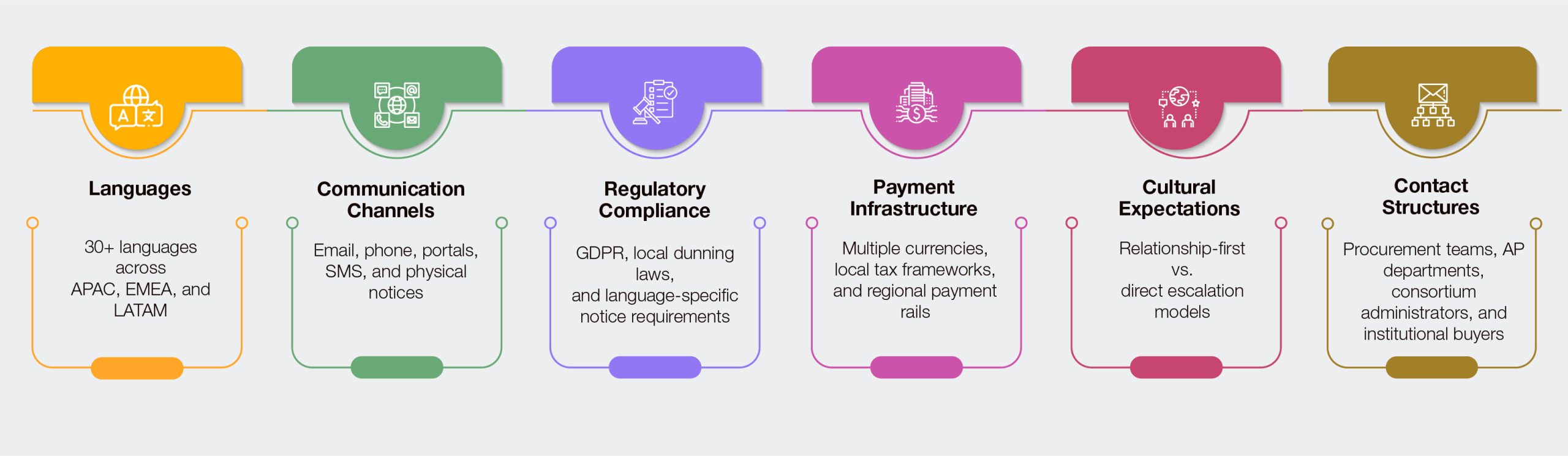
These variables create significant operational friction when collections workflows are managed centrally without localized adaptation.
From Translation to Cultural Orchestration in Global Collections Operations
Translation alone is no longer enough.
Modern collections performance depends on the ability to localize the entire customer engagement experience — including communication tone, escalation timing, payment preferences, and compliance workflows.
Research from CSA Research consistently shows that customers strongly prefer to engage in their native language, particularly during financially sensitive interactions.
In collections environments, culturally adaptive engagement can materially influence:
- Debtor responsiveness
- Dispute resolution speed
- Customer retention
- Renewal stability
- Recovery outcomes
- DSO performance

The most successful publishers are moving from translation-based operations toward fully localized recovery orchestration.
The LACE Framework for Multilingual Collections
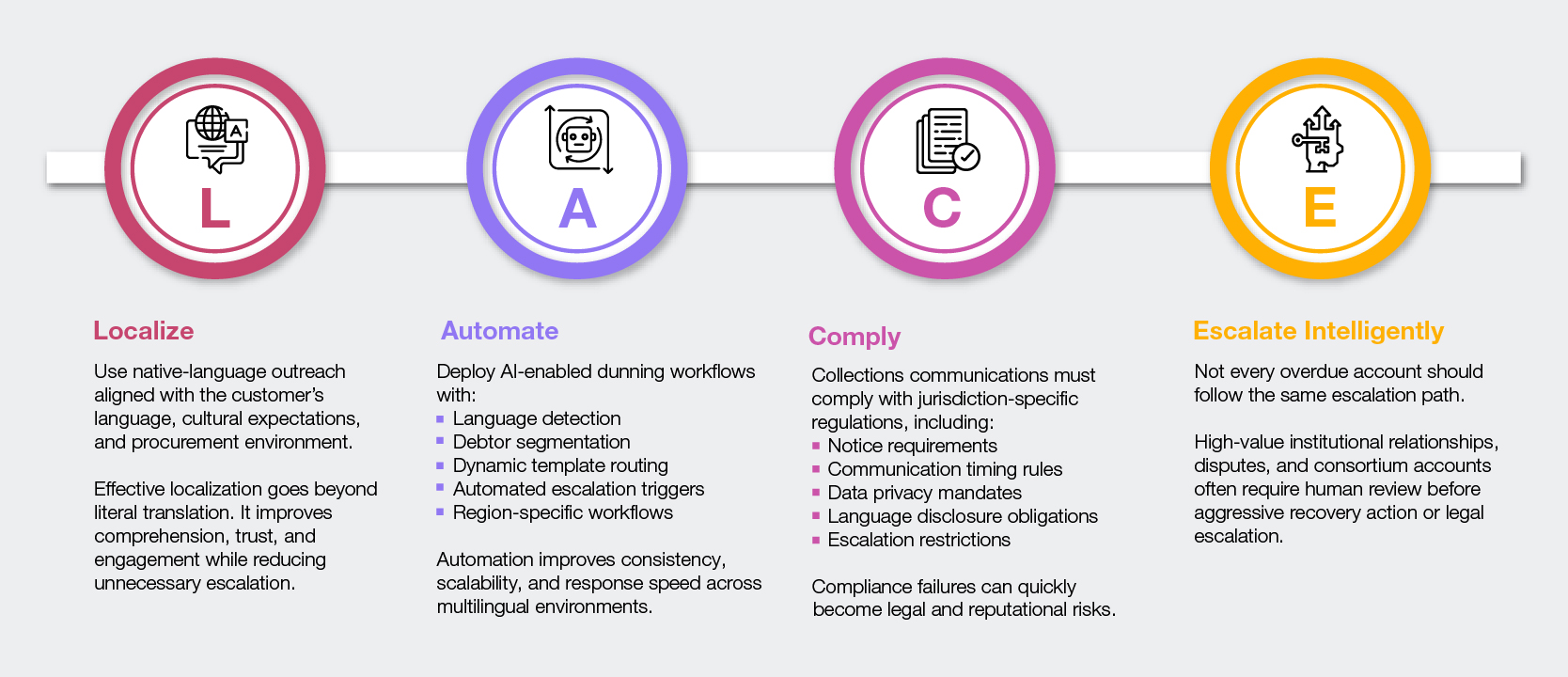
To scale collections operations across global markets, publishers should anchor their strategy around four core pillars: LACE.
L — Localize
Use native-language outreach aligned with the customer’s language, cultural expectations, and procurement environment.
Effective localization goes beyond literal translation. It improves comprehension, trust, and engagement while reducing unnecessary escalation.
A — Automate
Deploy AI-enabled dunning workflows with:
- Language detection
- Debtor segmentation
- Dynamic template routing
- Automated escalation triggers
- Region-specific workflows
Automation improves consistency, scalability, and response speed across multilingual environments.
C — Comply
Collections communications must comply with jurisdiction-specific regulations, including:
- Notice requirements
- Communication timing rules
- Data privacy mandates
- Language disclosure obligations
- Escalation restrictions
Compliance failures can quickly become legal and reputational risks.
E — Escalate Intelligently
Not every overdue account should follow the same escalation path.
High-value institutional relationships, disputes, and consortium accounts often require human review before aggressive recovery action or legal escalation.
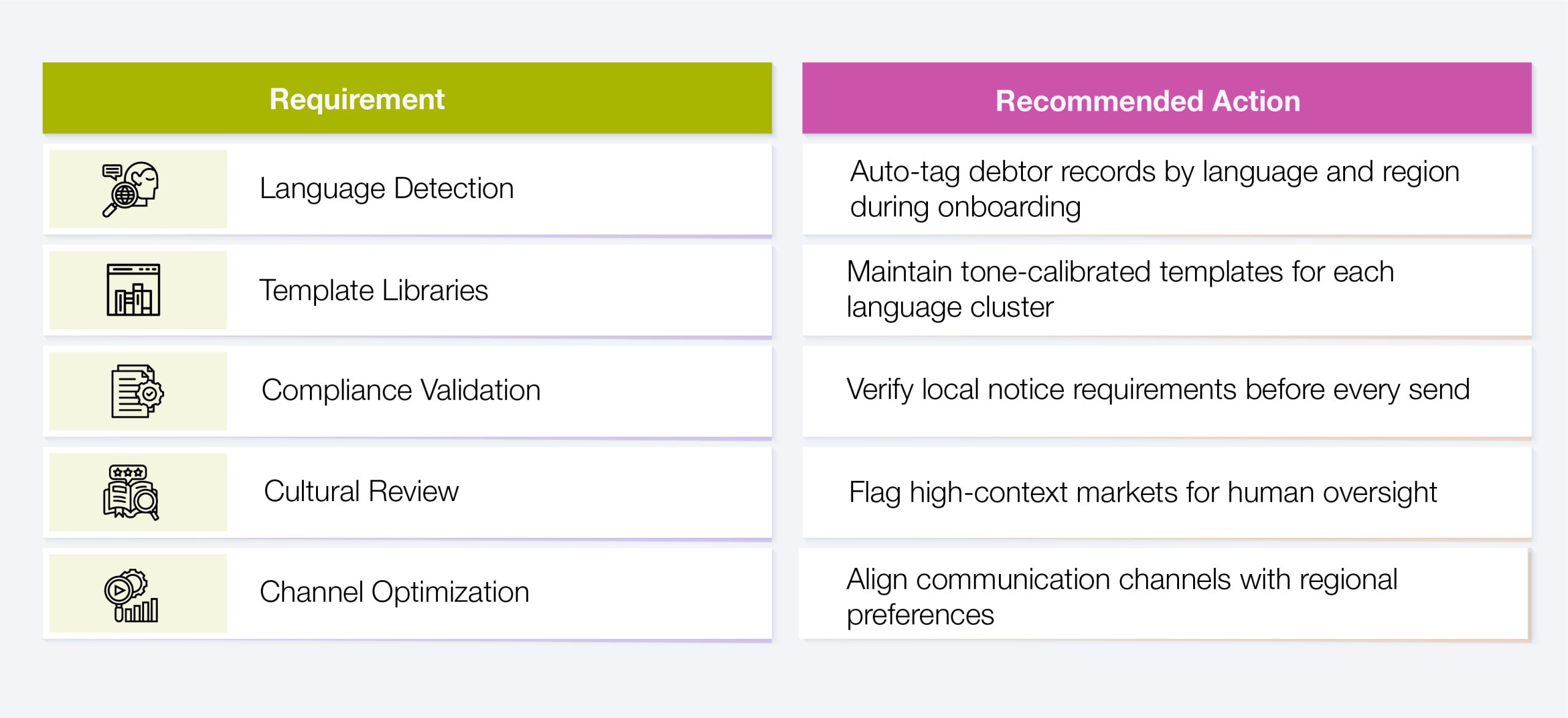
Operational Checklist for Multilingual Collections Teams
Localization Beyond Language: Optimizing the Entire Debtor Journey
To improve recovery outcomes globally, publishers must localize every stage of the payment experience.
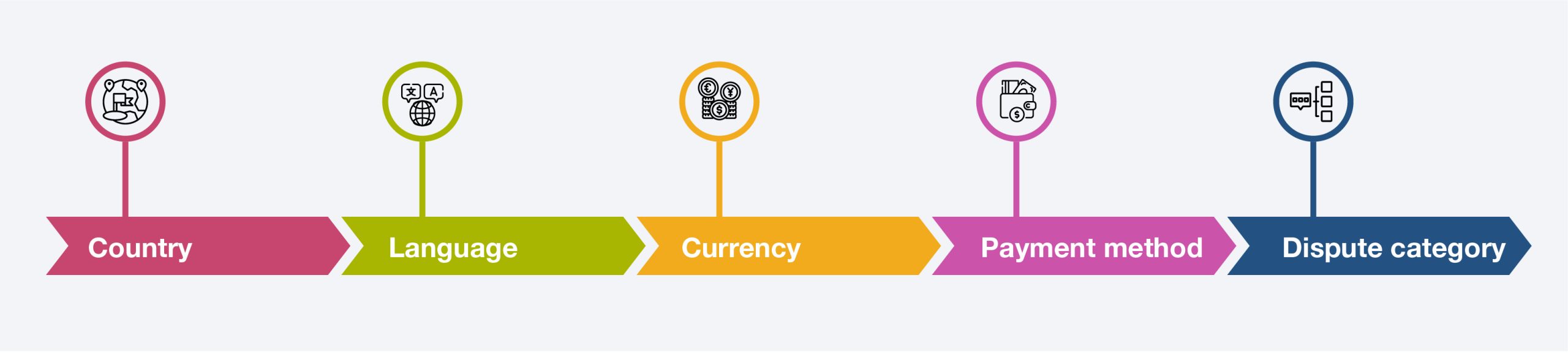
Start by segmenting overdue accounts by:
- Country
- Language
- Currency
- Payment method
- Dispute category
Many publishers discover that aging receivables accumulate disproportionately in non-English markets because collections workflows introduce unnecessary friction.
Payment compatibility also matters.
For example, sending fluent German-language outreach while only offering credit-card payments ignores local preferences such as SEPA transfers or Sofort. Language may open the conversation, but localized payment rails help close it.
Deploy a Tiered Hybrid Coverage Model
A one-size-fits-all collections strategy rarely works globally.
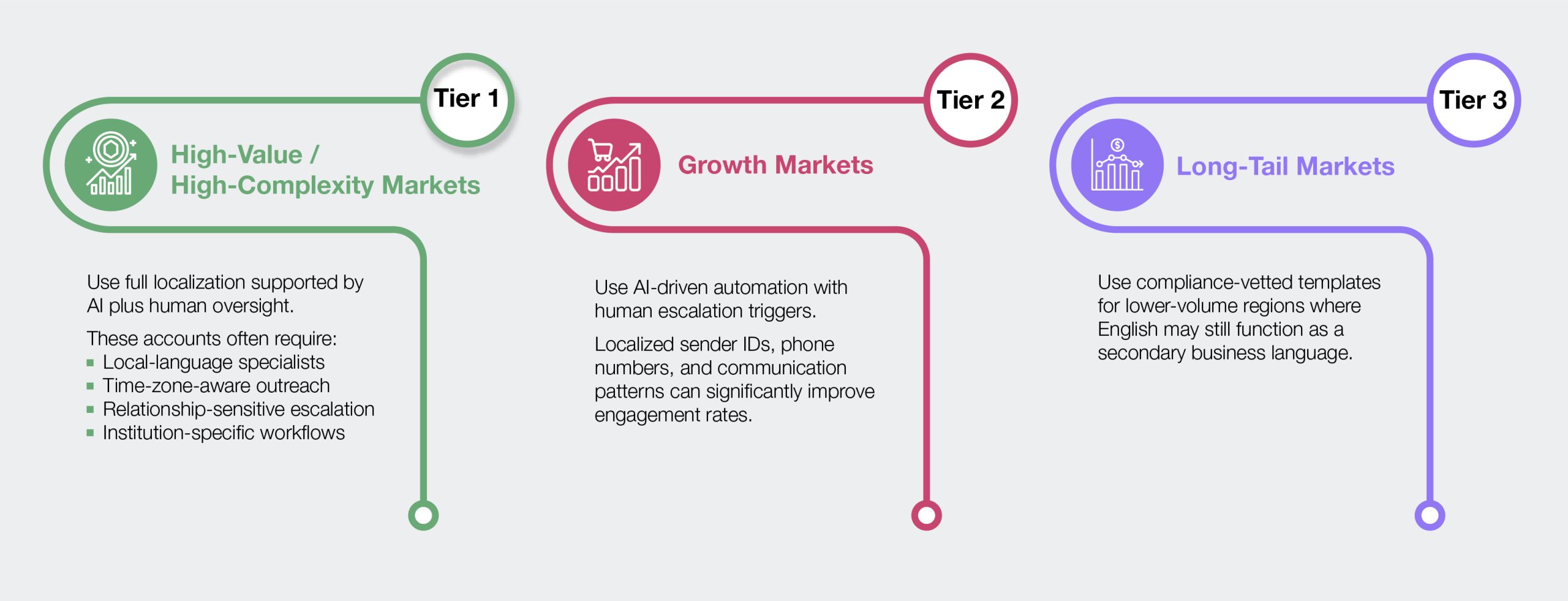
Tier 1: High-Value / High-Complexity Markets
Use full localization supported by AI plus human oversight.
These accounts often require:
- Local-language specialists
- Time-zone-aware outreach
- Relationship-sensitive escalation
- Institution-specific workflows
Tier 2: Growth Markets
Use AI-driven automation with human escalation triggers.
Localized sender IDs, phone numbers, and communication patterns can significantly improve engagement rates.
Tier 3: Long-Tail Markets
Use compliance-vetted templates for lower-volume regions where English may still function as a secondary business language.
Prioritize Accounts by Value and Friction
Collections complexity is not uniform across markets.
A high-value account in Japan may require significantly more relationship management than a mid-tier account in the Netherlands because of differences in business communication norms and escalation expectations.
Localization also intersects with compliance risk.
For example:
- Germany’s RDG influences recoverable collection costs
- The U.S. FDCPA and Regulation F impose strict communication rules for debt recovery activities
Any AI-assisted collections framework must incorporate jurisdiction-specific guardrails to avoid regulatory violations.
Build Closed-Loop Feedback Systems
High-performing collections organizations continuously refine their workflows using operational data.
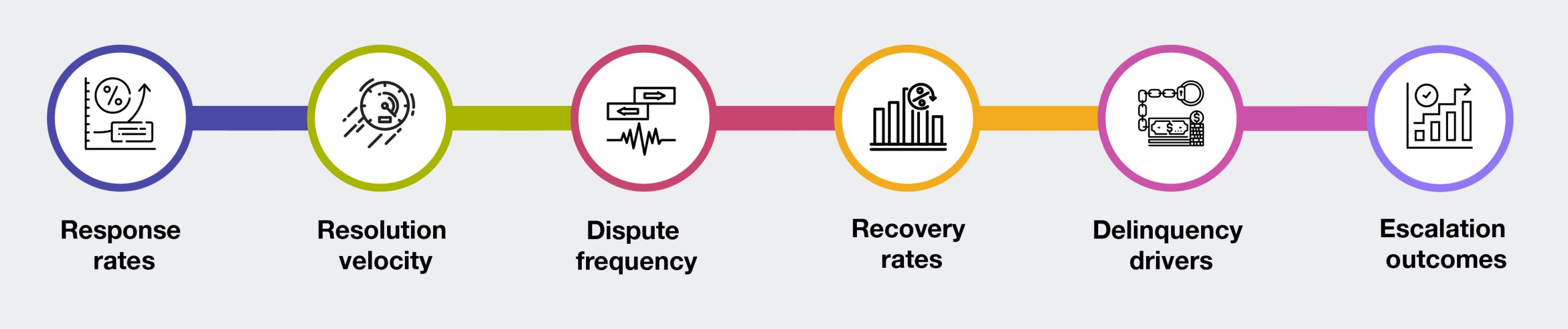
Track:
- Response rates
- Resolution velocity
- Dispute frequency
- Recovery rates
- Delinquency drivers
- Escalation outcomes
Also monitor Reason for Delinquency (RFD) trends by region.
If a market consistently reports:
- Invoice mismatches
- Tax issues
- Documentation errors
- Purchase-order discrepancies
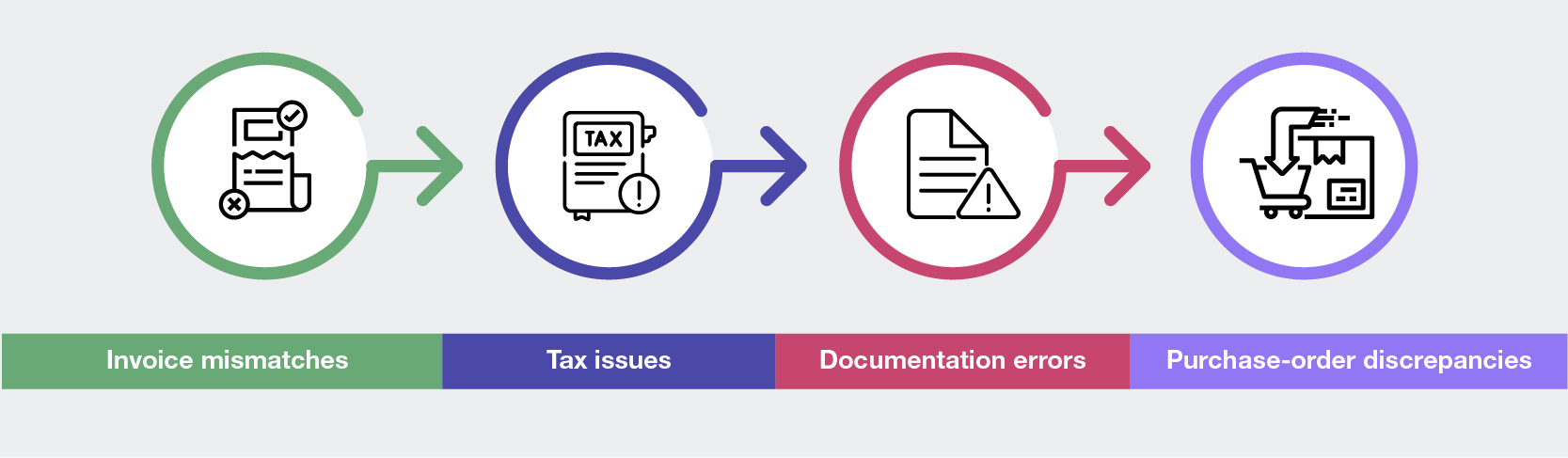
The root cause may lie upstream in the order-to-cash process rather than collections itself.
Collections analytics can become a powerful tool for identifying revenue leakage across the broader sales-to-cash lifecycle.
Designing Scalable International Collections Operations
A scalable multilingual collections platform requires more than translation tools. It demands intelligent workflow orchestration that can seamlessly align automation, customer engagement, and operational oversight across diverse markets and communication channels.
By combining AI-driven operationalization with human-led workflow governance, enterprises can improve operational efficiency, strengthen customer engagement, and drive better revenue outcomes. This operating model is especially critical in multilingual collections environments, where automation must be carefully balanced with cultural sensitivity, regulatory compliance, and relationship management.
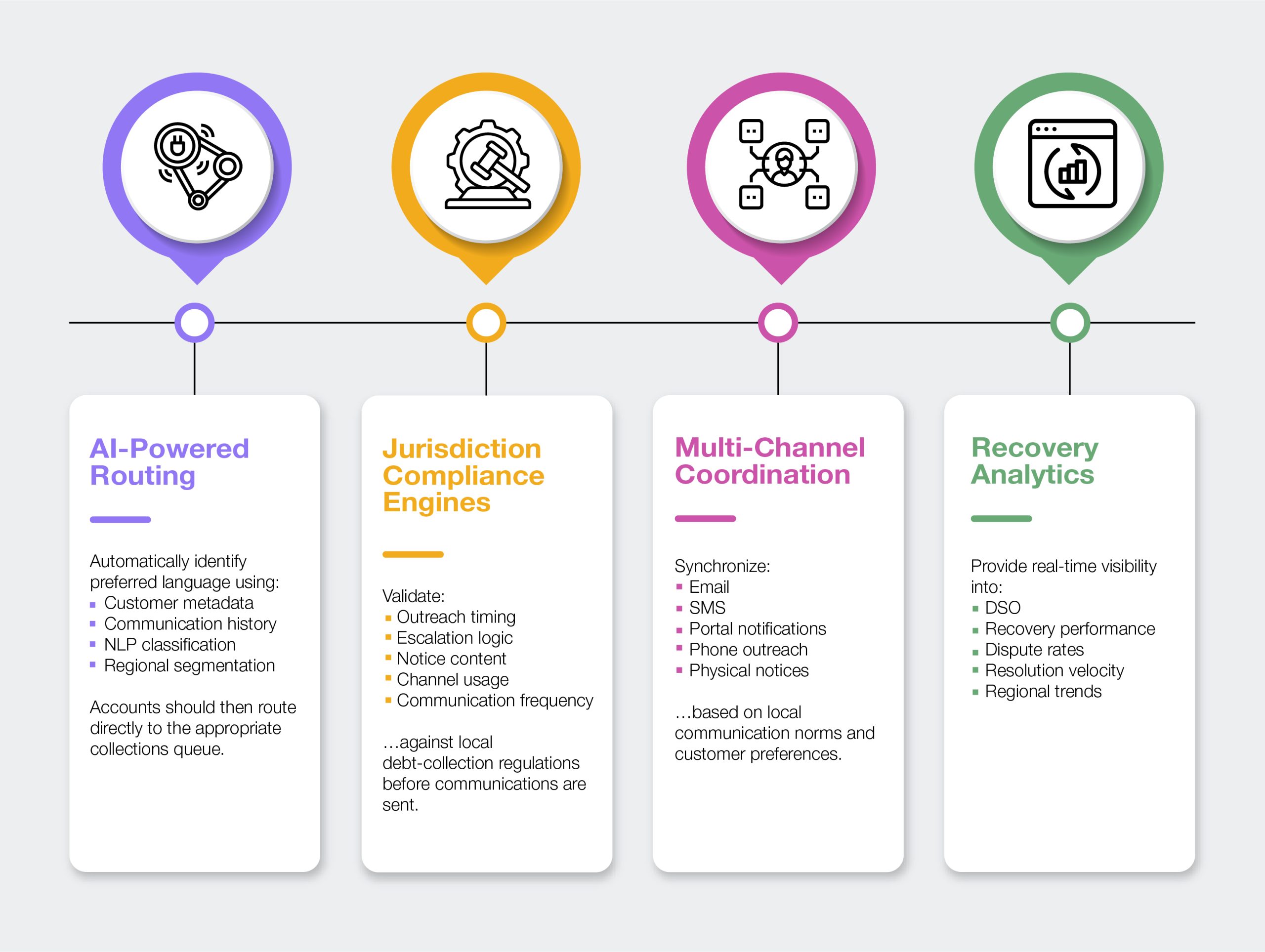
Core capabilities should include:
AI-Powered Routing
Automatically identify preferred language using:
- Customer metadata
- Communication history
- NLP classification
- Regional segmentation
Accounts should then route directly to the appropriate collections queue.
Jurisdiction Compliance Engines
Validate:
- Outreach timing
- Escalation logic
- Notice content
- Channel usage
- Communication frequency
…against local debt-collection regulations before communications are sent.
Multi-Channel Coordination
Synchronize:
- SMS
- Portal notifications
- Phone outreach
- Physical notices
…based on local communication norms and customer preferences.
Recovery Analytics
Provide real-time visibility into:
- DSO
- Recovery performance
- Dispute rates
- Resolution velocity
- Regional trends
Modern AR automation platforms increasingly combine predictive analytics, AI prioritization, and compliance-aware workflows. Industry analyses suggest that organizations implementing advanced AR automation can reduce DSO by approximately 15–25% while improving operational efficiency.
Partner vs. Vendor: Why Localization Expertise Matters
A translation vendor converts text.
A multilingual collections partner protects revenue across markets where language, procurement behavior, and institutional buying processes differ significantly.
The difference lies in operational expertise.
Publishing Domain Knowledge
A true collections partner understands:
- Library consortia
- E-resource licensing
- Institutional procurement
- Renewal cycles
- Publisher–institution negotiations
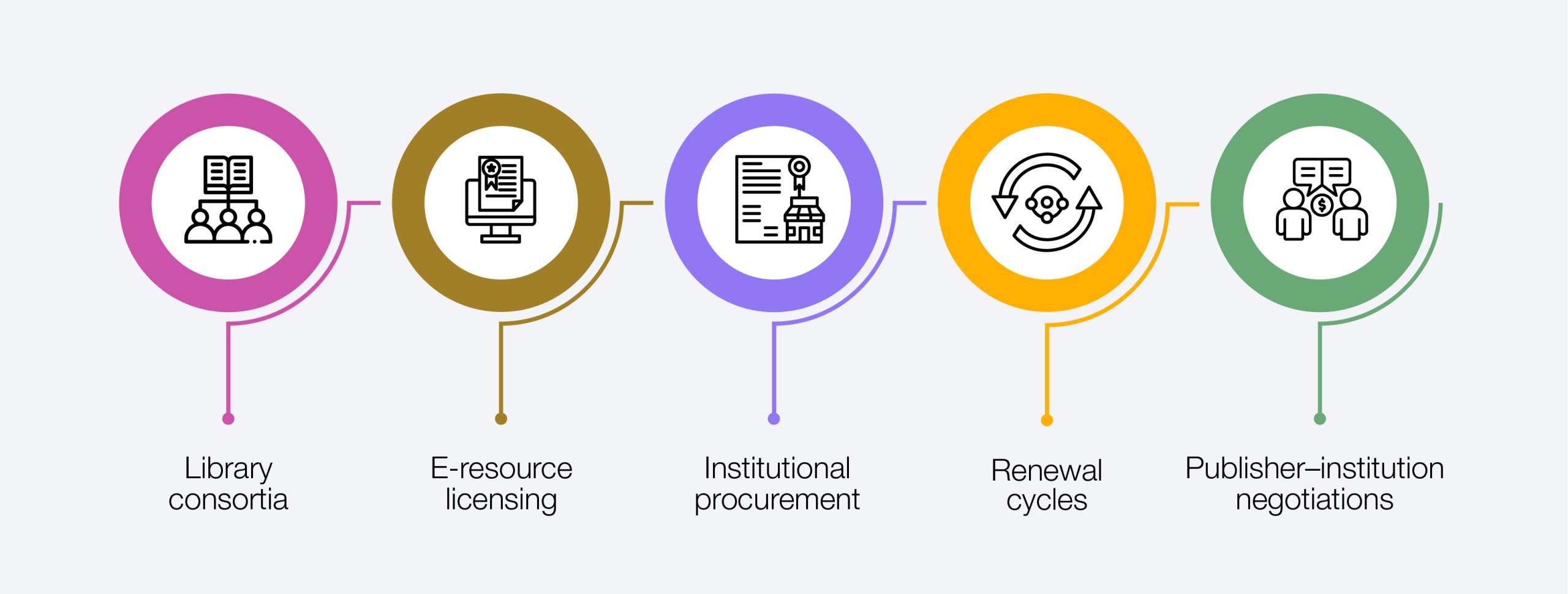
These workflows require specialized industry context, not generic translation support.
Simultaneous Global Scale
Collections operations cannot expand market by market when publishers operate globally across APAC, EMEA, and LATAM simultaneously.
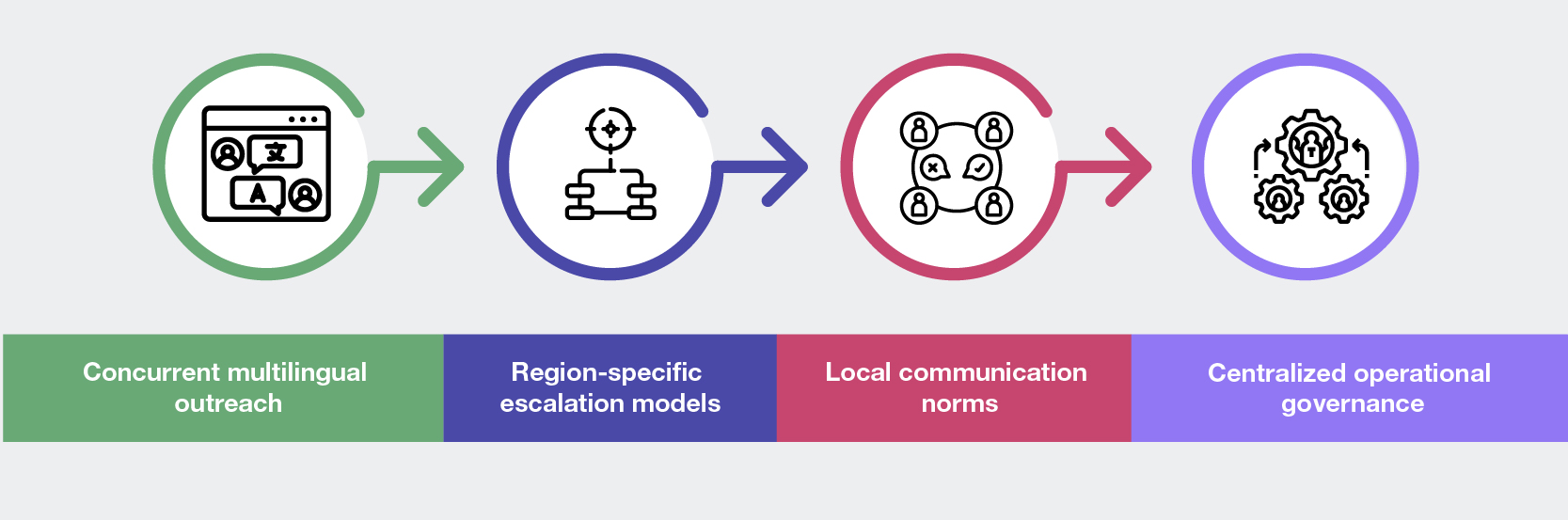
Effective partners must support:
- Concurrent multilingual outreach
- Region-specific escalation models
- Local communication norms
- Centralized operational governance
Governed Human + AI Models
AI creates scalability, but human oversight remains critical in relationship-sensitive collections environments.
ISO 18587 reinforces the importance of full human post-editing standards for machine-translated content, making governed hybrid models significantly more defensible than AI-only execution.
Closing the Multilingual Collections Gap
Global publishers risk leaving recoverable revenue on the table when collections remain structured as an English-first function.
Late payments, invoice disputes, and customer liquidity pressures already create substantial payment delays. Those risks compound when collections interactions occur across language barriers, regional procurement systems, and culturally mismatched communication workflows.
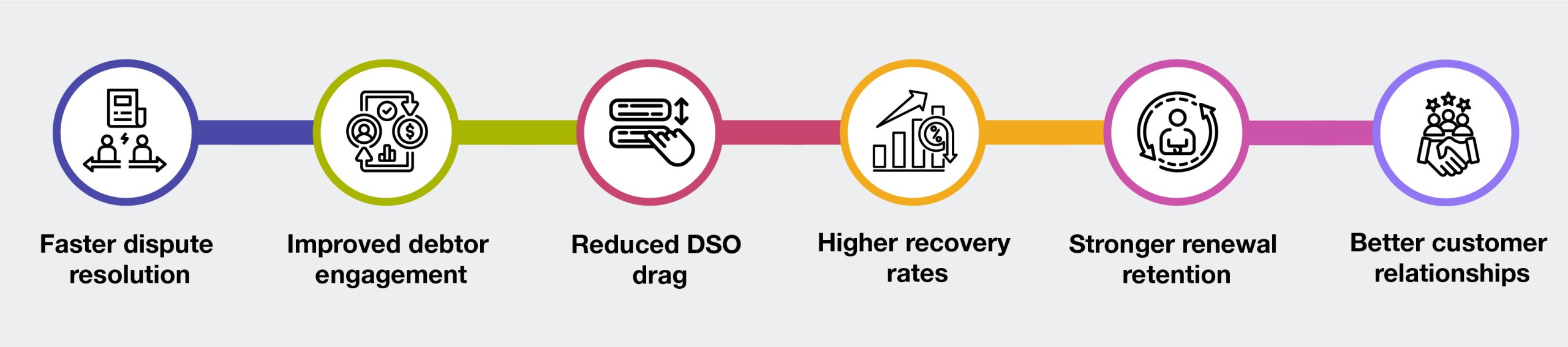
Closing the multilingual collections gap delivers measurable operational value:
- Faster dispute resolution
- Improved debtor engagement
- Reduced DSO drag
- Higher recovery rates
- Stronger renewal retention
- Better customer relationships
Most importantly, multilingual operations no longer require exponentially higher costs.
With AI-enabled, human-governed collections infrastructure, publishers can deliver locally relevant recovery experiences while maintaining centralized control, operational consistency, and global scale.
Ready to Improve Multilingual Collections Performance?
Straive helps global publishers improve multilingual collections performance through AI-enabled workflows, localized customer engagement, and scalable accounts receivable operations. Combining multilingual CX expertise with publishing-domain knowledge, Straive supports global recovery operations across complex international markets while helping organizations reduce DSO, improve recovery visibility, and preserve long-term customer relationships. Contact Straive to learn how multilingual collections strategies can help reduce DSO, improve recovery outcomes, and strengthen global customer relationships. |

Associate VP, Account Management


