
Posted on: July 30th 2025
In 2025, banking automation is becoming a front-line driver of speed, resilience, and smarter customer experiences. No longer just a cost-cutting tool, it’s now essential to meet growing compliance demands, rising complexity, and real-time expectations.
According to McKinsey, banks that scale automation across the value chain could reduce operational costs by up to 30% while improving turnaround times and accuracy.
The shift is real: powered by AI and live data, intelligent automation is redefining how banks operate at every level.
What is Banking Automation?
To understand how intelligent automation is reshaping banking, it’s helpful to start with what this shift means.
At its core, it’s about using technologies like AI, machine learning, and robotic process automation (RPA) to take over routine tasks, like data entry, reconciliations, and transaction processing.
Instead of just speeding up manual work, automation now helps banks run smarter—connecting systems, improving accuracy, and enabling faster decisions at scale.
The result? Faster processes → Fewer errors → Happier customers → Stronger margins.
The Rise of Banking Automation: Moving Beyond Legacy Systems
The demand for transformation in banking has reached a tipping point. Rising operational complexity, tighter regulations, and digital-first customers are forcing banks to rethink how they operate—fast.
Traditional AI in banking, built on rigid core systems and fragmented data silos, can’t keep pace with today’s speed, agility, and personalization needs—because of its inability to integrate real-time data, learn from new patterns, or adapt to evolving customer behaviors makes it inflexible.
To stay competitive, banks must move beyond digitizing legacy processes to fully reengineering them, putting AI and automation at the center of the operating model.
Formula for intelligent automation in banking:
Legacy Tech + Manual Ops → [AI + Data + Scalable Infrastructure] → Speed + Precision + CX Gains
Modern banks now see intelligent automation banking as more than a cost lever—it’s a strategic enabler of revenue growth and customer trust.
According to McKinsey, scaling AI across functions like underwriting and engagement could unlock up to $1 trillion in annual value.
In 2025, intelligent automation forms the foundation for hyper-personalization, agility, and real-time decision-making, key to banking success.
Intelligent Automation vs Traditional Banking Automation: What’s New?
Traditional banking automation was designed to follow rules. It handled routine, repeatable tasks—copying data, triggering alerts, or reconciling accounts—within tightly defined workflows.
While effective for structured processes, these systems often stall when faced with change, scale, exceptions, or ambiguity.
Intelligent automation is fundamentally different. It combines AI, machine learning, and decision intelligence to adapt, learn, and optimize continuously.
It doesn’t just execute—it analyzes, predicts, and evolves with each cycle.

In 2025, banks are rapidly shifting from task-based automation to integrated, AI-driven systems that boost agility and customer responsiveness.
Straive enables this transformation by embedding intelligent automation across banking functions—bridging legacy systems with context-aware, scalable, and continuously learning workflows.
Intelligent Automation Tools and Trends Reshaping Banking in 2025
In 2025, intelligent automation in banking is no longer driven by isolated tools—it’s powered by integrated ecosystems that combine AI, data, and human oversight.
Tools Redefining Automation in Banking
AI Copilots, Decision Intelligence & Predictive Analytics
AI copilots assist bankers with real-time recommendations, while decision intelligence engines and predictive models forecast risk, detect anomalies, and drive smarter, proactive actions across operations.
RPA 2.0 and Low-Code Automation
In robotic process automation banking, next-gen platforms now feature low-code builders and intelligent UI capture, making automation faster to scale and easier to maintain.
Cloud-Native, API-First Architectures
Modular, scalable systems enable seamless integration, faster updates, and smoother cross-platform automation.
NLP for Unstructured Data
NLP extracts insights from documents, emails, and transcripts—automating compliance, onboarding, and support.
Human-in-the-Loop (HITL)
Automation doesn’t eliminate human expertise—it amplifies it. Straive integrates HITL validation at critical points to ensure regulatory accuracy, data integrity, and explainability, especially in high-risk processes like onboarding or credit evaluation.
Trends Defining 2025
Hyper Automation
Banks are moving from isolated bots to full process orchestration—automating across systems, tools, and departments, such as linking risk checks with document flows and approvals to reduce turnaround times and eliminate handoffs.
Generative AI in Operations
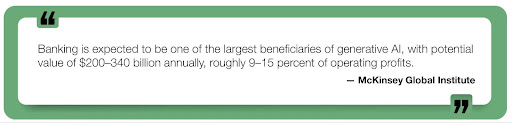
GenAI tools are driving document drafting, regulatory interpretation, and customer engagement—unlocking $200–340 billion in annual value, according to McKinsey.
Real-Time AI at the Edge
AI models now operate closer to data sources, enabling real-time fraud detection and transaction scoring. For instance, financial networks like Mastercard’s Decision Intelligence system analyzes transactions in under 50 milliseconds to flag suspicious activity at the point of swipe and prevent fraud before authorization.
Unified Automation Platforms
Banks are replacing fragmented tools that centralize workflows, compliance, and monitoring, enabling banks to integrate multiple processes such as customer service, dispute handling, and backend operations through a single window.
The Strategic Benefits of Intelligent Automation in Banking
Beyond efficiency, intelligent automation delivers measurable business value across operations, risk, compliance, and customer experience. Here’s how leading banks are gaining from its adoption:
Turnaround Times
Automation accelerates high-volume processes, reducing delays in onboarding, approvals, and transaction handling.
Scalable, Modular Architecture
Flexible systems adapt quickly to evolving compliance requirements without overhauling core infrastructure.
Stronger Risk and Fraud Detection
Real-time analytics enable proactive monitoring and response, reducing exposure and manual oversight.
Cross-Functional Visibility and Control
Unified workflows create better alignment across business, risk, and operations teams.
Superior Customer Experience
AI-led systems deliver faster service, personalized interactions, and consistent support across channels.
Where Automation Meets Outcomes: Real Banking Challenges Solved by Straive
Every bank faces complex, high-volume operations. What sets leaders apart is how they solve them—with precision, speed, and scale. At Straive, we work at the intersection of structured and unstructured data, human expertise, and intelligent automation to turn these challenges into lasting transformation.
Case Study 1: Streamlining Commercial Onboarding and Financial Spreading
A global bank was losing valuable time during commercial onboarding due to manual review of balance sheets, income statements, and other financial documents. The inconsistency of formats slowed down decisions.
We implemented an AI-powered automation engine that extracted data across formats, applied context-aware spreading logic, and used human-in-the-loop validation for quality control.
Impact:
- Over 99% extraction accuracy.
- 20% faster onboarding cycle.
- Reduced risk exposure and improved customer experience due to timely decisions.
Case Study 2: Automating News Workflow with BOT Integration
A financial insights firm relied on manual effort to process scraped news data and update tasks across Jira and internal platforms, leading to slow turnarounds and operational strain.
Straive deployed automation BOTs that extracted news links, eliminated duplicates, created Jira tickets, and triggered content curation—seamlessly integrating across systems with minimal human input.
Impact
- Processed up to 2,000 items per night.
- Reduced execution time to under 2 hours.
- Enabled high-volume, end-to-end workflow automation.
Why Straive: A Scalable Partner for Intelligent Automation in Banking
In an era where speed, compliance, and intelligence define success, Straive delivers more than automation—it builds future-ready banking operations. Our solutions go beyond tools, enabling end-to-end transformation that scales with purpose.

Data-first, industry-agnostic architecture
Designed to adapt across banking functions, without heavy dependency on legacy constraints.
Engineered for complexity
Capable of processing structured, semi-structured, and unstructured data accurately and at scale.
Built for trust and outcomes
From financial spreading to compliance automation, Straive drives results aligned with regulatory precision and customer experience goals.
Modular, cloud-native automation infrastructure
Built with microservices and API-first design, our solutions deploy rapidly, upgrade easily, and scale globally.
Embed governance with human-in-the-loop (HITL)
Straive integrates expert validation points where it matters—ensuring explainability, compliance, and high accuracy in risk-sensitive workflows.
As banks shift from experimentation to enterprise-wide automation, Straive provides the expertise, tools, and human alignment needed to operationalize intelligent automation securely and at scale.
About the Author

Dinesh Kumar Nuthi is an Engagement Manager in Analytics & AI at Straive, specializing in fraud prevention, financial crime risk management, and digital transformation for leading U.S. financial institutions. With over 9 years of experience across the U.S., Canada, and India, he has led cross-functional teams to deliver analytical and digital solutions that enhance fraud detection, reduce losses, and drive operational efficiency. Dinesh has managed large-scale analytics programs involving analytics, machine learning, automation, and real-time risk monitoring. A data-driven leader, he has worked closely with senior stakeholders to align solutions with business strategy while mentoring global teams. He is currently pursuing a part-time MBA from Leeds School of Business and is passionate about using technology and analytics to solve high-impact business problems.
Share with Friends:


