
Posted on: January 5th 2025
How Data-Driven Intelligence Is Redefining Customer Experience in 2026
Customer expectations are shifting faster than most organizations can recalibrate their operating models. What once qualified as a strong experience—reliable service, prompt replies, intuitive interfaces—now represents entry-level performance. In 2026, differentiation comes from how well a company understands its customers and how quickly it can turn that understanding into action. Intuition alone cannot meet that bar.
Organizations that are pulling ahead share a common discipline: they treat data as the organizing principle of customer experience, not an afterthought. They invest in data that is accurate, responsibly managed, and tightly integrated across channels. More importantly, they use that data to shape how journeys are designed, how support is delivered, and how decisions are made at critical moments.
This shift changes how businesses diagnose and resolve friction. Instead of relying on lagging indicators such as complaints or declining satisfaction scores, leaders monitor real behaviors: where customers stall, where intent weakens, where confusion peaks. These signals allow teams to intervene early and refine journeys before small issues become systemic failures.
High-performing CX organizations now view data not as a reporting asset but as an operating asset. They prioritize quality, governance, and clarity so insights can move quickly from analysis to execution. The result is a more responsive, adaptive customer experience—one that keeps pace with expectations rather than trailing behind them.
Experience excellence in 2026 emerges from this combination of intelligence, discipline, and design. Companies that internalize this approach are defining what modern customer experience looks like: informed, connected, and consistently aligned with what customers value most.
CX leaders once relied on anecdotal feedback, periodic surveys, and the instincts of frontline teams to understand what customers needed. That model cannot keep pace with digital behavior. Organizations now draw on continuous intelligence—signals such as browsing patterns, onboarding drop-off points, sentiment shifts in service conversations, and changes in product usage. These real-time indicators provide a far more accurate picture of intent and friction than retrospective surveys ever could.
When analytics is deliberately embedded into CX design, it shapes how journeys are orchestrated and how support is delivered. These gains come from three core analytics capabilities: behavioral analytics that reveal how customers move through digital and physical experiences, predictive insights that flag emerging risks or opportunities, and journey-level intelligence that connects signals across channels to show where the experience holds together—or breaks down.
Organizations that operationalize these capabilities are defining the next era of customer experience: faster to detect change, clearer in decision-making, and better aligned with what customers value in the moment.
Analytics as a Business Lever: Why CX Leaders Are Winning With Insight
Data and analytics in customer experience have moved far beyond static operational dashboards. Today, they shape how well a customer is understood, how consistently they are supported, and how intuitively their needs are met at every stage of the journey.
Organizations that embed analytics into everyday decision-making see measurable gains. Journeys become smoother. Service becomes faster. Customer relationships grow stronger and more resilient. Teams can detect early signs of frustration before they lead to churn, recognize when a customer is most open to an offer, and pinpoint exactly where support is needed.
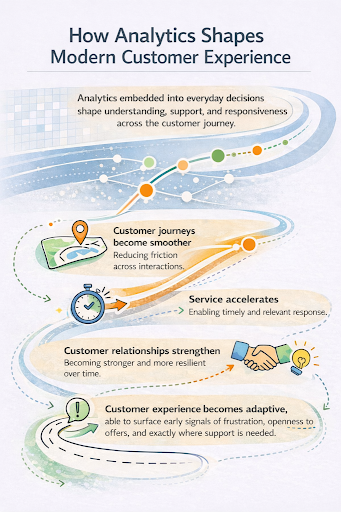
With a strong data-driven CX strategy, brands reduce friction, personalize at scale, and focus on what truly matters to customers. Decisions stop being guesswork and become grounded in real behavior and signals. Most importantly, organizations shift from reacting to preventing issues—resolving needs before customers feel friction.
The Evolution of Customer Experience: From Anecdotes to Algorithms
For years, organizations viewed customer experience through a narrow lens. They examined isolated touchpoints—individual service calls, one-off surveys, or feedback forms—and tried to infer broader needs from limited snapshots. Frontline teams supplied valuable context, but rarely had visibility across the full journey. Brands often found themselves stitching together fragments from emails, support logs, and systems in hopes of forming a coherent picture.
Digital transformation changed this foundation. Customers now engage across countless channels and devices, and each interaction leaves a signal. They browse, tap, swipe, compare, abandon, purchase, and return—micro-behaviors that collectively reveal what captures attention and what causes hesitation.
With millions of these micro-interactions happening daily, manual interpretation is no longer feasible. AI enables organizations to make sense of signals at a scale human teams cannot match. Machine learning identifies behavioral trends, natural-language systems interpret tone and sentiment, and predictive models estimate the likelihood of actions such as renewal, churn, or advocacy.

This marks a fundamental shift. Instead of treating customers as static records, AI-driven CX analytics recognizes them as participants whose needs evolve continuously. The result is a deeper, more connected understanding—one that helps organizations respond with precision as expectations rise.
The Evolution of Data-Driven Customer Experience
While digital transformation changed the volume of signals, an equally significant shift occurred inside organizations: how those signals are operationalized. Earlier CX programs struggled not because data was unavailable, but because it was scattered, inconsistent, and difficult to act on. Teams relied on small samples, periodic reviews, or anecdotal reports that offered only partial insight.
Modern data-driven CX is defined by the ability to consolidate, interpret, and activate insights at scale. As interactions expanded, organizations began building integrated data foundations—linking web analytics, CRM systems, support logs, product usage data, and call-center records. This created a single view of how customers move, decide, and seek help across channels.
AI strengthens this capability by filtering large information streams into clear guidance. Instead of simply flagging anomalies, modern tools highlight root causes of stalled journeys, identify emerging sentiment trends, and estimate the likelihood of behaviors such as upgrade adoption or disengagement. Organizations with strong data integration consistently outperform peers on loyalty, retention, and long-term value.
Leading brands now treat data as an operating discipline rather than a reporting function. Insights shape prioritization, design decisions, and interventions in near real time. This redefines what “customer-led” truly means: decisions grounded in evidence; execution guided by intelligence; experiences that improve continuously.
Real-Time Personalization: Turning CX From Static to Responsive
Real-time personalization transforms customer experience by treating every interaction as a live signal rather than a static event. Instead of relying solely on historical profiles or broad segments, real-time systems respond to what a customer is doing now—what they click, search, linger on, or dismiss. This allows brands to adjust content, offers, and support instantly.
Behavioral data processed within milliseconds enables these adaptive experiences. A returning shopper sees recommendations tied to recent activity, not outdated assumptions. A banking customer receives help aligned with current actions in the app. A traveler browsing hotel options receives suggestions that match their preferences and history.
Done well, real-time personalization removes friction and supports progress. It does not overwhelm customers with pop-ups or irrelevant choices. It clarifies next steps and reduces repeated questions.
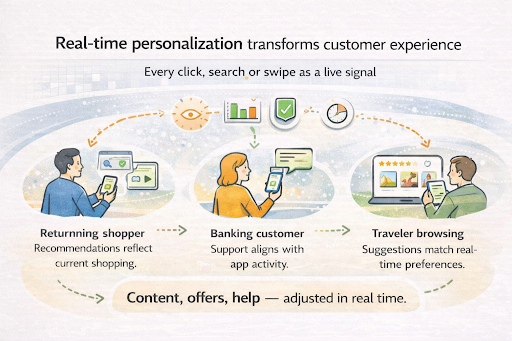
Organizations that invest in real-time personalization see stronger engagement, fewer abandoned journeys, and higher conversion. Customers feel recognized without feeling monitored. The goal is usefulness in the moment—providing the right content or guidance at the right time.
For CX leaders, real-time personalization has become foundational. It blends instant insight, omnichannel context, and AI-enabled decisioning to deliver experiences that adapt as quickly as customers do.
The Role of Predictive Analytics in Customer Experience
Predictive analytics is one of the most influential capabilities in modern CX, shifting organizations from reactive service to forward-looking strategies. It uses historical behavior, interaction patterns, product usage, and engagement signals to forecast what customers are likely to do next.
One of its most valuable applications is identifying churn risk early. Subtle markers—declining usage, repeated visits to help content, slower response to marketing messages, or rising complaints—can indicate dissatisfaction. With these signals, companies can intervene proactively with targeted support, timely outreach, or solutions to underlying issues.
Predictive analytics also identifies upsell and cross-sell opportunities rooted in actual behavior. Organizations can analyze lifecycle stages and purchase patterns to recommend offerings that align with current needs.
Beyond churn and growth opportunities, predictive analytics supports operational foresight. Teams can anticipate onboarding challenges, journeys likely to stall, or issues that often follow product updates. This enables improvements before customers encounter problems.
When integrated thoughtfully, predictive analytics becomes a strategic layer within customer experience—helping brands understand intent, prioritize actions, and address needs early.
Journey Mapping: Seeing the Customer Experience as a Whole
One of the biggest misconceptions about CX is treating it as a series of isolated moments. In reality, customers experience a continuous journey that spans channels, devices, and contexts. They don’t distinguish between mobile, web, store, or call-center interactions—it is all one relationship.
Journey analytics brings this continuity into focus. Instead of assessing each interaction independently, it connects data from every touchpoint to reveal the true shape of the customer’s path: from awareness to exploration, decision to service, and satisfaction to loyalty.
Effective journey mapping highlights where friction appears, where motivation increases, and where customers naturally slow down. It uncovers issues such as confusing onboarding steps, long checkout flows, or repeated visits to a support page. It also captures emotional indicators such as hesitation before purchase or frustration during troubleshooting.
Modern omnichannel analytics tools convert these insights into visual dashboards—heatmaps, drop-off curves, path views—that help teams quickly identify where customers succeed and where they struggle.

When organizations embrace journey-level insight, CX becomes an orchestrated system rather than a collection of fixes. Content, support, design, and communication align around how customers actually move. The result is an experience that feels coherent and predictable across every channel.
How Automation Elevates Responsiveness and Experience Quality
Automation in CX is often misunderstood as a cost-saving mechanism. Its real value lies in improving responsiveness and consistency. Effective CX automation handles background work that slows teams down—cleansing data, enriching profiles, integrating records, and routing support tickets accurately.
This removes manual friction. Agents no longer search across multiple tools or re-enter information. Instead, they receive a unified view of the customer’s recent activity, past issues, relevant products, and earlier commitments. With the full context available, they can focus on diagnosing and resolving.
For customers, the impact is direct: faster responses, smoother handoffs, fewer repeated explanations, and immediate resolution for routine tasks. More complex issues still reach human experts, supported by clean data and complete history.
When used thoughtfully, automation creates a partnership between technology and people. Technology handles repetition; humans provide judgment and empathy. Together, they deliver a support model that is fast, reliable, and scalable—without losing the human touch.
Hyper-Personalization: Designing Experiences for the Individual
Hyper-personalization marks a deeper evolution in customer experience—centered on understanding the person behind the behavior. Unlike real-time personalization, which responds to immediate actions, hyper-personalization examines long-term patterns, lifestyle signals, sentiment shifts, and motivations.
This enables experiences that feel intentional. In e-commerce, brands curate product assortments based on style preferences, price sensitivity, device-switching habits, and patterns in browsing. In financial services, institutions consider life events, financial aspirations, and risk preferences to offer long-term guidance. Travel companies design journeys aligned with traveler identities, based on historical choices and trip patterns.
Hyper-personalization works because it emphasizes recognition over reaction. Customers want to feel understood, not categorized. Advanced segmentation, applied with care, turns data into resonance.
With strong analytics and governance, hyper-personalization becomes a strategic differentiator—delivering experiences that reflect the uniqueness of each customer.
Managing Data Quality, Privacy, and Integration Responsibly
Trust remains the foundation of customer experience. Personalization and prediction mean little if customers don’t feel safe sharing their data. Challenges in data quality, privacy, and siloed systems can quietly undermine even sophisticated CX strategies.
Poor or inconsistent data leads to flawed insights. Fragmented systems limit visibility. Customers are increasingly aware of how their data is used, and regulations such as GDPR and CCPA continue to raise expectations for transparency and compliance.
Addressing these issues requires deliberate action. AI-powered data quality monitoring can flag duplicates, anomalies, and gaps early. Automated integration creates reliable, unified sources of truth. Ethical data handling—clear explanations of what is collected and why—reinforces credibility.
Organizations that invest in strong data integration and governance do more than improve dashboards. They signal respect, strengthening willingness to engage and share.
The Future: Analytics Shaping the Next Wave of CX Innovation
The future of customer experience is built on intelligence that feels seamless. Several trends are shaping this next era: generative AI that produces adaptive content and recommendations; emotionally aware systems that interpret tone and sentiment; AR and VR environments that enable immersive evaluation of products and services; IoT-connected devices that surface context-aware interactions; and edge analytics that deliver real-time insight with minimal latency.
These advancements expand CX beyond transactions and into personal, contextual engagement. By processing insights closer to the source, organizations can support ultra-responsive applications, from personalization to proactive service alerts.
To stay ahead, organizations must invest in flexible data architectures, strong governance, and cross-functional teams capable of turning analytics into action. Those that do will help define next-generation customer experience—predictive, immersive, human-centered, and continuously improving.
Conclusion: The Advantage Belongs to Those Who Turn Data Into Understanding
Data and analytics are not replacing human experience—they are enriching it. When used thoughtfully, analytics helps organizations understand customers more deeply, anticipate needs, and remove friction across the journey. The most powerful results come from pairing intelligence with empathy: using data to personalize responsibly, support proactively, and design experiences that feel effortless.
Throughout the lifecycle, analytics enables smarter decisions—identifying drop-off points, predicting frustration, and recommending next actions. These outcomes help brands deliver experiences that are emotionally resonant, operationally efficient, and consistently aligned with expectations.
Straive’s analytics, data engineering, and AI capabilities support enterprises in converting raw information into meaningful understanding. By grounding CX in responsible data practices and actionable insight, Straive helps organizations create experiences that are streamlined, scalable, and memorable.

Assistant Director, Strategic Programs
Abhishek leads operational excellence and transformative client outcomes, bringing extensive experience in orchestrating large-scale customer experience and technology programs


