
Posted on: May 13th 2026
Accessibility issues are still turning up late, during audits, onboarding reviews, platform ingestion, and procurement checks, after files have already been through production. What used to be treated as cleanup at the end of the process now sits much closer to core publishing quality.
For publishers, that changes the job. The challenge is no longer just fixing files when problems are flagged. It is building workflows that can produce accessible content consistently across formats, vendors, and delivery environments, without reopening the same issues title after title.
Why Reactive Accessibility Is No Longer an Option for Publishers
Most publishers did not set out to be reactive. They got there the same way many production teams do. Files moved on schedule, accessibility issues surfaced late, priority content was fixed, and the rest of the list kept moving.
For a while, that can look manageable.
Then the same problems start showing up across too many titles to ignore. A PDF looks fine in layout but breaks down when tagged properly. An EPUB clears technical validation but still fails on navigation, reading order, or image treatment. Alt text is present in one output and missing in another. A vendor fixes an issue in one batch, but the same issue turns up again in the next because nothing upstream changed.
Exhibit 1. The Reactive Accessibility Cycle
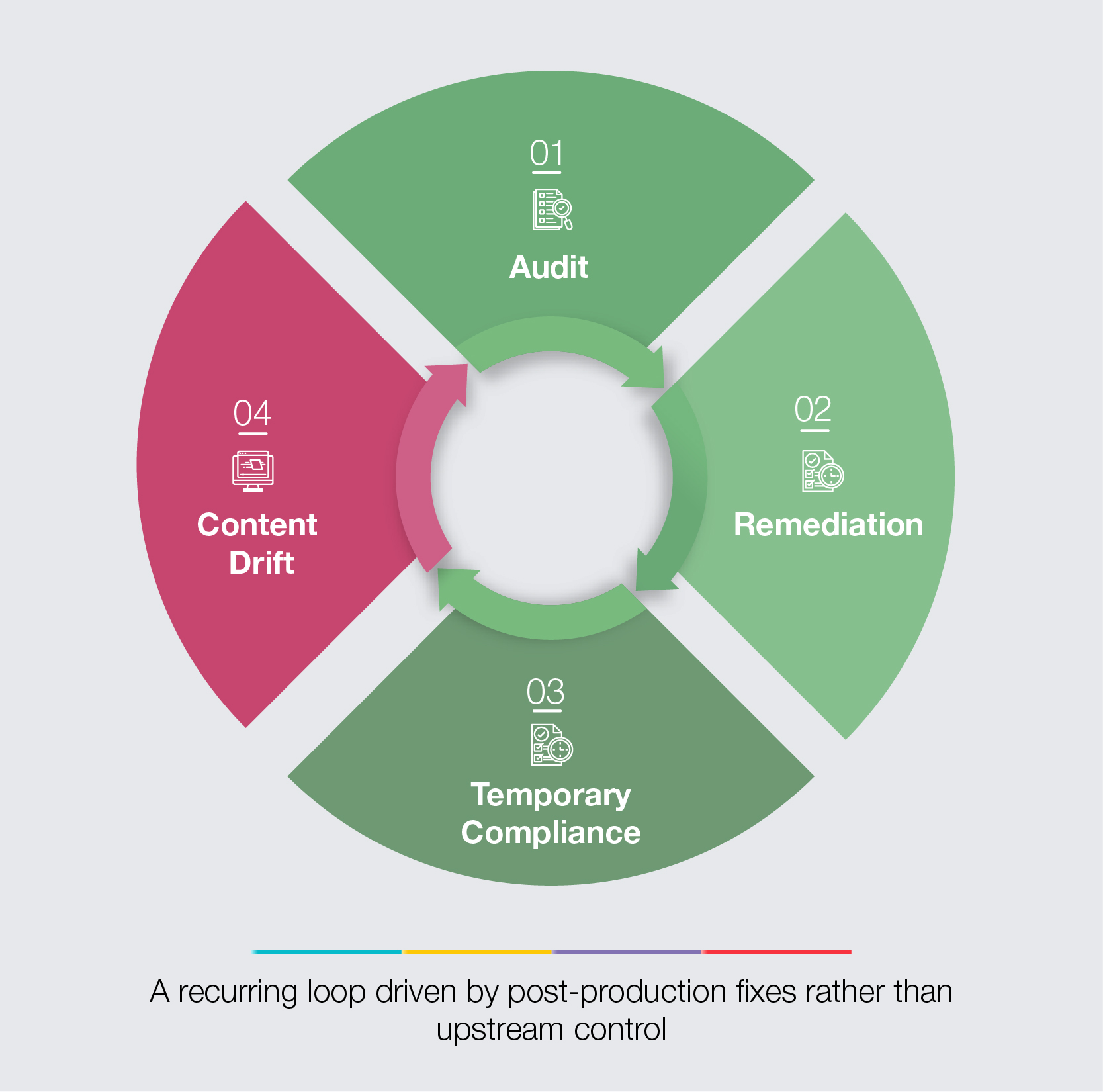
This is where reactive accessibility becomes expensive in ways that do not always show up in a budget line. Files move backward from QA into production. Vendors reopen work that was already signed off. Release dates absorb corrections that were never scoped in the first place. Backlist content comes back for another round because the last round dealt with the symptom, not the workflow that created it.
The longer this continues, the more accessibility gets treated as cleanup. Once that happens, quality becomes uneven. Standards depend on who catches the issue, how late it is found, and whether there is enough time left to fix it properly.
That is the weakness of reactive remediation. It can reduce immediate exposure, but it does not create production control. Without control, the same issues come back under a different title, in a different format, on a different deadline.
What a Proactive Digital Accessibility Program Publishing Model Actually Looks Like
A proactive accessibility program starts by moving accessibility checks upstream, into the publishing workflow itself. Not after the layout is complete. Not after downstream files have been generated. Not after a platform rejects content. It starts inside the workflow itself.
That is where accessibility governance publishing becomes operational. Ownership is clearly assigned. Checks exist at multiple stages, not just one late checkpoint. Standards show up in authoring templates, editorial instructions, QA criteria, and vendor requirements. Accessibility stops living as a policy statement and starts showing up in the way work is actually done.
Exhibit 2. Proactive Accessibility Workflow Integration
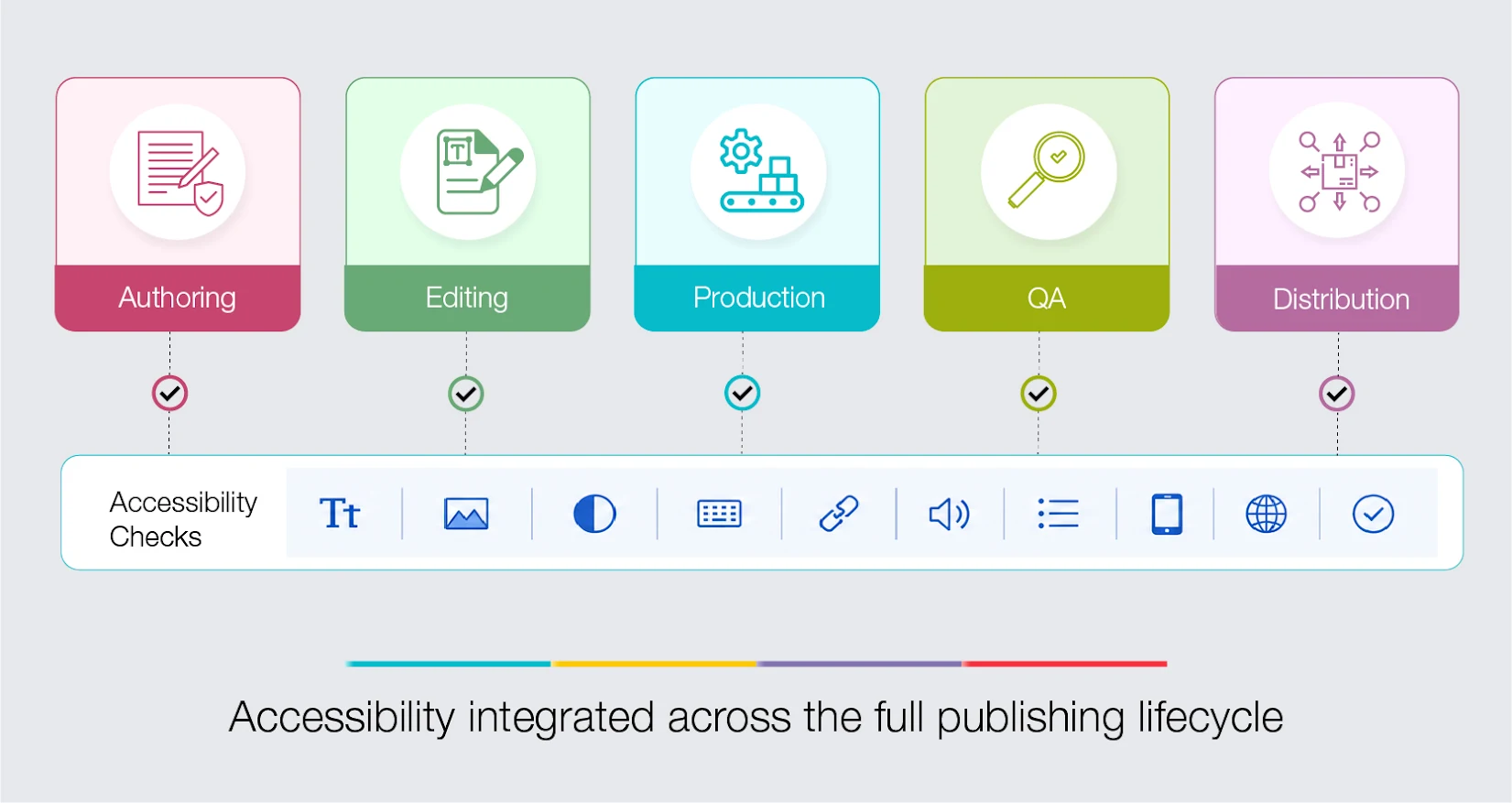
The strongest programs begin upstream because that is where avoidable errors are easiest to prevent. Authors and editors work with structured templates. Content systems require key metadata. Editorial review checks more than style and accuracy. It also checks whether accessibility requirements are being carried forward before content reaches full production.
This is what proactive accessibility compliance looks like in day-to-day production. Teams are not rebuilding structure after the file is finished. They are preventing common failures before they multiply across PDF, EPUB, HTML, and platform outputs.
Automation supports that work, but it cannot replace judgment. It is useful for catching missing structure, labeling gaps, and repeatable formatting errors. It is far less reliable when content needs interpretation. Scientific notation, complex tables, figure descriptions, and multimedia still depend on human review. In academic, educational, and STM publishing, that distinction matters because complexity shows up quickly and often.
A strong ADA compliance program for publishers brings those pieces together without treating them as separate tracks. Governance defines responsibility. Workflow design reduces repeat errors. Automation supports scale. Human review protects quality where meaning and context matter.
Once that structure is in place, accessibility is no longer a repair step. It becomes part of production.
Best Practices for Sustaining Ongoing WCAG Compliance
Ongoing WCAG compliance is not maintained by revisiting accessibility once or twice a year. It is maintained by building repeatable control into normal production.
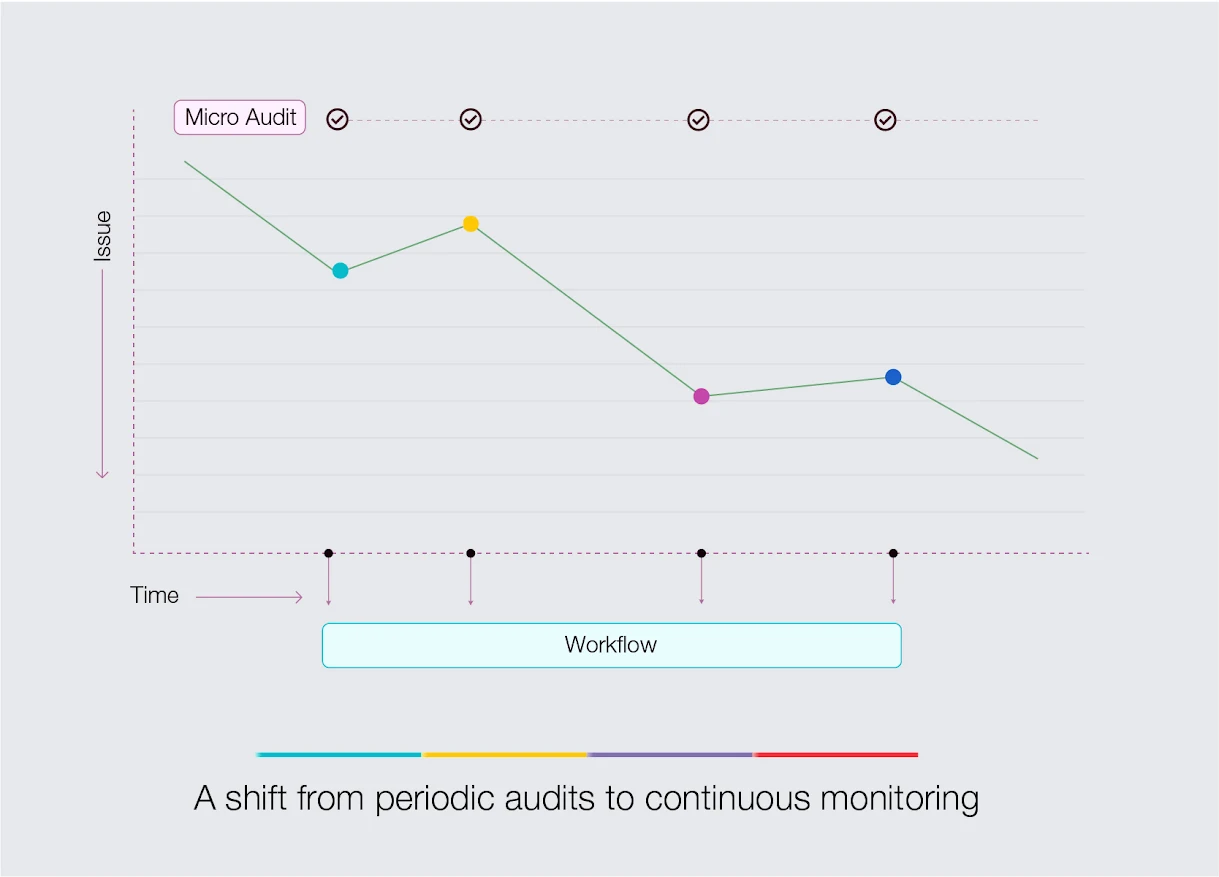
One of the clearest differences between reactive programs and stable ones is how auditing is used. Large audits still have their place, but they usually confirm problems after those problems have already spread across files, formats, and delivery schedules. Smaller, continuous checks are more useful operationally because they catch issues while teams still have time to correct them without reopening half the workflow.
Exhibit 3. Continuous Accessibility Monitoring Model
Accessible authoring is one of the strongest long-term controls publishers have. Training matters, but training by itself rarely holds under production pressure. What holds is when accessibility is built into the tools people are already using. Templates, prompts, validations, and checklists do more than remind teams what good looks like. They make it easier to do the right thing consistently, even when timelines tighten.
Stakeholder accountability is just as important. Many publishers depend on distributed production models, with different vendors handling different formats, workflows, or geographies. Accessibility breaks down quickly when expectations are vague. If vendors are measured only on turnaround time and file delivery, accessibility quality will remain uneven. Requirements have to be written into statements of work, review criteria, and quality thresholds in ways that can actually be enforced.
Measurement needs the same level of discipline. Pass-fail audit language only tells part of the story. More useful measures include whether content is passing accessibility checks earlier in the workflow, whether remediation effort is dropping over time, and whether outputs are staying consistent across PDF, EPUB, HTML, and delivery platforms. Those are the measures that show whether accessibility governance publishing is functioning as an operational system rather than a policy intention.
That is what ongoing WCAG compliance looks like when it is mature. Not a scramble. Not a side initiative. A controlled part of production.
Straive’s Expertise: Enabling Scalable, Governed Accessibility
Most publishers do not need more explanation about why accessibility matters. What they need is a way to make it work under real operating conditions, where backlist risk, format complexity, vendor coordination, and release pressures all collide.
That is where Straive’s content accessibility services are built to help.
Straive combines deep publishing domain expertise with AI-powered content accessibility services to help publishers move beyond emergency remediation into sustainable, governed accessibility programs. Through Straive SPACE and integrated production workflow solutions, publishers gain the infrastructure to produce accessible content by default, from manuscript through delivery.
Exhibit 4. Straive Accessibility Enablement Model
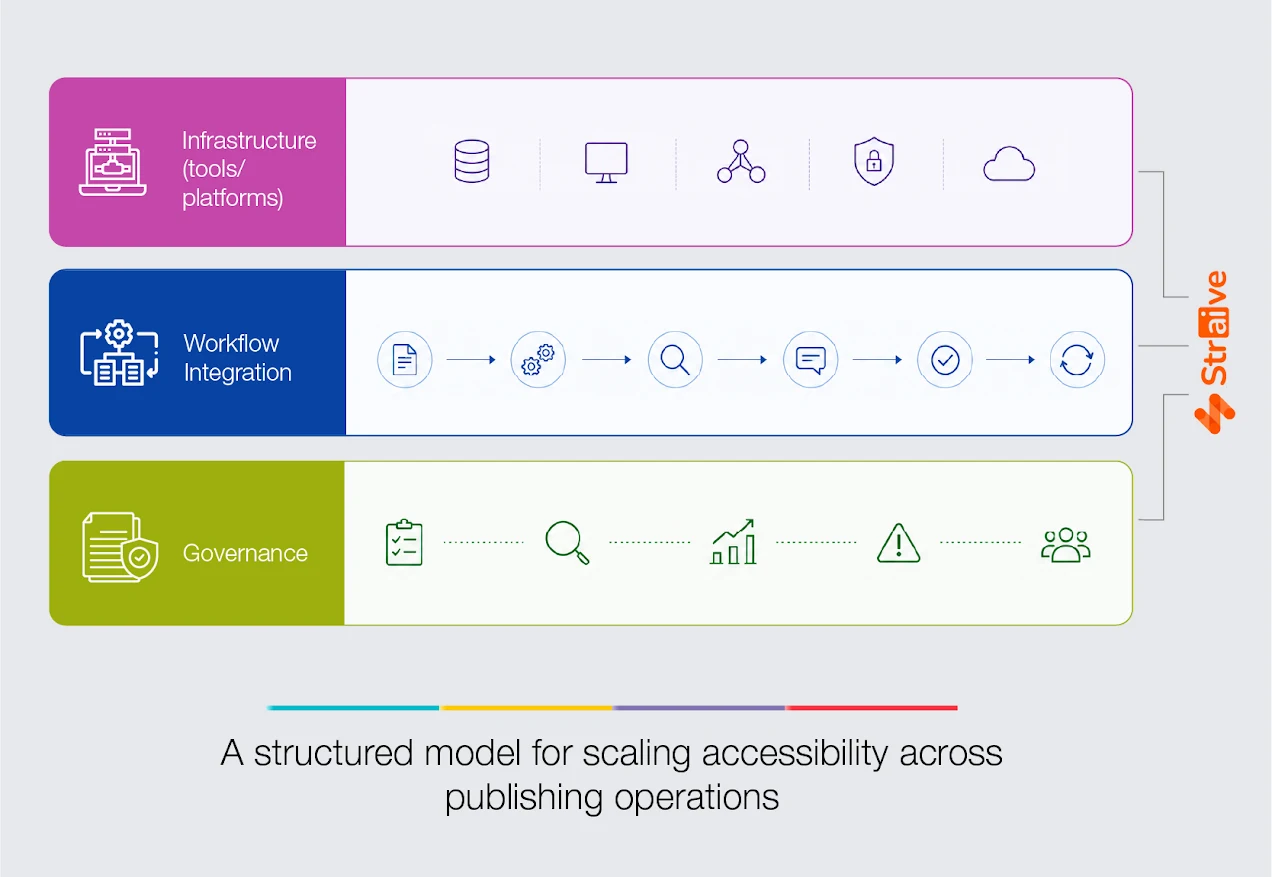
That matters because most publishers are dealing with two demands at once. They have backlog content that already carries compliance risk, and they have current production that cannot keep generating the same problems. Treating those as separate efforts often creates more fragmentation. Treating them as parts of one governed operating model works better.
Straive SPACE supports AI-assisted remediation at scale, continuous audit monitoring, compliance reporting, and integration with publishing production workflows. That gives publishers a practical way to maintain accessibility standards without falling back into repeated emergency fixes every time requirements tighten or content volumes increase.
The value is not only in remediation capacity. It is in production steadiness. Accessibility becomes something the workflow can support consistently, instead of something teams have to recover after the fact.
Conclusion
The move from reactive remediation to a structured digital accessibility program publishing model is not a matter of polish or positioning. It is a matter of operational control.
Publishers cannot continue absorbing accessibility issues at the end of the workflow and expect schedules, costs, and quality to stay predictable. The more content moves across formats, vendors, and delivery systems, the more punishing late-stage correction becomes.
A proactive model does not remove complexity. Publishing will remain complex. What it does is place accessibility where that complexity can be managed before it hardens into rework.
That is the real change. Accessibility stops being a recurring production liability and becomes part of the production standard.
End Notes
- Straive. Content Accessibility Services. https://www.straive.com
- W3C Web Accessibility Initiative (WAI). WCAG 2.1 Guidelines. https://www.w3.org/WAI/standards-guidelines/wcag/
- Straive. Accessibility in Publishing Workflows. https://www.straive.com
- U.S. Department of Justice. ADA Title II Overview. https://www.ada.gov
- Straive. Digital Publishing and Accessibility Solutions. https://www.straive.com
- WebAIM. Accessibility Evaluation and Compliance Trends. https://webaim.org
- Section508.gov. Accessibility Compliance Standards. https://www.section508.gov

Straive helps clients operationalize the data> insights> knowledge> AI value chain. Straive’s clients extend across Financial & Information Services, Insurance, Healthcare & Life Sciences, Scientific Research, EdTech, and Logistics.


