
Posted on: October 5th 2026
2,117 GCCs.
2.36 million professionals.
$98.4 billion in revenue.
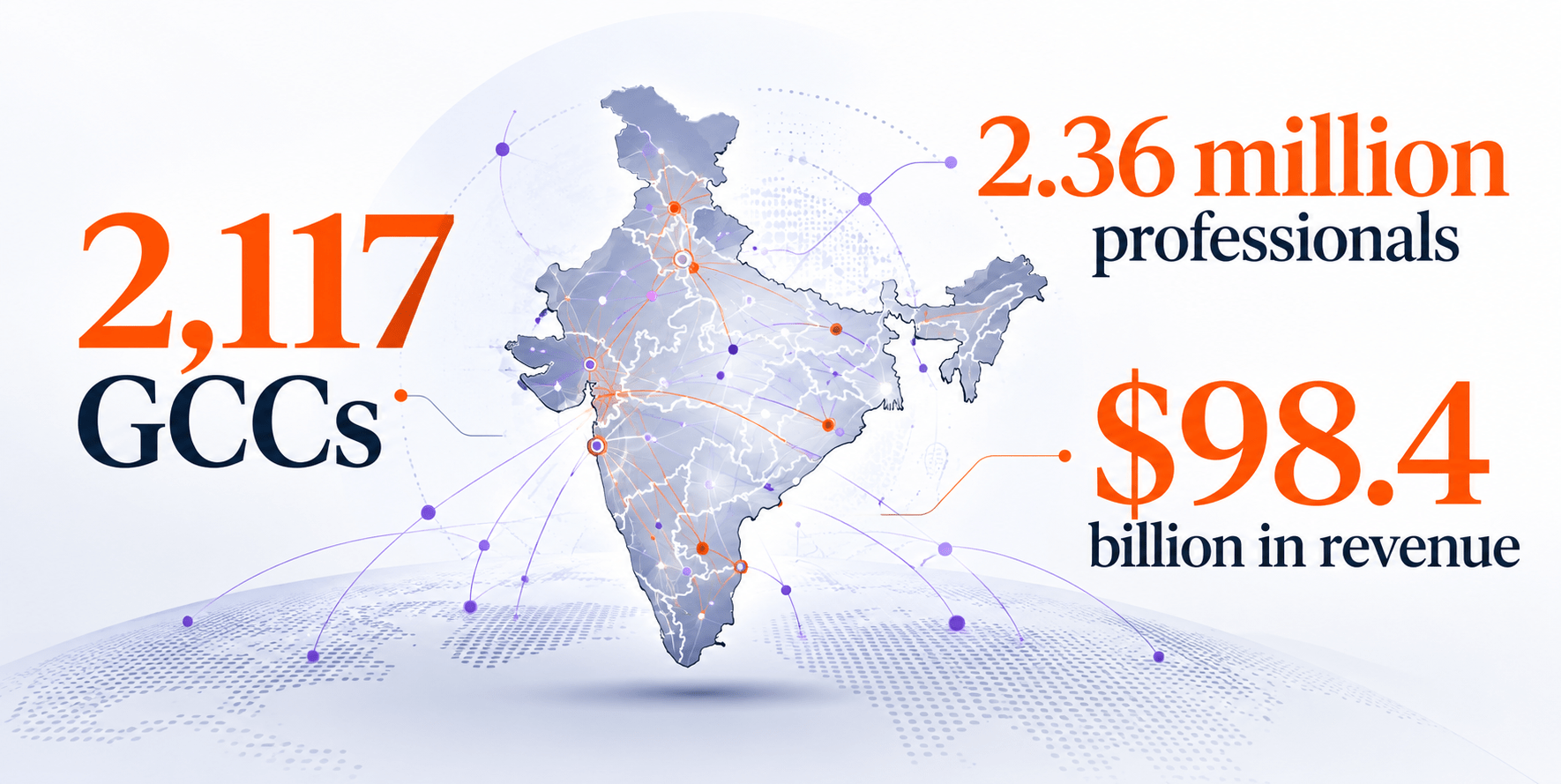
Source: Nasscom-Zinnov GCC Landscape Report 2026
Those numbers tell you just how big India’s Global Capability Center (GCC) ecosystem has become.
But they don’t tell you the most interesting part.
The GCC we knew is disappearing.
Having spent the last few years working in an organization specializing in GCC setup, operations, and transformation, I’ve had a close-up view of this shift.
For years, the GCC conversation started with fairly predictable questions:
Where should we set it up?
How much can we save?
How quickly can we hire?
What processes can we move?
What should remain at headquarters?
Those questions haven’t disappeared. But they are no longer the questions that matter most.
The conversation is moving towards something much bigger:
What can our GCC own?
And increasingly:
What enterprise value can it create?
That’s the shift I believe business leaders need to pay attention to.
What Is Changing in India’s GCC Ecosystem in 2026?
What Is Changing in India’s GCC Ecosystem in 2026?
Source: Nasscom-Zinnov GCC Landscape Report 2026
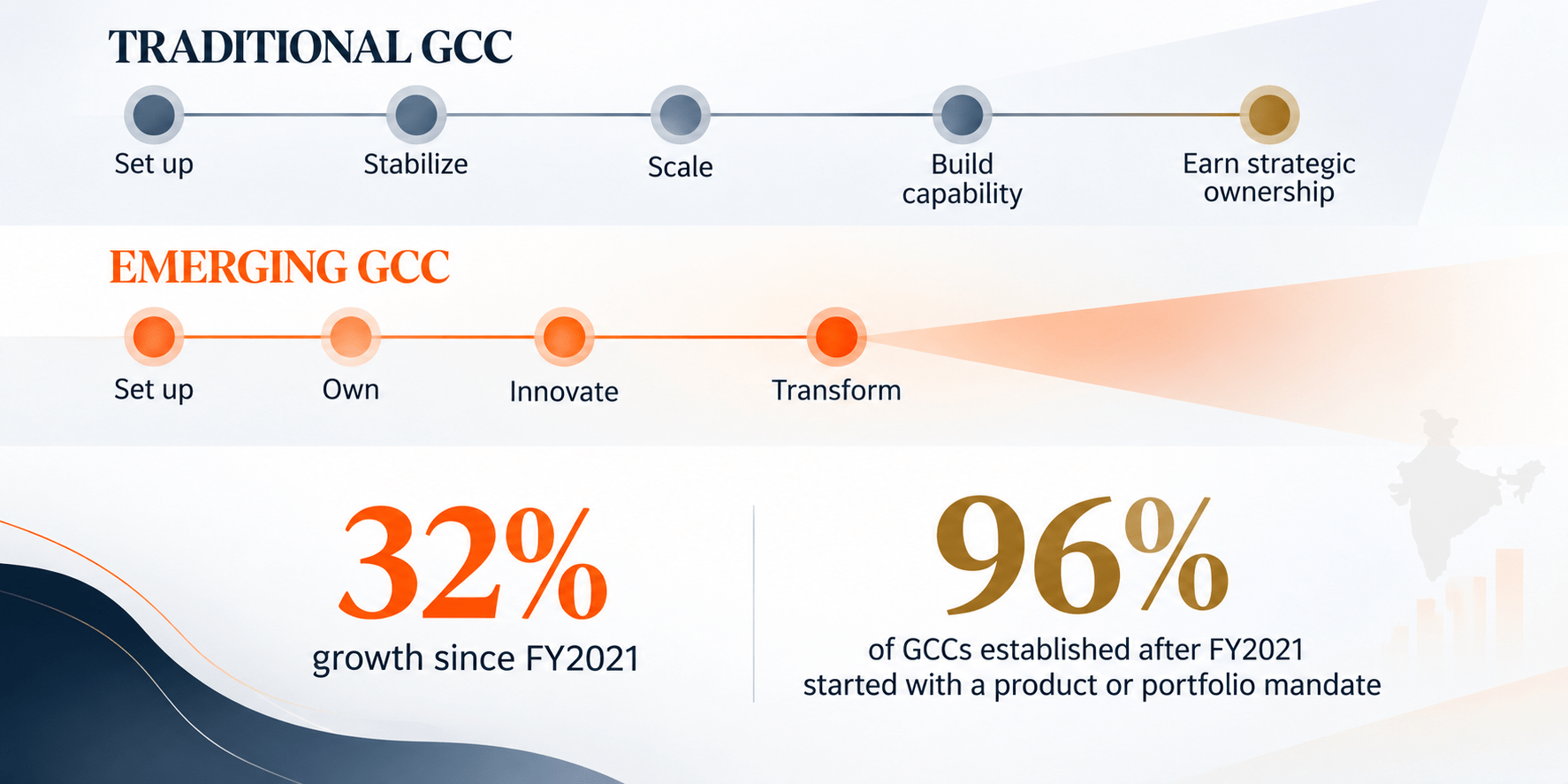
India’s GCC ecosystem has grown 32% since FY2021.
Today, it includes:
- 2,117 GCCs
- 3,728 GCC units
- 2.36 million professionals
- $98.4 billion in revenue
- 506 Forbes Global 2000 companies
But here is the number that caught my attention:
96%.
96% of GCCs established after FY2021 started with a product or portfolio mandate.
Think about what that means.
The traditional journey used to be:
Set up → Stabilize → Scale → Build capability → Earn strategic ownership
The emerging model increasingly looks like:
Set up → Own → Innovate → Transform
The maturity curve is collapsing.
And Artificial Intelligence (AI) is accelerating it.
How Are Global Capability Centers Evolving?
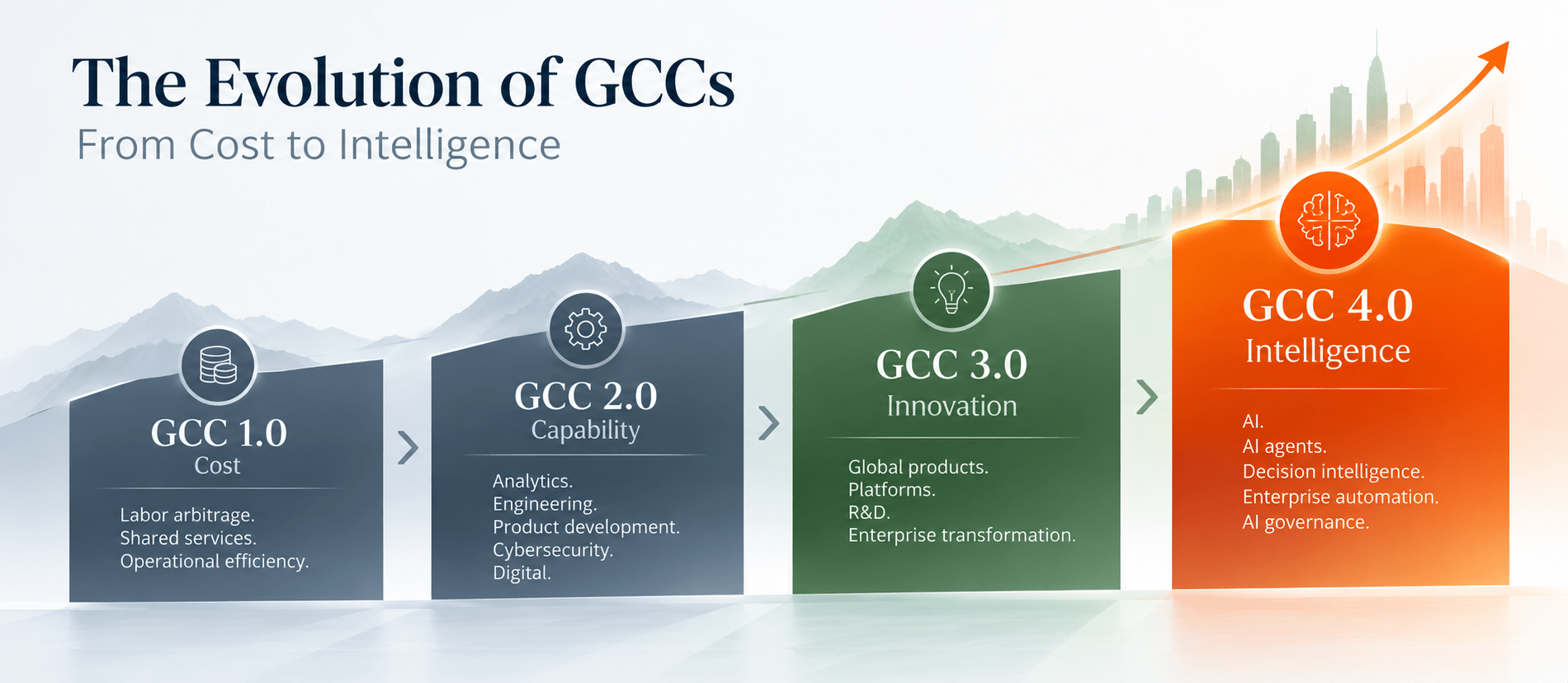
If I simplify the evolution of GCCs, I see four distinct eras:
GCC 1.0 — Cost
Labor arbitrage. Shared services. Operational efficiency.
GCC 2.0 — Capability
Analytics. Engineering. Product development. Cybersecurity. Digital.
GCC 3.0 — Innovation
Global products. Platforms. R&D. Enterprise transformation.
GCC 4.0 — Intelligence
AI. AI agents. Decision intelligence. Enterprise automation. AI governance.
The next-generation GCC won’t simply execute an enterprise strategy.
In many organizations, it will help shape it.
That isn’t a prediction about 2035.
It is already happening.
Nearly 46% of India’s GCCs now operate as Portfolio or Transformation Hubs.
And 64% of GCC site leaders now carry dual mandates, combining India leadership with global functional responsibilities.
That tells me something important:
Authority follows capability.
How Is AI Transforming GCCs?
India already has:
- 1,200+ GCCs with embedded AI/ML capabilities
- 250+ AI-focused Centers of Excellence
- 250,000+ AI professionals
Source: Nasscom-Zinnov GCC Landscape Report 2026
And nearly half of the GCCs established since FY2021 have AI as a core focus.
But here’s where I have a slightly contrarian view:
Having an AI Center of Excellence doesn’t make you an AI-first GCC.
Neither does running 50 Generative AI pilots.
The real test is much less glamorous:
Can you take AI from a PowerPoint slide to a production workflow that changes a business outcome?
That requires connecting AI with trusted data, domain expertise, engineering, governance, security, talent, and change management.
Pilots are easy. Operationalization is hard.
And that is precisely why GCCs could become incredibly strategic.
They already sit at the intersection of technology, data, operations, talent, and enterprise processes.
Done right, a GCC can become the place where AI moves from experimentation to enterprise-scale execution.
Or, put differently:
The next-generation GCC could become the AI operating system of the enterprise.
What Is an AI-Enabled GCC?
An AI-enabled GCC is more than a Global Capability Center that uses AI tools or runs AI pilots.
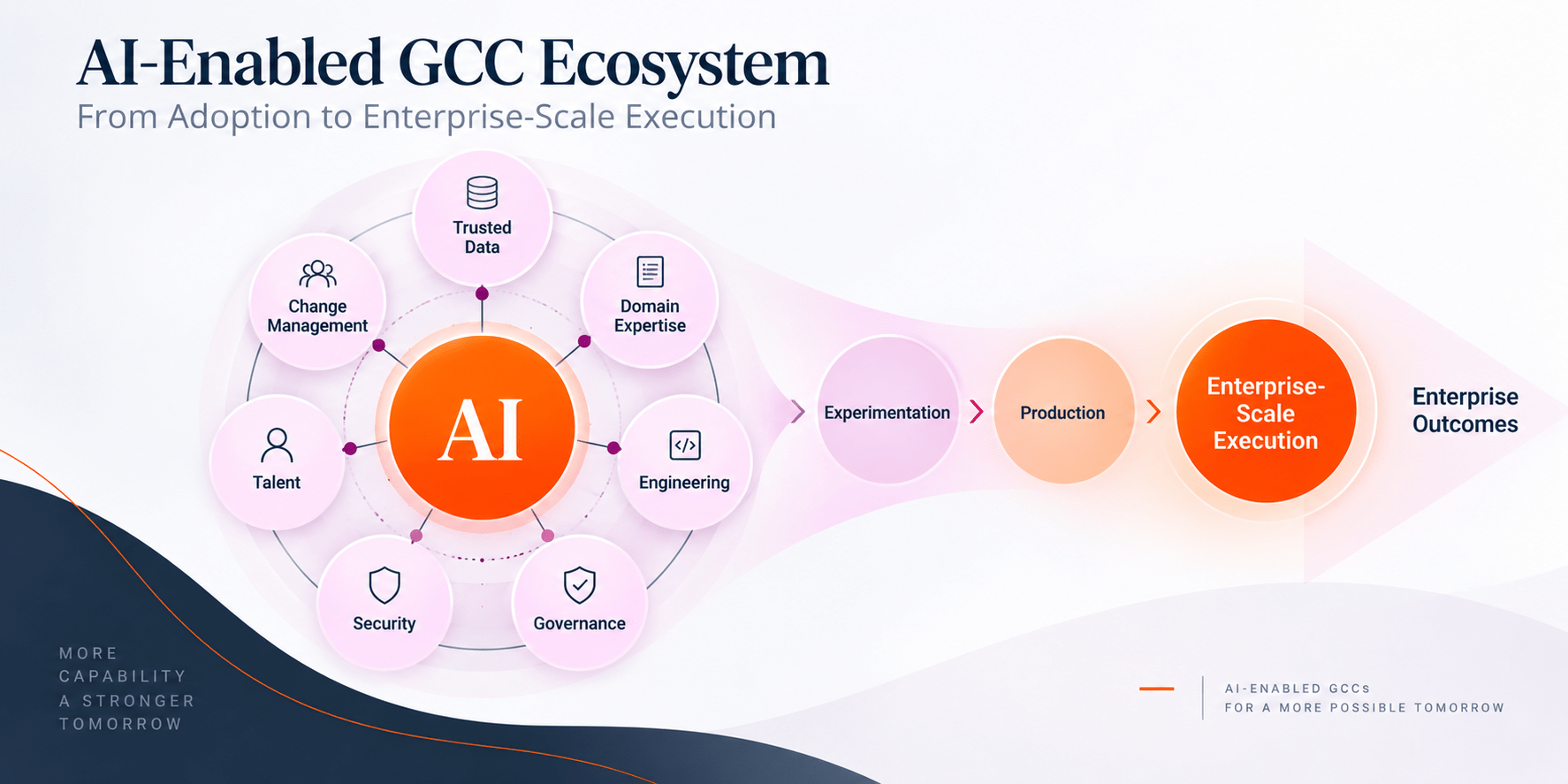
In my view, a truly AI-enabled GCC combines AI, trusted enterprise data, domain expertise, engineering, governance, and talent to embed intelligence into business processes and deliver measurable enterprise outcomes.
The distinction matters.
Using AI is an activity. Operationalizing AI is a capability.
The organizations that build the latter will have a significant advantage.
How Should Enterprises Measure GCC Success?
This may be the biggest change of all.
The traditional GCC dashboard celebrated:
Headcount.
Utilization.
SLAs.
Productivity.
Cost savings.
Those metrics still matter.
But imagine the GCC dashboard five years from now.
Enterprise leaders may increasingly ask:
How much revenue did the GCC enable?
How much faster did we launch products?
How many decisions did AI improve?
How much customer friction did we eliminate?
How much enterprise risk did we reduce?
How many AI use cases have moved from pilot to production?
How much measurable business value did those AI use cases create?
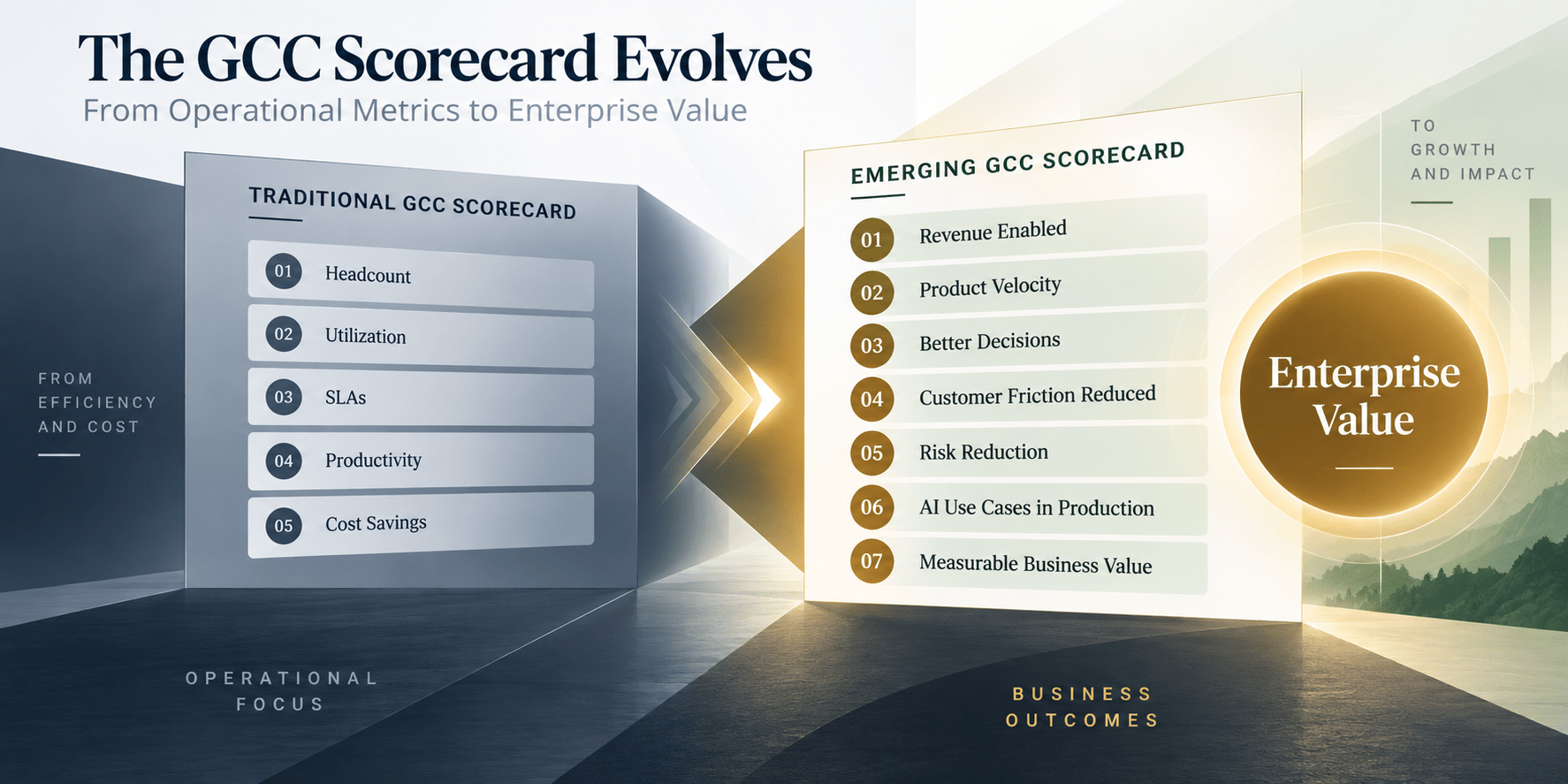
That’s a fundamentally different scorecard.
Because once you change what you measure, you change what the GCC is designed to do.
Why Could Mid-Market GCCs Be the Next Big Opportunity?
There’s another shift I don’t think we’re talking about enough:
The rise of the mid-market GCC.
For a long time, Global Capability Centers largely belonged to very large multinational enterprises.
Building one required significant capital, leadership bandwidth, infrastructure, and patience.
AI, cloud platforms, and flexible GCC operating models are beginning to change the economics.
I believe the next generation of mid-market GCCs could look very different from the mega-GCCs we know today.
Smaller.
Specialized.
AI-first.
Outcome-led.
Built around a handful of high-value capabilities rather than thousands of employees.
A mid-market company may not need a 5,000-person GCC.
It may need 200 exceptional people working on the five capabilities that create disproportionate enterprise value.
That’s a very different proposition.
And potentially a massive opportunity.
What Role Will Strategic GCC Partners Play?
The traditional GCC partnership question was:
“What can we outsource?”
The next one is:
“What should we build together?”
The winning GCC operating model won’t be enterprise versus partner.
It will increasingly be an ecosystem:
Enterprise + GCC + AI partners + hyperscalers + startups + academia + specialist talent
GCC partners will therefore need to move beyond providing capacity.
They will increasingly be expected to bring domain expertise, AI capabilities, IP, accelerators, specialized talent, and speed to value.
That is where flexible GCC models such as Embedded Pods, Build-Operate-Transfer (BOT/BOTT), and outcome-led managed services become particularly interesting.
At Straive, we see this evolution first-hand as enterprises rethink how they build, operate, and scale AI-enabled GCCs, combining domain expertise, AI, data, talent, and scalable operating models to move from ambition to measurable outcomes.
But I believe the bigger story goes beyond any one company.
What Is the Future of GCCs in India?
India isn’t simply becoming the world’s GCC capital.
It has an opportunity to become something much more consequential:
The enterprise AI execution layer for the world.
That’s a much bigger ambition.
And it requires a different mindset.
By 2030, the strongest GCCs may no longer be judged primarily by headcount, cost arbitrage, or operational efficiency.
They will be judged by their contribution to AI adoption, innovation, product velocity, decision intelligence, resilience, revenue, and enterprise value creation.
The question for GCC leaders is therefore no longer:
“How much work can we move to India?”
It is:
“How much of our company’s future can we build from India?”
Those two questions may sound similar.
They aren’t.
One creates a delivery center.
The other creates an enterprise value engine.
And that, in my view, is where the next chapter of AI-enabled Global Capability Centers begins.
Key Takeaways
What is an AI-enabled GCC?
A GCC that moves beyond using AI tools to operationalize AI across enterprise workflows, combining data, domain expertise, engineering, governance, and talent to create measurable business outcomes.
How are GCCs evolving?
GCCs are moving from cost and operational efficiency toward product ownership, innovation, AI operationalization, and enterprise value creation.
Why is India important to the future of GCCs?
India already has 2,117 GCCs, 2.36 million GCC professionals, and a $98.4 billion GCC industry, supported by a rapidly expanding ecosystem of AI, engineering, and technology talent.
What will define the next generation of GCCs?
Not headcount or the volume of work executed, but the business outcomes, intellectual property, innovation, and enterprise value they create.
What could be the next major GCC opportunity?
AI-first, outcome-led GCCs for mid-market organizations, enabled by cloud, AI, and more flexible setup-and-operate models.
My prediction:
By 2030, asking how many people work in a GCC may be far less important than asking how much enterprise value that GCC creates.
What do you think?
Will we still call the world’s most strategic GCCs “Global Capability Centers” by 2030, or will they have evolved beyond the term itself?

Prashakth Kamath, Marketing Director & Head of Global Demand Generation at Straive, brings 16+ years of global experience in marketing, GCCs, AI, and B2B growth. A LinkedIn Top Voice (2024 and 2025) and CMO Council Member, he focuses on turning emerging technologies and operating models into measurable business outcomes.


