
Posted on: September 29th 2026
Historically, accessibility was a remediation task, i.e., fixing files after they were published. Today, it has become a core requirement , a fundamental structural requirement, due to new international laws and industry-standard shifts.
The most significant driver of this shift is the European Accessibility Act (Directive 2019/882). This legislation mandates that e-books, e-readers, and e-commerce platforms meet strict accessibility standards typically WCAG 2.1 Level AA. While technically it is an EU law, its impact is global because any publisher, regardless of where they are based, must comply if they wish to sell digital books in the EU market.
Consequently, the industry is rapidly shifting toward a born accessible model, Born accessible describes a workflow where accessibility features like image alt-text, semantic tagging, and MathML are integrated at the manuscript or production stage rather than added later.
By embedding these elements, publishers ensure that content is usable by everyone, including those with visual, auditory, cognitive, or motor impairments, from the very moment of its creation.
Retrofitting vs. Born Accessible
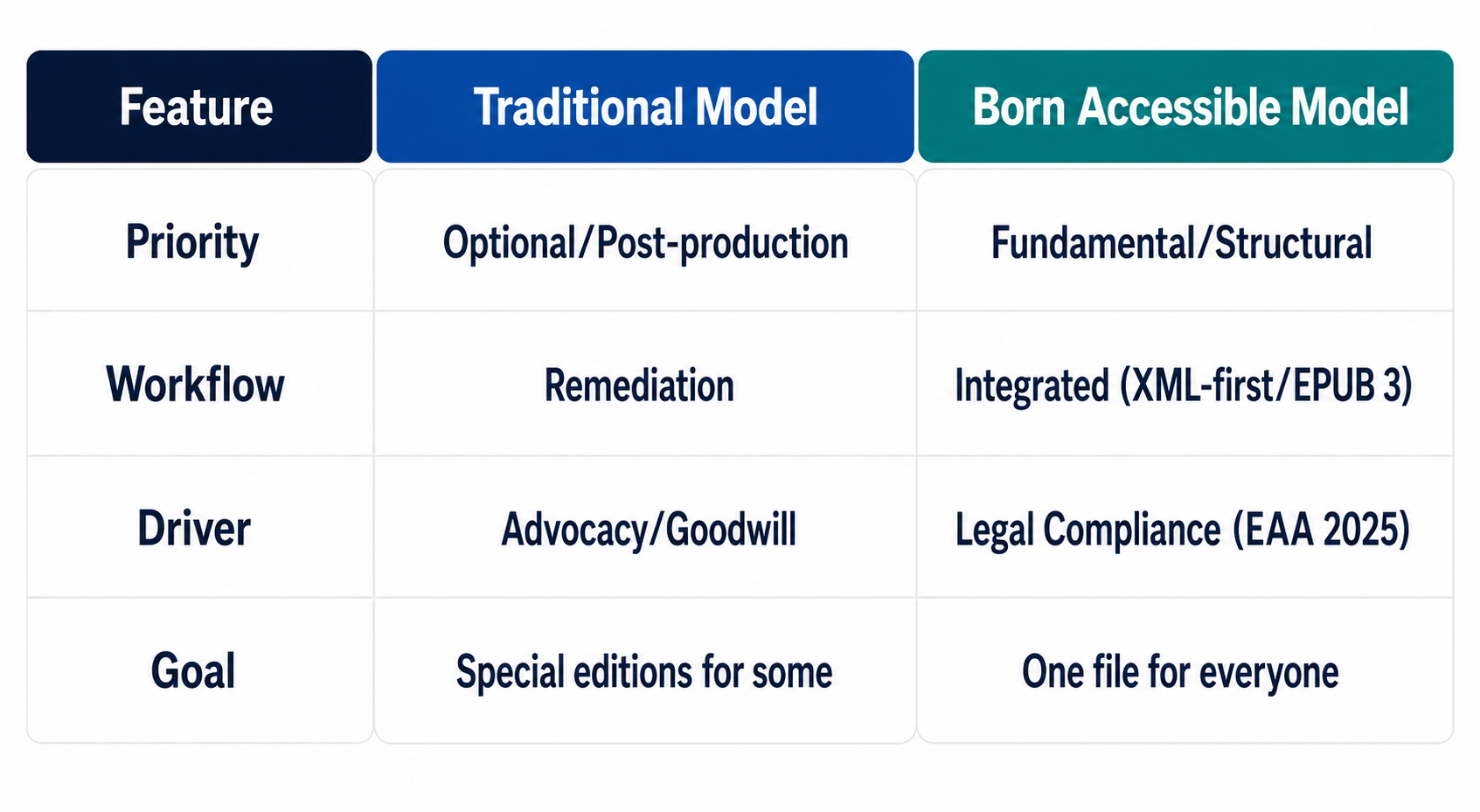
Figure 1. Traditional accessibility workflows compared with a born-accessible model that integrates accessibility into the publishing process from the outset.
What Born Accessible Actually Means
To be born accessible means that accessibility is integrated into the DNA of the digital file. In a professional publishing context, born accessible refers to a shift from post-production remediation to an integrated production workflow where accessibility is a native feature of the digital asset. This means that the authoring tools, editorial processes, and conversion pipelines are all configured to preserve semantic structure.
Consequently, a born-accessible book or journal article natively includes:
- Semantic HTML/XML tagging.
- Alternative text (Alt-text) for all functional images.
- Logical reading orders that assistive technologies (like screen readers) can follow.
- Mathematical notation rendered in accessible formats like MathML.
True Cost of Retrofitting
Many publishers still rely on post-production remediation—taking a finished PDF and attempting to retrofit it for accessibility. At scale, this often requires parallel, product-specific workflows that depend on shared content and rapid responses to urgent student accommodation requests, increasing operational complexity and costs.
- Complexity: Retrofitting accessibility into a flat PDF can be significantly more difficult than building accessibility into source content from the start.
- Accuracy Risks: Automated remediation tools can struggle with highly complex STM (Science, Technology, and Medicine) content, including equations, tables, figures, and semantic structure, which may result in accessibility or interpretation errors that require manual review.
- The Double Work Tax: Publishers may incur additional costs by first producing inaccessible content and then investing further resources to remediate accessibility issues after production.
The Double Work Tax
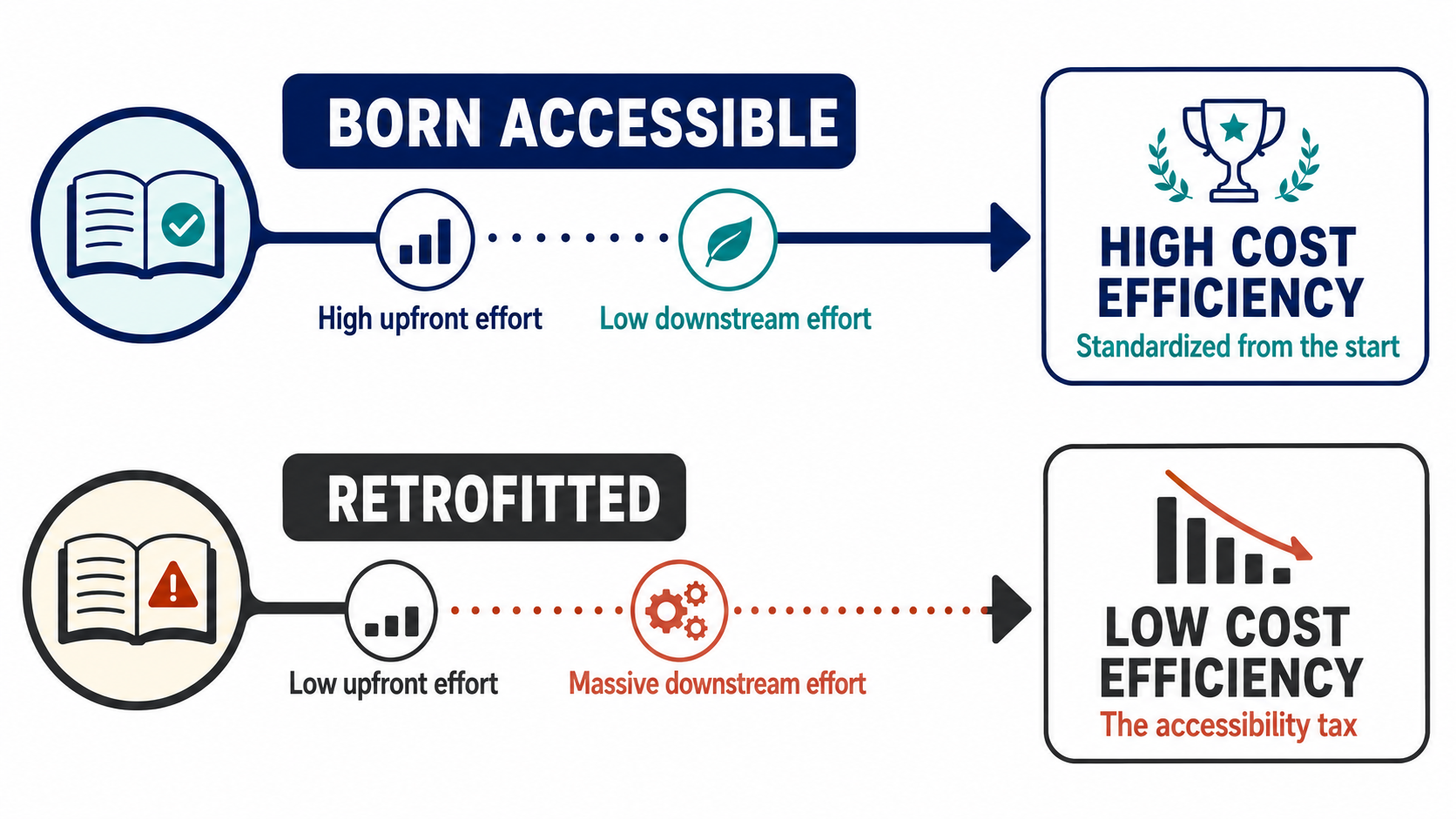
Figure 2. Born-accessible workflows require greater upfront effort but deliver standardized, long-term cost efficiency, while retrofitting creates a costly tail of remediation.
Ultimately, remediation is a bespoke solution to a systemic problem. It cannot scale at the pace of modern digital publishing without compounding the double work tax indefinitely.
XML-First and HTML-First Workflows
XML-first and HTML-first workflows are considered the structural foundation of modern publishing because they preserve the meaning and organization of content at the source level. Instead of treating content as a static visual layout, these workflows encode the underlying structure such as headings, paragraphs, tables, lists, figures, equations, references, and metadata in a machine-readable way.
This structural approach offers several foundational benefits:
- Content structure is preserved because semantic tagging defines what content is, not just how it looks. This enables accessibility tools, screen readers, search engines, and publishing platforms to interpret content correctly.
- Single-source publishing as one structured source file can be transformed into multiple output formats, including HTML, EPUB, PDF, mobile, and LMS-ready content, without recreating content for each channel.
- Accessibility is built in because structure and semantics are embedded from the beginning, accessibility features such as reading order, navigation, alt text, and tagged content can be carried through the production process more consistently.
- Automation becomes possible as structured content supports automated workflows for formatting, conversion, validation, indexing, and distribution, improving efficiency and scalability.
- Content becomes future-ready because structured source content is easier to adapt to evolving standards, devices, and platforms without major rework.
In short, XML-first and HTML-first workflows form the structural foundation because they separate content structure and meaning from visual presentation, enabling scalable, accessible, and multi-channel publishing.
What Needs to Change Upstream
To move away from the double work tax of retrofitting, accessibility must shift from being a final check to a starting requirement . The following upstream practices help establish a more scalable and sustainable publishing workflow:
Content Authoring
- Use structured authoring tools and templates.
- Apply proper heading hierarchy and semantic markup consistently.
- Write meaningful alt text for images, charts, and figures.
- Ensure tables are designed with clear headers and logical structure.
- Avoid using visual formatting alone to convey meaning.
Editorial and Content Standards
- Establish accessibility guidelines for authors, editors, and designers.
- Standardize naming conventions, metadata, and tagging practices.
- Include accessibility checks as part of editorial QA processes.
- Ensure link text and cross-references are descriptive and meaningful.
Design and Layout
- Design with accessibility in mind from the start rather than retrofitting later.
- Maintain sufficient color contrast and readable typography.
- Support responsive and reflowable content where possible.
- Ensure page layouts preserve logical reading order.
Structured Production Workflows
- Adopt XML-first or HTML-first workflows to preserve semantic structure.
- Maintain a single structured source for multi-format publishing.
- Use automation for tagging, validation, and format conversion where appropriate.
- Preserve accessibility metadata throughout the production pipeline.
Complex STM Content
- Use standards-based workflows for equations, tables, and scientific notation.
- Ensure MathML or equivalent accessible math support is available where needed.
- Validate accessibility of charts, graphs, and data visualizations.
Quality Assurance and Validation
- Combine automated testing with human review.
- Test content using screen readers and keyboard navigation.
- Validate outputs against WCAG, PDF/UA, EPUB Accessibility, or relevant standards.
- Conduct accessibility checks before final publication—not after distribution.
Organizational Readiness
- Train production, editorial, and design teams on accessibility best practices.
- Define clear ownership and accountability for accessibility compliance.
- Build accessibility requirements into vendor and technology evaluations.
- Treat accessibility as part of core production quality, not a separate remediation task.
Accessibility at the Source
The transition from reactive remediation to a proactive, structured workflow is essential for publishers looking to eliminate the double work tax. By integrating accessibility requirements into the initial stages of content creation, organizations can avoid the exponential costs of retrofitting flat files. Leading publishing production services like Straive support this transition by embedding accessibility directly into the production pipeline, ensuring that content is “born accessible” through a rigorous, source-oriented approach.
Embedding Accessibility at the Source
To achieve true scalability, the production process must move beyond manual tagging of finished PDFs. A production partner focuses on the following core pillars to ensure compliance is baked into the DNA of every digital asset:
- Structural Content Ingestion: By utilizing XML-first and HTML-first frameworks, the underlying meaning of the content—from complex nested tables to semantic heading hierarchies—is captured before the layout is even finalized. This creates a resilient foundation that supports multiple accessible outputs from a single source.
- Expert-Led Metadata and Alt-Text: Rather than relying on post-production guesswork, accessibility features like alt-text for complex STM imagery and charts are developed during the editorial phase. This ensures that the pedagogical intent of the author is preserved and accurately communicated to users with visual impairments.
- Integrated Quality Assurance: Accessibility validation is not treated as a final “check-box” audit. Instead, it is integrated into the automated and manual QA cycles throughout the production lifecycle. This “shift-left” strategy identifies and corrects potential barriers long before a product reaches the distribution stage.
- Standardized STEM Workflows: For scientific and technical content, a source-level approach ensures that equations are authored in MathML or other machine-readable formats. This eliminates the need for expensive, manual conversion of flat images into accessible math later in the process.
Shifting accessibility upstream transforms it from an operational burden into a mark of production quality. This alignment reduces the risk of legal non-compliance, accelerates time-to-market for inclusive education initiatives, and ensures that content is future-ready for evolving assistive technologies. By choosing to embed these standards at the earliest possible stage, Straive enables publishers to deliver high-quality, universally accessible content while maintaining a lean and efficient operational footprint.
Compliance Advantage
Born-accessible workflows provide a more sustainable and scalable path to accessibility compliance than post-production remediation. By embedding semantic structure and accessibility features at the source through XML-first and HTML-first workflows, publishers can reduce remediation costs, improve consistency across formats, and minimize compliance risks.
Critically, this structural approach creates a robust, machine-readable audit trail. Because accessibility features are embedded within the underlying source content, they can be consistently validated throughout the production lifecycle, simplifying audit readiness for evolving regulations such as the EAA and ADA Title II.
Rather than treating accessibility as a corrective step, accessibility-by-design approaches integrate it into the core production lifecycle. This not only improves operational efficiency and quality control but also delivers a better user experience across digital platforms. By shifting accessibility requirements upstream, publishers move from guessing at compliance through manual checks to “demonstrating” compliance through standardized, structured data.
For publishers managing growing accessibility requirements, the shift upstream—from retrofitting to structured, born-accessible production—is increasingly becoming both a strategic compliance advantage and a long-term business necessity.

Balamuraly K is an AI strategist and 25-year Straive veteran who transforms academic publishing workflows through Agentic AI. His work focuses on digital accessibility, content transformation, and leveraging data-driven AI models to ensure ethics in peer review. A lifelong learner, he holds advanced certifications in AI and disruptive tech from HBS Online and multiple IIMs.


