
Posted on: August 19th 2026
Agentic AI is having its moment
Almost every enterprise wants agents that can search, reason, and act across complex information. The promise is compelling. Ask a question in natural language, let the agent navigate the organization’s knowledge, and receive an answer that is relevant, timely, and ready to use.
But there is a problem. An AI agent cannot create a shared version of the truth when the organization itself has not agreed on one.
That is why the next breakthrough in enterprise AI will not come from another generic foundation model. It will come from making the models we already have useful within the messy realities of business. That requires well-structured data, clear definitions, strong governance, and deep domain expertise.
The model may generate the answer, but the knowledge foundation determines whether anyone should trust it.
| An intelligent agent is only as reliable as the knowledge foundation beneath it. |
What happens when everyone has a different answer?
A story from my time leading knowledge management at a major global publisher shows why this matters.
We were often asked what sounded like a simple question. How many journals do we have?
To an executive, it looked like a straightforward database lookup. It was anything but straightforward. Different teams returned different numbers, and every answer was valid within that team’s view of the business.
Editorial counted the active journals for which it was sourcing content. Production included every journal still being published, even those being phased out. Finance counted revenue-generating journals. Researchers counted the titles they could discover online.
Nobody was wrong. Each team was answering a different version of the question.
An AI agent pointed at those systems would inherit the same ambiguity. It might retrieve every number, but it should not be expected to decide which business definition is authoritative. That is not simply a search problem. It is a knowledge governance problem.
AI does not eliminate organizational ambiguity. Without the right foundation, it makes that ambiguity faster and more visible.
Do not ask the model to settle a business argument
When an agent gives conflicting or unreliable answers, the instinct is often to blame the model. Perhaps the prompt needs work. Perhaps the organization needs a larger context window. Perhaps a newer model will reason its way through the confusion.
Those changes may improve the experience, but they do not resolve the underlying issue. A language model should not quietly decide what a journal, customer, product, or active account means for the entire enterprise. Those definitions require ownership, agreement, and governance.
The answer is not simply to add a more powerful model. It is to establish shared definitions, accountable ownership, appropriate access controls, and a semantic layer that helps systems interpret information consistently. In complex environments, taxonomies and knowledge graphs can make relationships explicit and machine-readable.
Only then should AI be asked to reason across the information.
Why promising AI pilots lose people’s trust
The journal story reveals why so many impressive AI pilots struggle when they meet the real enterprise. The model is rarely the only issue. Four quieter forms of friction get in the way.
The four frictions of enterprise AI
- Intent friction appears when the system cannot determine what the user actually needs. People often begin with broad or incomplete questions.
- Content friction appears when useful information remains buried in disconnected repositories, legacy formats, and unindexed silos.
- Context friction appears when teams use different definitions for the same business concept and expect the agent to reconcile them.
- Cost friction appears when every request is routed through the most powerful and expensive reasoning path, whether the question needs it or not.
Together, these frictions create what I call the AI trust gap. Users ask a reasonable question, receive an answer that feels incomplete or inconsistent, and quickly learn not to rely on the system. Once that trust is gone, adoption falls while operating costs continue to rise.
| A polished interface cannot rescue an unreliable knowledge foundation. |
So what does better agentic search look like?
A well-designed agent does not rush to answer. It first understands who is asking, what they are trying to accomplish, and which sources are appropriate for that task.
First, understand the question and the user
Consider a user who asks for the latest enrollment numbers. Traditional search might return a page of links and leave the user to work out which document is current. A thoughtful agentic experience handles the request differently.
- Check access. The agent applies the organization’s configured permissions before retrieving information, so the search respects the user’s role and entitlements.
- Clarify intent. It reflects the likely purpose of the request and asks for confirmation when ambiguity matters. For example, it might ask whether the figures are needed for the upcoming board meeting.
- Retrieve precisely. It retrieves from approved sources using the definitions and time frame relevant to that purpose.
This may feel like a small change, but it moves search from document retrieval toward decision support. The goal is not to produce more answers. It is to produce the right answer for the right person in the right context.
Then, stop spending expensive AI on simple questions
There is a common belief that enormous context windows allow organizations to place everything into a prompt and let the model sort it out. In practice, more context is not the same as better context.
Research on the lost-in-the-middle effect has shown that model performance can vary depending on where relevant information appears in a long context. The exact impact differs by model and task, but the operational lesson is clear. Dumping more content into a prompt can increase cost without reliably improving the answer.
Agentic systems add another economic risk. Recursive loops can spend multiple reasoning cycles on questions that a search index, business rule, or cached result could answer almost instantly.
A smarter routing layer changes the economics.
- Simple factual requests can use approved indexes, cached answers, or deterministic services.
- Complex questions can be routed to more capable reasoning models with the relevant context already narrowed.
- High-risk decisions can trigger expert review rather than being treated like ordinary search queries.
The best enterprise AI architecture does not use the most powerful model for every task. It uses the least complex approach that can produce a trustworthy result.
Three layers that make agentic search work
Sustainable enterprise search rests on three connected layers. Each one answers a different question, and trust has to travel through all three.
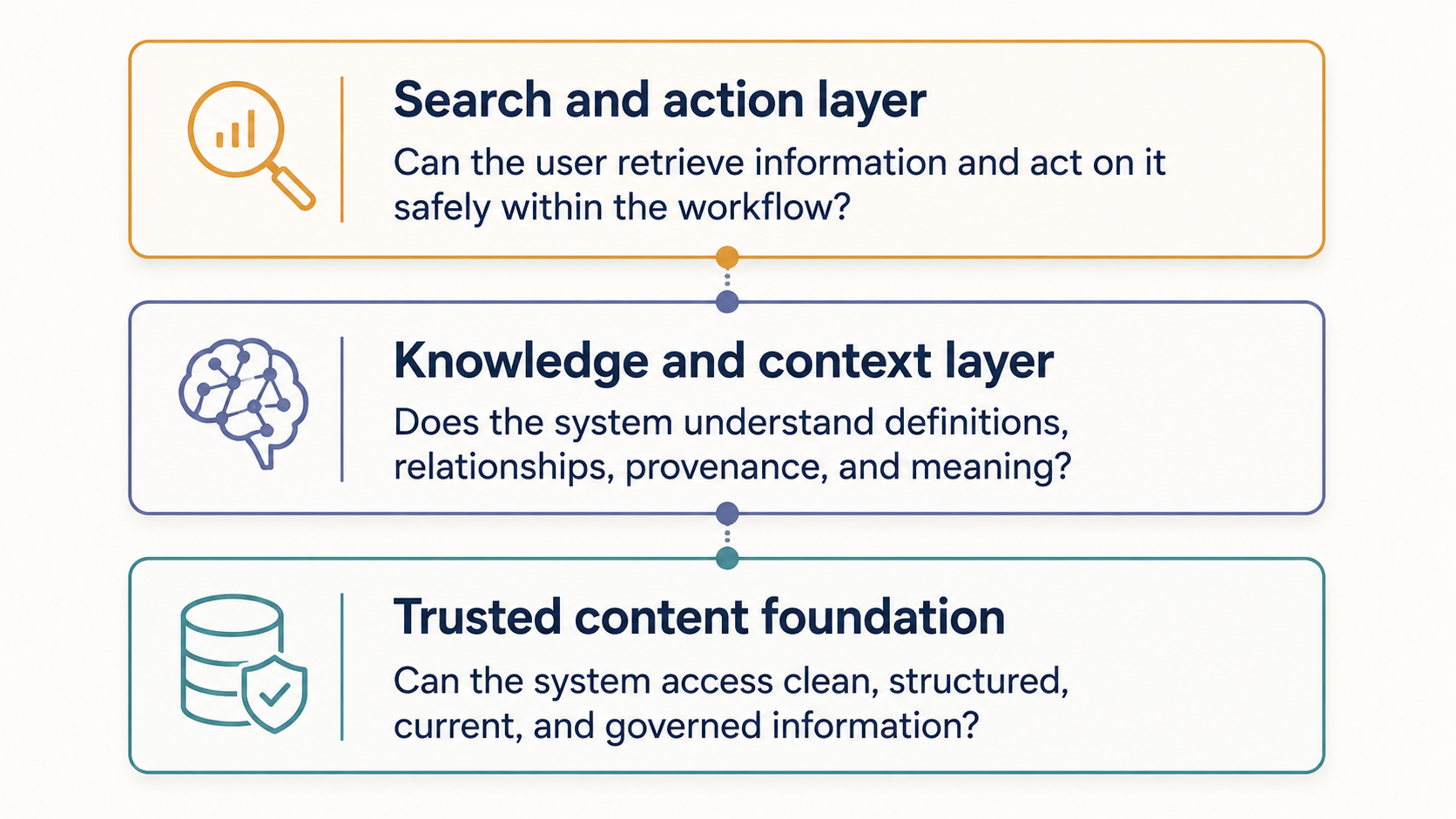
Figure 1: Three essential layers of an effective enterprise knowledge system—from trusted content to contextual understanding and safe action.
The temptation is to begin at the top with a copilot, chatbot, or elegant search interface. But trust flows upward. If the content foundation is weak, the knowledge layer will encode inconsistency, and the experience layer will simply present that inconsistency more confidently.
Where people still make the difference
Automation is invaluable for repetitive work at scale, but specialized domains are full of edge cases, evolving terminology, and judgments that cannot be reduced to a tagging rule.
That is why human-in-the-loop validation should not be treated as a temporary patch until the model becomes clever enough. It is an operating principle. AI can handle high-volume classification, extraction, and transformation. Specialists can focus on ambiguity, exceptions, risk, and the decisions that require genuine domain judgment.
The right balance will vary by workflow. A low-risk discovery tool can tolerate more automation than a system supporting clinical, financial, or regulatory decisions. The important question is not how much work can be automated. It is where human judgment creates the most trust and value.
What does this look like in the real world?
The principles become tangible when they are embedded in actual workflows.
Finding value in forgotten research
Scientific archives often contain decades of supplementary files in inconsistent formats. When those files are unpacked, classified, and structured automatically, researchers can spend less time searching and more time evaluating evidence. In one implementation, this approach accelerated review work by a factor of ten.
Turning manuscripts into usable data
Publishing workflows frequently stall when raw manuscripts must be converted into structured, validated formats. In one production workflow, automated transformation reduced a process that once took days to under five minutes. The important lesson is not simply speed. Structured content becomes easier to validate, reuse, discover, and govern across the publishing lifecycle.
Seeing connections across scientific literature
In life sciences, the answer often depends on a relationship hidden across thousands or millions of papers. Knowledge graphs can expose connections among entities, concepts, and evidence, allowing researchers to trace why a result appeared instead of receiving an answer with no visible path back to the source.
These examples share a pattern. AI creates value when it is placed inside a well-defined workflow and supported by trustworthy, domain-aware information. The model matters, but the surrounding system determines whether the result is useful.
The model is not your competitive advantage
The future of enterprise AI will not come down to who has the smartest model. As advanced models become widely available, the real advantage will come from the knowledge surrounding them.
Organizations that define their information clearly, govern it responsibly, and route each question to the right AI capability will build systems people can trust. Everyone else risks using faster technology to scale the same confusion they already have.

Olga Tchivikova is VP of Client Engagement at Straive and a digital transformation leader. She excels in navigating complex matrix organizations to shape customer-centric strategies that unlock measurable business value. Olga brings a proven track record of scaling global operations, leading multi-tiered teams, and managing expansive enterprise P&Ls across content operations, customer service, data management, and digital modernization.


