
Posted on: August 3rd 2026
According to Gartner, Artificial Intelligence (AI) spending is hitting a vertical climb, projected to reach a $2.52 trillion market by 2026. Expanding at 44% annually, the industry has moved beyond steady growth into a full-scale breakout.
Yet, despite this massive capital infusion, Gartner analysts note that AI has entered the “Trough of Disillusionment”. In this phase, the initial hype has faded, leaving enterprises to navigate implementation complexities—often defaulting to the perceived safety of their incumbent legacy vendors.
To capture this demand, nearly every enterprise platform is rebranding as “AI-powered.” Beneath these marketing claims lies a fundamental architectural divide that will determine which businesses thrive and which buckle under technical debt: AI-Enabled (bolting AI onto the surface) vs. AI-Native (weaving AI into the core execution layer).
At Straive, we call this analytical framework the Engine vs. Sidecar paradigm. Understanding this distinction is essential to selecting a platform built to scale.
Limitations of Legacy Systems
Most legacy platforms fall into this category. These systems were architectured in the pre-LLM era—structured around relational databases and rigid UI patterns—and have only recently bolted-on AI features to stay relevant.
Imagine these bolted-on features as a motorcycle sidecar. The core execution layer remains traditional, while a copilot window sits off to the side. Because the AI and the application logic live in two different worlds, they cannot truly communicate.
This bolt-on approach is exactly what fuels the Trough of Disillusionment. Enterprises have spent millions expecting a total business transformation, but because the AI is decoupled from the core logic, it lacks deep context. It acts as an assistant to the system rather than the engine of the system.
This operational disconnect shows up directly in user adoption. In deployments supported across mid-to-enterprise client environments, legacy bolt-on solutions typically see sharp drop-offs in active usage after the initial 90 days as context detachment forces users to constantly copy-paste data, switch tabs, and re-enter information manually.
The Trough of Disillusionment Breakdown
The gap between AI hype and reality stems from a fundamental mismatch in expectations.
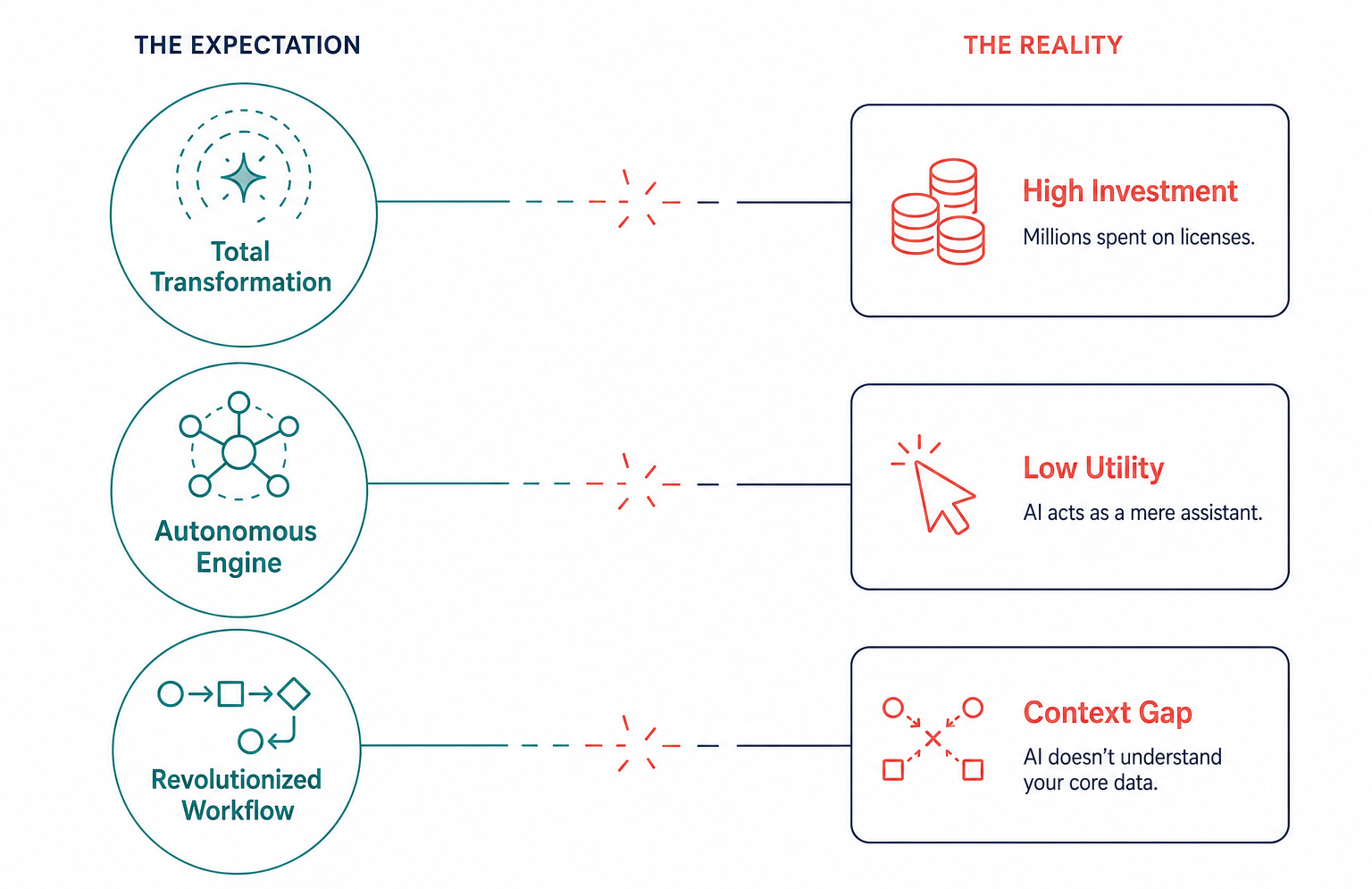
Figure 1: The gap between enterprise AI expectations and operational reality.
Across our enterprise client engagements, survey data shows that while 78% of leaders expect AI to automate core workflows, fewer than 15% of bolt-on implementations achieve full process automation without manual intervention.
As a result, users still have to navigate five menus to generate a report—only now there is a button to summarize it once they arrive. While this saves a few minutes, it does not fundamentally transform the workflow. This disconnect between high investment and marginal utility is the hallmark of the disillusionment phase.
Integrating Intelligence at the Execution Layer
An AI-native platform is designed from the ground up with the assumption that the machine will do the heavy lifting, while the human provides the intent.
Intelligence is embedded directly into the execution layer. Data isn’t just stored in static rows and columns; it is vectorized i.e., transformed into a multi-dimensional map that the AI can reason across instantly. Because the system isn’t bound by a rigid set of menus, the UI is fluid, generating the specific tools or data views you need exactly when you need them.
Besides, this architecture enables agentic workflows. Instead of simply summarizing a document, the system can autonomously navigate its own environment to execute complex multi-step tasks. The AI and the platform’s internal APIs speak the same language, the system can think its way through a problem rather than waiting for a manual click.
As a result, you stop merely operating the software and begin collaborating with it. Whether it’s anticipating a supply chain disruption or self-correcting a code deployment, the adaptive logic turns the platform from a static tool into an active partner.
Architectural Schism at a Glance
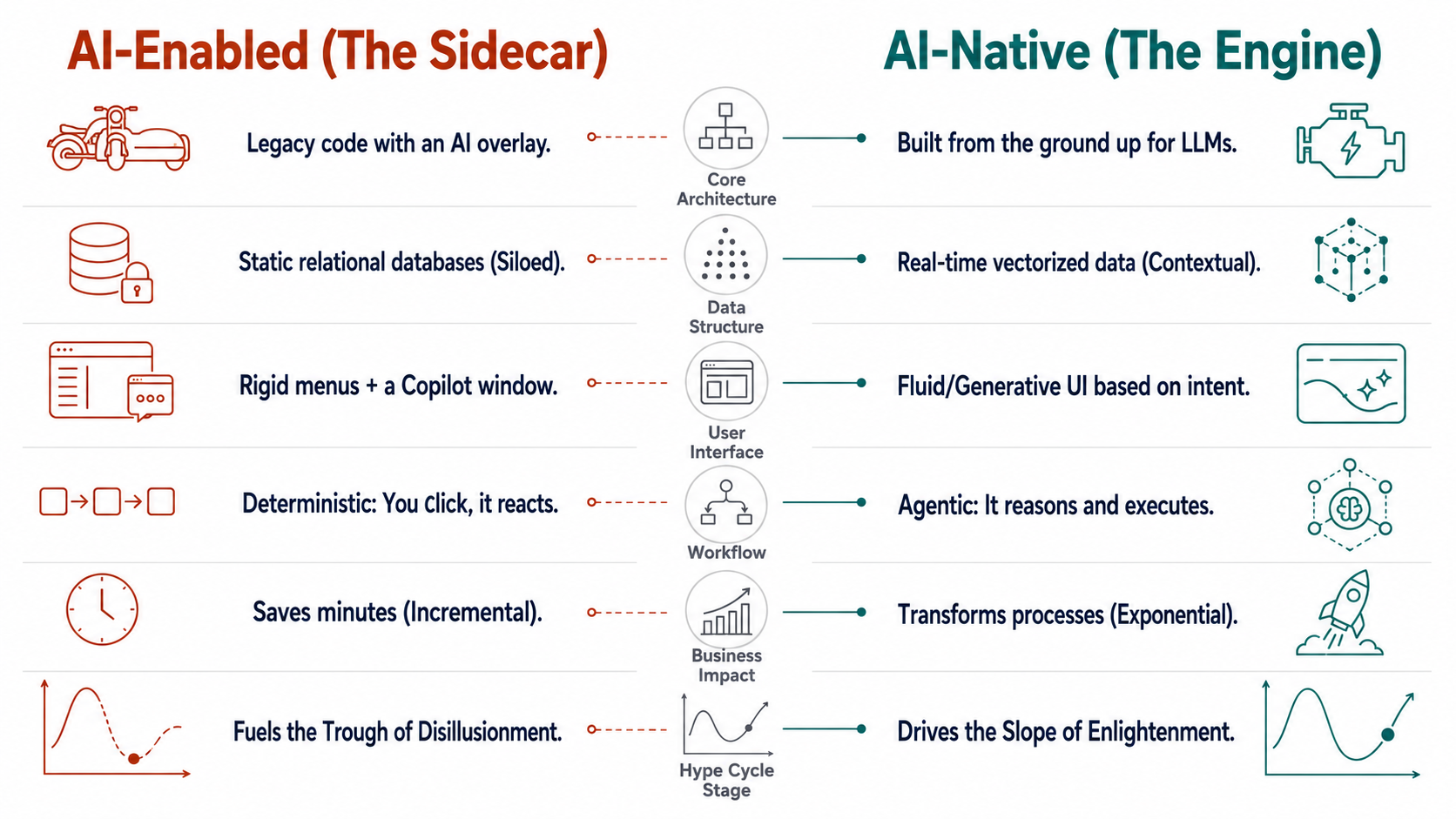
Figure 2: AI-enabled and AI-native platforms differ fundamentally across architecture, data, interfaces, workflows, business impact, and AI maturity.
On average, AI-Native architectures reduce end-to-end task duration by 60–80%, compared to a modest 10–15% efficiency gain seen in traditional AI-enabled sidecars.
Three Pillars of AI Success
Choosing between these two architectures is a strategic pivot that determines your ceiling for growth.
First, it dictates your productivity curve. AI-enabled tools offer incremental gains such as doing the same tasks perhaps 10% faster. In contrast, AI-native platforms offer exponential gains by automating entire sequences of work. They eliminate the human middleware once required to bridge disconnected steps, allowing workflows to move at the speed of thought.
Second, it builds a superior feedback loop. AI-native platforms capture interaction data, meaning they learn the logic used to solve a problem, rather than just recording the final output. By documenting the reasoning path, these systems create a compounding intelligence that a bolt-on competitor—which only sees the final output—simply cannot replicate.Over time, this makes the platform significantly more intelligent than any bolt-on competitor that only sees the final output.
Third, it provides essential future-proofing. Because AI-native architectures are modular, they allow you to swap brains as newer, more capable models emerge. This ensures your platform’s intelligence compounds at the exponential rate of the entire AI industry, rather than being capped by the linear pace of your internal engineering cycles.
The risk of ignoring this shift is manifest in the hallucination gap. Legacy systems often struggle with accuracy because their rigid databases were never designed to handle the messy, unstructured reality of advanced AI. These errors aren’t just AI being weird; they are a symptom of a model being starved for context. When a legacy architecture cannot feed the beast with multidimensional data, the AI is forced to fill the gaps with its own imagination. Simply put: you cannot solve a 21st-century reasoning problem with a 20th-century storage unit.
Future is AI-Native
If you are looking for a quick efficiency boost, AI-enabled tools are a functional patch. But if you are looking to redefine how your business operates, you must prioritize AI-native architecture.
To determine the true depth of a vendor’s offering, look beyond the chatbot and ask a single question: Does the AI have the permission to execute actions, or only to suggest them?
In the long run, systems that think as part of their core execution will always outpace those that simply speak through a chatbot interface. One is a tool for faster manual labor, the other is an engine for autonomous growth.
When defining your strategy, remember: the goal is to build a business that runs at the speed of AI.
How are you currently distinguishing between genuine architectural innovation and surface-level AI branding in your vendor evaluations?

Gayathri Doraiswami is Vice President of Transformation, Sales Strategy and Solutions, 25+ years of experience, currently leading transformation initiatives at Straive. She specializes in operationalizing AI at enterprise scale, transforming publishing workflows, and building AI-native technology and engineering models. Her expertise spans AI-assisted and agentic workflows, large scale transformation, human-in-the-loop systems, governance, cost optimization, and responsible AI adoption—ensuring that AI delivers measurable business value.


