
Posted on: July 31st 2026
The global banking industry is undergoing a complex race to modernize. As cross-border payments grow, trade finance becomes more complex, and customer onboarding speeds up, financial institutions are increasingly using AI to strengthen anti-money laundering (AML) and OFAC sanctions screening.
The goal is to reduce the crushing operational burden of false positives, ease chronic analyst fatigue, and process transactions at true machine scale.
However, a dangerous assumption has taken root in executive suites: the belief that deploying a “smarter” AI model naturally equals lower regulatory risk. In a zero-tolerance compliance environment where missing a single sanctioned entity can result in catastrophic fines, relying solely on a probabilistic model creates a governance illusion. For example, in 2010, the Office of the Comptroller of the Currency (OCC) issued a formal Consent Cease and Desist Order to HSBC, addressing inadequate anti-money laundering compliance rather than imposing monetary penalties.
To bridge the gap between AI efficiency and regulatory accountability, banks must recognize that AI-driven compliance requires an independent, continuous validation and audit layer. Beyond ensuring trust and compliance, this validation process creates a feedback loop that continuously refines models, improving their accuracy, resilience, and performance over time.
Why Probabilistic AI Fails Zero-Tolerance Compliance
Traditional compliance infrastructure relies on rigid, deterministic rules. AI introduces a shift to probabilistic reasoning, evaluating probabilities rather than definitive absolutes. While this allows for superior pattern recognition, it introduces structural vulnerabilities that conflict with regulatory expectations.
- Non-Deterministic Decisions: Unlike hardcoded rules, advanced AI models can yield variable risk scores for the same entity across different operational runs due to subtle shifts in context, data pathways, or model updates. This variability compromises the consistency required for entity resolution and fuzzy name matching.
- The Black-Box & Hallucination Dilemma: AI confidence does not equal regulatory correctness. A model may generate a highly confident decision to clear an alert based on hidden variables or flawed reasoning pathways that are opaque to auditors. Worse, generative or explanatory AI components can synthesize highly plausible but completely unsupported rationales for clearing a match.
- Recursive Trust Risk: A growing hazard in fintech operations is the practice of using AI models to validate, tune, or audit the outputs of other primary AI screening systems. This creates a closed-loop environment devoid of objective controls, in which systemic biases or blind spots remain uncorrected.
- Hidden Failure Modes: Even highly sophisticated models possess critical blind spots when navigating complex evasion tactics. Without structural constraints, AI can be systematically bypassed by minor alias manipulations, transliteration gaps, or hidden layers within complex ultimate beneficial ownership (UBO) structures.
The Illusion of “Human-in-the-Loop”
For years, the standard defense against model risk has been the “Human-in-the-Loop” (HITL) framework. The assumption was that as long as a human compliance analyst signs off on an AI’s output, the process remains safe. Modern transaction volumes have effectively shattered this assumption due to three structural limitations:
Scale Imbalance
AI processes millions of daily transactions in milliseconds per message. Human analysts possess neither the time nor the physical capacity to deeply investigate every alert forwarded to them.
The Understanding Gap
Analysts typically review a summarized dashboard of an alert rather than the model’s deep reasoning pathways. When an AI assigns a low risk-score based on thousands of multidimensional variables, the human reviewer lacks the visibility to challenge the underlying math.
Acute Decision Fatigue
While AI can reduce the absolute volume of alerts, high-volume environments still trigger thousands of false alarms. This manual overload induces cognitive fatigue, desensitizing analysts and significantly increasing the probability that a true, cleverly disguised sanctions match will be inadvertently cleared.
The Reality Check: Human oversight remains critical for final escalations, but it is no longer sufficient as a primary control framework. Banks require an automated, rule-based safety net to enforce independent boundaries around AI decisions.
A Continuous AI Validation and Audit Layer
An independent validation layer acts as an automated, objective referee. It sits entirely separate from model development and operations, ensuring that screening logic translates directly into defensible evidence of compliance.
True validation cannot be a one-time, pre-deployment exercise; it must span the entire model lifecycle.
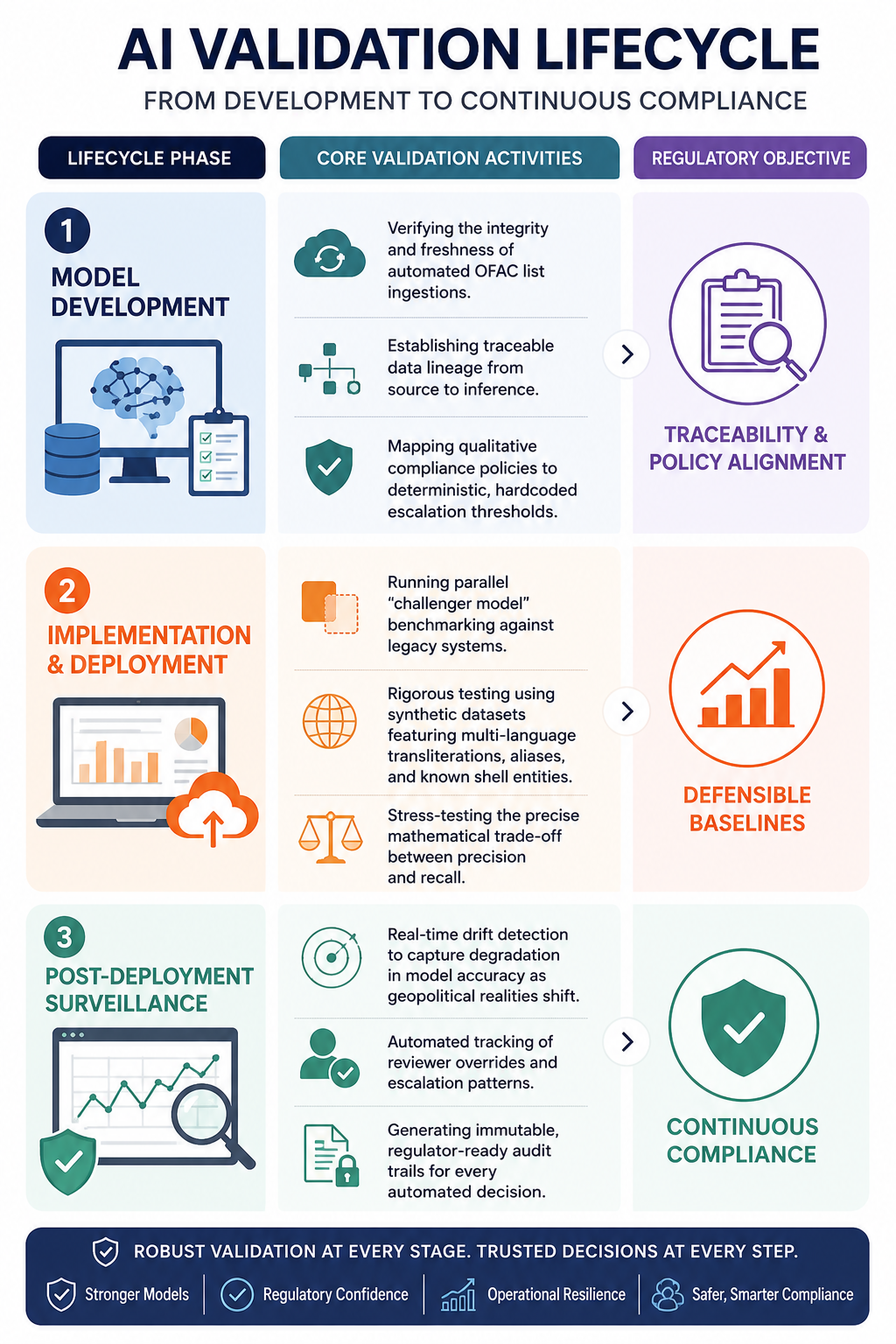
| Lifecycle Phase | Core Validation Activities | Regulatory Objective |
| 1. Model Development | • Verifying the integrity and freshness of automated OFAC list ingestions. • Establishing traceable data lineage from source to inference. • Mapping qualitative compliance policies to deterministic, hardcoded escalation thresholds. | Traceability & Policy Alignment |
| 2. Implementation & Deployment | • Running parallel “challenger model” benchmarking against legacy systems. • Rigorous testing using synthetic datasets featuring multi-language transliterations, aliases, and known shell entities. • Stress-testing the precise mathematical trade-off between precision and recall. | Defensible Baselines |
| 3. Post-Deployment Surveillance | • Real-time drift detection to capture degradation in model accuracy as geopolitical realities shift. • Automated tracking of reviewer overrides and escalation patterns. • Generating immutable, regulator-ready audit trails for every automated decision. | Continuous Compliance |
Active Adversarial Testing
A critical component of post-deployment monitoring is continuous adversarial simulation. By deliberately injecting synthetic identities, structured evasion tactics, and complex beneficial ownership scenarios into the live environment, the validation layer actively hunts for silent failures before regulators do.
Optimizing Efficiency Without Increasing Risk
Implementing an independent validation layer is not merely an exercise in regulatory box-checking; it unlocks the true operational and financial value of artificial intelligence.
When banks independently calibrate matching thresholds and implement risk-tiered review mechanisms, they safely eliminate the vast operational drag of false positives. This systematic reduction in alert volume alleviates analyst fatigue and eliminates investigation bottlenecks without exposing the bank to the catastrophic risk of missing true sanctions matches.
Furthermore, this architecture shifts an institution’s stance from reactive defense to proactive governance. When regulators review the compliance framework, the conversation changes from defending a “black-box” model to demonstrating an active, auditable ecosystem of checks and balances. The strategic results are clear:
- Accelerated Client Onboarding: Safely speed up corporate and retail onboarding through highly reliable, automated clearing mechanisms.
- Frictionless Global Payments: Substantially lower the rate of delayed cross-border payments and correspondent banking bottlenecks.
- Reduced Operational Overhead: Direct compliance talent away from sorting through false alarms and toward deep, high-value investigations in trade finance and complex financial crimes.
Conclusion: Moving Beyond the Smart Model
In the modern regulatory landscape, a smart model is a powerful tool, but an independent validation layer is what makes it safe to use. OFAC compliance demands absolute, verifiable accountability.
As financial crime compliance operations (FCC Operations) continue to evolve, the institutions that thrive will not be those that blindly trust the outputs of their advanced algorithms. The future belongs to banking organizations that implement rigorous, independent, and continuous AI audit layers, transforming probabilistic technology into a robust and regulator-ready system of record.

Dinesh Kumar Nuthi is an Engagement Manager in Analytics & AI at Straive, specializing in fraud prevention, financial crime risk management, and digital transformation for leading U.S. financial institutions. With over 9 years of experience across the U.S., Canada, and India, he has led cross-functional teams to deliver analytical and digital solutions that enhance fraud detection, reduce losses, and drive operational efficiency. Dinesh has managed large-scale analytics programs involving analytics, machine learning, automation, and real-time risk monitoring. A data-driven leader, he has worked closely with senior stakeholders to align solutions with business strategy while mentoring global teams. He is currently pursuing a part-time MBA from Leeds School of Business and is passionate about using technology and analytics to solve high-impact business problems.


