
Posted on: June 18th 2026
Most AI collections demos start with the easiest invoice: clean customer, clean contact, clean due date, clean reminder, clean promise-to-pay.
The real collections queue is not that polite.
It has partial payments with unclear remittance, portal deductions, pricing disputes, tax mismatches, stale AP contacts, unapplied cash, and customers who promise every Friday and miss every Friday.
That is where AI in accounts receivable collections has to prove itself: not in the demo queue, but in the actual queue.
The useful 2026 question is not, “Does this platform use AI?” Every platform will say yes. The better question is: “Does this help the team decide what to work, what not to chase, what is blocked, what is collectible, and what action is most likely to move cash?”
Collections teams do not need more automated activity. They need fewer wasted touches.
That is the line between AI that works and AI theatre.
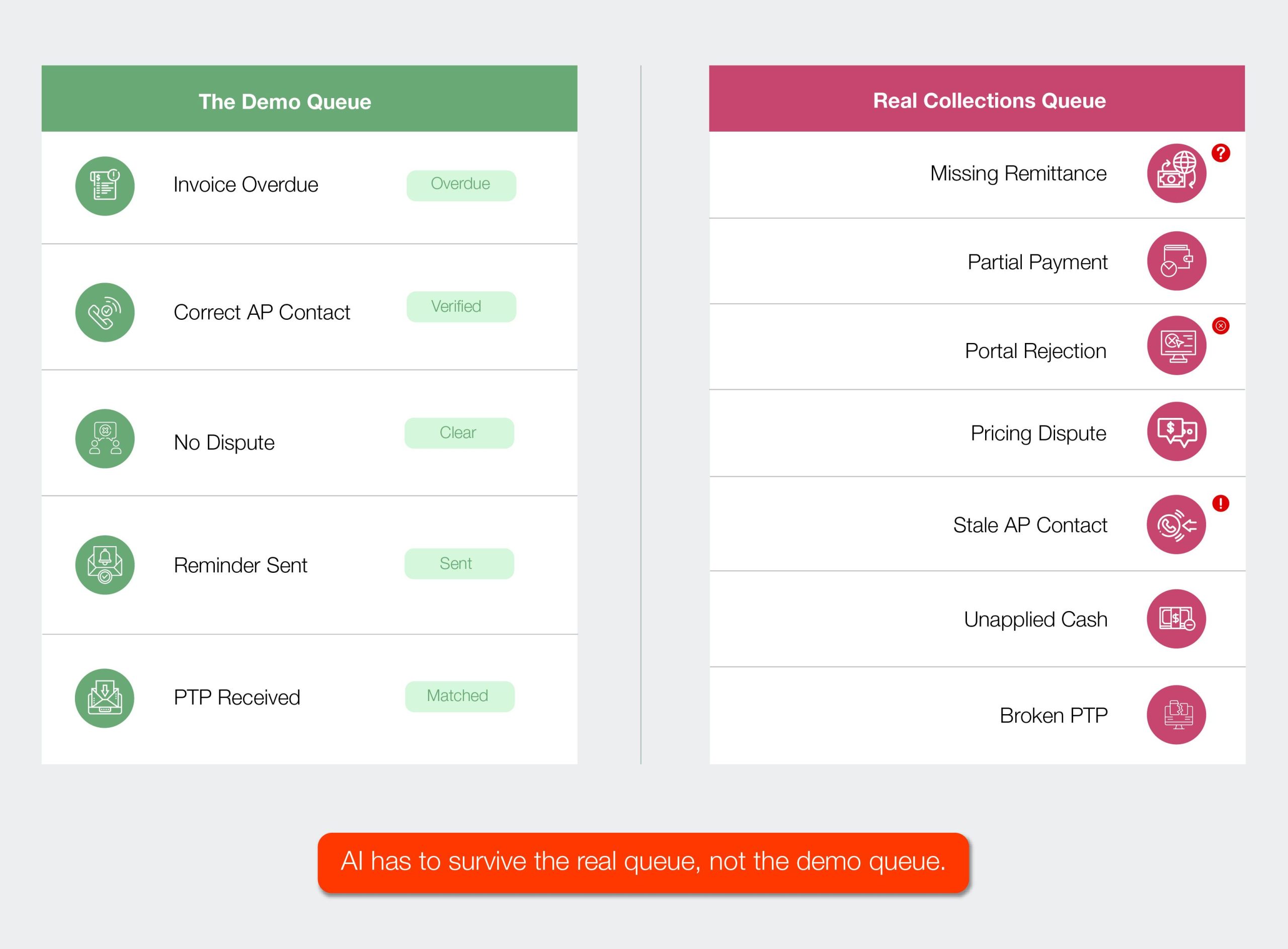
The Demo Queue vs. the Real Collections Queue
If AI cannot handle exception-heavy work, it will not survive beyond the sales demonstration.
Past Due Is Not a Diagnosis
Aging matters, but it does not explain why cash is stuck.
A 30-day overdue invoice may be true delinquency. It may also be tied to pricing, a missing PO, portal failure, tax mismatch, missing proof of delivery, unapplied cash, or an invalid contact.
Those are not variations of the same problem. They require different actions.
A clean overdue invoice may need a reminder. A disputed invoice needs ownership. A paid-but-unapplied invoice needs matching. A portal-blocked invoice needs correction and resubmission. A strategic account may need coordinated escalation. A chronic slow payer may need tighter credit discipline.
Weak AI accelerates the chase before it understands the blockage. Useful AI classifies the blockage first.
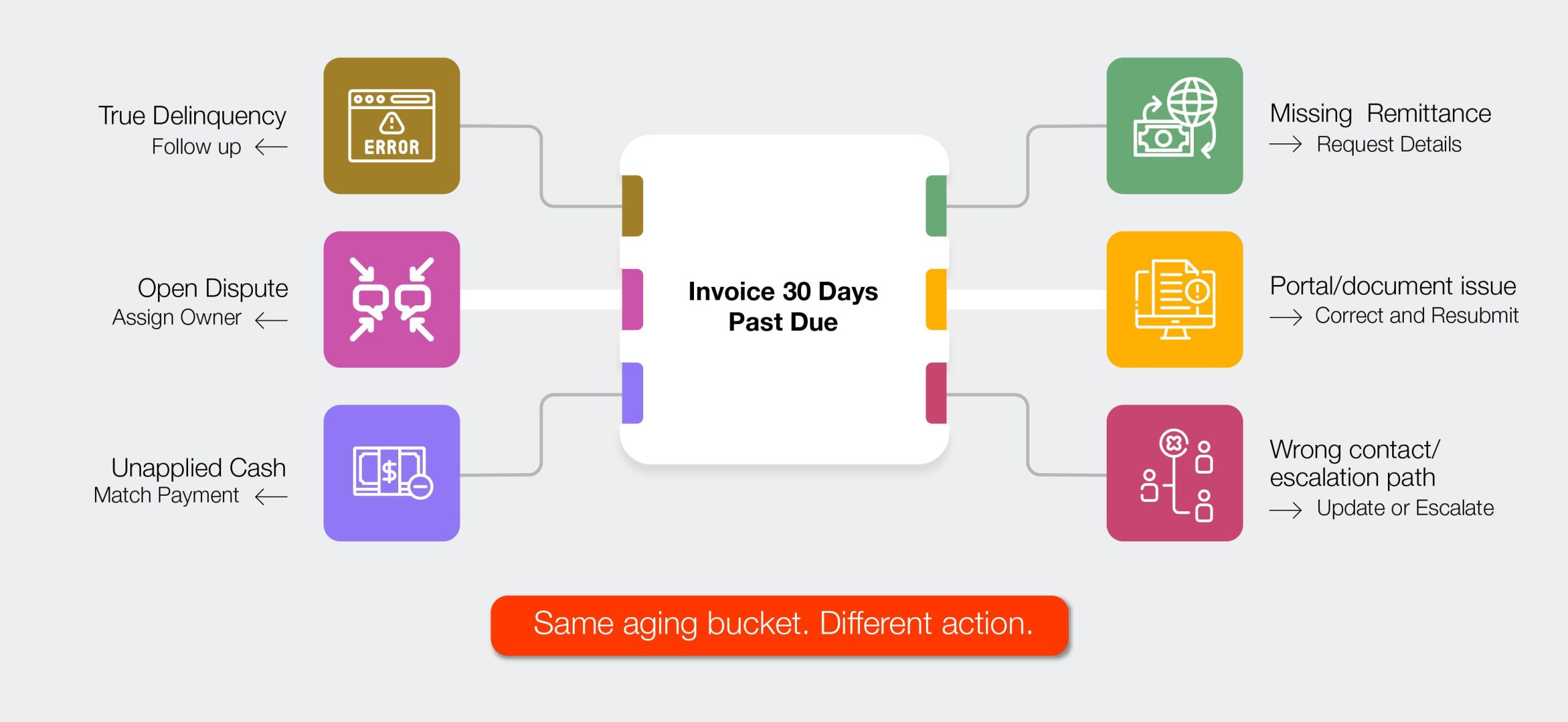
One Overdue Invoice, Six Different Next Actions
The value of AI begins here: not by sending the next reminder, but by helping the team choose the right next move.
Start Where the Ledger Lies
Cash application is not the flashiest AI use case in AR, but it may be one of the most important.
When cash is received but not applied, collectors chase invoices customers believe they have already paid. Statements lose credibility. Overdue balances look worse than they are. Customer conversations start in the wrong place.
Remittance rarely arrives neatly. It comes through bank files, lockbox feeds, emails, PDFs, spreadsheets, portals, and customer-specific formats. Payments cover multiple invoices. Deductions are bundled. References are incomplete.
Rules-based matching works when data is clean. AI helps when data is messy but patterned. It can extract remittance details, learn customer-specific matching behavior, suggest likely matches, identify deductions, and route uncertain cases to human review.
The goal is not fake “touchless” perfection. The goal is a cleaner open-item list.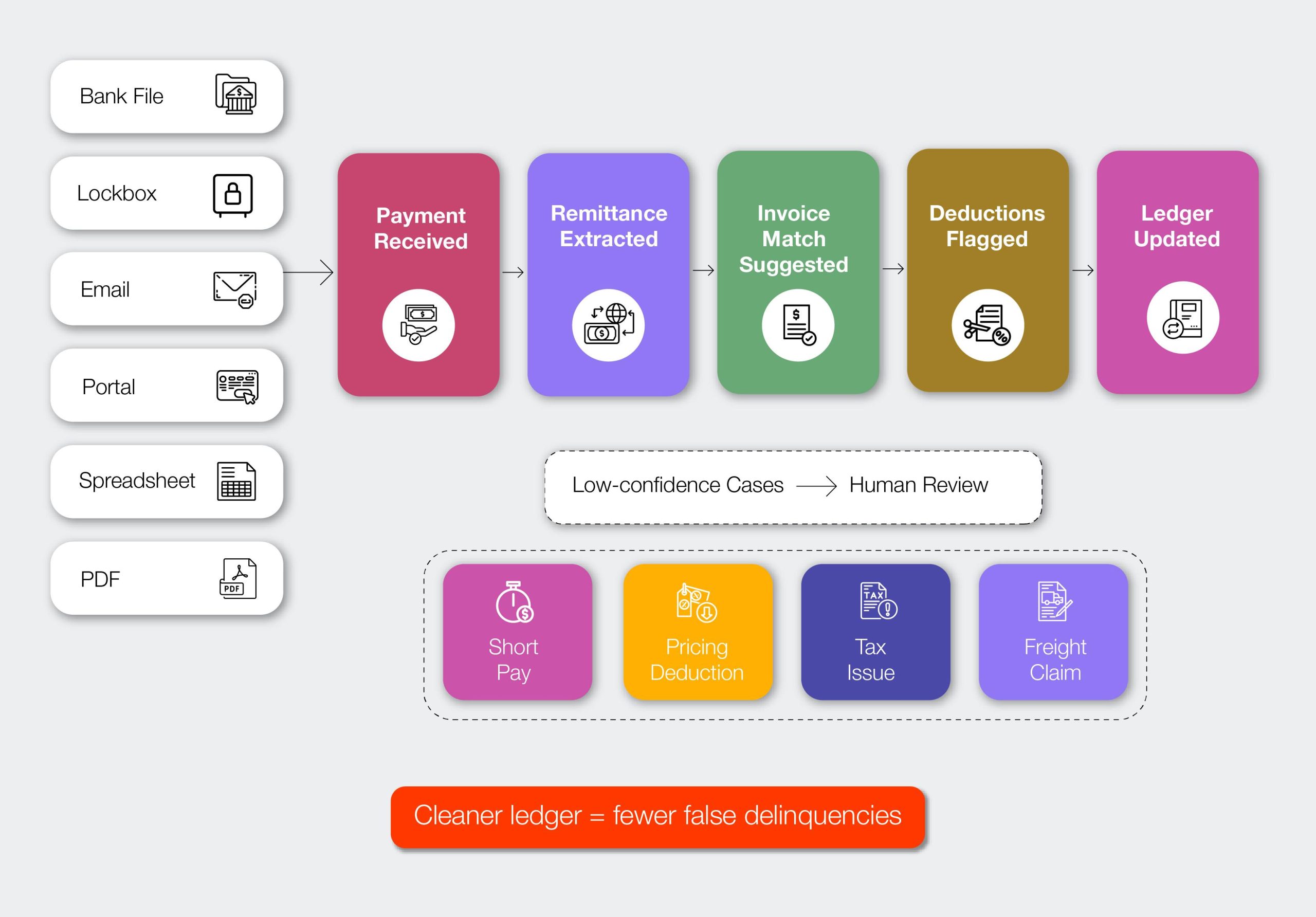
Where AI Cleans Up Cash Application
A cleaner ledger does not just help accounting. It prevents collectors from wasting time on items that should never have reached the queue.
The Worklist Is Where AI Earns Trust
The collector’s day is shaped by the queue. If the queue is wrong, the day is wrong.
Most queues lean on aging, balance, and customer segment. Those signals matter, but oldest is not always riskiest, and largest is not always most urgent.
Good AI prioritization explains the reason for action.
A collector does not need “Risk score: 82.” A collector needs: “This customer normally pays within 12 days. The last two invoices crossed 30 days. The latest PTP was missed. No dispute is open. Follow up today.”
That is a work instruction.
The best AI queues combine payment behavior, invoice value, dispute status, PTP reliability, contact responsiveness, deductions, credit exposure, unapplied cash, and recent payment-pattern changes. But all that complexity has to resolve into plain guidance: why this account, why now, and what should happen next.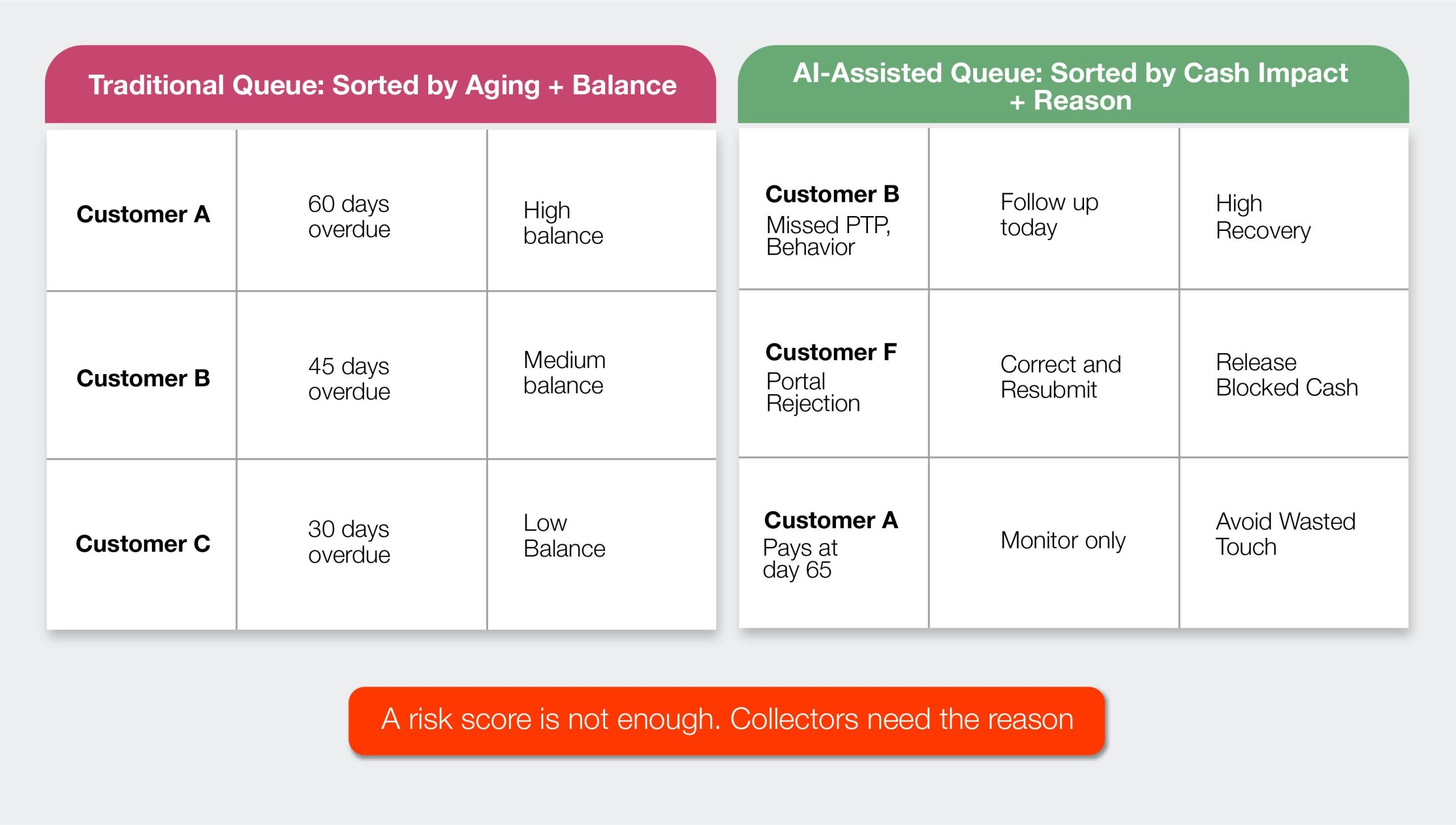
From Aging-Based Queue to Cash-Impact Queue
The winning queue is not the one with the most accounts. It is the one that protects collector time and directs it where cash can move.
Promise-to-Pay Is a Behavioral Signal
A promise is not cash. It is a claim about future cash.
Some customers promise because payment is scheduled. Some promise because they need to end the call. Some promise every Friday and miss every Friday.
Many teams record that a promise was made. Fewer measure whether the customer keeps promises. AI can track promise conversion, identify repeat broken promises, detect reliability changes, and separate sincere commitments from delay tactics.
A reply feels like progress. But a reply that does not convert is just a softer delay.
Disputes Are Not Outside Collections
Many organizations treat disputes as separate. In practice, disputed invoices still sit inside the collections number until resolved.
Aging does not pause because ownership is unclear.
The collector may not be able to resolve pricing, freight, tax, quantity, proof-of-delivery, or contract issues. But if the dispute is not classified, routed, owned, and tracked, the invoice will age while everyone waits.
AI can read dispute notes, classify reasons, identify missing evidence, route issues to the right owner, and show recurring causes. If no one owns the next move, cash stays stuck.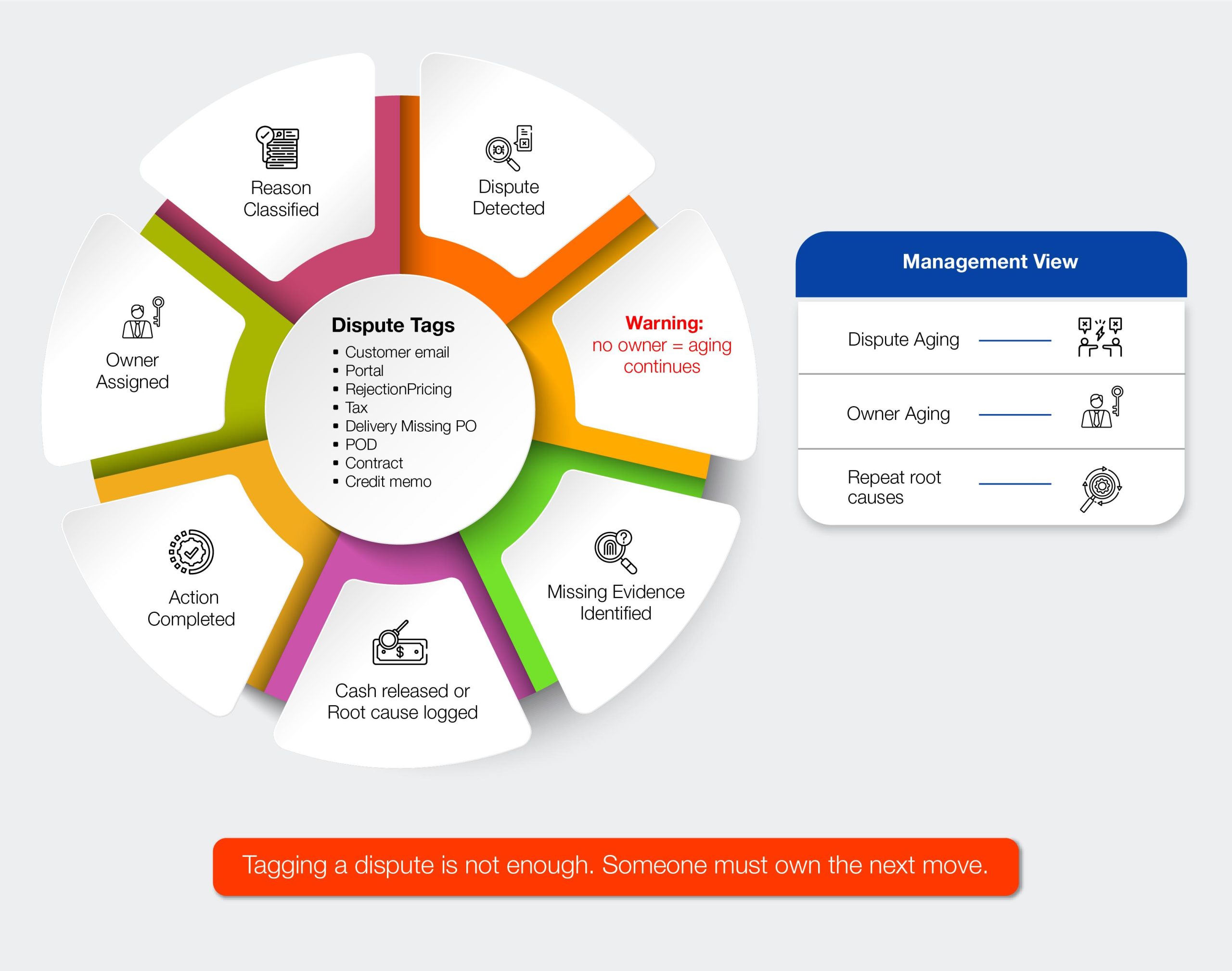
The Dispute-to-Cash Control Loop
The faster a dispute gets a reason, owner, evidence trail, and next action, the faster it stops being an aging problem disguised as process complexity.
Generative AI Should Prepare the Collector
Generative AI in collections should not be judged by whether it can write a polite reminder email. Its real value is preparation.
Before contacting a customer, a collector often reconstructs the account story from ERP notes, emails, disputes, payment history, remittance details, PTP entries, sales comments, and escalations.
A grounded AI assistant can summarize the account, highlight blockers, identify the last meaningful response, show broken promises, surface missing documents, draft the message, and recommend the next action.
The point is not prettier writing. The point is better-prepared collectors.
Be Careful With “Autonomous Collections”
Some work can be automated safely: reminders, document requests, inbound classification, payment links, remittance extraction, routine follow-up, and some dispute routing.
But full autonomous collections is still risky. A wrong action can irritate a strategic customer, trigger unnecessary escalation, undermine sales, or chase cash already sent.
Routine, low-risk, policy-clear work can be automated. Sensitive accounts, complex disputes, repeated broken promises, large exposures, credit holds, and commercial escalations still need human judgment.
Why Pilots Disappoint
AI pilots in AR usually fail for plain reasons.
The data is not ready: stale contacts, inconsistent notes, weak dispute codes, duplicated customer masters, poor PTP capture, and remittance outside the workflow.
The integration is shallow. The AI recommends action in one place, but collectors work in another.
The measurement is soft. Teams count emails, touches, and automation rates. Finance cares about cash. A serious pilot starts with baseline numbers: DSO, overdue balance, unapplied cash, dispute aging, PTP conversion, collector productivity, recovery rate, and cost-to-collect.
The 2026 Buying Test
Do not ask, “Do you have AI?”
Ask this instead: show me a paid-but-unapplied invoice; a missing remittance case; a broken PTP pattern; a strategic account with a real dispute; a stale contact problem; a portal rejection; a short pay with deductions; why the AI recommends this account today; what happens when the collector disagrees; what gets written back to the ERP; the audit trail; the cash metric.
If the product cannot handle the ugly cases, it is not ready for the real queue.
What Separates Value from Theatre
AI works when it helps teams know what is truly collectible, what is blocked, what has already been paid, what needs dispute ownership, what promise is worth trusting, what account needs attention today, and what action has the best chance of moving cash.
It is theatre when it sends more reminders, creates unexplained scores, claims autonomy without guardrails, or measures activity.
The best AR teams in 2026 will not automate the most touches. They will stop wasting them.

Assistant Director, Strategic Programs
Abhishek leads operational excellence and transformative client outcomes, bringing extensive experience in orchestrating large-scale customer experience and technology programs


