
Posted on: April 20th 2026
The best boardroom decisions don’t look impressive from the outside. Nobody claps. There’s no fanfare. But you can feel them in the room; the team moves without second-guessing, the call lands quickly, and nobody’s caught scrambling two weeks later when the market shifts. What separates those rooms from the ones where strategy stalls isn’t talent. It’s information. Specifically, it’s AI-powered insights arriving early enough to actually act on.
What Are AI-Powered Insights?
Most business data is a mess. It lives across a dozen systems, half of which don’t speak to each other, and by the time someone’s pulled it into a format that’s actually usable, three things have changed, and one of the source files has been updated. Handing that to a team and saying “draw us a strategy from this” works about as well as you’d expect.
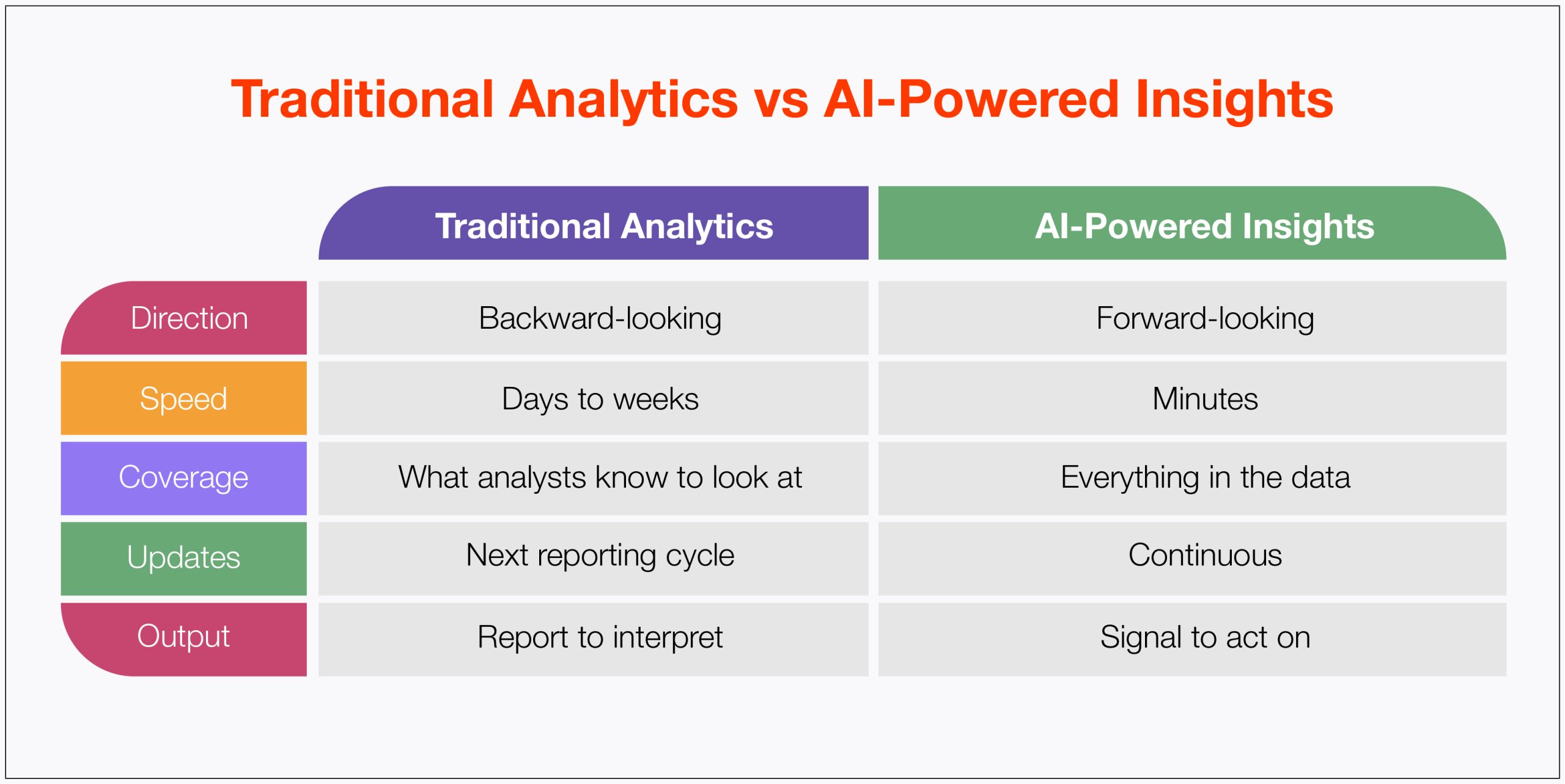
AI-powered insights replace guesswork. Machine learning and advanced analytics move through that complexity and return something usable, not a raw report that needs three meetings to interpret, but an actual signal. Something a decision-maker can act on by the end of the day.
Think of your business data as an ocean. Traditional analytics gave you a bucket. AI-powered insights give you sonar.
Why Traditional Strategy Approaches Are No Longer Enough
Nobody’s arguing that traditional strategy teams aren’t capable. The problem isn’t capability; it’s volume.
The data that now underpins a single strategic decision would have taken a full research department 6 months to compile 15 years ago. Today, it refreshes daily. A team working through it manually will always be a few steps behind, not because they’re slow, but because the data has genuinely outpaced what any group of humans can process cleanly.
And when humans work fast through large data sets, things get missed. Not the obvious things but the subtle ones. The anomaly is buried in column 47 of a spreadsheet nobody weighed correctly. The trend that only becomes visible once you’ve crossed a certain data threshold. These aren’t failures of intelligence; they’re failures of scale.
There’s a cost attached to that lag, too. Every hour your best analysts spend assembling data is an hour they’re not spending on the work that actually requires their judgment. Preparation for strategy isn’t strategy. It just looks like it from far enough away.
Read also: AI & Automation in CX: Enhancing Lead Qualification and Customer Support Wondering how AI is reshaping the customer-facing side of your business? Check this blog for a closer look at where the real operational gains are happening. |
How AI-Powered Insights Are Transforming Business Strategy
Here’s the thing about AI that doesn’t get said enough: it’s not doing anything magical. What it’s doing is something very ordinary, at a scale and consistency that no human team can sustain.
A good analyst will catch most things. But they also get tired. They get interrupted mid-thought. They make a judgment call to skip a data point that doesn’t look important, and occasionally that’s the one that matters. AI doesn’t make that call. It’s as thorough in iteration ten thousand as it was in iteration one, and when something looks off, it flags it rather than quietly moving past it.
What that changes practically: work that used to take the better part of a week now takes minutes. The strategy team isn’t the last group to find out anymore. They’re the first. That’s the real shift AI in business strategy creates: not replacing the strategist, but making sure they’re always working from the best available picture rather than last Tuesday’s.
Key Business Functions Transformed by AI-Powered Insights
AI-driven business transformation doesn’t land in one department and stop there. It tends to compound across the organization once it takes hold.
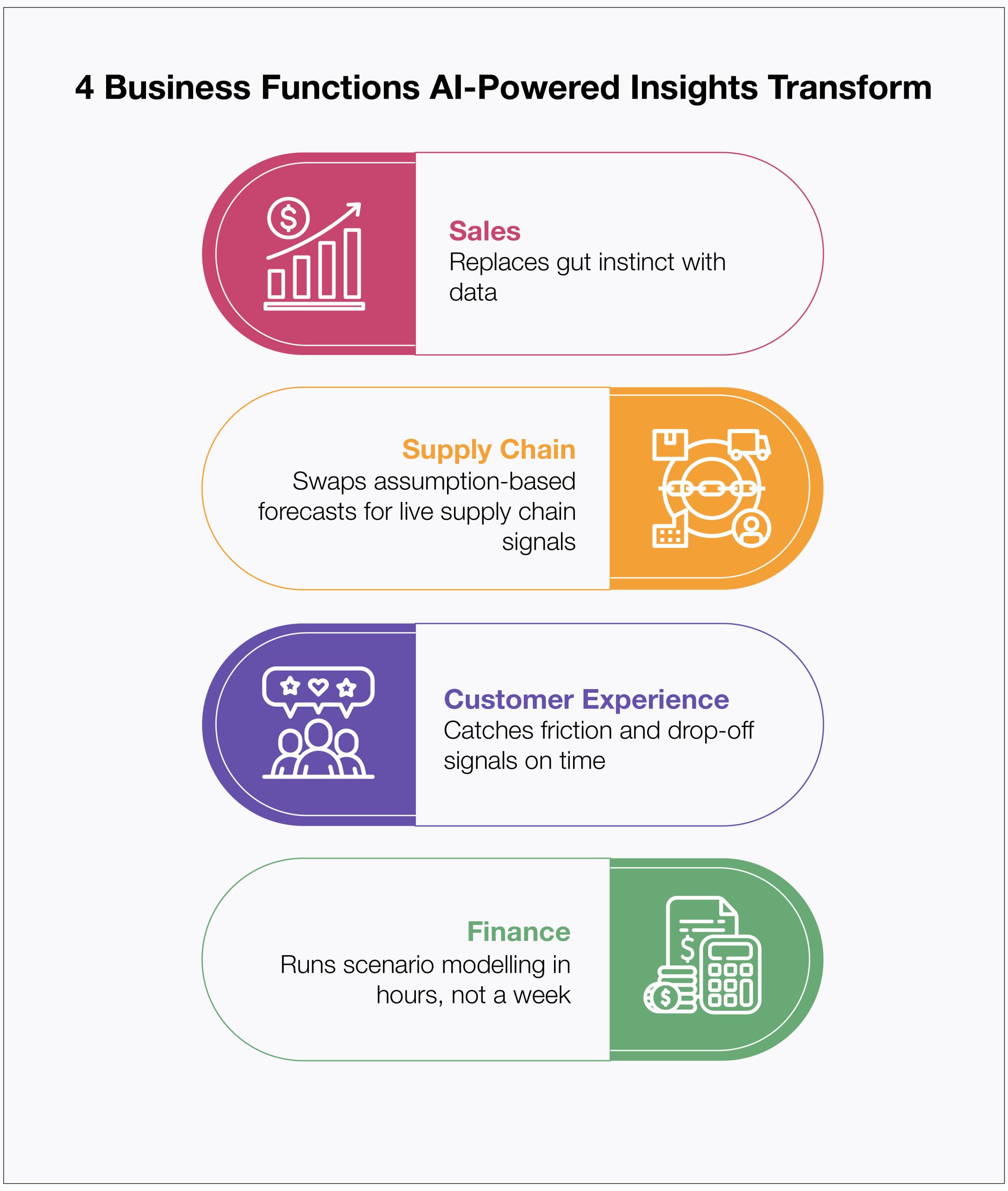
Sales and Revenue: Every sales leader will tell you that timing is the whole game. The tricky part is knowing which account is about to go cold, which deal has real legs, and where there’s room to move on price that used to come from instinct built over the years. AI-powered insights put a factual foundation under that instinct. The team isn’t working off a hunch anymore. They’re working off data.
Supply Chain and Operations: Most demand forecasts are built on last year’s numbers, adjusted by feel. That’s not cynicism; it’s just how manual forecasting works. Demand forecasting with analytics swaps that out for a view grounded in what’s actually happening across the supply chain right now, so procurement teams can move before a problem develops rather than after it’s already expensive.
Customer Experience: By the time a customer survey comes back, the customers who had a bad experience are often already gone. AI in customer experience picks up the behavioral signals. Where friction lives, what’s driving drop-off, and what customers are actually responding to long before the survey data catches up.
Finance: Scenario modeling used to mean booking a room with four analysts for a week. Now the same modeling runs in hours, covers more variables, and leaves the team with more confidence in the range of outcomes they’re planning around.
Read also: How Are Banks Using AI to Elevate Customer Service? The strategy is only part of the story. If you’re curious how AI-powered insights are playing out on the ground in heavily regulated industries, this blog is worth a read. With real applications, real constraints, and what’s actually working. |
Applications of AI-Powered Insights
No business is short of data. What most are short of is the capacity to do anything useful with all of it consistently. AI-driven insights for business close that gap by watching the surfaces most teams can’t keep up with manually. In practice, that looks like:
- Spotting emerging market opportunities while they’re still forming, not once the consensus has already formed around them.
- Adjusting pricing in real time based on what competitors and demand signals are actually doing.
- Finding operational inefficiencies that are too small to show up in a quarterly review but add up to real money at scale.
- Personalizing customer engagement in ways that rule-based systems simply can’t sustain.
- Catching risk in financial or supply chain data early enough to do something about it.
Each of these is a place where AI-based decision-making removes a layer of uncertainty that traditional methods just carry permanently.
Benefits of AI-Powered Insights for Business Strategy
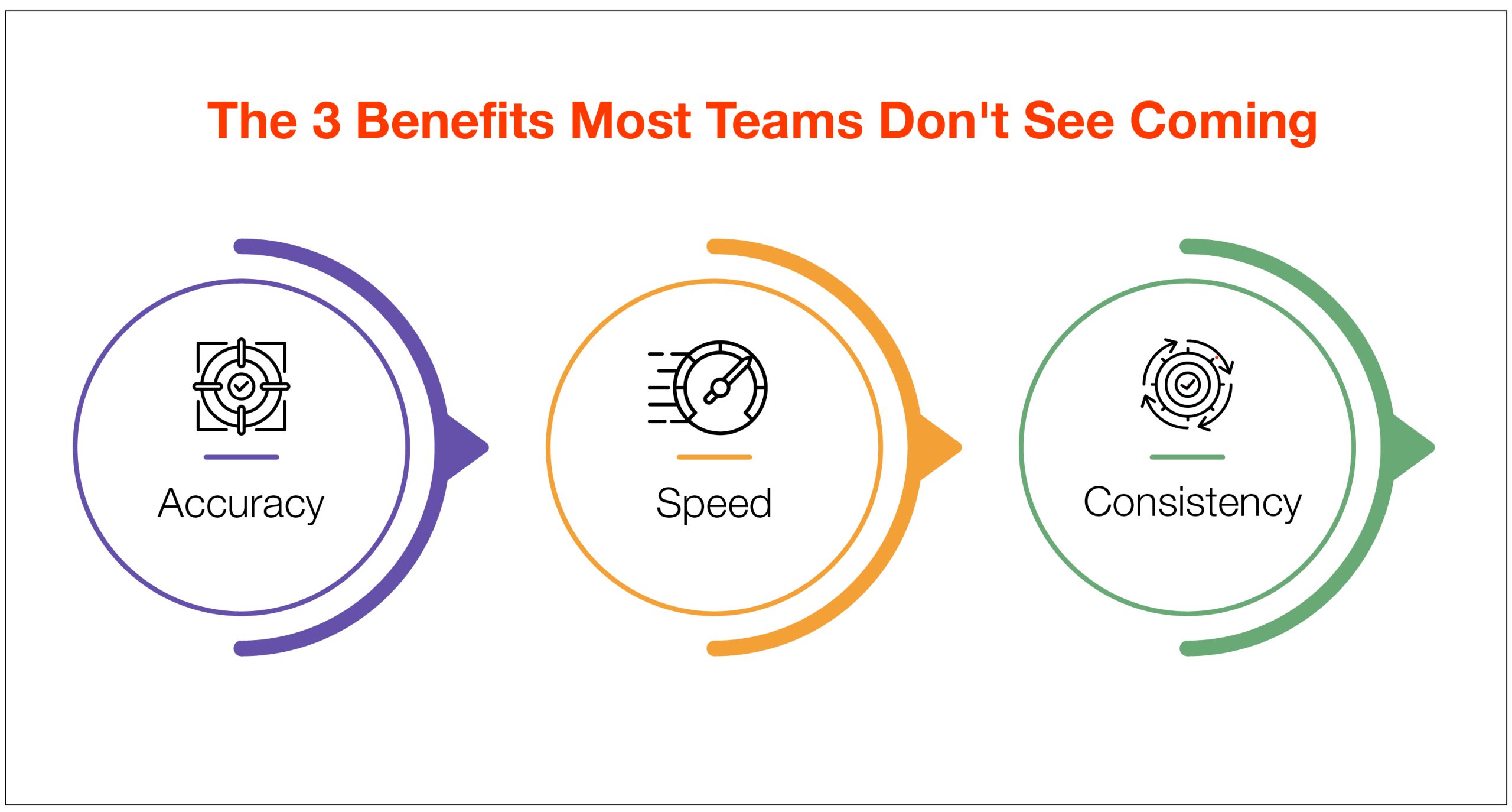
The first thing most people reach for is accuracy. Fair enough, but AI-powered insights don’t have off days. They don’t miss the footnote because they were in back-to-back meetings. They work through what’s there.
Speed is the second thing. A data-driven business strategy powered by AI analysis doesn’t wait a week for results. The time between question and answer compresses significantly, which speeds up a team’s iteration when conditions shift.
But consistency might be the most underrated benefit of all. Human analysis varies. An analyst under deadline pressure produces something different from the same analyst with adequate time and a clear brief. Nobody talks about that honestly, but it’s true. AI runs the same process at 2 am on a Friday as it does on a calm Tuesday morning. For any organization that regularly makes high-stakes decisions, that reliability isn’t a convenience; it’s a competitive edge.
The fourth shift is where the resource goes. When AI takes on the finding and structuring of information, the people doing insights and analytics services stop spending their time producing findings and start spending it interrogating them. That’s a better use of a smart person’s day.
Challenges in Using AI for Strategic Decision-Making
Worth saying clearly: AI-powered insights are only as good as what goes into them. A model doesn’t know it’s reading bad data. It processes what’s there and returns an answer that looks confident, because that’s what models do. Garbage in, confident garbage out. That’s a genuinely serious problem if the data foundation hasn’t been built carefully.
Business data management is, for this reason, not an operational detail. It’s the bedrock. Organizations that haven’t invested in data quality will find that deploying AI exposes their data problems at speed rather than solving their strategy problems. The tool is only as trustworthy as the inputs.
Interpretation is the other challenge. A number without context isn’t an insight; it’s a starting point for a question. The people reading AI outputs need enough understanding to push back when something doesn’t look right, to add the business context the model doesn’t have, and to resist over-relying on a result just because it came from a system rather than a person.
And then there’s culture. An advanced analytics strategy only works inside an organization willing to be told when its assumptions don’t hold. That’s harder than it sounds and has nothing to do with the technology.
Building an AI-Driven Strategy Framework
The organizations that do this well share a starting point: they define the decision before they think about the tool. What’s the strategic question? What data would genuinely change the answer? That comes first. The technology comes later.
After that, it comes down to the data itself: Is it clean? Is it current? Does it actually reflect what’s happening in the business right now? And are there feedback loops in place to prevent the model from drifting as things change? The infrastructure question matters, but it’s only half of it. The people who’ll use the outputs need to be invested, too. Most stalled implementations got the technology right, and the people piece wrong.
An advanced analytics strategy isn’t a deployment. It’s a practice, something that gets sharper over time, the same way any serious capability does.
The Future of Business Strategy with AI
AI in business strategy is moving from a competitive advantage to a competitive baseline. The organizations that moved early aren’t ahead because they used AI; they’re ahead because they built the cultural and data infrastructure to use it well before everyone else had to figure that out under pressure.
What’s coming next is prescriptive intelligence: not just what happened, not just what’s likely to happen, but a reasoned recommendation for what to do about it, one you can actually audit and interrogate. That’s not fully here yet, but it’s closer than most strategy teams have planned for.
For a CXO, the honest question isn’t whether AI-powered insights will reshape how strategy gets made. They already have. The question is whether the organization is ahead of that curve or about to find itself catching up to it.
How Businesses Can Get Started with AI-Powered Insights
Waiting for the perfect moment to start is one of the more expensive habits in business. Most organizations already have enough data to benefit, and the limiting factor isn’t volume. Usually, the data’s there. What’s missing is structure, or a specific enough question to build around. Pick one decision your team keeps making, something recurring, something where the answer currently lives in a spreadsheet someone built three years ago and updates by hand. Run AI-powered analysis alongside it. Give it a quarter. You’ll see the gap pretty fast, and that gap tells you where to go next.
Scale from there. Build the data infrastructure that supports more ambitious questions. And find a partner who’s done this before. The learning curve is real, and the common mistakes are well-documented by now.
Partner with Straive for AI-Driven Strategy
Strategy has always been about making the best call with what you know. What AI-driven business transformation changes is how much you know, how quickly you know it, and how confident you can be in it. Organizations that treat AI-powered insights as a core strategic capability, not a software line item, will run faster and adapt better than those that don’t.
Straive sits at this exact juncture. The work isn’t just analytics delivery; it’s building the data foundations that make analysis trustworthy, combining domain expertise with technical depth, and ensuring what’s produced is contextually relevant, not just computationally valid. That gap between a proof of concept and something that actually drives decisions is where Straive operates.
The data is already there. Straive helps you know what to do with it.

Straive helps clients operationalize the data> insights> knowledge> AI value chain. Straive’s clients extend across Financial & Information Services, Insurance, Healthcare & Life Sciences, Scientific Research, EdTech, and Logistics.


