
Posted on: January 16th 2025
Setting the Stage: How Customer Experience Is Evolving in 2026
Customer expectations have undergone a profound shift in recent years. In 2026, individuals expect experiences that are fast yet thoughtful, technologically seamless yet deeply human. They are used to intuitively designed apps, instant support, tailored recommendations, and consistent interactions across the many channels they move between. When these expectations are not met, their patience has grown thinner, and their willingness to switch to another provider has increased.
Customer Experience (CX) has therefore become one of the most important differentiators available to modern organizations. Everything else—products, pricing, distribution—can be replicated to some degree. But the experience a customer has with a brand is unique, shaped by countless micro-interactions that accumulate into perceptions, emotions, and ultimately loyalty.
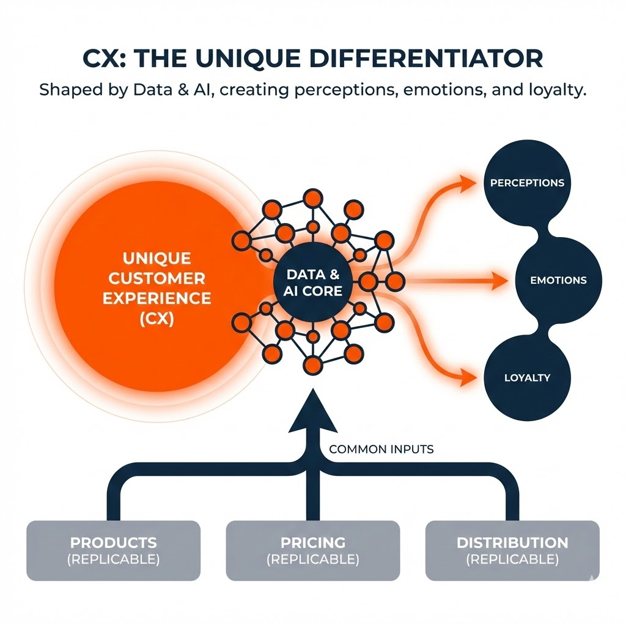
Data and artificial intelligence now sit at the center of how those experiences are designed and delivered. They give organizations the ability to understand customers as individuals rather than segments, to respond instantly rather than days later, and to anticipate needs rather than react to them. CX in 2026 is no longer about improving isolated touchpoints; it is about creating connected, intelligent ecosystems that feel natural to the customer.
Defining Today’s Customer Experience: More Than Service
Customer Experience encompasses everything a customer encounters in their relationship with a brand—every step, every impression, every interaction, and every emotional response. It includes the usability of a website, the clarity of a notification, the friendliness of a service representative, the resolution time of an issue, and the joy of discovering something relevant at the right moment. It is shaped equally by functional elements (speed, accuracy, convenience) and emotional elements (trust, reassurance, recognition).
Crucially, Customer Experience is not defined by what a company intends but by what a customer perceives. A process that seems perfectly logical internally may still feel confusing to the customer. A generous policy that requires multiple steps may still feel frustrating. In this sense, CX can never be considered complete; it must evolve as expectations evolve.
Unpacking CX: What It Really Means
Customer Experience (CX) is the overall perception and emotional impression that customers form based on all their interactions with a brand across touchpoints and over time. It includes pre-purchase research, buying processes, support moments, ongoing use of a product or service, and all the communication that occurs in between.
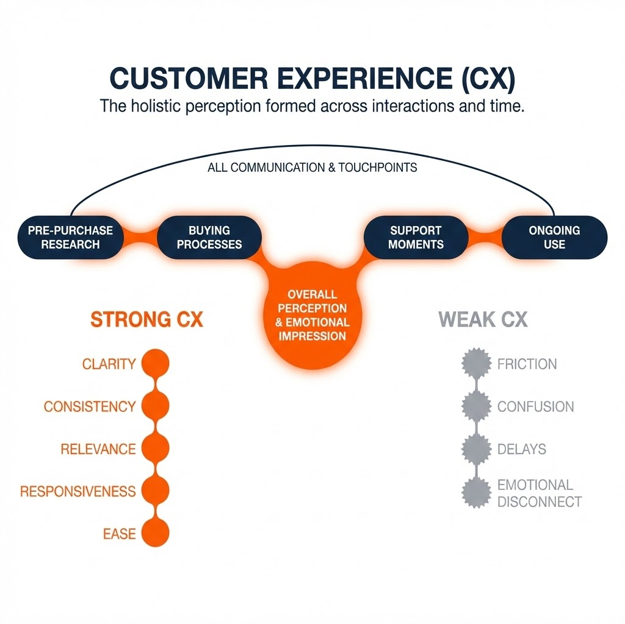
A strong CX is marked by clarity, consistency, relevance, responsiveness, and ease. A weak one is marked by friction, confusion, delays, and emotional disconnect. As organizations gather and analyze more data across channels, CX increasingly becomes a measurable, improvable discipline informed by real behavioral insights—not just assumptions or qualitative feedback.
Crafting Better Experiences: Where to Begin
Improving customer experience requires a combination of the right mindset, the right operational structure, and the right enabling technologies. It starts by adopting a genuinely customer-centered lens—understanding real-world behaviors, motivations, frustrations, and expectations. It requires breaking down organizational silos so that teams collaborate around the customer rather than around their functions. And it relies on using data and AI not as decorative add-ons but as central tools for understanding, designing, and continuously refining journeys.
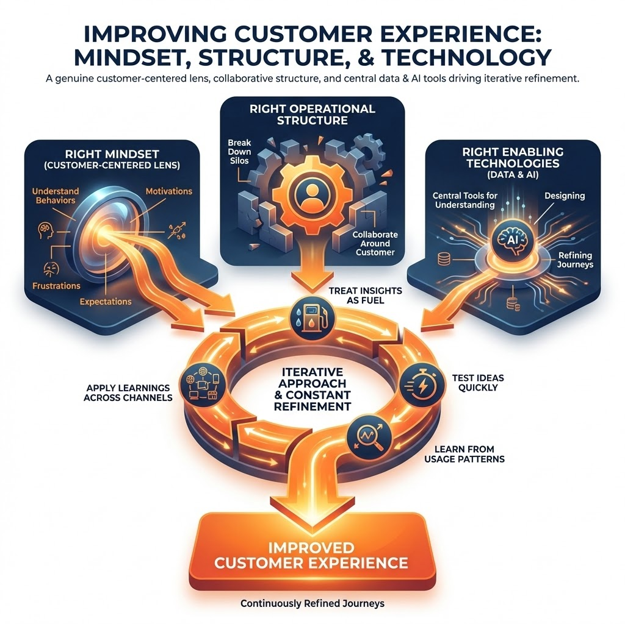
Organizations that excel in CX today take an iterative approach. They treat insights as fuel for constant refinement, testing ideas quickly, learning from real usage patterns, and applying those learnings across channels. The most successful recognize that great experiences are not accidents—they are engineered deliberately, monitored continuously, and adapted intelligently.
Harnessing Data and AI: The Engine Behind Next‑Gen CX
The combination of data and AI has reshaped the very foundations of CX. Data provides the factual record of how customers behave—what they click on, when they drop off, which channels they use, what questions they ask, how they respond to messages, and what their journey looks like over time. AI turns that record into something actionable. It can detect patterns that human analysts might miss, forecast future behavior, recommend interventions, and automate tasks that once required manual work.
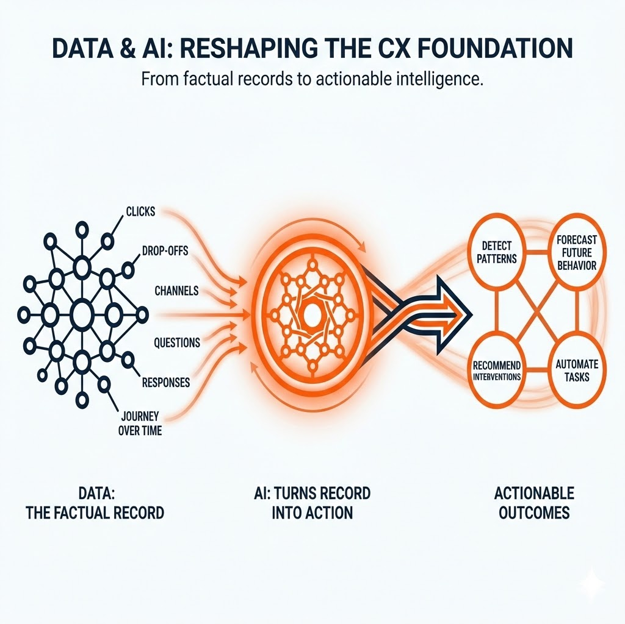
With AI’s ability to process and interpret large amounts of information in real time, companies can now respond in ways that feel not only fast but intelligently aligned with each customer’s context. This is critical in a world where customers expect instant clarity and personalized support.
Data and AI influence every major dimension of CX: personalization, speed, engagement, forecasting, service, operations, and even trust. The following ten approaches show how they are reshaping the customer experience landscape in 2026.
Ten Strategies to Elevate CX Using Data & AI
1. Create a 360° Customer Portrait
The foundation of great CX is understanding who the customer is, what they have done previously, what they might want now, and what issues they may have encountered. Yet many organizations still rely on systems that store this information separately—CRM data in one place, web analytics in another, support data in a third, and billing in a fourth.
A unified customer view brings these fragments together into a coherent whole. It becomes possible to see patterns, context, and intent. It prevents customers from having to repeat themselves across channels. It enables service teams to respond with confidence and relevance. And it lays the groundwork for personalization, predictive analytics, and proactive intervention.
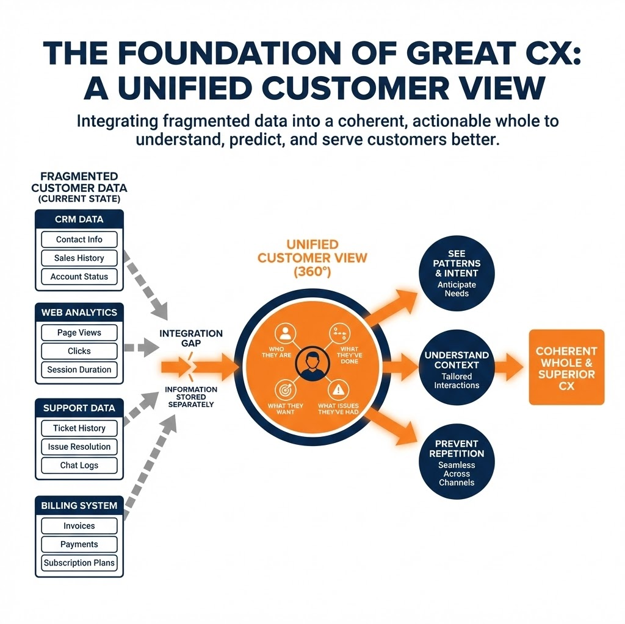
Creating this unified view requires thoughtful data architecture and robust governance, but it transforms every subsequent CX initiative.
2. Personalization 2.0: Tailoring Beyond the Basics
Personalization in 2026 is far more sophisticated than greeting someone by name or targeting them based on broad demographic categories. Customers expect experiences that genuinely reflect their needs, intentions, history, and real-time behavior.
Data and AI together make this possible. They reveal micro-behaviors and contextual clues that inform the next best action: what content to highlight, which support examples to surface, when to send a message, and what tone or format to use. True personalization feels seamless and intuitive; the customer barely notices it because it aligns naturally with their goals.
This type of personalization must be handled responsibly, of course. Customers want relevance but not intrusion. They want to be understood, not surveilled. The balance lies in using data ethically and transparently, applying it in ways that genuinely improve the customer’s experience rather than benefiting the organization alone.
3. Effortless Service Through Smart Automation
When customers reach out for help, they rarely do so lightly. They expect quick, accurate resolution, and excessive effort is one of the most reliable predictors of dissatisfaction. Intelligent automation—through virtual assistants, automated workflows, and smart routing—reduces this effort dramatically.
Automation can answer routine questions instantly, collect necessary information before a human agent takes over, provide step-by-step guidance, or escalate issues automatically when emotional cues suggest urgency. It helps maintain speed while freeing human agents to focus on more complex and emotional cases.
When used thoughtfully, automation does not remove the human touch; it amplifies it by removing the friction that distracts from real service.
4. Stay One Step Ahead: Predictive Insight
Great CX in 2026 isn’t only about reacting well; it’s about acting early. Predictive intelligence helps organizations identify what customers are likely to need next, where they might struggle, and when they might be at risk of dropping off or leaving.
Predictive models analyze patterns such as declining engagement, repeated errors, browsing behavior, usage trends, or previous support interactions. This allows brands to send relevant guidance before confusion arises, offer support before frustration appears, or provide alternatives before a customer abandons a process.
Proactivity signals attentiveness. It builds trust by showing customers that their success matters—not just their transaction.
5. Empower Agents: Real‑Time Knowledge for Real Results
Even the best service teams cannot deliver exceptional CX if they lack information. In 2026, customer expectations for clarity and accuracy are higher than ever, and agents must be able to find answers instantly.
AI-driven knowledge systems help surface the most relevant information in real time—policies, troubleshooting instructions, past interactions, product details, or contextual recommendations. These systems analyze incoming messages, detect intent, and suggest likely solutions. They reduce the need for manual searching and allow agents to spend more time listening and understanding the customer.
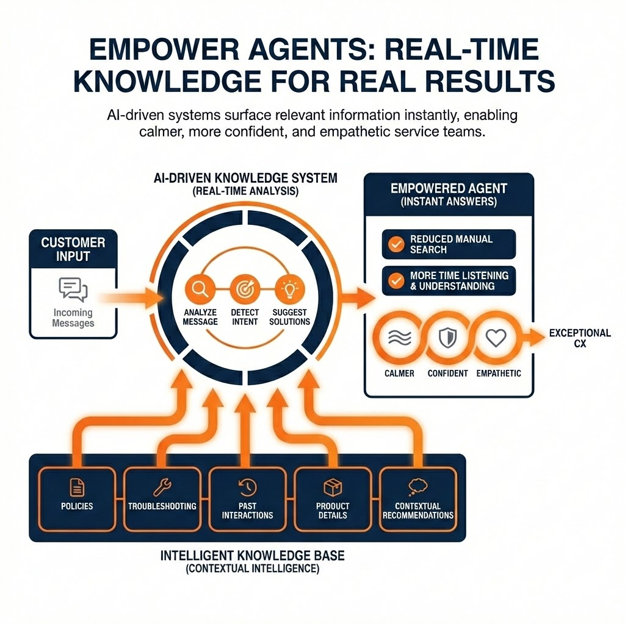
With the right intelligence at their fingertips, service teams become calmer, more confident, and more empathetic—all qualities customers notice immediately.
6. Smooth Every Path: Continuity Across Channels
Customers move between channels fluidly, and they expect brands to keep up. They should not have to re-explain an issue when switching from chat to voice. They should not receive conflicting information on different channels. They should not see offers that contradict their previous interactions.
Seamless omnichannel CX requires a consistent data layer and intelligent orchestration across channels. It demands that context is captured once and carried forward everywhere. When done well, the customer hardly notices the transition—they simply experience the brand as a unified entity rather than a collection of disconnected systems.
Channel continuity is one of the clearest indicators of CX maturity in 2026.
7. Reading the Room: Sentiment‑Driven Empathy
Customers express emotion in their words, tone, pace, and behavior. Understanding these signals provides invaluable context for shaping the right response. A frustrated customer expects acknowledgment and urgency; a confused customer expects clarity; a worried customer expects reassurance.
AI-powered sentiment analysis helps interpret these emotional cues in real time. It guides service teams to adjust their tone, speeds up escalation for sensitive cases, and even enhances automated systems so they respond with empathy rather than generic scripts. Emotion-aware experiences resonate more deeply because they align with how customers actually feel, not just what they say.
Emotion is the invisible architecture of CX, and sentiment intelligence reveals it.
8. Backstage Efficiency for Frontstage Excellence
Many customer frustrations originate inside the organization rather than in the customer’s actions. Slow internal approvals, manual checks, unclear responsibilities, or duplicated work can all delay responses and reduce quality.
Data and AI help improve internal processes so that external experiences naturally improve. Automated document checks, intelligent triage, risk scoring, data extraction, and workflow orchestration reduce cycle times considerably. They eliminate errors that previously led to customer frustration. And they free skilled employees to focus on tasks requiring judgment rather than repetitive administration.
CX excellence depends just as much on backstage efficiency as on front-stage polish.
9. Iterate and Evolve: Insights That Refine the Journey
Customer journeys are dynamic. They evolve as products evolve, markets shift, and customer habits change. What worked last year may no longer work today.
Data-driven journey analysis provides a living view of how customers navigate touchpoints—where they hesitate, when they abandon, what triggers confusion, and which paths lead to success. These insights allow organizations to make ongoing refinements, replacing guesswork with real behavioral evidence.
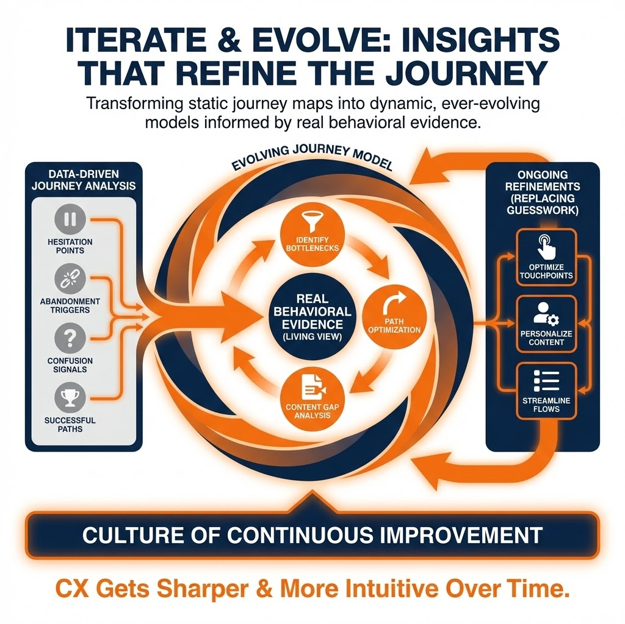
Instead of treating journey maps as static diagrams, leading companies treat them as ever-evolving models informed by real usage. This creates a culture of continuous improvement, where CX gets sharper and more intuitive over time.
10. Trust by Design: Ethical Data & AI Practices
In an age of personalization and automation, trust becomes a central pillar of customer experience. Customers want to know that their data is secure, used ethically, and applied to genuinely improve their interactions—not manipulated for opaque purposes.
Transparency, accuracy, data quality, and respect for customer choice are therefore essential. Businesses must communicate clearly about how data is used, avoid overly invasive targeting, and ensure that automated decisions are fair, explainable, and error-checked.
Responsible data practices are not just regulatory requirements; they are experience requirements. Trust is the emotional currency of CX, and brands that handle data thoughtfully strengthen that trust with every interaction.
Looking Forward: Charting the Next Frontier of CX
Customer Experience in 2026 is shaped by intelligence, empathy, speed, and trust. It is no longer confined to customer service or digital design; it is a multidisciplinary practice informed by data, strengthened by AI, and guided by a deep understanding of human behavior.
Organizations that excel do not focus only on technology, nor only on emotional connection. They combine the two—using data to understand customers more deeply, using AI to act more intelligently, and using human-centered principles to ensure every touchpoint feels respectful, relevant, and clear.
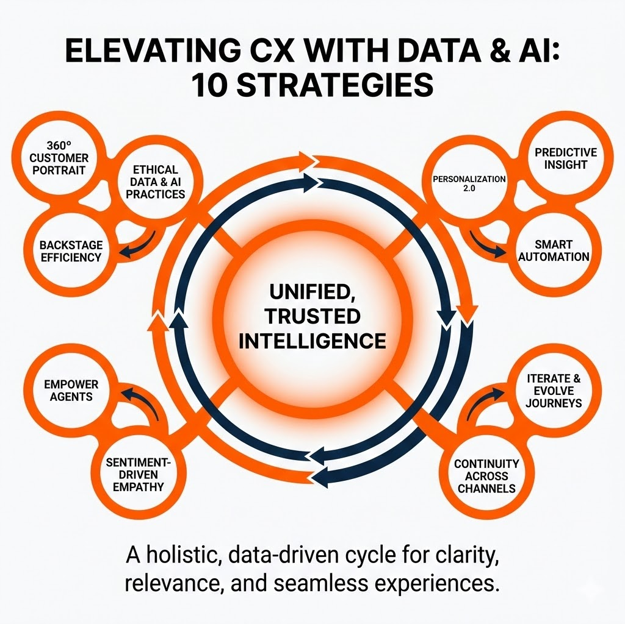
The future of CX belongs to brands that treat it as a long-term discipline. Those that listen closely, respond thoughtfully, adapt continuously, and use technology not to replace human connection but to enhance it. When these principles come together, the result is an experience that customers choose, return to, and recommend—an experience that creates enduring value in a world defined by constant change.

Associate VP, Account Management


