
Posted on: October 27th 2025
In the high-stakes world of financial crime, the spotlight often falls on external threats, such as sophisticated cybercriminals, card skimmers, international syndicates, and dark web marketplaces. Yet, a more insidious and pervasive threat is quietly draining the resources of US banks: first-party fraud. This “inside job” is committed not by outsiders, but by a bank’s own customers. It’s a complex and growing problem with blurred boundaries, and its financial costs are staggering.

What is First-Party Fraud?
First-party fraud occurs when a customer intentionally manipulates their own financial accounts with a financial institution for personal gain. Unlike third-party fraud, where a criminal uses a stolen identity, the first-party fraudster uses their real identity to exploit the system. This makes it particularly challenging to detect, as the transactions and account activity often appear legitimate.
The first-party frauds are of varied forms and evolving, but they all share a common thread of deception. Some of the most prevalent forms of first-party fraud in the banking sector include:
- Chargeback Fraud (or “Friendly” Fraud): A customer makes a legitimate purchase with their debit or credit card, receives the goods or services, and then files a fraudulent dispute with their bank, claiming the transaction was unauthorized. This is particularly prevalent in e-commerce and digital service sectors, costing banks and merchants billions annually.
- Application Fraud: This is often the first step. A customer misrepresents their income, employment history, or financial status on a loan, credit card, or mortgage application. This allows them to secure credit they would otherwise not qualify for, with the intent of defaulting on the debt.
- Bust-Out Fraud: This is a long-term play. Customer opens a new account and establishes a pattern of good behavior, making payments on time and building trust with the bank. Over time, they seek and receive credit limit increases, and once they’ve maxed out their credit, they disappear without a trace, leaving the bank with a massive loss.
- Check Kiting: Check kiting is a type of bank fraud in which someone exploits the delay between depositing a check and the check’s actual clearing to create the illusion of available funds, allowing them to temporarily access or withdraw money that doesn’t truly exist in their account.
The Financial Fallout: A Multi-Billion Dollar Problem
The financial impact of first-party fraud on the US banking sector is immense. A 2023 report by Socure estimated that this type of fraud costs the US over $100 billion annually. A more recent report from LexisNexis Risk Solutions in 2024 revealed that first-party fraud has surpassed scams to become the leading type of global attack, representing a staggering 36% of all reported fraud, a significant leap from 15% the previous year. It is expected to grow even more in the coming years.
The repercussions of this fraud are felt across the entire banking ecosystem.
- Direct Losses: Banks suffer direct financial losses from defaulted loans, unrecovered credit card debt, and chargeback refunds. This hits their bottom line and can impact their profitability.
- Increased Operational Costs: Financial institutions are forced to invest heavily in advanced fraud detection systems, hire specialized teams for investigation and resolution, and dedicate significant resources to managing these cases.
- Higher Costs for Consumers: Ultimately, the cost of fraud is often passed down to consumers in the form of higher interest rates, fees, or premiums.
- Reputational Damage: When a bank fails to detect and prevent first-party fraud, such as account manipulation or loan default by legitimate customers, it undermines trust, inflates risk exposure, and erodes the institution’s credibility, leading to financial losses and lasting damage to its reputation.
Read More: How to secure banking transactions with adaptive AI-driven fraud detection
The Rise of First-Party Fraud in the Digital Age: Crypto and Gambling
The rise of digital banking, cryptocurrencies, and online gambling has opened new frontiers for first-party fraud. These fast-moving, largely irreversible ecosystems make detection and recovery difficult. Fraudsters often exploit ATM cash withdrawals in high-risk areas, such as near casinos, where once funds are withdrawn, banks face direct losses with no chargeback recourse. In many cases, they later dispute these transactions, resulting in overdrafts and eventual charge-offs, further amplifying the financial impact on banks.
- Cryptocurrency: Fraudsters are using crypto to facilitate their schemes. They may open bank accounts to purchase crypto, then file a chargeback with their bank, claiming the transaction was fraudulent. The bank is left with the loss, while the fraudster retains the crypto, which is notoriously difficult to trace and recover. This is a common form of authorized push payment (APP) fraud where the account holder authorizes the transaction and then claims it was a scam.
- Online Gambling: Similarly, fraudsters exploit online gambling platforms. They deposit funds into a gambling account using a credit card, play or withdraw the money, and then file a chargeback with their bank, claiming they never made the deposit. These transactions are a bit more vulnerable to chargebacks, as if the customer loses the money, they are more likely than the average type of transaction to initiate a chargeback. The rapid nature of these transactions and the difficulty in proving a customer’s intent make this a significant challenge for banks.
How We Help Banks Fight First-Party Fraud with AI and Data
The traditional methods of fraud detection are no longer sufficient to combat the sophisticated and evolving nature of first-party fraud. Relying on simple rules-based systems or manual investigations leads to high false-positive rates and a poor customer experience. To effectively address this problem, banks need a multi-layered, data-driven approach that leverages the power of artificial intelligence (AI) and machine learning (ML). This is where Straive comes in.
Straive helps the banks and financial institutions to build fraud controls to reduce the risk of first-party fraud.
Here’s how we can help:
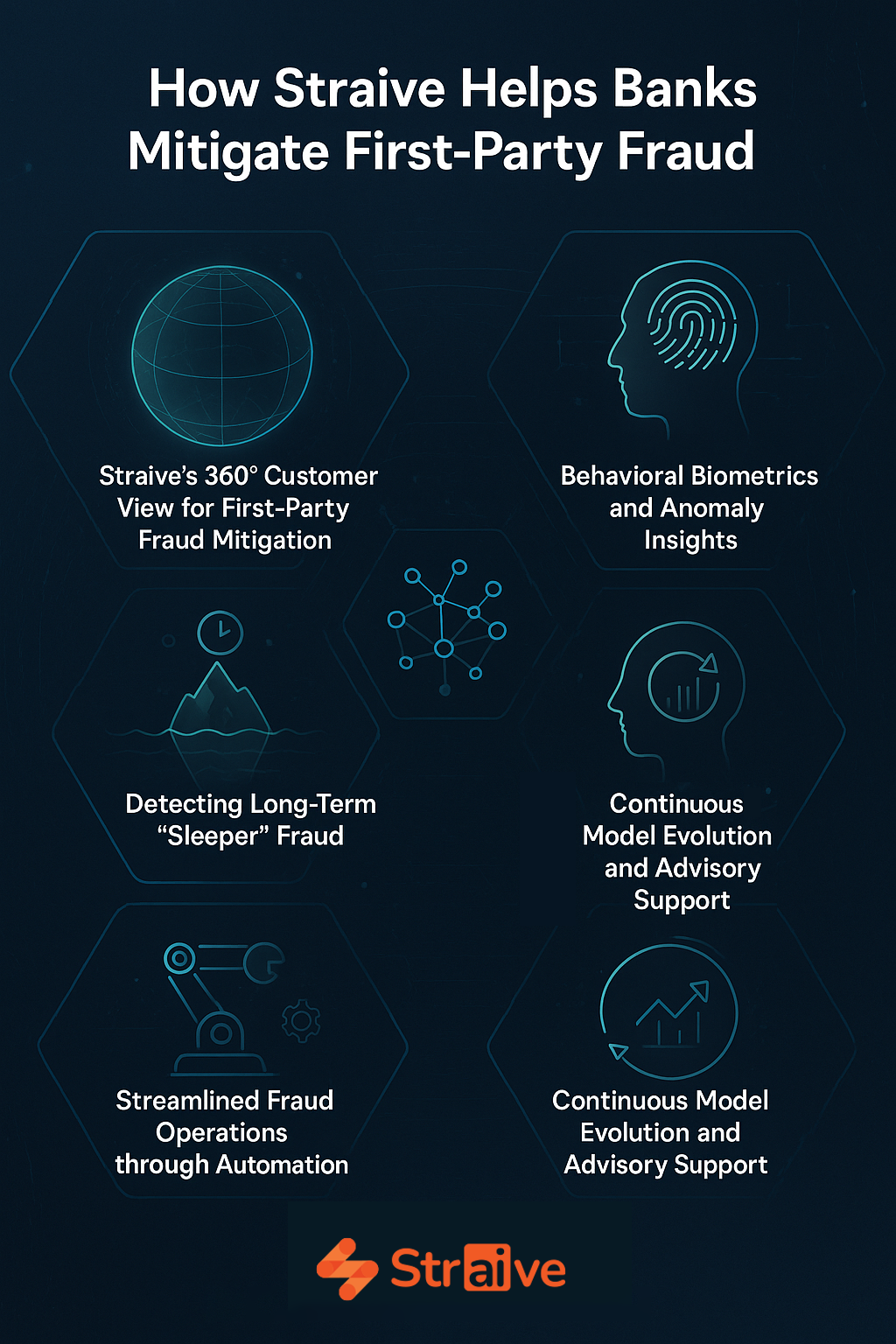
Straive’s 360° Customer View for First-Party Fraud Mitigation
As a data and AI consultancy, Straive partners with banks to design and implement advanced data-driven frameworks for combating first-party fraud. By helping institutions create a unified, 360-degree view of customers and generate personalized risk scores based on behavioral and transactional patterns, Straive enables more precise fraud risk management. Through dynamic segmentation into risk tiers, banks can apply tailored prevention strategies aligned with customer profiles. Straive’s approach also includes guidance, frameworks, and solutions on continuous monitoring and re-evaluation processes to ensure that risk profiles remain accurate over time, with enhanced vigilance applied to sensitive demographic or behavioral shifts.
Enhanced Fraud Intelligence through Data Integration
Straive helps banks strengthen their fraud detection ecosystem by integrating consortium data sources, such as Early Warning Services and other industry datasets tracking customer behavior (suspected first-party fraud, retail, and e-commerce behaviors), with internal banking data. By architecting a comprehensive fraud intelligence framework, Straive empowers institutions to identify anomalies earlier, uncover hidden relationships between customer behaviors, and improve detection accuracy. This integrated data strategy supports proactive mitigation of first-party fraud risks across channels.
Behavioral Biometrics and Anomaly Insights
Leveraging its expertise in AI and machine learning, Straive assists banks in developing and deploying behavioral biometric models that analyze customers’ digital interactions. By assessing patterns such as typing cadence, navigation habits, and device usage, banks can establish behavioral baselines to detect anomalies in real time. Straive’s approach focuses on helping institutions design systems that flag subtle deviations, like sudden changes in transaction behavior or device shifts, that may indicate fraudulent intent or chargeback-related risk.
Detecting Long-Term “Sleeper” Fraud
Through advanced data analytics and model development, Straive enables banks to detect long-term, low-visibility schemes such as bust-out fraud. By analyzing historical customer data and behavioral trajectories, banks can flag accounts that show signs of strategic credit buildup or suspicious utilization spikes. Straive’s teams guide institutions in constructing predictive models and alert mechanisms that detect and deter such fraud before it escalates.
Streamlined Fraud Operations through Automation
Recognizing the operational strain caused by manual investigations, Straive works with banks to optimize and automate case management workflows. This includes automating data collection, alert routing, and compliance reporting, freeing fraud analysts to focus on complex cases requiring judgment and expertise. Straive also advises on implementing tamper-proof audit trails that support regulatory compliance and streamline the filing of Suspicious Activity Reports (SARs).
Continuous Model Evolution and Advisory Support
Fraud patterns evolve rapidly, and Straive ensures that its clients’ fraud detection models evolve with them. Straive provides ongoing model monitoring, retraining strategies, and governance frameworks to keep AI and ML systems adaptive and effective against emerging fraud typologies. This continuous learning approach helps banks maintain resilience in an ever-changing threat landscape.
A Path Forward for Banks
First-party fraud is a central threat to the financial stability and reputation of the US banking sector. The digital age, with its rapid transactions and new platforms for crypto and gambling, has only amplified the problem. The solution lies in embracing a new generation of fraud detection tools. By leveraging AI and ML, banks can move beyond reactive, rules-based systems to proactive, predictive models.
The fight against first-party fraud requires a sophisticated, data-driven approach. With its integrated solutions and focus on AI-powered analytics, Straive offers a powerful defense against this costly and complex problem. By partnering with leading technology providers, US banks can not only protect their bottom line but also rebuild trust and ensure the integrity of the financial system for years to come.
About the Author

Dinesh Kumar Nuthi is an Engagement Manager in Analytics & AI at Straive, specializing in fraud prevention, financial crime risk management, and digital transformation for leading U.S. financial institutions. With over 9 years of experience across the U.S., Canada, and India, he has led cross-functional teams to deliver analytical and digital solutions that enhance fraud detection, reduce losses, and drive operational efficiency. Dinesh has managed large-scale analytics programs involving analytics, machine learning, automation, and real-time risk monitoring. A data-driven leader, he has worked closely with senior stakeholders to align solutions with business strategy while mentoring global teams. He is currently pursuing a part-time MBA from Leeds School of Business and is passionate about using technology and analytics to solve high-impact business problems.
Share with Friends:


