
Posted on: September 23rd 2025
CX at an Inflection Point
Customer expectations are more complex and multidimensional than ever before. People engage with brands across various touchpoints—websites, apps, messaging platforms, and social media—and expect every interaction to be seamless, consistent, and emotionally intelligent.
A courteous tone or a prompt response is no longer sufficient. Today’s consumers want to feel genuinely understood. They seek services and experiences that anticipate their needs, respect their time, and deliver relevance in real time. This fundamental shift is transforming how organizations approach CX.
No longer a peripheral function confined to support teams or contact centers, CX must be recognized as a core strategic driver. According to McKinsey & Company, the most effective CX programs are “holistic, predictive, and tied to business outcomes,” leveraging real-time data, integrated customer insights, and cross-functional collaboration.
Several technology partners—including domain-focused providers like Straive—are helping enterprises reframe CX not as an isolated service layer, but as a business capability aligned with retention, revenue, and long-term brand equity.
Redefining CX: From Function to Intelligence Layer
Traditional CX models emphasized transactional service—resolving complaints, managing queries, and collecting periodic feedback. While functional, these models lack the agility and intelligence required in today’s fast-paced, data-rich environment.
Today’s leading organizations are shifting CX into a central intelligence layer that connects customer signals across the entire lifecycle. This includes onboarding, post-purchase support, product usage, feedback loops, renewals, and even brand advocacy.
Artificial intelligence and analytics are being deployed to parse vast volumes of data in real time, helping companies identify patterns, anticipate customer behavior, and personalize interactions at scale.
McKinsey reports that companies integrating predictive tools into their CX stack see measurable performance improvements. Similarly, Forrester’s 2023 CX Index reveals that emotionally resonant experiences—where positive emotions dominate—have strong ties to loyalty.
Straive’s solutions are designed to enable both: measurable impact and meaningful connection.
The Four Pillars of Future-Ready CX
To thrive in this evolved CX landscape, enterprises must adopt four foundational pillars that define scalable, emotionally attuned, and intelligence-powered experiences.
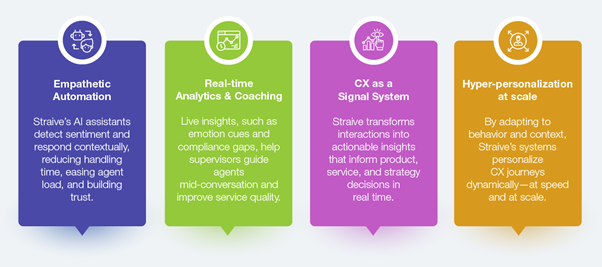
- Empathetic Automation
Automation is no longer just about handling volume or improving speed. The next-generation CX automation is defined by emotional intelligence. Straive’s AI-powered virtual assistants are trained to detect customer sentiment, modulate tone, and determine escalation points, blending operational efficiency with human-centered design.
From WhatsApp bots to enterprise-grade voice assistants, Straive’s self-service solutions help reduce average handling time, lower agent workload, and deliver relevant, on-brand responses. These systems are designed not just to answer questions—but to understand context and preserve trust.
- Real-Time Analytics and Agent Coaching
Contact centers are no longer back-office support hubs; they’re evolving into real-time intelligence engines. With capabilities like sentiment monitoring, speech analytics, and live coaching, supervisors can now guide agents mid-conversation for better outcomes.
This not only improves resolution rates and satisfaction scores, but also increases agent confidence and reduces training cycles. Tools that provide real-time visibility into interaction quality—such as emotion analytics and voice auditing—are becoming critical to CX success.
Straive, for example, integrates such capabilities into agent-assist systems, enabling supervisors to identify coaching moments, detect compliance risks, and maintain consistent service quality across distributed teams.
- CX as a Strategic Signal System
Every customer interaction, whether via email, phone, chat, or feedback form, contains valuable signals: frustration, delight, confusion, intent. When aggregated and analyzed, these signals can inform everything from product design to marketing to operational process improvement.
Rather than relying solely on lagging indicators like surveys or NPS snapshots, leading companies are embedding real-time signals into their decision-making loops. This signal-driven model allows them to respond with agility and precision.
Organizations operating in high-volume, feedback-rich environments—such as EdTech, publishing, or digital services—are increasingly turning to platforms that can structure this data at scale. Straive is among the providers enabling such transformation through configurable analytics layers and domain-aware data pipelines.
- Hyper-Personalization at Scale
Personalization has evolved beyond token gestures like name usage or location targeting. Today, it means adapting support, messaging, and content in real time—based on behavior, history, and individual preferences.
With the right data and machine learning models, organizations can now adjust touchpoints to match where a customer is in their journey—offering proactive nudges, timely interventions, or tailored service paths.
This level of hyper-personalization is especially impactful in sectors where interactions are frequent and decision-critical. Companies with strong domain expertise—like Straive—are helping clients embed this personalization logic into core CX infrastructure, ensuring both scale and relevance.
CX as a Competitive Moat
In an increasingly commoditized world, where products and pricing often reach parity, customer experience becomes the defining differentiator. It’s what builds brand affinity, deepens customer trust, and sustains competitive advantage.
McKinsey reports show that organizations aligning CX strategies to business KPIs, like retention, customer lifetime value, and operational costs, see up to 30% improvements in satisfaction metrics and cost reductions of up to 20%. When embedded into business strategy, CX becomes not just an experience layer but a protective moat that sustains customer loyalty and competitive advantage.
Inside Straive’s CX Accelerators
Straive offers a suite of CX solutions specifically built to address the needs of modern enterprises navigating the complexity of personalization, scale, and customer understanding. With deep roots in publishing, education, and enterprise domains, our approach is grounded in real-world workflows and vertical-specific requirements.
Key capabilities include:
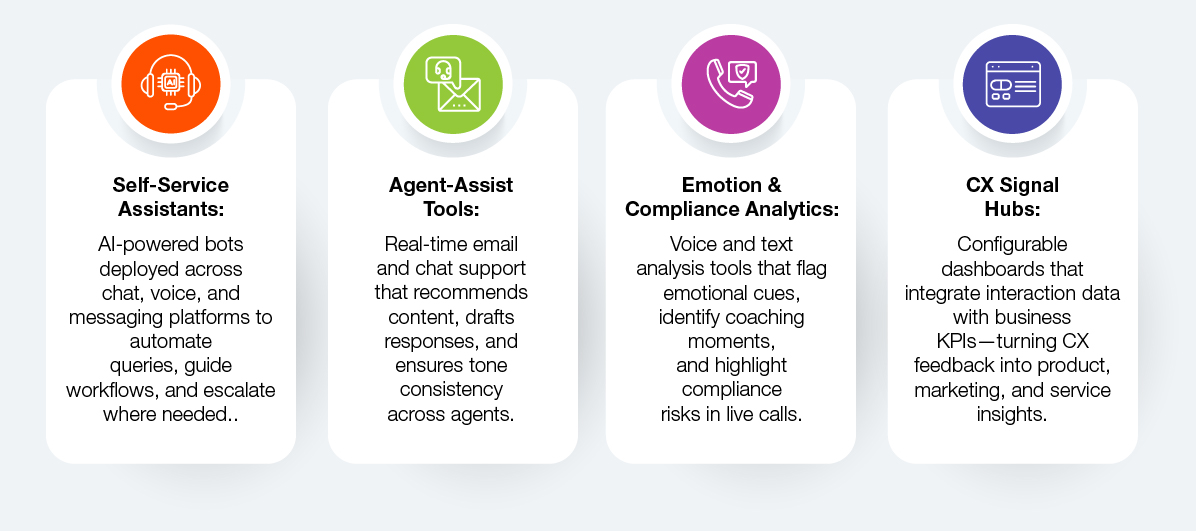
These accelerators are not one-size-fits-all. They’re tailored to the requirements of content-heavy, regulation-sensitive industries—making them especially effective in publishing, education, and enterprise services.
Conclusion: A New Blueprint for CX Transformation
Customer experience has outgrown its traditional boundaries. It’s no longer a support function; it’s a foundational business capability that informs how companies design products, deliver services, and build trust.
Straive’s CX accelerators are built for this future. By combining deep domain expertise with AI-powered tools, Straive enables companies to build CX strategies that scale with intelligence and empathy. The organizations that will thrive in this new era are those that invest in intelligent systems, real-time insights, and emotionally resonant design.
About the Author

Associate VP, Account Management
Share with Friends:


